
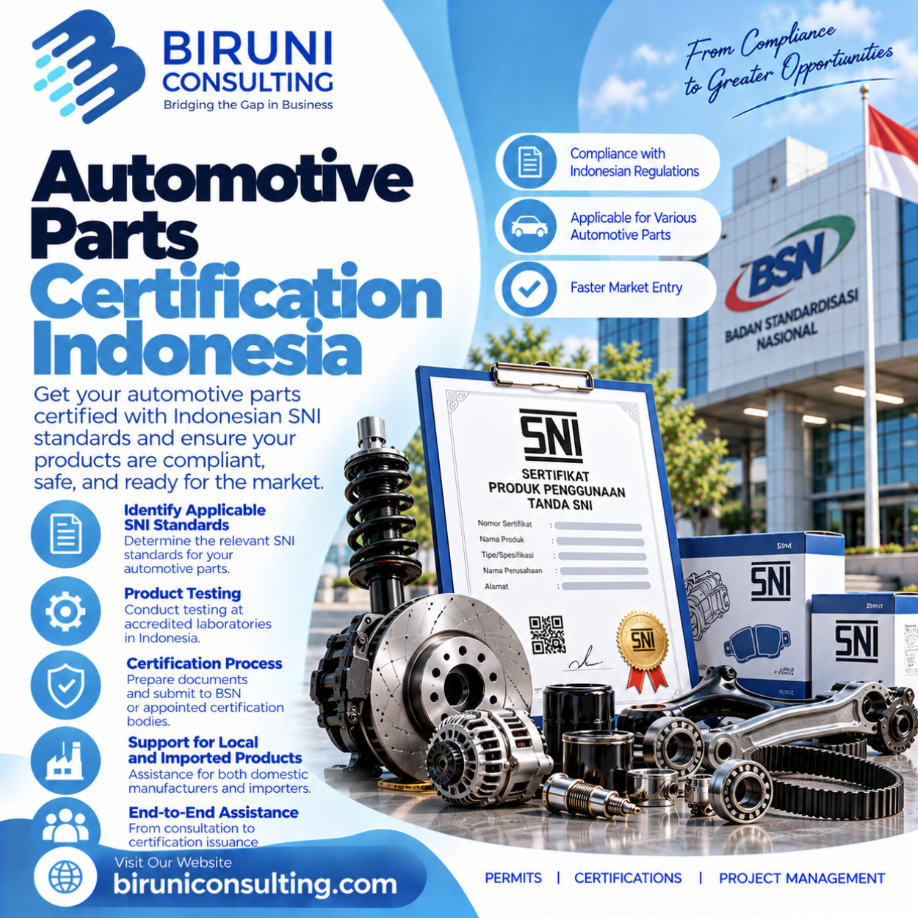
Guide to Automotive Parts Certification for Local and Imported Products in Indonesia
Automotive parts certification Indonesia is a compliance process that needs to be considered by companies manufacturing, importing, or distributing motor vehicle components in the Indonesian market. Certification requirements may differ depending on the type of component, product function, vehicle category, technical specifications, HS code, and regulations applicable to the product.
Not all motor vehicle components are required to have an SNI Certificate. However, several automotive product groups are subject to mandatory SNI requirements by the Ministry of Industry, including motor vehicle tires, motor vehicle wheels, motor vehicle safety glass, and certain lubricating oils. Therefore, regulatory assessment is the first step before a company determines the type of certification required.
Automotive parts certification Indonesia may involve SNI identification, document review, laboratory testing, production facility audits, SNI Certificate issuance, SPPT SNI processing where required, and surveillance throughout the certificate validity period.
What Is Automotive Parts Certification Indonesia?
Automotive parts certification Indonesia is a process to ensure that automotive products or components comply with applicable technical and regulatory requirements before being marketed in Indonesia.
For products subject to mandatory SNI, companies need to undergo conformity assessment according to the certification scheme established under the relevant product regulation. The process may include a production process audit and product conformity testing.
Meanwhile, automotive parts that do not fall within the mandatory SNI scope may have other requirements depending on their function and intended use. Certain products may relate to vehicle homologation, type testing, vehicle technical specifications, import requirements, or other sector-specific provisions.
Therefore, automotive parts certification should not be considered a single type of certificate applicable to every vehicle component.
Are All Automotive Parts Subject to Mandatory SNI?
No. An SNI may exist for a product without the standard being subject to mandatory implementation.
Companies need to distinguish between an SNI that has been established or remains valid and an SNI that has specifically been made mandatory through a Minister of Industry Regulation.
Certification obligations should be reviewed based on:
- Product name and function.
- Relevant SNI number.
- SNI status.
- Mandatory SNI regulation.
- HS code or tariff classification.
- Product material and construction.
- Vehicle category.
- Product application.
- Country of origin.
- Production facility location.
This identification is particularly important for companies importing spare parts from overseas because incorrect product classification can result in errors when determining certification obligations.
Automotive Parts Requiring SNI Certification
Several automotive product groups are subject to mandatory SNI regulations currently in force in Indonesia.
Motor Vehicle Tires
Motor vehicle tires are automotive products subject to mandatory SNI under Minister of Industry Regulation No. 9 of 2025.
The regulation includes SNI 98:2019 for passenger car tires, SNI 100:2019 for light truck tires, SNI 99:2019 for truck and bus tires, SNI 101:2019 for motorcycle tires, and SNI 6700:2012 for motor vehicle inner tubes. The certification scheme uses a type 5 certification system.
Motor Vehicle Wheels
Motor vehicle wheels in categories M, N, O, and L are subject to mandatory SNI under Minister of Industry Regulation No. 71 of 2024. The regulation replaced the previous requirements concerning mandatory SNI implementation for motor vehicle wheels.
SNI 1896:2008 applies to wheels in categories M, N, and O, while SNI 4658:2015 applies to vehicle wheels in category L.
Motor Vehicle Safety Glass
Motor vehicle safety glass is subject to mandatory SNI under Minister of Industry Regulation No. 15 of 2025. The regulation has been effective since October 25, 2025 and revoked Minister of Industry Regulation No. 80 of 2015.
The applicable standard is SNI 8210:2018 concerning Safety Glass for Motor Vehicles. Its certification scheme uses a type 5 certification system and covers initial certification, surveillance, and recertification.
Motor Vehicle Lubricating Oils
Motor vehicle lubricating oils are also automotive-related products subject to mandatory SNI through Minister of Industry Regulation No. 8 of 2025. The regulation has been effective since July 24, 2025.
The applicable standards include the SNI 7069 series for gasoline engine oils, motorcycle oils, diesel engine oils, manual transmission and differential gear lubricants, and automatic transmission lubricants. Certification uses a type 5 system.
SNI Certification and Automotive Parts Homologation
SNI certification and vehicle homologation are two processes that need to be distinguished.
SNI certification focuses on product conformity with national standards made applicable to specific products. The process may involve Product Certification Bodies, testing laboratories, factory audits, and SNI Certificate issuance.
Homologation or vehicle type testing concerns compliance with technical and roadworthiness requirements for motor vehicles under transportation-sector regulations.
In practice, one automotive project may require an assessment under both pathways. For example, a component may be required to comply with SNI as a product, while the vehicle using that component may also need to comply with type-testing requirements.
Therefore, companies need to determine from the beginning whether the product requires only SNI, only homologation-related compliance, both, or neither.
Automotive Parts Certification Indonesia Requirements
Certification requirements depend heavily on the product. However, for various products using type 5 certification, assessments generally cover not only product samples but also the production process.
Requirements that may need to be prepared include:
- Company legality.
- Manufacturer information.
- Factory address and location.
- Trademark documents.
- Product list.
- Product types, models, and sizes.
- Technical specifications.
- Materials or raw materials.
- Production process flowchart.
- Production machinery and facility list.
- Quality control system.
- Inspection and testing equipment.
- Quality management system where required.
- Product labels and markings.
- Available test reports, if any.
Documents need to be adjusted according to the product regulation and requirements of the Product Certification Body holding the relevant certification scope.
How to Obtain Automotive Parts Certification Indonesia
Product Identification
The first stage is to conduct complete product identification.
Information that should be available includes the product name, function, material, trademark, model, type, size, vehicle category, HS code, country of origin, and production facility location.
This information forms the basis for determining the applicable regulations.
Identification of SNI and Regulations
After the product has been identified, the company needs to identify the SNI related to the product and determine whether that SNI is mandatory.
This stage is important because not every standard available in the SNI catalog is mandatory.
Companies must also pay attention to the version or year of the standard. Using an old SNI number when a regulation refers to a newer revision may result in errors in certification preparation.
Document Preparation
After the regulatory scope has been determined, the company needs to prepare legal, technical, production, trademark, and quality management system documentation according to the requirements.
For imported products, Overseas Manufacturer documents need to be prepared together with documents of the party representing the manufacturer in Indonesia where required by regulation.
Certification Application
The certification application is submitted according to the applicable product regulation and through a Product Certification Body with the appropriate scope.
For various recent mandatory SNI schemes, administrative processes are linked to SIINas. Company, manufacturer, product, production location, and other information must remain consistent between the application and supporting documents.
Product Sampling
The products then undergo sampling according to the certification scheme.
The number of samples may be determined based on models, sizes, construction, materials, product groupings, or other parameters established by the standard and certification scheme.
Therefore, one SKU does not necessarily mean one sample, and several SKUs cannot always be combined into one testing group.
Laboratory Testing
Samples are tested according to the applicable standard.
The type of testing depends heavily on the product. Tires may require specific performance and construction tests, wheels require testing according to their mechanical characteristics, while safety glass has different testing parameters.
The laboratory used must meet the requirements established under the relevant regulation and certification scheme.
Factory Audit
For type 5 certification systems, the factory audit is an important part of the certification process.
The audit may cover:
- Raw material control.
- Production processes.
- Machinery and equipment.
- Product inspection.
- Internal testing.
- Equipment calibration.
- Product traceability.
- Nonconforming products.
- Complaint handling.
- Quality management systems.
The purpose of the audit is to ensure that the manufacturer is capable of consistently producing products corresponding to samples that have been confirmed as complying with SNI.
SNI Certificate Issuance
If the audit, testing, and evaluation results meet the requirements, the Product Certification Body may issue an SNI Certificate according to the approved product scope.
Companies need to review certificate information such as the manufacturer name, factory location, SNI number, trademark, type, model, or product scope before using it for subsequent processes.
Automotive Parts Certification for Imported Products
Imported automotive parts that fall within the mandatory SNI scope generally remain subject to certification requirements applicable in Indonesia.
Certificates or test reports from the country of origin do not automatically replace an SNI Certificate where the product falls within mandatory SNI requirements.
Under several recent automotive regulations, an Overseas Manufacturer must have an Official Representative in Indonesia. The Official Representative is an Indonesian legal entity representing the Overseas Manufacturer in certification processes and product-related obligations.
For motor vehicle wheel certification, for example, the regulation establishes Official Representative requirements for Overseas Manufacturers and SNI procedures for imported products.
Because Official Representative requirements differ by product, companies should review the specific regulation before determining the importer structure and party responsible for certification.
Official Representative for Automotive Parts
An Official Representative may be an important part of automotive parts certification Indonesia for Overseas Manufacturers.
Depending on the regulation, the Official Representative may be required to provide:
- Indonesian company legality documents.
- Appointment letter from the Overseas Manufacturer.
- Trademark-use license.
- Evidence of license registration where required.
- Warehouse arrangements according to product requirements.
- SIINas account.
- Importer information.
- Coordination with the Overseas Manufacturer.
The structure should be determined before the certification application begins because changes to parties stated in the certification structure may have consequences for the SNI Certificate.
SNI Certificate and SPPT SNI for Automotive Parts
An SNI Certificate is the result of conformity assessment issued by a Product Certification Body after certification requirements have been fulfilled.
For certain products subject to mandatory SNI, after the SNI Certificate has been obtained there may still be a process for approval to use the SNI Mark in accordance with the product regulation.
Under various recent regulations, this approval is issued in the form of SPPT SNI.
Companies therefore need to distinguish SNI Certificate issuance from approval to use the SNI Mark. Products should not bear an SNI mark or claim before all relevant requirements have been fulfilled.
Automotive Parts Certification Surveillance
For type 5 certification, company obligations do not end once the SNI Certificate has been issued.
The Product Certification Body conducts surveillance to ensure that manufacturers continue to maintain their production processes and product conformity throughout the certificate validity period.
The tire certification scheme under Minister of Industry Regulation No. 9 of 2025 explicitly covers initial certification, surveillance, and recertification. Similar provisions apply under the motor vehicle safety glass scheme established by Minister of Industry Regulation No. 15 of 2025.
Throughout the certification period, companies need to maintain documentation, quality systems, formulations or materials, product specifications, production locations, trademarks, and testing facilities in accordance with the certified scope.
Changes to Trademarks, Models, and Products
Automotive companies frequently add models, change sizes, change materials, add trademarks, or modify specifications.
Such changes need to be evaluated before the new product is marketed using an existing certification.
Adding a trademark or model may require an extension of the SNI Certificate scope. Changes to technical specifications or materials may require additional testing. Changes in production location may even trigger separate certification requirements depending on the applicable product regulation.
Therefore, any significant change should be discussed with the Product Certification Body before it is implemented on products bearing the SNI Mark.
Automotive Parts Certification Indonesia Cost
There is no single automotive parts certification fee applicable to every product.
Total costs may be influenced by:
- Product type.
- SNI number.
- Number of models.
- Number of sizes.
- Number of trademarks.
- Number of samples.
- Testing parameters.
- Factory location.
- Audit duration.
- Product Certification Body used.
- Testing laboratory used.
- Auditor transportation and accommodation.
For Overseas Manufacturers, costs may increase because the production facility audit takes place in the country where the factory is located and coordination with an Official Representative in Indonesia may also be required.
Cost estimates should therefore be prepared after the product list and certification scope have been identified.
How Long Does Automotive Parts Certification Take in Indonesia?
The certification duration differs for every project.
Factors affecting processing time include document readiness, audit schedules, sample availability, laboratory schedules, number of products, testing results, audit findings, and the time required for corrective actions.
Companies with complete technical documentation, an operating quality management system, and production facilities ready for audit can generally conduct the process in a more structured manner.
Therefore, companies should conduct a gap assessment before formal submission so that documentation, facility, testing, and improvement requirements can be identified earlier.
Things to Consider Before Automotive Parts Certification
Before starting automotive parts certification Indonesia, companies should ensure that:
- The product has been technically identified.
- The HS code has been reviewed.
- The SNI number has been determined.
- Mandatory or voluntary status has been verified.
- The applicable Minister of Industry Regulation has been reviewed.
- The product list has been prepared.
- The trademark has a clear legal basis.
- The production location has been identified.
- The quality management system is ready where required.
- The production facility is ready for audit.
- Samples are available for testing.
- An appropriate laboratory has been identified.
- An Official Representative has been prepared for imported products where required.
- SPPT SNI requirements have been reviewed.
- Homologation or other technical regulatory obligations have been evaluated.
These checks can help companies avoid errors in determining the applicable standard and improve certification preparation.
Conclusion
Automotive parts certification Indonesia is a process to ensure that certain automotive components comply with technical and regulatory requirements before being marketed in Indonesia.
Not all automotive parts are required to obtain an SNI Certificate. However, several product groups are subject to mandatory SNI, including tires under Minister of Industry Regulation No. 9 of 2025, wheels under Minister of Industry Regulation No. 71 of 2024, motor vehicle safety glass under Minister of Industry Regulation No. 15 of 2025, and lubricating oils under Minister of Industry Regulation No. 8 of 2025.
Automotive parts certification Indonesia may involve SNI identification, document review, laboratory testing, production facility audits, SNI Certificate issuance, SPPT SNI processing where required, and surveillance throughout the certificate validity period.
Contact Us
Biruni Consulting assists companies with automotive parts certification Indonesia professionally and in accordance with applicable regulations in Indonesia.
Our services include:
- Regulatory consultation.
- Identification of applicable standards.
- Preparation of certification documents.
- Assistance with laboratory testing.
- Certification processing until certificate issuance.
With experience in product certification in Indonesia, Biruni Consulting helps ensure products meet applicable safety, quality, and standard requirements so they are ready to be legally marketed in Indonesia.
Contact Us for consultation, certification assistance, and certificate processing services.