
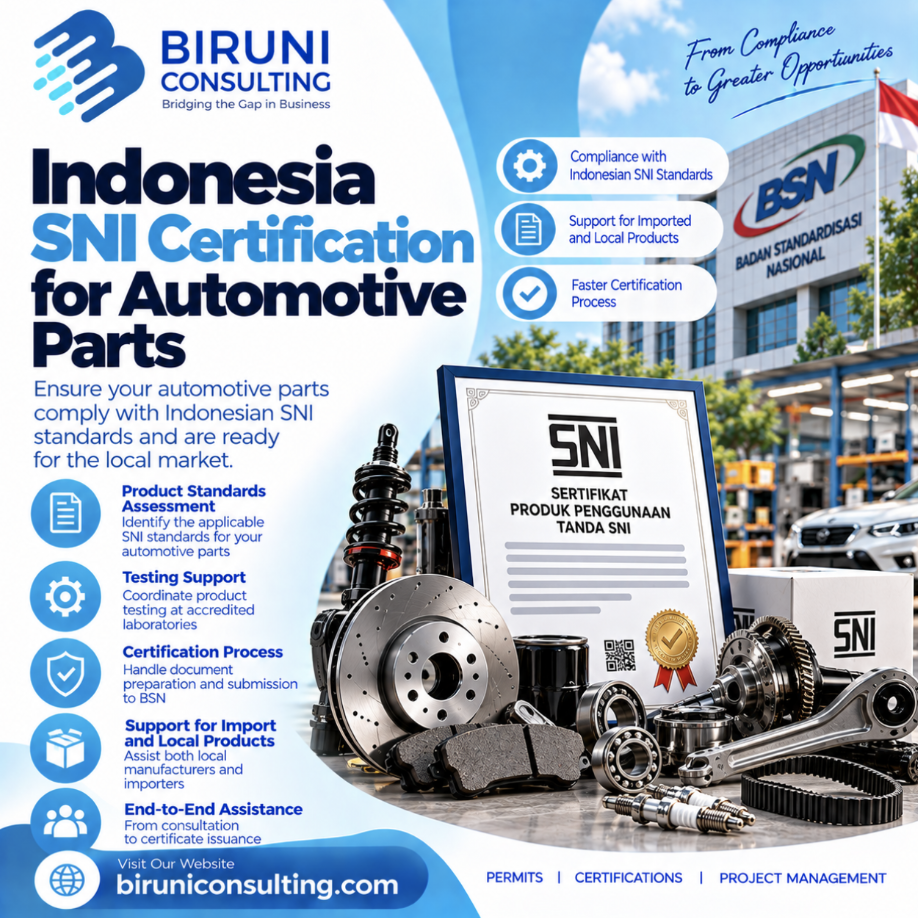
Guide to SNI Certification for Automotive Parts in Indonesia
Indonesia SNI certification for automotive parts is an important process for manufacturers, importers, and automotive companies intending to market motor vehicle components in Indonesia. Several types of automotive components are subject to mandatory Indonesian National Standards, meaning that the products must meet technical standards and undergo conformity assessment before they can be distributed in accordance with applicable requirements.
Indonesia SNI certification for automotive parts ensures that certain products meet applicable standard requirements through testing, factory audits, and conformity assessment. However, not all automotive parts are automatically required to obtain an SNI Certificate. Companies must first identify the product type, function, specifications, HS code, applicable standard, and mandatory SNI regulation related to the product.
Several automotive-related product groups currently subject to mandatory SNI include motor vehicle tires, motor vehicle wheels, motor vehicle safety glass, and vehicle lubricating oils. Each group has different standards, scope, certification schemes, product requirements, and regulations. Database Peraturan | JDIH BPK
What Is SNI for Automotive Parts?
SNI, or the Indonesian National Standard, is a standard established by the National Standardization Agency of Indonesia. In the automotive industry, SNI may regulate safety requirements, quality, dimensions, testing methods, performance, or technical characteristics for various vehicle products and components.
An important distinction needs to be made between an available SNI standard and a mandatory SNI standard. An automotive part may have an SNI listed as valid by BSN, but this does not automatically mean the product must obtain an SNI Certificate before being marketed. The certification obligation must be determined by checking regulations that specifically make the relevant SNI mandatory.
Therefore, companies intending to manufacture or import automotive parts should not immediately apply for certification based only on the product name. Regulatory identification should be carried out first to determine whether the product is subject to mandatory SNI, voluntary SNI, or other technical requirements.
Automotive Parts Subject to Mandatory SNI in Indonesia
Several automotive-related products are currently clearly within the scope of mandatory SNI implementation.
Motor Vehicle Tires
Tires are one category of automotive parts subject to mandatory SNI. Minister of Industry Regulation No. 9 of 2025 makes several standards mandatory, namely SNI 98:2019 for passenger car tires, SNI 100:2019 for light truck tires, SNI 99:2019 for truck and bus tires, SNI 101:2019 for motorcycle tires, and SNI 6700:2012 for motor vehicle inner tubes. The regulation has been effective since July 24, 2025. Database Peraturan | JDIH BPK
The product scope needs to be reviewed carefully because the regulation also specifies product descriptions and certain tariff or HS classifications. Tires already mounted on wheels are also included within certain scopes established under Minister of Industry Regulation No. 9 of 2025. Database Peraturan | JDIH BPK
Motor Vehicle Wheels
Motor vehicle wheels are also automotive components subject to mandatory SNI. Minister of Industry Regulation No. 71 of 2024 establishes SNI 1896:2008 for motor vehicle wheels in categories M, N, and O and SNI 4658:2015 for motor vehicle wheels in category L. CRPG Law Database
BSN currently lists SNI 1896:2008 and SNI 4658:2015 as valid standards. SNI 1896:2008 applies to wheels in categories M, N, and O, while SNI 4658:2015 applies to category L. Pesta
Motor Vehicle Safety Glass
Motor vehicle safety glass is subject to mandatory SNI through Minister of Industry Regulation No. 15 of 2025, which has been effective since October 25, 2025. The regulation replaced the previous requirements under Minister of Industry Regulation No. 80 of 2015. Database Peraturan | JDIH BPK
The applicable standard is SNI 8210:2018 concerning Safety Glass for Motor Vehicles. Its scope includes laminated safety glass and tempered safety glass used as windshields, panel glass, or partitions in vehicles in categories L, M, N, O, and T. Pesta
Vehicle Lubricating Oils
Lubricating oil is not a mechanical vehicle component, but it is an automotive product that is also subject to mandatory SNI. Minister of Industry Regulation No. 8 of 2025 establishes mandatory SNI requirements for lubricating oils and has been effective since July 24, 2025. Database Peraturan | JDIH BPK
The applicable standards include the SNI 7069 series, covering gasoline vehicle engine oil, motorcycle oil, diesel engine lubricating oil, gear oil for manual transmissions and differentials, and automatic transmission lubricating oil. The certification scheme under the regulation uses a type 5 certification system. Database Peraturan | JDIH BPK
Are All Car and Motorcycle Components Subject to Mandatory SNI?
No. The existence of an SNI for an automotive component does not mean that every such component is automatically subject to mandatory SNI certification.
The BSN catalog, for example, lists various standards for vehicle components such as wheel nuts, power-steering hoses, radiators, shock absorbers, and other vehicle parts. However, the status of a valid standard must be distinguished from the existence of a regulation specifically requiring certification for that product. Pesta
Therefore, regulatory checking is a critical stage. Companies need to match the product name and function with the SNI number, mandatory regulation, HS code, technical specifications, vehicle category, and intended use before concluding that an SNI Certificate is required.
In addition to SNI, certain automotive parts may relate to vehicle technical requirements and vehicle homologation or type approval processes. Indonesia has separate regulations concerning Motor Vehicle Type Testing, so automotive compliance analysis should not end with an SNI review alone. Database Peraturan | JDIH BPK
Indonesia SNI Certification Requirements for Automotive Parts
Certification requirements differ by product, but several groups of requirements are commonly found for automotive parts using a type 5 certification system.
Companies generally need to prepare applicant legality documents, manufacturer information, trademarks, production facility locations, product specifications, production flowcharts, quality control systems, raw material documents, testing facilities, and quality management system documentation.
For motor vehicle wheels, for example, Minister of Industry Regulation No. 71 of 2024 uses a type 5 certification system consisting of a production process audit and implementation of ISO 9001:2015 or IATF 16949:2016 as well as product conformity testing against the applicable SNI. CRPG Law Database
For motor vehicle tires, Minister of Industry Regulation No. 9 of 2025 also establishes a type 5 certification system covering production process auditing, quality management system assessment, and product conformity testing. Database Peraturan | JDIH BPK
Documents for SNI Automotive Parts Certification
Required documents differ according to the product and company status, but companies generally need to prepare complete legal and technical documentation.
Documents that may be required include:
- Company legality documents.
- NIB and relevant business licenses.
- Manufacturer and production facility profiles.
- Trademark ownership or licensing documents.
- Product list.
- Product models, types, sizes, and specifications.
- Technical drawings where relevant.
- Production process flowchart.
- Raw material list.
- Production machinery and equipment list.
- Inspection and testing equipment list.
- Quality management system documents.
- Quality control procedures.
- Product labels, markings, and packaging designs.
- Available test reports, if any.
For imported products, overseas manufacturer documents and the Official Representative structure in Indonesia may form an important part of the requirements, depending on the relevant product regulation.
How to Obtain SNI Certification for Automotive Parts
Product Identification
The first stage is to perform technical identification of the product. Companies need to determine the product name, application, material, trademark, model, size, vehicle category, country of origin, production location, and HS code.
Correct identification helps determine whether the product falls within the mandatory SNI scope and which standard applies.
Identification of SNI and Regulations
After the product has been identified, the company needs to review the applicable SNI and Minister of Industry Regulation.
Even within one automotive parts category, more than one standard may apply. Tires are a clear example because different standards are used for passenger cars, light trucks, trucks and buses, motorcycles, and inner tubes. Database Peraturan | JDIH BPK
Document Preparation
The company then prepares company documents, manufacturer documents, technical specifications, trademark documentation, quality management system documents, production process information, and other documents required for the product.
Information consistency is important. The manufacturer name, factory location, trademark, model, specifications, and tested products must correspond with the certification application scope.
Certification Application
The certification application is submitted through the applicable mechanism and processed by a Product Certification Body with the appropriate scope.
Under several recent mandatory SNI regulations, administrative processes are integrated with SIINas. For certain products, information from the company or Official Representative is forwarded to the Product Certification Body for conformity assessment.
Product Sampling
The Product Certification Body or sampling officer conducts sampling according to the certification scheme.
The number of samples is not necessarily determined only by the number of SKUs. Product families, types, sizes, materials, construction, and specific standard requirements may influence sampling decisions.
Laboratory Testing
Samples are then tested by a laboratory that meets the applicable certification scheme requirements.
Testing differs according to the product. Tires, wheels, and safety glass have different characteristics and testing methods, so companies need to determine the applicable standard before calculating sample requirements and laboratory costs.
Factory Audit
For products using a type 5 certification scheme, an audit of the production facility is an important part of certification.
Auditors may examine raw materials, production processes, machinery, inspections, quality controls, testing equipment, calibration, traceability, nonconforming products, quality management systems, and production consistency.
SNI Certificate Issuance
If the testing, audit, and evaluation results meet the requirements, the Product Certification Body may issue an SNI Certificate according to the approved product scope.
Companies must ensure that the product, manufacturer, production location, trademark, model, and type information stated on the certificate correspond with the products to be marketed.
SNI Certification for Imported Automotive Parts
Indonesia SNI certification for automotive parts also applies to imported products where they fall within the mandatory SNI scope. Products manufactured overseas are not automatically exempt merely because they already hold certificates or comply with standards from another country.
Under several recent automotive regulations, an Overseas Manufacturer requires an Official Representative in Indonesia. Under the motor vehicle wheel regulation, for example, an Overseas Manufacturer submits an SNI Certificate application electronically through its Official Representative using SIINas. If a manufacturer has more than one production location, certification applications must be submitted for each production location. CRPG Law Database
The regulation also establishes Official Representative documentation requirements including company legality, official appointment, trademark licensing, evidence of license registration, and control of a warehouse. Because these requirements are product-specific, companies must review the Minister of Industry Regulation applicable to each automotive part. CRPG Law Database
SNI Certificate and SPPT SNI
An SNI Certificate and SPPT SNI need to be distinguished. Under several recent mandatory regulations, the SNI Certificate is issued by the Product Certification Body after the product and manufacturer successfully complete the conformity assessment process.
After the SNI Certificate is obtained, certain products must receive approval to use the SNI Mark in the form of SPPT SNI before the SNI Mark and electronic mark can be applied. Under the tire regulation, for example, a product that has obtained an SNI Certificate must also obtain SPPT SNI, with the application submitted through SIINas. Database Peraturan | JDIH BPK
Similar provisions exist for motor vehicle wheels, where SPPT SNI is issued to the Industrial Company or Official Representative and applied for electronically through SIINas. CRPG Law Database
SNI Certificate Surveillance for Automotive Parts
Certification does not end when the certificate is issued. For products using a type 5 certification system, the Product Certification Body conducts surveillance to ensure that the manufacturer and product continue to comply with the requirements while the SNI Certificate remains valid.
Under the current tire regulation, periodic surveillance is conducted once every year. The SNI Certificate for tires is valid for five years from the date of issuance. Database Peraturan | JDIH BPK
Companies therefore need to maintain production-process consistency, quality controls, documentation, equipment calibration, product specifications, trademarks, and production locations throughout the certification period. Significant changes should also be evaluated before implementation because they may affect the SNI Certificate scope.
Changes to Products, Trademarks, and Production Locations
Automotive parts manufacturers frequently make changes to models, sizes, materials, trademarks, suppliers, or production locations. Such changes should not be implemented without evaluating their effect on certification.
Adding a trademark or model may require an extension of the certification scope. Changes to materials or specifications may require technical evaluation or additional testing. Changes to the production location may have greater consequences because several regulations apply certification by factory location.
For imported products, changes to the Official Representative also require particular attention. For example, the wheel regulation provides that if an Overseas Manufacturer changes its Official Representative before the SNI Certificate expires, the certificate is considered to have expired. CRPG Law Database
Cost of Indonesia SNI Certification for Automotive Parts
There is no single certification price that applies to every automotive part.
Total costs may be influenced by the product type, SNI number, number of models or sizes, number of trademarks, production facility location, number of samples, type of laboratory testing, audit duration, Product Certification Body, laboratory, auditor travel, and corrective action requirements.
For Overseas Manufacturers, costs may also include auditor travel and accommodation to the overseas factory, shipment of samples, translation or legalization of documents where required, and preparation of the Official Representative.
Therefore, cost estimates should be prepared after the product list and SNI scope have been identified rather than based only on the product name.
How Long Does SNI Certification for Automotive Parts Take?
There is no single processing period that applies to every automotive component.
The process is affected by document readiness, audit scheduling, factory country, number of product types, number of samples, laboratory capacity, testing results, audit findings, and corrective action requirements.
Products supported by complete technical documentation and production facilities ready for audit can proceed through the process more systematically than companies that begin preparing quality-control systems only after submitting the application.
Therefore, regulatory assessment and gap assessment before submission can help companies identify in advance which documents, testing, facilities, and systems still need to be prepared.
Things to Consider Before Applying for SNI Automotive Parts Certification
Before beginning certification, companies need to make sure that the product is genuinely within the mandatory SNI scope and that the selected standard corresponds with the product’s characteristics.
Items to review include product classification, applicable SNI, relevant Minister of Industry Regulation, HS code, vehicle category, trademark, manufacturer, factory location, product list, technical specifications, quality management system, laboratory readiness, and the Official Representative structure for imported products.
Companies also need to determine whether obligations other than the SNI Certificate apply, including SPPT SNI, electronic marks, surveillance, homologation, vehicle type testing, or other sector-specific technical requirements.
This approach helps prevent common problems such as applying for an incorrect SNI, using a certificate for products outside its scope, or importing products before mandatory requirements have been completed.
Conclusion
Indonesia SNI certification for automotive parts needs to be carried out according to the product type and the regulation specifically applicable to that product. Not all vehicle components are subject to mandatory SNI, making product identification and regulatory checking a critical first step.
Automotive product groups currently within the mandatory SNI scope include tires under Minister of Industry Regulation No. 9 of 2025, wheels under Minister of Industry Regulation No. 71 of 2024, motor vehicle safety glass under Minister of Industry Regulation No. 15 of 2025, and lubricating oils under Minister of Industry Regulation No. 8 of 2025. Database Peraturan | JDIH BPK
Indonesia SNI certification for automotive parts ensures that certain products meet applicable standard requirements through testing, factory audits, and conformity assessment. For imported products, companies also need to consider the Overseas Manufacturer, Official Representative, trademark, production location, SIINas, SNI Certificate, and SPPT SNI according to the applicable product regulation.
Contact Us
Biruni Consulting assists companies with Indonesia SNI certification for automotive parts professionally and in accordance with applicable regulations in Indonesia.
Our services include:
- Regulatory consultation.
- Identification of applicable standards.
- Preparation of certification documents.
- Assistance with laboratory testing.
- Certification processing until certificate issuance.
With experience in product certification in Indonesia, Biruni Consulting helps ensure products meet applicable safety, quality, and standard requirements so they are ready to be legally marketed in Indonesia.
Contact Us for consultation, certification assistance, and certificate processing services.