
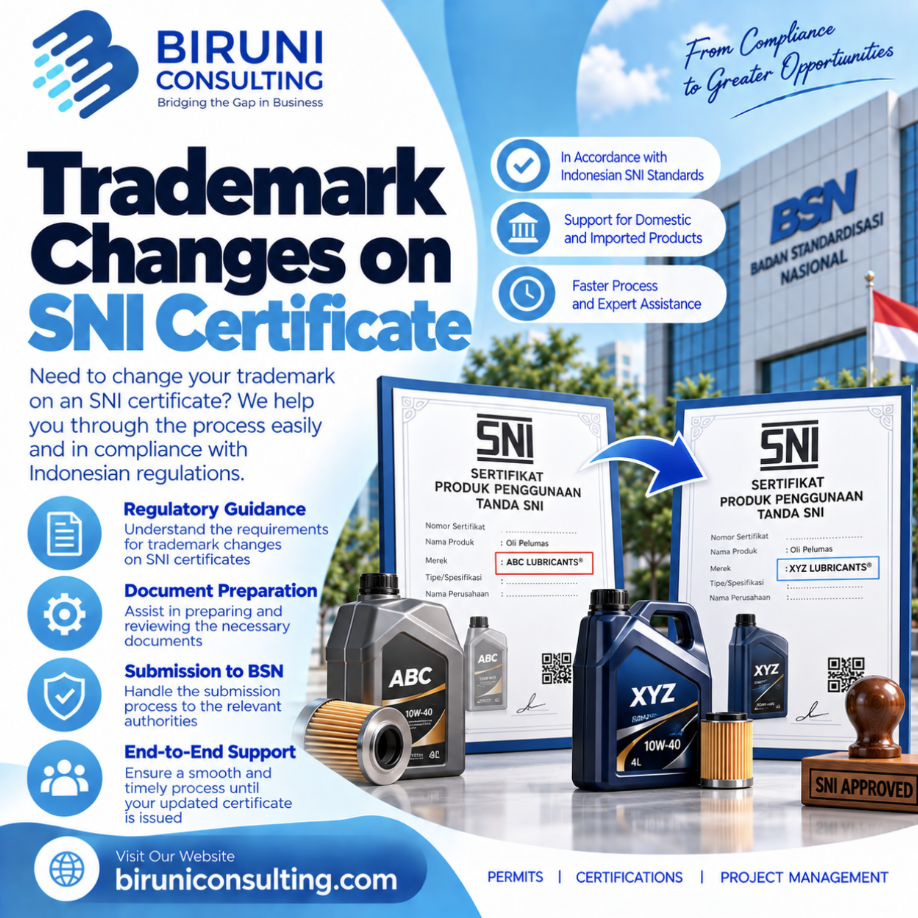
Process for Adding and Changing Trademarks on an SNI Certificate in Indonesia
Trademark changes on an SNI Certificate are a process that needs to be considered when a company intends to add a new trademark, use a different trademark, enter into a trademark cooperation arrangement, or adjust trademark information already stated on the certificate. A trademark is important information within the certification scope because it connects the marketed product with the manufacturer, production location, and conformity assessment that has been conducted.
A trademark change cannot always be completed simply by replacing the trademark name on an existing SNI Certificate. Depending on the product and applicable regulation, adding a trademark may be processed as an extension of the certification scope and may require a review of trademark documents, sampling, testing, or additional assessment by the Product Certification Body or LSPro.
Trademark requirements are also not identical for every SNI product. For example, Minister of Industry Regulation No. 8 of 2025 concerning lubricating oils allows more than one trademark to be included in one SNI Certificate for each SNI within one production location. However, where Trademark Cooperation or Contract Manufacturing arrangements exist, specific provisions may apply regarding certificate ownership and trademark use.
What Is a Trademark Change on an SNI Certificate?
A trademark change on an SNI Certificate may cover several different situations. Because their certification consequences are not always the same, companies first need to determine the type of change being proposed.
Such changes may include:
- Adding a new trademark to an SNI Certificate.
- Adding a trademark together with a product type or variant.
- Changing trademark ownership.
- Using another company’s trademark through a license.
- Trademark Cooperation.
- Contract Manufacturing using another party’s trademark.
- Changing the design or logo of the same legally registered trademark.
- Replacing an old trademark with a new trademark.
Adding a trademark to the same product manufactured at the same facility may involve a different process from replacing a trademark due to a change in trademark owner or manufacturer. Therefore, the Product Certification Body and applicable product regulation should be reviewed before the company changes its packaging or begins marketing the product under a new trademark.
Can a Trademark on an SNI Certificate Be Changed?
In principle, changes to the certification scope may be made provided that they comply with the certification scheme, product regulation, and requirements of the Product Certification Body that issued the certificate.
However, the term “trademark change” needs to distinguish between adding a trademark and replacing a trademark. Adding a trademark may generally be treated as an extension of the certification scope where the product, manufacturer, production facility, and other relevant conditions continue to meet the requirements.
The Product Certification Body may conduct document evaluation, sampling, testing, or additional assessment depending on the type of change proposed and the procedure applicable to the relevant product.
Replacing an old trademark with a new one should not automatically be considered a simple administrative change. The Product Certification Body needs to confirm trademark legality, its relationship with the SNI Certificate holder, and whether the change affects the scope or basis on which the certificate was issued.
Adding a Trademark to an SNI Certificate
Adding a trademark is one of the most common situations arising after an SNI Certificate has been issued. A company may launch a new trademark for a product manufactured using the same facilities, processes, and specifications.
Under such circumstances, the company needs to apply for a scope extension to the Product Certification Body and follow the mechanism established for the relevant product.
Adding a trademark may require review of trademark legality, evaluation of product conformity, sampling, testing, and additional assessment where required.
Companies should therefore confirm the mechanism for adding a trademark with the Product Certification Body that issued the certificate before setting a launch date for products carrying the new trademark.
Trademark Changes and Extension of the SNI Certificate Scope
Adding a trademark is generally related to the concept of extending the certification scope. A scope extension means adding products, trademarks, types, or certain information that was not previously covered by the SNI Certificate.
Assessment of an additional trademark may consider whether:
- The product is manufactured by the same factory.
- The production location remains unchanged.
- The applicable SNI remains the same.
- Product specifications remain unchanged.
- Product formulation or materials have not changed significantly.
- The production process remains the same.
- The new trademark has a valid ownership or licensing basis.
- The new product remains within the Product Certification Body’s scope.
If the trademark change is accompanied by changes to the product, type, formulation, production facility, or standard, the Product Certification Body may require a broader additional assessment.
Documents Required for an SNI Trademark Change
Trademark change documentation may differ according to the product and Product Certification Body, but companies generally need to prepare documents demonstrating trademark legality and its relationship with the certificate holder.
Documents that may be required include:
- Application letter for a change or scope extension.
- Valid SNI Certificate.
- NIB and company legality documents.
- Trademark certificate or evidence of trademark registration.
- Trademark licensing agreement where the trademark is not owned by the applicant.
- Evidence of trademark license registration where required by regulation.
- Updated product list.
- Product specifications.
- Product photographs.
- Artwork or product label and packaging designs.
- Information on types or variants using the new trademark.
- Other technical documentation requested by the Product Certification Body.
Trademark Certificate Requirements
A trademark to be included on an SNI Certificate needs a clear legal basis. Under many mandatory SNI regulations, a trademark certificate or evidence of trademark legality forms an important part of certification documentation.
The required trademark class may differ according to the type of product. Lubricating oils, for example, use class 4 trademarks. Other products may use different trademark classes according to the intellectual property classification applicable to those goods.
Where the trademark is owned by another company, use of that trademark may require a trademark licensing agreement and evidence that the license has been registered with the Directorate General of Intellectual Property where required by the product regulation.
How to Process a Trademark Change on an SNI Certificate
Identify the Type of Change
The first stage is to determine whether the company intends to add a trademark, replace a trademark, establish Trademark Cooperation, establish Contract Manufacturing, or simply alter the visual design of the same trademark.
This identification is important because each circumstance may have different certification requirements.
Review the Existing SNI Certificate
The company needs to review its current SNI Certificate, including the SNI number, manufacturer name, production location, trademark, product type, and certificate validity period.
A trademark change still needs to respect the certification scope that has already been approved.
Review Trademark Documents
The company then needs to confirm the legal status of the new trademark.
Where the trademark is owned by the company, ownership or registration documentation should be prepared. Where the trademark belongs to another party, the company needs to determine whether a trademark-use license and its registration are required.
Apply for a Scope Extension
Where the change involves adding a trademark, the company may apply for an extension of the certification scope according to the Product Certification Body’s mechanism and applicable regulation.
For mandatory SNI products whose administrative processes are handled through SIINas, the application also needs to follow the applicable electronic mechanism for that product.
Product Certification Body Evaluation
The Product Certification Body evaluates whether the new trademark can be included within the scope of the existing certificate.
The evaluation may consider the relationship between the trademark and applicant, the products using the trademark, production location, product specifications, and previous certification results.
Product Sampling
Where required, the Product Certification Body may take samples of products carrying the new trademark.
Sampling is intended to ensure that products under the additional trademark represent products that have already been assessed for SNI conformity.
Laboratory Testing
Samples may undergo laboratory testing where required by the certification scheme or Product Certification Body evaluation.
Testing requirements may be influenced by the product type, changes in specifications, certification scope, and Product Certification Body procedures.
Additional Assessment
Under certain circumstances, adding a trademark may require an additional assessment of the production facility.
Additional assessment is generally required where the trademark change affects the certification scope, product, specifications, production process, or other conditions that need to be verified.
Issuance of an Updated SNI Certificate
If the evaluation confirms compliance with the requirements, the Product Certification Body may issue an SNI Certificate with an updated scope in accordance with the applicable mechanism.
Companies should make sure that the new trademark is correctly stated before products use certification claims or the SNI Mark based on the expanded scope.
Does a Trademark Change Require Retesting?
Not every trademark change automatically requires the complete certification testing process to be repeated. Testing requirements are determined according to the certification scheme, product type, nature of the change, and Product Certification Body evaluation.
If only a trademark is being added while the product, materials, process, facility, and specifications remain the same, the Product Certification Body may use a scope-extension mechanism involving sampling and testing according to its procedures.
In contrast, where a trademark change is accompanied by changes to formulation, raw materials, product types, designs affecting quality, or technical specifications, broader testing may be required.
Does a Trademark Change Require a Factory Audit?
A factory audit is not always required merely because the trademark name changes. However, an additional assessment may be required where the additional trademark affects the certification scope or the application circumstances require reassessment.
Where the factory, production process, quality management system, product, and standard remain unchanged, the Product Certification Body will determine the extent of additional evaluation required.
However, if adding a trademark also involves a change of manufacturer or production location, the company should not treat it as a simple trademark change.
A production location change can have significantly greater certification consequences because many regulations issue SNI Certificates based on a single production location.
Adding a Trademark for Products from the Same Manufacturer
Adding a trademark is relatively easier to assess when the new product continues to be manufactured by the same manufacturer at the same production location.
Under such circumstances, the company needs to demonstrate that products carrying the new trademark originate from the production facility covered by certification and comply with the same specifications or permitted certification scope.
However, the new trademark should not immediately be used with the SNI Mark before the necessary scope extension or certificate change has been approved.
Companies should complete the administrative and assessment process first so that the trademark on the packaging corresponds with the scope of the valid SNI Certificate.
Trademark Changes Due to Trademark Cooperation
Trademark Cooperation has different characteristics from simply adding a company’s own trademark.
Under a Trademark Cooperation arrangement, a trademark may belong to another company and be used by the manufacturer based on a contractual and licensing relationship. Product regulations may require the trademark provider or recipient to hold certain SNI Certificates.
For products such as lubricating oils, regulations may specifically govern the use of third-party trademarks, ownership of SNI Certificates, and trademark licensing.
Therefore, using another party’s trademark cannot be treated merely as changing a name on the certificate.
Trademark Changes Due to Contract Manufacturing
Contract Manufacturing is a situation where one party uses another manufacturer to produce goods carrying a particular trademark.
For products whose regulations specifically cover Contract Manufacturing, the certification structure needs to comply with the relevant requirements. The contract manufacturer generally needs to have the required production capability and SNI Certificate, while trademark use needs a valid licensing basis.
Therefore, before adding a contract-manufactured product trademark to an SNI Certificate, the company needs to determine whether the relevant product regulation provides a special mechanism for such arrangements.
Trademark Changes for Imported Products
Trademark changes for imported products may involve additional requirements because the SNI Certificate can be connected to an Overseas Manufacturer, Official Representative, trademark owner, importer, and warehouse in Indonesia.
Companies need to determine whether the new trademark belongs to the Overseas Manufacturer or another party and whether the Official Representative holds the appropriate license.
Therefore, trademark changes for imported products should be assessed together with the structure involving the manufacturer, trademark owner, Official Representative, and importer.
Change of Trademark Ownership
Trademark ownership may change due to trademark assignment, corporate restructuring, mergers, acquisitions, or other commercial transactions.
Such circumstances are more complex than simply adding another trademark because documents previously forming the basis of trademark ownership under the SNI Certificate may change.
Companies need to prepare trademark assignment documentation and evidence of the recorded ownership change according to intellectual property requirements and then consult the Product Certification Body regarding its impact on the SNI Certificate.
Before this process is completed, the company should not unilaterally change trademark information on its products because information in the certificate, trademark documents, labels, and products on the market needs to remain consistent.
Can an Old Trademark Be Removed from an SNI Certificate?
Removing a trademark is not necessarily processed using the same mechanism as adding one.
The Product Certification Body needs to determine whether the removal affects the certificate scope and whether the product regulation provides a mechanism for amendment, reduction of scope, or issuance of an updated certificate.
If a company wants to discontinue an old trademark and replace it entirely with a new trademark, the applicable mechanism should be confirmed with the Product Certification Body that issued the certificate.
Can One SNI Certificate Include More Than One Trademark?
The answer depends on the product regulation.
For some products, one SNI Certificate may include more than one trademark provided that applicable requirements are met.
For example, under current lubricating oil regulations, more than one trademark may be included in an SNI Certificate for each SNI within one production location.
However, this provision should not automatically be applied to all product categories. Other products may have different schemes or requirements regarding the number of trademarks and the relationship between trademarks and product types.
Therefore, before submitting an application to add a trademark, companies need to review the applicable product regulation and Product Certification Body certification scheme.
Trademark Changes and SPPT SNI
In addition to the SNI Certificate, companies need to consider SPPT SNI where the product is required to obtain approval for use of the SNI Mark.
A trademark change on the SNI Certificate may affect information contained in the SPPT SNI because the trademark used on the product needs to correspond with the approved certification scope.
Therefore, after the SNI Certificate change or scope extension is completed, the company needs to determine whether the SPPT SNI must also be amended or reapplied for under the product regulation.
Products carrying a new trademark should not immediately bear the SNI Mark before all required approvals have been aligned.
Cost of Changing a Trademark on an SNI Certificate
There is no single fee applicable to every trademark change on an SNI Certificate.
Costs may be affected by:
- The Product Certification Body issuing the certificate.
- Product type.
- Certification scheme.
- Number of trademarks being added.
- Number of product types or variants.
- Sampling requirements.
- Laboratory testing requirements.
- Additional assessment requirements.
- Production facility location.
- Administration of the scope extension.
Where only document evaluation is required, costs may differ from an application requiring sampling, testing, and reassessment.
Therefore, a quotation should be requested after the Product Certification Body receives complete information concerning the existing certificate, new trademark, product list, and proposed changes.
How Long Does an SNI Trademark Change Take?
There is no single processing time applicable to every application.
Completion time is affected by the completeness of trademark documents, Product Certification Body evaluation, sampling requirements, laboratory schedules, test results, audit or additional assessment requirements, and government-system administration where applicable.
Where trademark documents are already available and the change does not affect the product or production process, the process may be simpler than a case requiring additional technical evaluation.
Companies should submit the change before the planned launch date of the new trademark so that products are not marketed using an SNI claim that is not yet covered by the certificate.
Things to Consider Before Changing a Trademark on an SNI Certificate
Before applying for a trademark change, companies should ensure that:
- The SNI Certificate remains valid.
- The new trademark has a clear legal basis.
- The trademark class corresponds with the product.
- A trademark license is available where the trademark is not owned by the manufacturer.
- The manufacturer and production location have not changed without evaluation.
- The applicable SNI remains appropriate.
- Product specifications have been reviewed.
- Formulation and raw materials have been reviewed.
- An updated product list has been prepared.
- Product artwork and labels are available.
- Sampling requirements have been confirmed.
- Testing requirements have been confirmed.
- The impact on SPPT SNI has been reviewed.
- For imported products, the Official Representative and importer structure have been reviewed.
- Products carrying the new trademark are not distributed with the SNI Mark before the required approval is obtained.
These checks help reduce the risk of inconsistencies between the SNI Certificate, trademark documentation, SPPT SNI, product labels, and goods circulating in the market.
Conclusion
A trademark change on an SNI Certificate needs to follow the appropriate certification mechanism and should not be handled merely by changing the trademark on the product packaging. Adding a trademark may constitute an extension of the certification scope and may require document review, sampling, laboratory testing, or additional assessment.
Trademark-change requirements differ according to the product, regulation, and Product Certification Body. Some products allow more than one trademark to be included in one SNI Certificate, while others may have different requirements.
Companies therefore need to review the existing SNI Certificate, trademark legality, relationship with the manufacturer, production location, product specifications, and applicable regulation before applying for a trademark change.
Contact Us
Biruni Consulting assists companies with trademark changes on SNI Certificates professionally and in accordance with applicable regulations in Indonesia.
Our services include:
- Regulatory consultation.
- Identification of trademark change or addition mechanisms.
- Review of trademark and certification documents.
- Preparation of scope-extension documentation.
- Assistance with laboratory testing where required.
- Assistance with SNI Certificate amendment processes.
- Assistance with SPPT SNI amendments where required.
With experience in product certification in Indonesia, Biruni Consulting helps companies ensure that trademark changes comply with the certification scope, trademark documentation, and applicable regulations.
Contact Us for consultation, trademark changes, scope extensions, and SNI Certificate processing services.