
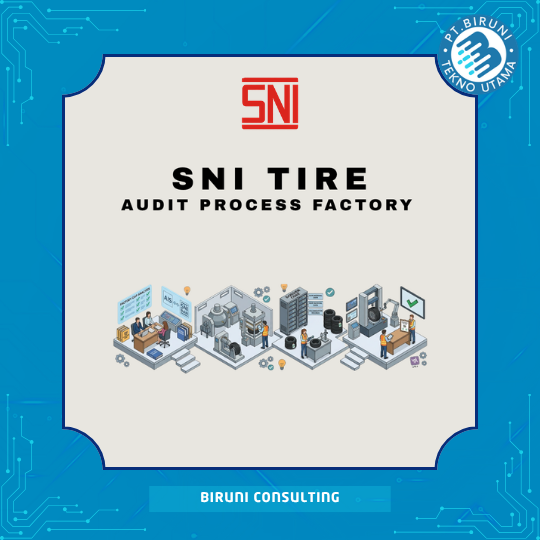
Guide to the Factory Audit Process for SNI Tire Certification in Indonesia
A factory audit is an important stage in the SNI tire certification process. Based on Minister of Industry Regulation No. 9 of 2025 concerning Mandatory Indonesian National Standards for Tires, compliance with mandatory SNI for tires is conducted through a type 5 certification system that includes an audit of the production process and quality management system implementation, as well as conformity testing according to the applicable SNI. The audit is conducted by an LSPro that meets the accreditation and appointment requirements.
A factory audit does not only examine production facilities, but also assesses the company’s ability and consistency in producing tires according to applicable standards. Therefore, companies need to prepare quality management system documents, production processes, facilities, equipment, raw material controls, product testing, and mechanisms for handling nonconforming products before the audit is conducted.
What Is an SNI Tire Factory Audit?
An SNI tire factory audit is an assessment conducted to ensure that the company’s production facilities and quality management system are capable of consistently producing tires that comply with SNI requirements. Under the tire certification scheme, the audit consists of a document adequacy audit and a conformity audit before the assessment results become the basis for certification decision-making.
The conformity audit assesses the production process and quality management system. For initial certification and recertification, the audit covers all elements or functions within the organization’s quality management system. The production process audit is conducted while production is operating so that auditors can directly observe the implementation of procedures at the production facility.
The quality management system assessed may use ISO 9001:2015 or IATF 16949:2016, according to the applicable tire certification scheme.
Stages of the SNI Tire Factory Audit
The SNI tire factory audit process generally consists of several interconnected stages.
Stage 1 Audit or Adequacy Audit
Stage 1 is conducted after the documents submitted by the company have been declared complete, correct, and compliant with the requirements. At this stage, the auditor reviews the company’s quality management system documents and technical information.
Documents that may be reviewed include:
- Quality manual.
- Quality plan or control plan.
- Product quality control from raw materials through finished products.
- Production process flowchart.
- Latest internal audit report.
- Latest management review report.
- Organization structure.
- Factory layout or production location map.
- Production equipment list.
- Testing equipment list.
- Documented information according to ISO 9001:2015 or IATF 16949:2016.
- Business process map and interaction between processes.
In addition to reviewing documents, the Stage 1 audit is also used to verify the adequacy of production facilities, production equipment, and testing equipment owned by the company. The auditor also considers the tire sizes that will represent the highest production volume and critical sizes for marketing in Indonesia.
If the Stage 1 audit requirements have been fulfilled, the process can proceed to Stage 2 or the conformity audit.
Stage 2 Audit or Conformity Audit
Stage 2 is a direct assessment of the implementation of the quality management system and production process at the factory. The audit is conducted while production is operating so that auditors can verify whether documented procedures are actually implemented in production activities.
At this stage, auditors may conduct assessments through observation, interviews with relevant personnel, document and record review, and verification of production facilities and equipment.
The audit also verifies that production, Quality Control (QC), and Quality Assurance (QA) activities are carried out by competent personnel. For production process and QC/QA audits, auditors must have tire product competence according to the certification scheme.
What Is Checked During an SNI Tire Factory Audit?
Raw Material Inspection
One of the important audit points is the inspection of production materials or raw materials entering the factory, also known as incoming material inspection. Auditors examine how the company receives, inspects, identifies, and controls raw materials before they are used in production.
The controls should be supported by evidence and records demonstrating that the raw materials used comply with the requirements established by the company.
Production Process Inspection
Auditors examine the production process and equipment controls on the production line based on the company’s reference documents or control plan. The objective is to ensure that production is carried out consistently and that established parameters are properly controlled.
For tire products, the production process may include material preparation or pre-process, building or assembly, and curing. Production facility requirements are adjusted to the type of tire submitted, such as passenger car tires, light truck tires, truck and bus tires, or motorcycle tires.
Quality Control and Quality Assurance Inspection
The audit also examines the quality control system used to ensure product consistency. Auditors may review how the company conducts monitoring, measurement, inspection, and product testing at specified production stages.
The company must demonstrate that quality control activities are not only performed on finished products but also at production stages that affect product quality.
Production and Testing Equipment Inspection
Facilities and equipment used to manufacture and test products are verified during the audit. Auditors ensure that the company has adequate facilities and is capable of carrying out the production process according to the product submitted for certification.
The production equipment and testing equipment lists are also part of the documents reviewed during the adequacy audit stage.
Nonconforming Product Inspection
The company needs to have a mechanism to identify, control, and segregate nonconforming products. This is one of the aspects verified during the production assessment because the company must be capable of preventing products that do not meet requirements from entering the distribution chain.
Preparation Before an SNI Tire Factory Audit
Preparation before the audit is important to reduce the risk of nonconformities being identified. Companies should conduct an internal review of their documents and actual factory conditions beforehand.
Several aspects that should be prepared include:
- Ensuring that the ISO 9001:2015 or IATF 16949:2016 certificate is available and valid according to the requirements.
- Ensuring that quality management system documents have been updated.
- Ensuring that the production flowchart reflects actual conditions.
- Ensuring that the control plan has been implemented on the production line.
- Ensuring that the machine and equipment list matches the actual facilities.
- Ensuring that testing equipment is available and operational.
- Ensuring that raw material inspection records are available.
- Ensuring that production process control records are available.
- Ensuring that product testing and inspection records are available.
- Ensuring that the nonconforming product handling mechanism has been implemented.
- Ensuring that relevant personnel understand their duties and responsibilities.
- Ensuring that the production area is ready for the audit.
This preparation is important because auditors do not only assess documents but also verify consistency between the documents and actual conditions at the production facility.
Nonconformities in an SNI Tire Factory Audit
During the audit, auditors may identify nonconformities if the factory implementation does not meet the applicable requirements. Such nonconformities must be followed up by the company through corrective actions according to the mechanism established by the LSPro.
The company needs to analyze the cause of the nonconformity, determine corrective or improvement actions, and provide evidence that the actions have been implemented. The corrective action results then become part of the LSPro evaluation before the certification process proceeds.
In the tire conformity assessment process, audit results and test results become the basis for review before the certification decision is established.
Factory Audit for Imported Tires
Factory audits are not limited to tire manufacturers located in Indonesia. Under the applicable scheme, an Overseas Manufacturer may also apply for certification through an Official Representative. If a manufacturer has more than one production location, a certification application must be submitted for each production location.
For overseas manufacturers, the audit is conducted to ensure that the facilities, quality management system, production process, and quality control at the manufacturing plant are capable of producing tires that comply with SNI requirements.
This makes factory audit preparation particularly important for companies importing tires because the certification process is not only related to importer documentation but also to the actual conditions and capabilities of the overseas manufacturer’s factory.
Results of the SNI Tire Factory Audit
The factory audit results become part of the conformity assessment results used in the certification decision-making process. Minister of Industry Regulation No. 9 of 2025 stipulates that conformity assessment results are submitted through SIINas and include, among other information, the date of the adequacy audit, certification scheme, conformity audit date, auditor’s name, sampling officer, audit results, and information about the submitted tire products.
If all conformity assessment and testing requirements are fulfilled, the process may proceed toward the issuance of the SNI Certificate according to applicable requirements.
Why Is SNI Tire Factory Audit Preparation Important?
A factory audit is an important part of SNI tire certification because it demonstrates the company’s ability to maintain consistent product quality. Failure to prepare documents, facilities, production processes, or quality control systems may result in nonconformities and extend the certification process.
By conducting a gap assessment before the audit, companies can identify areas that still need improvement so that documents and actual factory implementation are better prepared when the LSPro audit is conducted.
Contact Us
Biruni Consulting helps companies with the preparation and assistance for SNI tire factory audits professionally and in accordance with applicable regulations in Indonesia.
Our services include
- Consultation on SNI tire regulations.
- Identification of applicable standards and certification scope.
- Review of factory document and facility readiness.
- Audit document preparation.
- Factory audit assistance.
- Laboratory testing assistance.
- Corrective action assistance when nonconformities are identified.
- Certification processing until certificate issuance.
With experience in product certification in Indonesia, Biruni Consulting helps companies prepare their systems, documents, facilities, and production processes so they are better prepared for an SNI tire audit.
Contact Us for consultation, factory audit preparation, certification assistance, and SNI tire certificate processing.