
Role of LSPro in Automotive SNI Certification in Indonesia
Automotive SNI LSPro refers to a Lembaga Sertifikasi Produk, or Product Certification Body, that conducts conformity assessment and certification for automotive products according to the SNI standards within its certification scope. Under mandatory SNI schemes, an LSPro has an important role because it performs certification assessment, conducts audits where required, evaluates testing results, makes certification decisions, and issues the SNI Certificate.
The abbreviation LSPro comes from Lembaga Sertifikasi Produk. Under Minister of Industry Regulation No. 15 of 2025 concerning motor vehicle safety glass, an LSPro is defined as an accredited institution that conducts certification of industrial goods and/or services and issues SNI Certificates according to mandatory SNI requirements. BPK Regulation
Within the automotive sector, LSPro certification may apply to various product groups, including motor vehicle tires, wheels, motor vehicle safety glass, and lubricating oils. However, one LSPro does not necessarily cover all automotive products. Each LSPro has a defined scope, meaning that manufacturers need to confirm the relationship between the product, SNI number, regulation, LSPro scope, and testing laboratory before certification begins.
This is particularly important for mandatory SNI certification. Under several recent regulations, the LSPro must not only hold the relevant accreditation but must also be appointed by the Minister of Industry. For motor vehicle safety glass, for example, the LSPro conducting the audit must be accredited by KAN for the applicable SNI scope and appointed by the Minister. BPK Regulation
What Is an Automotive SNI LSPro?
An Automotive SNI LSPro is an LSPro with a certification scope covering products related to motor vehicles or the automotive industry.
The term does not mean that there is one special LSPro automatically authorized to issue SNI Certificates for every automotive component. LSPro competence always needs to be reviewed according to its specific certification scope.
For example, an LSPro with a motor vehicle tire scope does not necessarily have a scope for wheels. An LSPro capable of certifying wheels may also not have the necessary scope for motor vehicle safety glass or lubricating oils.
Companies should therefore not begin the process by asking “which LSPro is the fastest?” before first identifying the exact SNI applicable to the product.
The first stage should remain product identification and regulatory assessment. Once the SNI number and regulation have been confirmed, the appropriate LSPro can be selected.
Role of LSPro in Automotive SNI Certification
The primary role of the LSPro is to determine whether the manufacturer and product satisfy the applicable certification requirements.
During this process, the LSPro may conduct document review, production-process audits, quality-management-system assessment, sampling or supervision of sampling, evaluation of laboratory test results, review of corrective actions, and the final certification decision.
For motor vehicle safety glass, conformity assessment uses a type 5 certification system. The regulation provides that this system includes a production-process audit, implementation of ISO 9001:2015, and product conformity testing against SNI requirements. BPK Regulation
Lubricating oils also use a type 5 certification system. The audit is performed by the LSPro, which must hold the appropriate KAN accreditation and be appointed by the Minister. BPK Regulation
An LSPro therefore does more than determine whether a single product sample passes laboratory testing. It also evaluates whether the manufacturer is capable of consistently maintaining product conformity while the SNI Certificate remains in use.
Is LSPro the Same as a Testing Laboratory?
No. An LSPro and a Testing Laboratory perform different functions.
The LSPro is responsible for the certification process and certification decision. The Testing Laboratory conducts testing on product samples according to the parameters established under the applicable SNI.
Minister of Industry Regulation No. 15 of 2025 clearly distinguishes the two. The LSPro performs certification activities and issues the SNI Certificate, while the Testing Laboratory conducts conformity testing on product samples. BPK Regulation
Under the same regulation, the audit is conducted by the LSPro, while testing is conducted by an eligible Testing Laboratory. For an Indonesian laboratory, requirements include relevant KAN accreditation and appointment by the Minister. BPK Regulation
Receiving a laboratory test report therefore does not automatically mean that the company has obtained an SNI Certificate. Certification and testing are connected processes, but they have different functions.
Can Every LSPro Certify Automotive SNI Products?
No. Not every LSPro can certify every automotive product.
An LSPro has a certification scope identifying the products or standards it is qualified to handle. The scope needs to be verified before the company submits its certification application.
For mandatory SNI schemes, companies also need to determine whether the LSPro satisfies the appointment requirements established under the applicable regulation.
In simple terms, before selecting an LSPro, a company should verify:
- The correct product and SNI number.
- The LSPro’s relevant certification scope.
- Applicable accreditation status.
- Current appointment for the mandatory SNI scheme.
- Eligibility of the Testing Laboratory.
This simple verification is important because selecting an unsuitable LSPro may require documents to be transferred, audit schedules to be changed, or the certification process to be reorganized.
Automotive SNI LSPro for Motor Vehicle Tires
Tires are one of the automotive product groups subject to mandatory SNI requirements.
The regulation currently in force is Minister of Industry Regulation No. 9 of 2025 concerning mandatory SNI for tires. It became effective on July 24, 2025 and revoked the previous mandatory tire regulation. BPK Regulation
The mandatory scope includes several principal standards:
- SNI 098:2019 – passenger car tires.
- SNI 099:2019 – truck and bus tires.
- SNI 100:2019 – light truck tires.
- SNI 101:2019 – motorcycle tires.
- SNI 6700:2012 – motor vehicle inner tubes.
One example of an LSPro currently and officially listing all five scopes is LSPr BBSPJIKKP, part of the Ministry of Industry. Its official certification page states that LSPr BBSPJIKKP is accredited by KAN under accreditation number LSPr-009-IDN and lists all five mandatory tire standards under Minister of Industry Regulation No. 9 of 2025, with appointment shown under Minister of Industry Decree No. 341 of 2026. The page was last updated on May 6, 2026. BBSPJIKKP
This demonstrates the importance of using current information. An LSPro used under an older regulation should not automatically be assumed to retain the same status or scope after a new regulation comes into effect.
Automotive SNI LSPro for Motor Vehicle Wheels
Motor vehicle wheels are governed by a separate regulation, Minister of Industry Regulation No. 71 of 2024 concerning mandatory SNI for motor vehicle wheels in categories M, N, O, and L.
The principal standards are SNI 1896:2008 for motor vehicle wheels in categories M, N, and O and SNI 4658:2015 for category L motor vehicle wheels. The regulation requires conformity assessment through a type 5 certification system. Peraturan.go.id
Testing under the certification scheme is performed according to SNI 1896:2008 and/or SNI 4658:2015 depending on the product included in the application. Peraturan.go.id
Wheel manufacturers should therefore select their LSPro only after the vehicle category and wheel type have been clearly identified. A category L manufacturer, for example, should not rely only on certification experience involving category M, N, or O wheels without verifying the relevant scope.
This becomes even more important for Overseas Manufacturers because the process may involve an overseas factory audit, sampling, testing, auditor travel, and coordination with the Official Representative in Indonesia.
Automotive SNI LSPro for Motor Vehicle Safety Glass
Motor vehicle safety glass is currently regulated under Minister of Industry Regulation No. 15 of 2025. The regulation became effective on October 25, 2025 and revoked Minister of Industry Regulation No. 80 of 2015. BPK Regulation
One of the principal standards under the regulation is SNI 8210:2018 for motor vehicle safety glass.
The conformity-assessment mechanism uses a type 5 certification system covering a production-process audit, implementation of ISO 9001:2015, and conformity testing. BPK Regulation
The LSPro conducting the audit must be accredited by KAN for the applicable safety-glass SNI scope and appointed by the Minister. Similar requirements apply to the Indonesian Testing Laboratory used for product testing. BPK Regulation
For Overseas Manufacturers, applications are submitted through the Official Representative. During the SIINas application stage, the applicant selects the relevant SNI and the LSPro that will conduct conformity assessment. BPK Regulation
An automotive-glass manufacturer should therefore not merely search for a “glass LSPro.” It should confirm that the LSPro has the appropriate scope and status for the applicable motor vehicle safety-glass SNI.
Automotive SNI LSPro for Lubricating Oils
Lubricating oils are another important part of automotive regulatory compliance.
Minister of Industry Regulation No. 8 of 2025 concerning mandatory SNI for lubricating oils became effective on July 24, 2025 and revoked Minister of Industry Regulation No. 25 of 2018. BPK Regulation
The certification scheme uses a type 5 system involving a production-process audit, implementation of ISO 9001:2015, and conformity testing. The LSPro conducting the audit must hold appropriate KAN accreditation and be appointed by the Minister. BPK Regulation
For automotive applications, the regulation includes several SNI 7069 series standards covering lubricating oils for gasoline engines, motorcycles, high-speed diesel engines, manual transmissions and final drives, and automatic transmissions. BPK Regulation
The broad term “automotive lubricant” is therefore not enough to identify the appropriate LSPro. Companies need to determine the exact lubricant type, function, and applicable SNI before selecting the certification body and Testing Laboratory.
KAN Accreditation and LSPro Appointment
Accreditation and appointment are two important concepts when selecting an LSPro.
Accreditation demonstrates that the institution’s competence has been assessed for a specified conformity-assessment scope. In Indonesia, the National Accreditation Committee, or KAN, performs an important accreditation role.
For certain mandatory SNI products, however, the applicable regulation also requires the LSPro to be appointed by the Minister of Industry.
This is clearly demonstrated under the lubricating-oil regulation. Minister of Industry Regulation No. 8 of 2025 requires the LSPro conducting the audit to be accredited by KAN for the relevant lubricating-oil SNI scope and appointed by the Minister. BPK Regulation
The motor vehicle safety-glass regulation uses the same structure. BPK Regulation
Companies should therefore review accreditation and appointment together according to the latest applicable regulation.
How Does Certification Through an LSPro Work?
The Automotive SNI LSPro process differs according to the product, but the overall structure is relatively similar.
The first stage is confirming the correct product, SNI, and regulation. The company then prepares application documentation and information concerning the production facility.
The process may then continue with a factory audit, sampling, laboratory testing, closure of any nonconformities, evaluation of results, and a certification decision.
For mandatory SNI products regulated by the Ministry of Industry, SIINas forms an important part of the administrative process. The official LSPr BBSPJIKKP page also explains that certification applications for products whose SNI implementation is mandatory under the Ministry of Industry are submitted through SIINas. BBSPJIKKP
Under the motor vehicle safety-glass scheme, the official procedure specifically shows that applicants select the SNI and LSPro through SIINas before conformity assessment proceeds. BPK Regulation
Companies should therefore understand the regulatory process before simply sending documents directly to an LSPro.
Documents for Automotive SNI LSPro Certification
Required documentation depends on the product and certification scheme.
In general, the LSPro needs information sufficient to identify the company, manufacturing location, product, trademark, type or model, production process, quality management system, testing facilities, and other technical information needed to determine the certification scope.
For foreign manufacturers, documentation may be more extensive because certain product regulations also require an Official Representative in Indonesia.
Documents may include manufacturer legal documentation, factory addresses, product lists, trademarks, ISO 9001 certificates where required, production-flow diagrams, quality-control plans, raw-material specifications, testing equipment information, and Official Representative documentation.
Data consistency is particularly important. Manufacturer names, factory addresses, trademarks, product types, Representative information, and application data should correspond with one another.
Factory Audit by the LSPro
A factory audit is an important element in many type 5 automotive SNI schemes.
The objective is not simply to inspect one sample to be sent for testing, but to verify that the manufacturing facility has a system capable of producing consistently compliant products.
For motor vehicle safety glass, the regulation expressly requires a production-process audit and implementation of ISO 9001:2015. BPK Regulation
Lubricating oils follow the same general approach under the type 5 system. BPK Regulation
In practice, the audit may cover raw materials, production processes, inspection, internal testing, traceability, calibration, nonconforming-product control, personnel competence, and document control according to the relevant product scheme.
For Overseas Manufacturers, the audit may take place at the production facility outside Indonesia. Factory documentation, personnel, testing facilities, and production schedules should therefore be prepared before the auditors arrive.
Automotive Product Testing
Testing is an important part of conformity assessment.
Each product uses different testing methods. Tire testing differs from wheel testing, while motor vehicle safety glass and lubricating oils require entirely different types of evaluation.
For motor vehicle wheels, testing is conducted according to SNI 1896:2008 and/or SNI 4658:2015 depending on the product included in the application. Peraturan.go.id
For motor vehicle safety glass, the type 5 system expressly includes conformity testing against the SNI. BPK Regulation
Lubricating oils similarly require conformity testing as part of the type 5 certification system. BPK Regulation
Companies therefore need to confirm not only the correct LSPro but also an eligible Testing Laboratory meeting the certification-scheme requirements.
Automotive SNI LSPro for Overseas Manufacturers
Foreign manufacturers remain subject to technical assessment of the production facility and product. However, applicable regulations may establish additional administrative requirements.
One of the most important requirements for certain products is an Official Representative in Indonesia.
Under the motor vehicle safety-glass scheme, an Overseas Manufacturer submits its application through its Official Representative. SIINas is then used to select the applicable SNI and LSPro for conformity assessment. BPK Regulation
The roles of the LSPro and Official Representative should not be confused. The LSPro performs certification and makes the certification decision. The Official Representative performs local representation functions for the Overseas Manufacturer according to the applicable product regulation.
A foreign company may therefore require both parties within the same certification project.
Automotive SNI LSPro and SIINas
SIINas, or the National Industrial Information System, forms an important part of mandatory SNI administration under the Ministry of Industry.
For certain products, applications are submitted electronically through SIINas. Applicants can select the relevant standard and LSPro that will conduct conformity assessment.
Under the motor vehicle safety-glass scheme, the certification procedure expressly provides for electronic application through SIINas and LSPro selection during the application stage. BPK Regulation
Official information from LSPr BBSPJIKKP also states that certification applications for products whose SNI implementation is mandatory under the Ministry of Industry are submitted through SIINas. BBSPJIKKP
Companies should therefore ensure that documentation and information submitted through SIINas are correct before the application proceeds to auditing and testing.
SNI Certificate and SPPT SNI
An SNI Certificate and SPPT SNI are two documents that need to be distinguished.
The SNI Certificate is issued by the LSPro after the manufacturer and product successfully complete conformity assessment.
SPPT SNI represents approval to use the SNI Mark through the government mechanism established under the relevant product regulation.
This distinction is clearly illustrated under the motor vehicle safety-glass regulation. The LSPro issues the SNI Certificate, while application of the SNI Mark takes place after approval to use the mark has been obtained through SPPT SNI issued by the Head of the relevant Agency. BPK Regulation
A similar concept applies to lubricating oils, where conformity-assessment results are expressed in the form of an SNI Certificate. BPK Regulation
Companies should therefore avoid using the term SPPT SNI to describe the SNI Certificate issued by the LSPro.
Surveillance by the LSPro
Type 5 SNI certification does not end when the first SNI Certificate is issued.
The LSPro may perform surveillance to ensure that the manufacturer continues maintaining conformity while the certificate remains valid.
Under the motor vehicle wheel regulation, periodic surveillance is performed once per year. The regulation also allows special surveillance in response to complaints or instructions from the Minister. Surveillance results are reported by the LSPro through SIINas. Peraturan.go.id
The motor vehicle wheel scheme also expressly applies to initial certification, surveillance, and recertification. Peraturan.go.id
Manufacturers therefore need to maintain their quality systems, production records, testing, calibration, documentation, and product consistency after certification has been granted.
Automotive SNI LSPro and Vehicle Homologation
SNI certification and vehicle homologation should be treated as separate processes.
The LSPro certifies products according to the SNI within its certification scope. Motor vehicles or certain automotive components may also be subject to other technical requirements under vehicle regulations.
Obtaining an SNI Certificate for tires, wheels, safety glass, or another component therefore does not automatically mean that every type-approval or vehicle-homologation requirement has been completed.
Automotive manufacturers should separately map product SNI requirements and other applicable vehicle obligations.
This approach helps prevent the assumption that one certification automatically replaces every form of technical approval required in Indonesia.
How to Select an Automotive SNI LSPro
LSPro selection should be based on certification scope and regulatory suitability rather than cost alone.
Companies should first confirm the product SNI and then review the LSPro scope, accreditation status, appointment, capability to handle the relevant product and factory, and the Testing Laboratory involved.
For Overseas Manufacturers, experience in arranging audits at factories outside Indonesia is also a practical consideration.
Companies should obtain confirmation of the LSPro scope before scheduling an audit, sending product samples, or paying certification fees.
This helps reduce the risk of having to change the LSPro after the project has already started.
Automotive SNI LSPro Cost
There is no single fee applicable to all Automotive SNI LSPro projects.
Costs can vary according to product type, number of models, number of trademarks, factory location, certification scheme, number of auditors, required testing, and auditor travel.
For foreign manufacturers, costs may increase because the audit takes place outside Indonesia.
Companies also need to distinguish LSPro fees from laboratory testing, auditor travel and accommodation, sample shipment, translation, document legalization, and Official Representative services.
A quotation should therefore be evaluated based on the complete scope of work rather than only the certificate issuance fee.
How Long Does the Automotive SNI LSPro Process Take?
There is no single timeline applicable to all products.
Processing time depends on document completeness, factory readiness, auditor availability, sampling, laboratory capacity, test results, and audit findings.
Where nonconformities are identified, corrective actions need to be completed before certification can continue.
Where samples fail to satisfy the standard, additional testing or corrective action can extend the certification schedule.
For Overseas Manufacturers, auditor travel planning also needs to be considered.
Strong document and audit preparation from the beginning is generally more important than simply selecting an LSPro based on the shortest estimated processing time.
Common Mistakes When Selecting an Automotive SNI LSPro
One of the most common mistakes is selecting an LSPro before the product’s SNI number has been clearly identified.
Another mistake is asking only whether the institution “can handle SNI certification” without confirming its specific accreditation scope and appointment.
Companies may also incorrectly assume that a Testing Laboratory and LSPro perform the same function, or that a laboratory test report automatically becomes an SNI Certificate.
For Overseas Manufacturers, delays in preparing the Official Representative, SIINas, trademarks, and factory documentation can also affect the certification schedule.
Conducting regulatory assessment before selecting an LSPro helps reduce these risks.
Conclusion
Automotive SNI LSPro plays an important role in the certification of automotive products in Indonesia.
The LSPro performs conformity assessment, scheme-specific audits, evaluation of testing results, certification decisions, and issuance of the SNI Certificate. However, one LSPro does not automatically have the authority or scope to certify every automotive product.
Tires, motor vehicle wheels, safety glass, and lubricating oils each have their own standards and regulations. Manufacturers need to verify the SNI number, LSPro scope, accreditation status, appointment, Testing Laboratory, and certification mechanism before starting the process.
For example, LSPr BBSPJIKKP currently lists five mandatory tire SNI scopes under Minister of Industry Regulation No. 9 of 2025 and appointment under Minister of Industry Decree No. 341 of 2026. Motor vehicle wheels, safety glass, and lubricating oils operate under their own regulations and certification schemes. BBSPJIKKP
Selecting the appropriate Automotive SNI LSPro from the beginning helps reduce the risk of repeated documentation, changes of certification body, delayed audits, or use of a laboratory outside the applicable certification scheme.
Contact Us
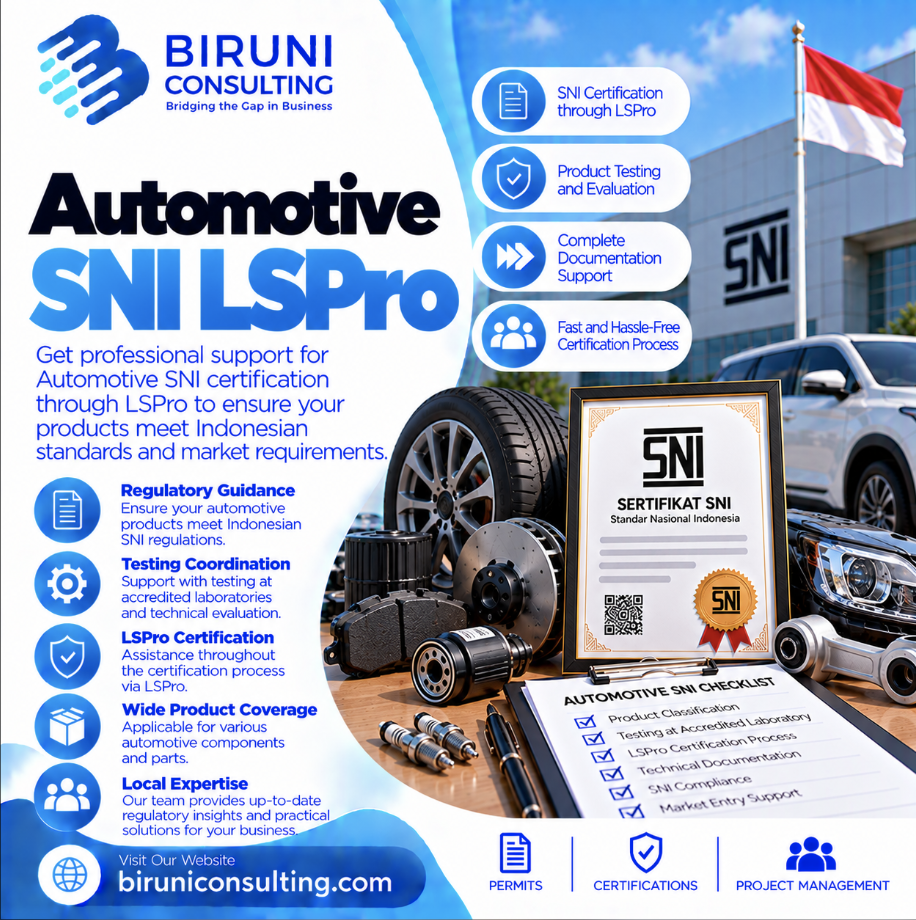
Biruni Consulting assists companies with Automotive SNI LSPro processes professionally and in accordance with applicable regulations in Indonesia.
Our services include:
- Regulatory consultation.
- Identification of applicable standards.
- Preparation of certification documents.
- Assistance with laboratory testing.
- Certification processing until certificate issuance.
Biruni Consulting assists manufacturers in identifying applicable automotive SNI standards, determining the appropriate LSPro and Testing Laboratory process, preparing production facilities for audits, and supporting Official Representative requirements for Overseas Manufacturers.
Contact Us for Automotive SNI LSPro assistance, tire SNI certification, motor vehicle wheel certification, motor vehicle safety glass, lubricating oils, and other automotive-product certification in Indonesia.