
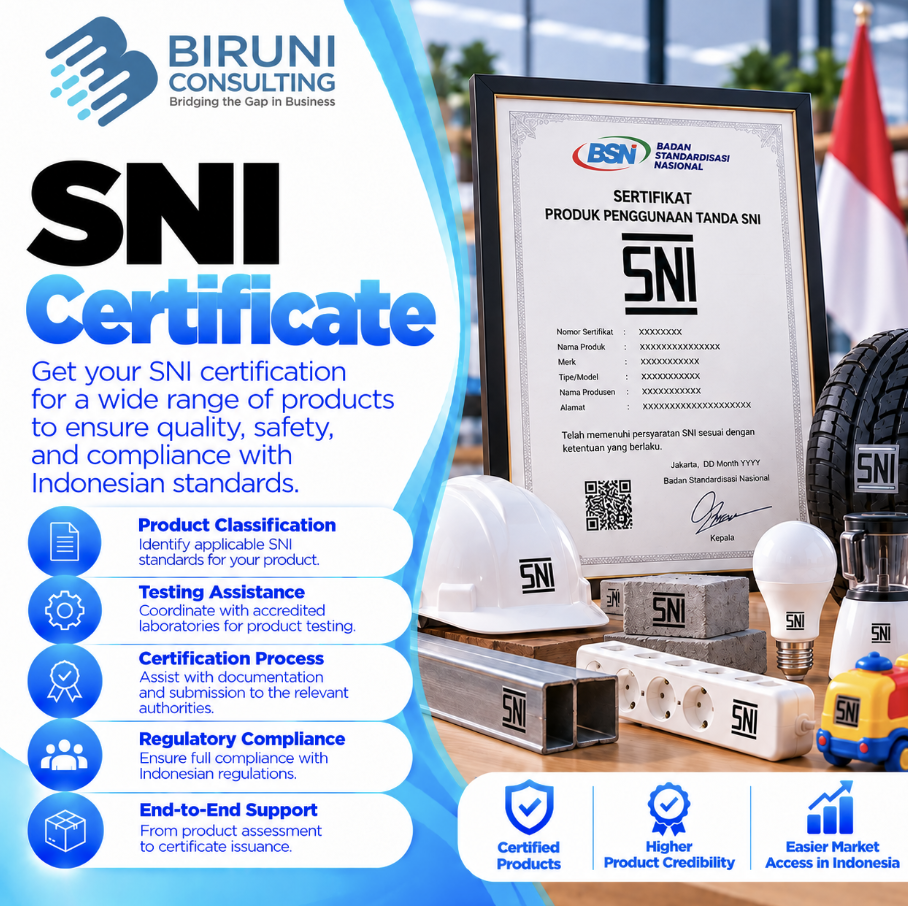
Guide to SNI Certification, Mandatory and Voluntary SNI, Testing, Factory Audits, Product Certification Bodies, and SNI Marking
An SNI Certificate is a document demonstrating that a product, service, process, system, or another certified object has undergone conformity assessment against the applicable Indonesian National Standard or SNI. In product certification, the process may include document review, laboratory testing, manufacturing-process evaluation, factory audits or inspections, and surveillance activities according to the applicable certification scheme.
Indonesia’s general legal framework for standardization and conformity assessment includes Law No. 20 of 2014 concerning Standardization and Conformity Assessment and Government Regulation No. 34 of 2018 concerning the National Standardization and Conformity Assessment System. Government Regulation No. 34 of 2018 remains in force. BPK Regulations
Law No. 20 of 2014 provides that certification can include certification of goods, services, systems, processes, personnel, and other certification intended to demonstrate conformity with SNI. Certification results are expressed through conformity certificates that may be based on audit, testing, and/or inspection reports. BPK Regulations
Companies seeking SNI certification should therefore first establish the applicable SNI number, mandatory or voluntary status, product scope, HS Code, certification scheme, product family, laboratory, and appropriately scoped product certification body before beginning product testing.
What Is SNI?
SNI stands for Standar Nasional Indonesia, or Indonesian National Standard.
SNI standards can specify requirements for goods, services, systems, processes, testing methods, terminology, safety, performance, quality, and other technical characteristics.
SNI is not limited to electrical products. Indonesian standards cover electronics, electricity, construction, food and beverages, machinery, steel, textiles, chemicals, medical devices, agriculture, management systems, and numerous consumer products.
The existence of an SNI standard does not automatically mean that a product is subject to mandatory SNI certification. Companies need to distinguish between a standard that exists and remains active and a standard that has been made mandatory through a technical regulation.
What Is an SNI Certificate?
The term “SNI Certificate” is commonly used to describe evidence that a product or other certified object complies with a particular SNI.
Legally, Law No. 20 of 2014 states that certification results are expressed in the form of a certificate of conformity. Conformity-assessment activities are performed by conformity-assessment bodies accredited by the National Accreditation Committee or KAN, subject to provisions concerning recognized foreign bodies. BPK Regulations
For product certification, terminology such as product certificate, SPPT SNI, SNI Mark Product Certificate, SNI Certificate, or approval to use the SNI Mark may appear depending on the sector, regulation, and certification scheme.
Companies should therefore follow the terminology and administrative procedure established for the particular regulated product.
There Is No Single SNI Certificate for Every Product
A common misunderstanding is to treat SNI certification as one general certificate applicable to different products.
In practice, each product needs to be mapped to its applicable standard.
Lighting products use standards different from MCBs. Socket outlets use standards different from cables. Helmets, water pumps, refrigerators, tires, cement, and steel products also have their own standards and certification scopes.
The first stage of certification should therefore be product identification and standard mapping.
Mandatory and Voluntary SNI
SNI application is generally voluntary unless a competent ministry or agency makes a particular SNI mandatory.
Law No. 20 of 2014 authorizes ministries and non-ministerial government agencies to make SNI mandatory where matters such as safety, security, health, or environmental protection are involved. Businesses covered by the resulting regulation must comply with it. BPK Regulations
Government Regulation No. 34 of 2018 also regulates both voluntary application and mandatory implementation of SNI within Indonesia’s national standardization system. BPK Regulations
Companies therefore need to establish whether their product merely has an active SNI or is specifically covered by a regulation making that SNI mandatory.
Mandatory SNI Certification
Where an SNI has been made mandatory for a particular product scope, businesses falling within that scope need to follow the certification requirements established by the applicable regulation.
Law No. 20 of 2014 requires businesses to hold the required certificate for mandatory SNI. Businesses without the required certificate, or whose certificate has expired, been suspended, or been revoked, may not market covered goods that fail to meet the applicable requirements. The provisions also address imported goods. BPK Regulations
Mandatory status must nevertheless be assessed according to the regulatory scope. HS Code, product type, rating, capacity, construction, intended use, and exclusions can determine whether a particular model is actually covered.
Voluntary SNI Certification
A product that has not been made subject to mandatory SNI may still apply an SNI voluntarily where an applicable standard and conformity-assessment scheme are available.
Companies may pursue voluntary certification to improve market confidence, demonstrate product quality or safety, satisfy tenders or customers, or strengthen brand positioning.
Government Regulation No. 34 of 2018 provides rules for businesses voluntarily applying SNI and using the SNI Mark after certification. Where a certificate expires, is suspended, or is revoked, continued use of the mark is prohibited. BPK Regulations
Voluntary certification therefore remains a formal conformity-assessment process rather than a company’s self-declaration that it follows an SNI.
An Active SNI Is Not Automatically Mandatory
An SNI shown as active in the BSN catalogue is an active national standard, but this status alone does not establish mandatory certification.
Mandatory status needs to be established from technical regulations issued by the competent ministry or authority.
For example, certain electrical products are regulated through the Ministry of Energy and Mineral Resources, while other industrial products can be regulated by the Ministry of Industry. Other product groups may have different sectoral regulators.
Product assessment should therefore distinguish between an available SNI, an active SNI, and an SNI made mandatory for a defined product scope.
What Is SPPT SNI?
The term SPPT SNI is widely associated with approval or product certification for use of the SNI Mark under various product schemes and regulations.
BSN Regulation No. 2 of 2017 concerning procedures for the use of the SNI Mark and SNI-based conformity marks is currently listed as in force. BPK Regulations
Various BSN conformity-assessment schemes also state that use of the SNI Mark follows the applicable approval procedure. BPK Regulations
Administrative terminology and procedures can nevertheless differ under newer sector-specific regulations. The relevant product regulation and certification scheme should therefore be checked for each project.
What Is the SNI Mark?
The SNI Mark is a conformity mark showing that the object carrying it has demonstrated compliance with the relevant SNI within the certified scope.
A company cannot legitimately use the SNI Mark merely because it has purchased the standard, conducted its own internal testing, or obtained an IEC report.
Use of the mark needs to follow the applicable conformity-assessment and approval procedure.
Government Regulation No. 34 of 2018 also prohibits certificate holders from using the SNI Mark outside the scope stated in the certificate or displaying an SNI number different from the one covered by the certificate. BPK Regulations
Who Issues SNI Product Certification?
Product certification is conducted through a Product Certification Body or LSPro with appropriate competence and certification scope for the product and standard involved.
Law No. 20 of 2014 provides that conformity-assessment activities are performed by conformity-assessment bodies accredited by KAN. BPK Regulations
For mandatory products, accreditation may not be the only consideration. Sector-specific regulations may impose additional requirements regarding which conformity-assessment bodies can perform certification.
Companies should therefore verify the LSPro’s product scope, SNI scope, certification scheme, and status under the applicable regulation.
What Is an LSPro?
An LSPro is a Product Certification Body that performs product certification according to a defined conformity-assessment scheme.
Its activities may include application review, document evaluation, sample selection, testing, manufacturing-process assessment, review of evaluation results, certification decisions, and surveillance.
Certification schemes are not necessarily identical for every product. BSN Regulation No. 9 of 2023 establishes procedures for preparing conformity-assessment schemes against SNI. BPK Regulations
BSN also currently lists SNI ISO/IEC 17067:2013 Confirmation 2020 concerning fundamentals of product certification and guidelines for product certification schemes as active. Pesta
Is Certification Applied for Directly to KAN?
KAN or the National Accreditation Committee has a key role in accrediting conformity-assessment bodies.
Law No. 20 of 2014 provides that conformity-assessment activities are performed by bodies accredited by KAN, subject to provisions concerning recognized foreign bodies. BPK Regulations
A manufacturer or importer generally does not apply directly to KAN for product certification. Product certification applications are normally submitted to an appropriately scoped LSPro.
KAN accredits the competence of conformity-assessment bodies, while the LSPro conducts the certification process for the company’s product.
Testing for SNI Certification
Testing is an important part of many product-certification schemes.
Samples are evaluated against the technical requirements specified in the applicable SNI.
Electrical products may be tested for protection against electric shock, temperature rise, insulation, electric strength, mechanical construction, abnormal operation, and other characteristics. Other products can require chemical, physical, dimensional, strength, composition, performance, or other sector-specific tests.
Law No. 20 of 2014 recognizes that conformity certificates may be based on testing, audit, and/or inspection reports. BPK Regulations
Test samples should therefore represent the products that will actually be manufactured and marketed.
Can an IEC Test Report Replace an SNI Certificate?
Not automatically.
IEC reports, CB Test Reports, CB Certificates, ISO reports, or foreign laboratory reports can be valuable technical evidence during initial assessment. They do not, however, automatically replace mandatory Indonesian SNI certification.
Acceptance depends on the certification scheme, laboratory competence, recognition arrangements where relevant, sectoral regulation, and the LSPro’s applicable procedures.
Companies should submit existing reports for assessment before assuming that full or additional testing will or will not be required.
Factory Audits for SNI Certification
Many product-certification schemes include some form of manufacturing-process or production-control evaluation.
The purpose is to establish that mass-production units can be produced consistently in accordance with the configuration that was evaluated.
Factory assessment may review incoming inspection, production control, testing equipment, calibration, traceability, nonconforming-product control, final inspection, quality records, complaint handling, and engineering-change control.
However, factory audits should not be assumed to follow one universal format for every SNI certificate. The applicable scheme determines the required evaluation method.
Is ISO 9001 Mandatory?
ISO 9001 is not universally required for every SNI product certificate.
Some certification schemes evaluate quality-management or manufacturing processes as part of product certification. An existing ISO 9001 certificate may provide useful evidence of a factory’s management system, but actual requirements depend on the applicable product scheme.
A company should therefore not obtain ISO 9001 solely on the assumption that every SNI certification process requires it.
SNI Certificates for Imported Products
Products manufactured overseas can still fall within mandatory SNI scope where the relevant regulation includes imported goods.
Certification may therefore require involvement from the overseas manufacturer or factory because the certified product needs to be traceable to its actual production facility.
Required documentation can include manufacturer and factory information, product catalogues, model lists, technical drawings, test reports, quality documentation, and authorization between relevant parties.
Where factory assessment is required, the overseas production facility may also be subject to evaluation.
SNI compliance should therefore be considered before mass production and shipment rather than only after goods arrive in Indonesia.
Who Can Be the Certificate Holder?
The appropriate certificate holder depends on the certification scheme and sectoral regulation.
Depending on the product, the manufacturer, importer, representative, brand owner, or another authorized party may have a specific role in certification administration.
Companies should clarify the relationship between the brand owner, manufacturer, factory, importer, certificate holder, and distributor before the application is submitted.
SNI Certification for OEM and Private-Label Products
OEM and private-label products are frequently produced by one factory for several brands.
Assessment needs to establish the manufacturer, brand owner, models, technical identity, and how the applicable certification scheme treats additional brands or private labels.
One factory does not automatically mean that every brand can use the same certificate.
Similarly, one brand manufactured at several factories may require separate assessment of each facility.
Certification structure should therefore be planned before production agreements and labels are finalized.
Product Family Assessment
Many manufacturers have dozens or hundreds of models.
Not every model necessarily requires an entirely separate certification project, but models cannot automatically be grouped simply because they share a similar appearance.
Product family assessment determines which models have sufficiently similar technical construction and which representative models should be tested.
For electrical products, family characteristics may include rated voltage, power, materials, circuits, critical components, drivers, plugs, cables, enclosures, electrical class, and additional functions.
For other products, family criteria may include dimensions, materials, composition, manufacturing process, grade, type, and other relevant characteristics.
The model list should therefore be finalized before samples are selected.
Representative Samples
A representative sample is selected to represent one or more products within a certification family.
The model with the highest rating is not always the only critical sample. Critical conditions depend on the requirements of the applicable standard.
More than one sample may be necessary where material, construction, rating, or configuration differences exist.
Manufacturers should therefore avoid sending samples before product-family grouping has been confirmed.
Documents for SNI Certification
Documentation requirements depend on the product and certification scheme, but companies generally need comprehensive legal and technical information.
Typical documentation can include:
- Company, manufacturer, and factory legal information.
- Product catalogues, datasheets, model lists, and photographs.
- Technical drawings, construction drawings, and material or component specifications.
- Label artwork, brand information, and user manuals.
- Existing test reports, certificates, and quality documents.
- Documents describing the relationship between importer, brand owner, manufacturer, and factory where relevant.
Documents should be checked before application so that models, brands, factory addresses, and technical information remain consistent.
Product Labels and SNI Certification
Product labels are important because information on the marketed product needs to correspond with certification records.
Brand, model, ratings, manufacturer, country of origin, applicable standard, conformity markings, and other product-specific information may need to be controlled depending on the certification scheme.
A model discrepancy between the product label and certificate model list can create problems during production control, importation, registration, or market surveillance.
Label artwork should therefore ideally be finalized before mass production.
The SNI Mark Should Not Be Used Before Approval
Companies should not print the SNI Mark on mass-production goods simply because laboratory testing has been completed or a certificate application is in progress.
Use of the mark must follow the approval and certification procedures applicable to the product.
BSN Regulation No. 2 of 2017 regulates procedures for using the SNI Mark and SNI-based conformity marks and remains listed as in force. BPK Regulations
Government Regulation No. 34 of 2018 also limits use of the SNI Mark to the certified scope. BPK Regulations
SNI Certificate Validity
There is no single validity period applicable to every SNI certificate.
Certification periods, surveillance, recertification, and periodic evaluation depend on the relevant certification scheme and product regulation.
Companies need to understand whether their certificate has a specified certification cycle, requires periodic surveillance, or has specific recertification requirements.
An issued certificate should not be assumed to remain valid indefinitely without maintenance activities.
Surveillance
Surveillance helps verify that products continuously manufactured after certification remain compliant with the certified requirements.
Depending on the scheme, surveillance may involve factory assessment, sampling, testing, document review, or other activities.
Companies should maintain quality records, supplier information, approved component lists, testing records, complaint records, and engineering-change documentation.
Significant changes can require additional assessment.
Product Changes After Certification
Changes to models, materials, component suppliers, factories, ratings, construction, formulas, or manufacturing processes should not be implemented without considering their effect on certification.
Changes that appear commercially minor may be technically significant.
Replacing an LED driver, housing resin, cable, terminal, motor, compressor, battery, steel grade, chemical formula, or safety-critical component can affect conformity.
Companies should maintain a change-control procedure and perform an assessment before introducing changes into mass production.
Adding Models to an Existing Certificate
Companies with an existing certificate may later want to add models.
Whether a model can be added depends on product-family criteria, construction differences, and scheme requirements.
Models based on the same technical platform may be eligible for additional assessment, while materially different construction can require additional testing or separate certification.
Product roadmaps should therefore ideally be considered from the beginning.
Adding Brands
Additional brands also need to be assessed according to the applicable scheme.
An OEM product sold under multiple brands cannot automatically use one certification approval without the required administrative process.
Brands on product labels, certificates, registrations, importer documentation, and packaging should remain consistent.
This is particularly important for private-label products and products distributed through multiple companies.
Changing the Factory
Changing a manufacturing facility is significant because product certification can involve both product design and the factory’s ability to consistently manufacture conforming units.
A product with the same model and brand manufactured at a different factory may not automatically be covered by the existing certificate.
A new factory may require production evaluation, sample testing, or certificate modification according to the applicable scheme.
Companies should therefore consider long-term factory strategy before certification begins.
SNI Certificate and HS Code
SNI and HS Code are different concepts, although mandatory regulations often connect them.
An HS Code is a customs and trade classification, while SNI is a technical standard.
Many mandatory-SNI regulations define product scope through a combination of product description, technical parameters, and HS Codes.
Finding an HS Code in a mandatory regulation therefore does not necessarily mean that every product under that tariff heading is subject to the same SNI requirement.
Product assessment and HS classification should ideally be carried out together before importation.
SNI Certificate and NPB
For certain imported products covered by Ministry of Trade quality-policy requirements, an NPB or Goods Registration Number may also apply.
An SNI certificate and an NPB are not the same document.
SNI certification demonstrates conformity with the applicable standard and certification scheme, while NPB is a goods-registration requirement for products falling within the relevant quality-policy scope.
Importers should therefore check whether additional registration remains necessary after SNI certification.
SNI Certificate and Import Licensing
Holding an SNI certificate does not automatically complete every import requirement.
Additional obligations can depend on the HS Code, product sector, and type of goods.
In addition to general importer legality, some products may require product registration, technical permits, surveyor verification, NPB, telecommunications-device certification, marketing authorization, or other sector-specific requirements.
SNI certification should therefore be considered one part of a broader regulatory compliance assessment.
SNI Certification for Electrical Products
Electrical products are among the categories where mandatory SNI frequently applies.
MCBs, plugs, socket outlets, various luminaires, cables, and other products can fall within mandatory electricity-standardization regulations.
Not every electrical product is automatically subject to mandatory SNI.
Product description, voltage, current, rating, construction, intended use, HS Code, and regulatory exclusions need to be reviewed.
Technical datasheets are therefore particularly important during initial assessment.
SNI Certification for Products Imported from China
Products manufactured in China follow the same Indonesian regulatory principles as products imported from other countries.
Country of origin alone does not determine whether SNI is mandatory. Product type, applicable standard, HS Code, regulatory scope, and certification scheme are the critical factors.
Chinese manufacturers need to provide technical documentation and cooperate with product testing and factory assessment where required.
Assessment should ideally take place before the importer issues a mass-production purchase order.
SNI Certification for Products from Other Countries
Products from Vietnam, Thailand, Malaysia, South Korea, Japan, Taiwan, India, Europe, the United States, and other countries also need to be assessed against Indonesian requirements.
CE marking, UL certification, TÜV reports, CB Certificates, IEC reports, JIS, KS, TIS, or other foreign standards do not automatically replace mandatory Indonesian SNI certification.
They can, however, provide useful technical evidence during assessment.
Is CE the Same as SNI?
No.
CE marking relates to European regulatory requirements for products within its applicable scope, while SNI is Indonesia’s national standardization framework.
A product with CE marking is not automatically compliant with every Indonesian SNI requirement.
Likewise, SNI certification does not automatically meet European CE requirements.
Companies selling to multiple markets should therefore maintain separate regulatory compliance matrices.
Is a CB Certificate the Same as SNI?
No.
CB Certificates and CB Test Reports form part of the IECEE CB Scheme for certain electrotechnical products.
They can provide valuable evidence because they are based on applicable IEC standards.
However, where Indonesia uses a modified SNI, national differences, product-specific certification requirements, or additional regulatory obligations, an existing CB report may not replace the entire SNI certification process.
Existing CB documentation should be reviewed during pre-assessment.
How Long Does SNI Certification Take?
There is no universal processing time for every SNI product.
The overall process depends on documentation readiness, product family, sample quantities, test requirements, laboratory capacity, testing results, corrective actions, factory evaluation, factory location, and certification review.
Failed testing or incomplete technical documentation can extend the process considerably.
A strong pre-assessment is therefore one of the most effective ways to reduce avoidable delays.
How Much Does SNI Certification Cost?
There is also no single certification fee applicable to every product.
Costs can depend on the certification body, number of models, product-family structure, testing requirements, sample quantities, factory location, production assessment, auditor travel, surveillance, and administrative requirements.
A meaningful quotation can generally only be prepared after the applicable SNI, product scope, model list, factory, and testing requirements have been identified.
SNI Certification Process
The process should begin with product identification and regulatory assessment. The technical product name, intended use, HS Code, and potentially applicable SNI are identified first. The company then determines whether SNI is mandatory or voluntary and identifies the applicable certification scheme.
The complete model list is then prepared for product-family assessment. Manufacturers provide datasheets, drawings, labels, material or component information, existing reports, factory documentation, and legal information.
After an application is accepted by the LSPro, the scheme may require document review, sampling, laboratory testing, and production assessment. Any nonconformities need corrective action.
Once all requirements are satisfied, the evaluation is reviewed and a certification decision can be made. SNI marking and any additional registrations are then completed according to the applicable requirements.
Common SNI Certification Mistakes
One common mistake is requesting certification before identifying the applicable SNI and product scope. This can result in selecting the wrong certification body or laboratory.
Another is starting testing before product-family assessment is complete, resulting in samples that do not represent the full model range.
Companies may also begin mass production before critical components and labels have been finalized. If assessment later requires changes, large quantities of goods may already have been manufactured.
For imported products, another major risk is checking mandatory SNI only after shipment. Regulatory assessment should ideally be completed before production and dispatch.
Why Is Pre-Assessment Important?
Pre-assessment helps identify the correct certification route before formal procedures begin.
It can determine whether SNI is mandatory, which SNI applies, the relevant HS Code, an appropriately scoped LSPro, product-family grouping, representative samples, missing documentation, and possible additional post-certification requirements.
For imported products, this assessment should ideally occur before mass production and shipment.
Manufacturers then have time to adjust construction, materials, components, labels, packaging, and documentation where necessary.
Compliance After Certification
Certification is not the end of product compliance.
Companies need to maintain consistency between production and certified configurations, comply with surveillance, control engineering changes, maintain certificate validity, and use the SNI Mark only within the approved scope.
Law No. 20 of 2014 also establishes supervision of goods, services, systems, processes, and personnel subject to mandatory SNI or using certificates and conformity marks. BPK Regulations
Internal compliance systems after certification are therefore just as important as obtaining the initial certificate.
Why Use SNI Certification Consulting Services?
SNI certification can involve regulatory interpretation, standard mapping, product classification, technical documentation, product families, laboratory testing, factory assessment, and administrative procedures.
A consultant can assist with initial assessment before the formal certification process begins so potential issues can be identified earlier.
Assistance can also help coordinate communication between importers, brand owners, manufacturers, factories, certification bodies, and laboratories, particularly for projects involving overseas factories or large model ranges.
The consultant’s role is to help prepare products and documentation efficiently, while certification decisions remain with the authorized certification body.
Contact Us
Biruni Consulting assists companies with SNI Certificate applications and certification, including SNI identification, mandatory-SNI assessment, product family assessment, document preparation, testing, and certification assistance.
Our services include:
- Consultation on SNI Certificate requirements and identification of mandatory or voluntary SNI.
- Regulatory, HS Code, product-specification, and product-list assessment.
- Identification of appropriately scoped certification bodies, laboratories, certification schemes, and representative models.
- Review of technical documentation, labels, critical components, existing test reports, and manufacturer documentation.
- Product family assessment and preparation for certification and factory audit or production evaluation.
- Testing, corrective-action, certification, SNI Mark, and related registration assistance where applicable.
Contact Biruni Consulting for information regarding SNI Certificate services, product SNI certification, SPPT SNI, SNI testing, SNI factory audits, imported-product SNI certification, and mandatory-SNI consultation according to your product type, brand, model, specifications, HS Code, factory, and country of origin.