
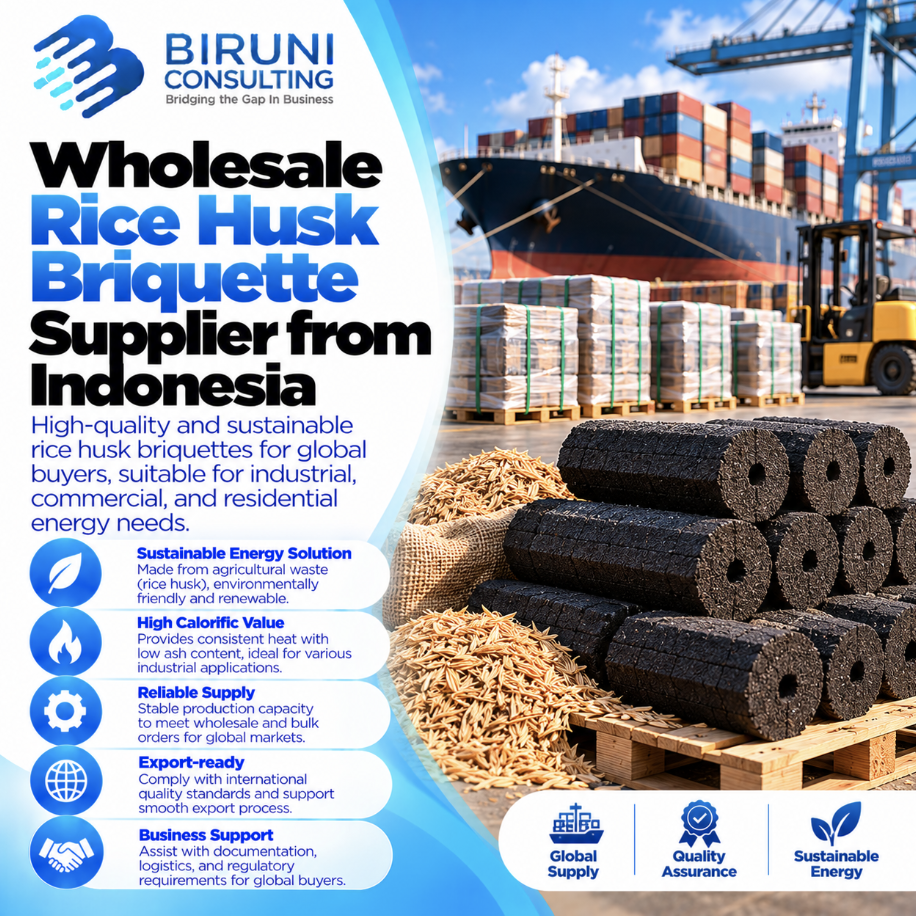
Sourcing Rice Husk Briquettes from Indonesia at Wholesale Scale
Indonesia’s agricultural and rice-milling activities generate rice husk that can be utilized as a biomass feedstock.
After drying, processing, and densification, loose rice husk can be converted into a compact solid fuel that is easier to store, handle, and transport.
Industrial users, importers, distributors, and biomass traders may therefore consider working with a wholesale rice husk briquette supplier from Indonesia for recurring bulk requirements.
Wholesale sourcing, however, involves more than finding the lowest price per metric ton.
Buyers should evaluate technical specifications, monthly supply capacity, raw-material security, quality control, packaging, logistics, and the supplier’s ability to maintain consistent performance over multiple deliveries.
International buyers should also consider export and documentation capability.
What Is a Rice Husk Briquette?
Rice husk briquettes are densified solid biomass fuels manufactured from rice husks generated during rice milling.
Loose rice husk has relatively low bulk density.
Briquetting compresses the material into a denser format that can be more practical for warehousing, transportation, inventory management, and industrial fuel handling.
Depending on manufacturing equipment, the product may be cylindrical, hexagonal, rectangular, or produced in other configurations.
Rice husk briquettes can be considered for compatible boilers, furnaces, dryers, biomass burners, and other thermal systems.
Rice Husk Briquettes as Non-Woody Biomass
Rice husk is an agricultural residue rather than woody biomass.
ISO 17225-7:2021 establishes quality classes and specifications for graded non-woody briquettes. Its scope includes herbaceous biomass, including cereal crops and by-products from food-production and processing industries. ISO
This distinction is important because rice husk briquettes should not automatically be expected to perform like wood pellets or wood briquettes.
Ash characteristics, mineral composition, volatile matter, and energy properties can differ substantially.
Why Purchase Rice Husk Briquettes Wholesale?
Wholesale purchasing is relevant where customers have recurring, relatively large fuel requirements.
An industrial boiler may consume several tons per day, while importers and distributors may require regular container shipments.
Predictable wholesale orders can help suppliers schedule raw materials, production, packaging, and deliveries more efficiently.
Buyers can also gain greater supply continuity compared with making repeated spot purchases.
These advantages depend on the supplier maintaining both consistent quality and sufficient quantity.
Industrial Applications
Rice husk briquettes may be considered for compatible steam boilers, biomass boilers, industrial dryers, certain furnaces, biomass burners, agricultural processing, food processing, and other industrial processes requiring heat or steam.
Technical compatibility should be verified before substantial purchases.
Fuel dimensions, feeding characteristics, calorific value, moisture, and ash behavior need to match the customer’s combustion equipment.
A good fuel specification alone does not guarantee suitable boiler performance.
Carbonized vs. Non-Carbonized Products
Buyers should identify the exact product being offered before comparing suppliers.
Non-Carbonized Rice Husk Briquettes
Rice husk is processed, dried, and densified without first being converted into charcoal.
More of the original biomass characteristics remain.
Carbonized Rice Husk Briquettes
Thermal treatment changes the characteristics of the fuel.
Carbonization can affect fixed carbon, volatile matter, moisture, ash, calorific value, and combustion behavior.
For this reason, carbonized and non-carbonized briquettes should not be compared solely on a price-per-ton basis.
Wholesale Rice Husk Briquette Specifications
Technical requirements should be agreed before a large order.
| Parameter | Information to Confirm |
|---|---|
| Raw Material | Rice husk or actual composition |
| Product Type | Carbonized / non-carbonized |
| Calorific Value | GCV and/or NCV |
| Moisture | Percentage and reporting basis |
| Ash | Percentage and reporting basis |
| Proximate Analysis | Volatile matter and fixed carbon |
| Density | According to test method |
| Dimensions | Diameter, length and shape |
| Physical Quality | Durability/fines where required |
| Packaging | Bag, big bag, jumbo bag or other format |
Procurement decisions should be based on actual supplier-product data rather than generic research values.
Calorific Value
Calorific value is one of the primary fuel specifications considered by biomass buyers.
The buyer should confirm whether the figure refers to Gross Calorific Value (GCV/HHV) or Net Calorific Value (NCV/LHV).
Reporting basis also matters.
Results may be expressed on an as-received, air-dried, or dry basis.
A value of 5,000 kcal/kg on a dry basis should not automatically be considered better than 4,500 kcal/kg on an as-received basis without accounting for moisture.
Wholesale contracts should clearly define the testing and reporting basis.
Moisture Content
Moisture affects useful fuel energy because part of the heat generated during combustion is required to evaporate water.
It can also influence product condition during long-term storage and transportation.
Briquettes should therefore be protected against rain and excessive humidity throughout manufacturing, warehousing, loading, transportation, and final storage.
Buyers may establish a maximum moisture requirement within the purchasing specification.
Ash Content
Ash is particularly important when evaluating rice-husk-based biomass.
Rice husk contains a different mineral profile from woody biomass.
For boiler operators, ash can influence cleaning frequency, residue management, maintenance, and total operating costs.
Where necessary, buyers may also request additional ash analysis to evaluate deposit, clinker, or ash-melting concerns.
Calorific value should therefore be reviewed together with ash performance.
Dimensions, Strength and Fines
Wholesale fuel needs to survive multiple handling stages.
Export cargo, for example, may move through production, packaging, trucking, container loading, ocean freight, unloading, warehousing, and boiler feeding.
Weak briquettes may break and generate excessive fines.
Buyers should confirm the physical dimensions required by their hoppers, conveyors, grates, or feeders and evaluate product strength during qualification.
Certificate of Analysis
A Certificate of Analysis or CoA can support technical evaluation.
It may include calorific value, moisture, ash, volatile matter, fixed carbon, and other agreed parameters.
Buyers should also verify sample identification, testing method, reporting basis, and test date.
For recurring transactions, buyer and supplier can agree whether a CoA will be issued for every shipment, batch, or defined sampling period.
What Is Considered a Wholesale Volume?
There is no universal threshold.
Some suppliers may accept orders of several metric tons, while industrial suppliers may use a truckload or full container as their MOQ.
For example:
20 MT/week × 4 weeks = approximately 80 MT/month.
Larger industrial buyers may require 250 MT, 500 MT, or more each month.
At these volumes, available capacity becomes more important than theoretical production capacity.
Production Capacity vs. Available Capacity
Suppose a manufacturer has installed capacity of:
1,000 MT/month.
If 750 MT is already committed to existing customers, only approximately:
250 MT/month
may be available for new contracts.
Wholesale buyers should therefore ask about actual production, existing commitments, available monthly capacity, and backup capacity.
This provides a more realistic picture of supply reliability.
Feedstock Security
A briquetting plant also needs reliable access to rice husk.
Buyers can evaluate the supplier’s rice-mill network, raw-material storage, seasonal availability, and backup sourcing.
For six- or twelve-month agreements, reliable feedstock can be just as important as briquetting-machine capacity.
A supplier unable to secure sufficient raw material may struggle to maintain contracted output.
Batch-to-Batch Consistency
One excellent shipment does not establish reliable wholesale supply.
The supplier should maintain agreed ranges for calorific value, moisture, ash, dimensions, density, and physical quality throughout recurring deliveries.
The purchasing agreement can define minimum or maximum specifications and the applicable testing method.
This prevents quality approval from depending solely on the initial sample.
Samples and Trial Orders
Large commitments should generally be preceded by product qualification.
A small sample can be used for physical inspection and laboratory testing.
A larger trial quantity can then be used for combustion testing.
For export buyers, a trial container provides additional information about packaging durability, fines after transportation, documentation quality, and actual boiler performance.
Regular monthly supply can follow after successful qualification.
Boiler Trial
A boiler trial provides information beyond laboratory specifications.
A practical evaluation can focus on:
- Fuel consumption and fuel-to-steam ratio.
- Steam output and combustion stability.
- Feeding performance.
- Ash quantity and condition.
- Cleaning requirements and total operating cost.
These results can be significantly more useful than comparing price or calorific value alone.
Wholesale Pricing
Wholesale rice husk briquette prices depend on product specification, product type, packaging, order quantity, supplier location, delivery frequency, testing requirements, and commercial terms.
For international shipments, port of loading and Incoterm also affect the quotation.
A detailed RFQ allows competing supplier quotations to be compared on equivalent technical and commercial terms.
Compare Total Fuel Cost, Not Only Price per Ton
A cheaper fuel per metric ton does not necessarily produce lower steam costs.
For example:
Supplier A
Price: IDR 3,000/kg
Consumption: 190 kg/ton steam
Cost: IDR 570,000/ton steam
Supplier B
Price: IDR 3,400/kg
Consumption: 160 kg/ton steam
Cost: IDR 544,000/ton steam
Supplier B is more expensive per kilogram but provides a lower fuel cost per ton of steam in this simplified illustration.
Actual results should be based on operational trials.
Total Cost of Use
Industrial buyers can evaluate:
Fuel Price + Logistics + Handling + Storage + Actual Consumption + Ash Handling + Maintenance + Downtime
This provides a more meaningful Total Cost of Use.
A higher-priced briquette can still be more economical if it reduces fuel consumption, ash-handling requirements, or operating interruptions.
Wholesale Packaging
Packaging should match the customer’s unloading, warehouse, and handling systems.
Options can include standard bags, woven polypropylene bags, big bags, jumbo bags, or palletized configurations.
For export orders, the buyer should specify net weight, bag material, labeling, moisture protection, and pallet requirements where relevant.
Packaging decisions can have a significant impact on the final quotation.
Container Loading
International buyers should request an estimated loading quantity.
Actual container payload depends on briquette density, packaging, palletization, container type, and relevant road, port, and shipping-line weight restrictions.
There is therefore no single net loading quantity that should be assumed for every shipment.
The buyer should distinguish between net product weight, gross cargo weight, and total container gross weight.
MOQ
MOQ varies by supplier.
Domestic industrial suppliers may define minimum quantities by tonnage or truckload.
For international shipments, full-container orders can be commercially more efficient because documentation, inland trucking, and port-handling costs are spread over a larger quantity.
New buyers may begin with samples or controlled trial shipments before moving to recurring full-container orders.
Ex-Factory, FOB, CFR and CIF
Commercial terms should be included in the RFQ.
An ex-factory quote generally reflects pricing at the supplier’s facility.
International shipments may be quoted under FOB, CFR, or CIF according to the agreed Incoterm and named port.
Instead of asking:
“Please quote 300 MT.”
a more useful request would be:
“Please quote 300 MT/month, FOB Tanjung Priok, packed in jumbo bags.”
This gives the supplier a clearer basis for pricing.
Export Readiness in Indonesia
International wholesale suppliers need administrative capability in addition to manufacturing capacity.
Indonesian Customs states that exporters or their authorized representatives generally submit a Pemberitahuan Ekspor Barang (PEB) with supporting customs documents. Applicable restrictions or licensing requirements may also be checked before export clearance is issued. Official Website Bea Cukai Kendari
Since August 3, 2026, specified supporting PEB documents must be uploaded electronically. Invoice and packing list are required with the initial submission, while a bill of lading or relevant transport document is also handled under the mandatory supporting-document procedure. Bea Cukai
For global buyers, export-document readiness should therefore form part of supplier qualification.
Export Documentation
Actual document requirements depend on product classification, destination country, and contractual terms.
A shipment may involve a commercial invoice, packing list, PEB, bill of lading, Certificate of Analysis, Certificate of Origin where applicable, and additional inspection or destination-specific documents.
Importers should verify requirements in their destination country before production and shipment are finalized.
Verify HS Classification
Rice husk briquettes should not automatically be assigned the same customs classification as wood briquettes simply because they have a similar physical form.
Classification needs to consider actual material composition, manufacturing process, and applicable tariff rules.
HS classification may affect customs declarations, duties, documentation, Certificate-of-Origin treatment, and other import requirements.
Exporter and importer should therefore resolve classification before recurring shipments begin.
Lead Time and Supply Planning
Wholesale lead time includes more than briquette production.
It can include raw-material preparation, drying, manufacturing, quality control, packaging, trucking, container positioning, and vessel scheduling.
Recurring buyers can improve supply reliability by providing a rolling forecast.
A three-month forecast, for example, gives the supplier greater visibility for reserving feedstock and production capacity.
Long-Term Wholesale Contracts
After successful qualification, buyer and supplier can establish a regular supply agreement.
Key commercial areas should include monthly volume and specification, price and Incoterm, delivery schedule, payment terms, and quality-control procedures for off-specification product.
For larger contracts, sampling and inspection procedures can also be agreed in advance.
This reduces uncertainty when shipments are tested or accepted.
Information to Include in a Wholesale RFQ
A practical RFQ can provide:
- Trial quantity and monthly volume.
- Destination and preferred Incoterm.
- Required calorific value, moisture, and ash.
- Dimensions and packaging.
- Intended application and delivery schedule.
- CoA or inspection requirements.
These details allow the supplier to determine technical suitability and production capacity before finalizing its commercial offer.
How to Select a Wholesale Rice Husk Briquette Supplier from Indonesia
Supplier qualification can be completed in several stages.
1. Verify the Product
Review technical data, CoA, raw material, dimensions, and physical samples.
2. Verify Capacity
Confirm actual production and available capacity for your required monthly volume.
3. Review Quality Control
Understand how raw materials, moisture, dimensions, production conditions, and finished products are controlled.
4. Conduct a Trial
Use an operational trial or trial shipment to verify actual performance.
5. Review Supply Performance
Assess quality consistency, communication, packaging, documentation, and shipment reliability before moving to a long-term agreement.
Manufacturer, Trader or Exporter?
Wholesale buyers may work with manufacturers, traders, or export aggregators.
Manufacturers produce the briquettes directly. Traders source products from other factories. Exporters or aggregators may coordinate several production sources while managing international logistics.
None is automatically superior.
The buyer should focus on quality consistency, available capacity, traceability, documentation, and delivery reliability.
For large contracts, understanding the actual production source can strengthen supply-chain risk management.
Red Flags When Selecting a Supplier
Caution is appropriate when a supplier cannot provide clear technical specifications, cannot explain available capacity, or frequently changes product data.
For international purchases, uncertainty around the manufacturer, packaging, Incoterms, export documents, or container loading can also indicate additional risk.
Extremely low pricing should be evaluated together with these factors.
A reliable supplier should communicate its capabilities and limitations clearly.
Monthly Wholesale Supply
Suppose a factory requires:
10 MT/day × 25 operating days = 250 MT/month.
A supplier ideally needs production capacity above that contracted volume to maintain some buffer for maintenance, raw-material variation, and production disruptions.
Where boiler fuel is critical to continuous production, buyers may also maintain a primary supplier and an approved backup supplier.
This can reduce the risk of fuel shortages interrupting operations.
Why Source Rice Husk Briquettes from Indonesia?
Indonesia’s rice-processing activities create potential access to rice-husk feedstock across multiple regions.
For wholesale buyers, the opportunity becomes commercially relevant when a supplier combines feedstock access with production capacity, quality control, warehousing, logistics, and recurring-delivery capability.
The best long-term supplier is therefore not necessarily the one offering the lowest initial quotation.
For industrial and global buyers, reliable specifications, monthly volume, communication, documentation, and delivery schedules are often more valuable.
Contact Us
Biruni Consulting can assist companies that require information and support regarding product requirements, documentation, and compliance processes related to product importation, marketing, or use according to business requirements in Indonesia.
The services that can be supported include:
- Consultation on product requirements for industrial needs.
- Initial assessment of product specifications and applications.
- Review of technical product documents and information.
- Consultation on applicable regulatory requirements and preparation of supporting documentation.
- Consultation on certification or licensing processes where required based on product characteristics and intended use.
Contact Biruni Consulting for information regarding product requirements, documentation, certification, and compliance needs to support business activities and product marketing in Indonesia.