
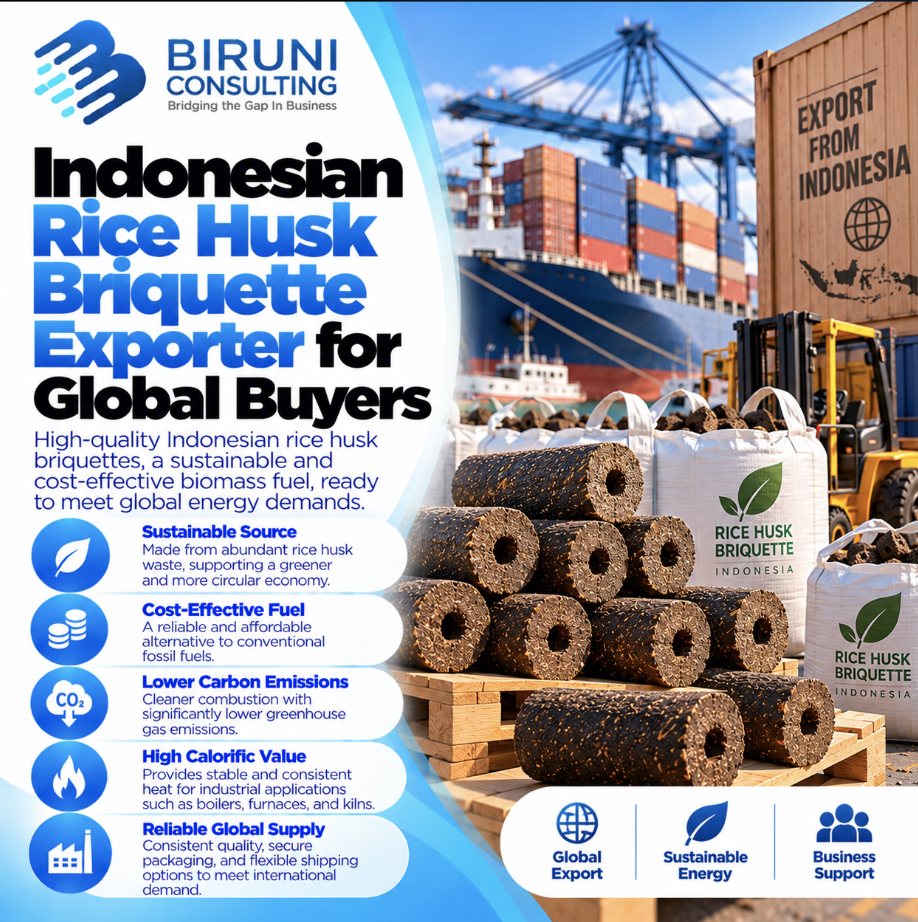
Indonesia as a Source of Rice Husk Briquettes
Indonesia’s rice-processing industry generates rice husk that can be used as an agricultural biomass feedstock.
Through drying, processing, and densification, loose rice husk can be transformed into briquettes that are more compact and practical for storage, handling, and transportation.
For international buyers, Indonesian rice husk briquettes may be considered as biomass fuel for boilers, furnaces, industrial dryers, biomass burners, and other compatible thermal-energy systems.
However, selecting an Indonesian rice husk briquette exporter requires considerably more than comparing the lowest FOB price.
Global buyers should evaluate:
- Technical specifications.
- Quality consistency.
- Production capacity.
- Available export capacity.
- Raw-material security.
- Packaging.
- Container loading.
- Quality-control procedures.
- Export documentation.
- Incoterms.
- Lead time.
- Long-term supply capability.
These factors determine whether a supplier can become a reliable international biomass partner.
What Is a Rice Husk Briquette?
A rice husk briquette is a densified solid biomass fuel manufactured primarily from rice husk generated during rice milling.
Instead of shipping the material in its lightweight loose form, the husk is processed and compressed into a denser physical shape.
Densification can make the product more practical for:
- warehousing,
- container loading,
- long-distance transportation,
- material handling,
- and inventory management.
Briquette shapes and dimensions vary according to production technology and customer requirements.
Rice Husk Briquettes Are Non-Woody Biomass Fuel
Rice husk is an agricultural residue rather than a woody feedstock.
This distinction is important for international fuel specifications.
ISO 17225-7:2021 establishes fuel-quality classes and specifications for graded non-woody briquettes. Its scope includes herbaceous biomass and by-products from cereal crops and food-processing industries.
Rice husk briquettes should therefore not automatically be evaluated using the same assumptions applied to wood briquettes or wood pellets.
Why Do Global Buyers Consider Rice Husk Briquettes?
Several characteristics can make the product relevant to international biomass buyers.
1. Agricultural-Residue Feedstock
Rice husk is generated as a by-product of rice milling.
Converting it into a fuel provides an additional utilization pathway for agricultural residues.
For industrial facilities diversifying their thermal-energy sources, rice-husk-based fuel can be considered alongside wood pellets, wood chips, palm kernel shells, and other solid biofuels.
2. Densified Fuel Form
Loose rice husk has relatively low bulk density.
Briquetting creates a denser product that can be more practical for long-distance trade.
Improved density can help utilize storage and shipping space more effectively compared with transporting loose husk.
3. Industrial Thermal Applications
Where combustion equipment is compatible, rice husk briquettes may be used for:
- Industrial boilers.
- Steam production.
- Furnaces.
- Industrial dryers.
- Biomass burners.
- Agricultural processing.
- Food processing.
- Process heating.
- Other compatible thermal applications.
Technical compatibility should always be confirmed before commercial-scale use.
Carbonized vs. Non-Carbonized Rice Husk Briquettes
International buyers should clarify which product type a supplier is offering.
Non-Carbonized Rice Husk Briquettes
Rice husk is generally prepared, dried, and densified without first being converted into charcoal.
The product retains more of the original biomass characteristics.
Carbonized Rice Husk Briquettes
The rice husk undergoes carbonization before briquetting.
Carbonization can change:
- calorific value,
- volatile matter,
- fixed carbon,
- moisture,
- ash,
- and combustion characteristics.
These products should not be compared solely by price per metric ton because they may behave very differently in industrial equipment.
Key Specifications for Global Buyers
Most serious industrial buyers require a technical data sheet before discussing a long-term supply agreement.
Important parameters may include:
| Parameter | Information to Confirm |
|---|---|
| Raw Material | Rice husk / full composition |
| Product Type | Carbonized / non-carbonized |
| GCV | Gross Calorific Value |
| NCV | Net Calorific Value where available |
| Moisture | Percentage |
| Ash | Percentage |
| Volatile Matter | Percentage |
| Fixed Carbon | Percentage |
| Density | Applicable unit |
| Dimensions | Diameter, length and shape |
| Binder | Type and percentage where used |
| Fines | Where specified by buyer |
| Packaging | Bags, jumbo bags or other format |
Values used for procurement should come from the actual product being supplied rather than generic research figures.
Calorific Value
Calorific value is typically one of the first specifications reviewed by an international biomass buyer.
However, the number cannot be evaluated correctly without understanding its basis.
The supplier should identify whether the result is:
GCV / HHV
or:
NCV / LHV.
The buyer should also verify whether it is reported on:
- an as-received basis,
- an air-dried basis,
- or a dry basis.
A dry-basis GCV should not be directly compared with an as-received NCV.
For international tenders, the reporting basis can be included explicitly in the purchasing specification.
Moisture Content
Moisture affects both useful fuel energy and storage performance.
Higher moisture means that more heat must be used to evaporate water during combustion.
For international shipments, moisture is also relevant because the briquettes may spend an extended period in packaging and containers during ocean transportation.
Exporters should therefore have procedures for controlling product condition before packaging and protecting the cargo from water during storage and container loading.
Ash Content
Ash is particularly important when evaluating rice-husk-based fuel.
International buyers should determine whether their combustion and ash-handling systems can manage the expected residue volume.
Ash can affect:
- Cleaning frequency.
- Ash-removal equipment.
- Maintenance.
- Residue management.
- Furnace operation.
- Deposit or clinker behavior under certain conditions.
A higher calorific value alone does not guarantee the best boiler performance.
Ash Chemistry
For technically demanding applications, the buyer may request more detailed ash analysis.
Mineral composition can help engineering teams assess potential:
- slagging,
- fouling,
- deposition,
- and ash-melting behavior.
The level of analysis required depends on the specific combustion technology and project.
Briquette Dimensions
Fuel dimensions can directly affect material handling.
The buyer should verify that the product can pass through its:
- hopper,
- conveyor,
- screw feeder,
- grate,
- or other feeding equipment.
An exporter can provide:
- Diameter.
- Average length.
- Dimensional tolerance.
- Shape.
- Product photographs.
- Packaging photographs.
Automatic feeding systems may require tighter dimensional consistency than manually fed systems.
Mechanical Strength and Fines
Export products must withstand a longer handling chain than many domestic shipments.
A typical journey may include:
production → handling → packaging → trucking → port → container loading → ocean freight → unloading → warehousing → boiler feeding.
Briquettes with poor mechanical strength may break during these stages and generate excessive fines.
Buyers may therefore specify:
- mechanical durability,
- maximum fines,
- breakage tolerance,
- or inspection after a trial shipment.
Certificate of Analysis
A serious global buyer should request a Certificate of Analysis or CoA for the proposed product.
Depending on the contract, the CoA may contain:
- Moisture.
- Ash.
- GCV.
- NCV where tested.
- Volatile matter.
- Fixed carbon.
- Sulfur where required.
- Chlorine where required.
- Density.
- Other agreed parameters.
A contract may also specify whether a CoA is required for every shipment, production batch, or specified sampling period.
Pre-Shipment Inspection
For larger international transactions, pre-shipment inspection can reduce commercial risk.
The inspection scope may include:
- Quantity.
- Weight.
- Packaging.
- Visual condition.
- Dimensions.
- Sampling.
- Moisture testing.
- Laboratory analysis.
- Container condition.
- Loading supervision.
Where required, buyer and seller can appoint an independent inspection company.
Representative Sampling
A small courier sample may not necessarily represent several hundred tons of regular production.
Long-term buyers should therefore discuss the sampling method.
Options may include:
- random samples from multiple bags,
- composite samples,
- sampling across several production batches,
- and samples collected during container loading.
The agreed sampling procedure can be written into the sales contract to reduce disputes.
Sample and Trial Process
A structured qualification process can include several stages.
Stage 1 – Small Sample
Used for:
- visual assessment,
- dimensional verification,
- basic laboratory testing.
Stage 2 – Larger Trial Quantity
Used for combustion tests or boiler trials.
Stage 3 – Trial Container
A commercial-size container shipment allows the buyer to evaluate:
- quality consistency,
- packaging,
- shipping performance,
- unloading,
- warehousing,
- and actual boiler performance.
Regular contracts can then be considered after successful qualification.
Boiler Trial
Laboratory testing indicates potential fuel characteristics.
A boiler trial demonstrates real operating performance.
International buyers can measure:
- Fuel consumption.
- Fuel-to-steam ratio.
- Ignition behavior.
- Furnace temperature.
- Steam output.
- Steam pressure.
- Ash generation.
- Ash condition.
- Clinker formation.
- Deposits.
- Cleaning requirements.
- Feeding stability.
- Total fuel cost.
The results provide a stronger basis for technical approval than calorific value alone.
Exporter Production Capacity
Large buyers should verify that a supplier can actually meet the requested volume.
Suppose the buyer requires:
500 metric tons per month.
A producer with nominal capacity of 700 MT/month may still be unable to supply 500 MT/month if most production is already committed to other customers.
Buyers can ask for information on:
- Installed production capacity.
- Actual monthly output.
- Available capacity.
- Current customer commitments.
- Number of briquetting lines.
- Production shifts.
- Warehouse capacity.
- Feedstock availability.
- Backup production arrangements.
- Expansion plans.
Raw-Material Security
Production machinery alone cannot guarantee supply.
The exporter also needs reliable access to rice husk.
A global buyer may ask about:
- number of supplying rice mills,
- feedstock locations,
- seasonal availability,
- raw-material inventory,
- warehouse capacity,
- backup suppliers,
- and incoming material quality controls.
Feedstock security becomes especially important for 6- or 12-month contracts.
Batch-to-Batch Consistency
International customers generally require more than one good container.
Fuel quality must remain consistent throughout the contract period.
Large variations in:
- moisture,
- ash,
- calorific value,
- dimensions,
- density,
- or durability
can change boiler performance.
A supply agreement can therefore define:
minimum specifications, maximum limits, tolerances, sampling methods, testing methods, and procedures for off-specification cargo.
Factory Quality Control
A capable exporter should be able to explain its quality-control process.
Raw Material Control
Possible checks include:
- moisture,
- contamination,
- foreign materials,
- feedstock source.
Production Control
Important controls can include:
- particle preparation,
- drying,
- briquetting pressure,
- dimensions,
- binder quantity,
- production temperature,
- process consistency.
Finished Product Control
Checks can include:
- dimensions,
- moisture,
- physical strength,
- fines,
- weight,
- packaging.
Laboratory Testing
Fuel testing may include:
- calorific value,
- ash,
- volatile matter,
- fixed carbon,
- and additional parameters required by the buyer.
Export Packaging
Packaging requirements should be agreed before production.
Options may include:
- Small bags.
- Woven polypropylene bags.
- Big bags.
- Jumbo bags.
- Palletized bags where required.
- Other industrial packaging configurations.
The buyer should specify:
- net weight per bag,
- gross weight,
- bag material,
- labeling,
- pallet requirements,
- and moisture protection.
Different packaging arrangements can significantly affect the final quotation.
Labeling Requirements
Buyers may require labels containing:
- product name,
- net weight,
- country of origin,
- manufacturer or exporter,
- batch number,
- production date,
- handling instructions,
- and other contract information.
Destination-country requirements should be checked before final packaging is printed.
Container Loading
A key export question is not simply price per metric ton but also:
How much net product can be safely loaded into one container?
Actual loading quantity depends on:
- product density,
- packaging,
- palletization,
- container type,
- cargo weight limits,
- shipping-line requirements,
- and road or port weight restrictions.
Exporters should provide an estimated loading quantity based on the proposed shipping configuration.
Buyer and seller should distinguish between:
- net product weight,
- gross cargo weight,
- and total container gross weight.
Container Inspection Before Loading
Briquettes should be protected from water and contamination.
Before loading, exporters can inspect whether the container is:
- Clean.
- Free of visible holes.
- Dry.
- Structurally suitable.
- Free from contaminants from previous cargo.
- Capable of closing and sealing correctly.
Photographs before, during, and after loading can support shipment records.
Incoterms
International quotations should clearly identify the applicable Incoterm and named location or port.
Common discussions may involve:
EXW
The buyer assumes logistics responsibilities relatively early in the transaction according to the agreed terms.
FOB
The seller handles the agreed export responsibilities up to the relevant stage at the port of shipment according to the applicable Incoterms rules.
CFR
The seller arranges ocean freight to the agreed destination port, while risk allocation follows the applicable Incoterms rules.
CIF
The quotation also includes insurance obligations within the scope of CIF.
A request such as:
“Please send best price”
is therefore incomplete.
A better request would be:
“Please quote FOB Tanjung Priok, Indonesia.”
or:
“Please quote CIF Port Klang, Malaysia.”
FOB Price Is Not the Same as Factory Price
FOB pricing can include several cost components.
A simplified structure may be:
Product + Packaging + Inland Transportation + Export Handling + Port Charges + Documentation + Other Agreed Costs
FOB price can therefore change depending on:
- production location,
- port of loading,
- packaging,
- volume,
- container configuration,
- and shipment schedule.
Indonesian Export Documentation
Commercial exports from Indonesia generally involve the Pemberitahuan Ekspor Barang (PEB) customs declaration.
Depending on the shipment, export documentation may include:
- Commercial Invoice.
- Packing List.
- PEB.
- Bill of Lading.
- Certificate of Origin where required.
- Certificate of Analysis.
- Inspection Certificate where contractually required.
- Other documents required by the destination country or transaction.
The exact requirements depend on product classification, destination, buyer requirements, and applicable regulations.
Certificate of Origin
Indonesia’s Surat Keterangan Asal (SKA) is the country’s Certificate of Origin system.
A preferential COO may support preferential tariff treatment under applicable trade arrangements, while a non-preferential COO can serve as evidence of origin where required for trade purposes.
The correct origin document depends on:
- destination country,
- HS classification,
- applicable trade agreement,
- rules of origin,
- and buyer requirements.
HS Classification Must Be Verified Carefully
Rice husk briquettes should not automatically be assigned the tariff classification used for wood briquettes simply because both products are densified fuels.
Classification should take account of:
- material composition,
- manufacturing process,
- physical characteristics,
- applicable Indonesian tariff rules,
- and the destination country’s customs treatment.
The exporter and importer should confirm the classification before shipment.
HS classification can affect:
- Customs declarations.
- Import duties.
- Restrictions or licensing requirements.
- Certificate-of-Origin treatment.
- Trade statistics.
- Destination-country compliance.
Destination-Country Requirements
Indonesian export clearance is only one part of the transaction.
The buyer must also check import requirements in the destination country.
Depending on the market, requirements can involve:
- import licensing,
- tariff classification,
- customs duties,
- biosecurity requirements where applicable,
- fumigation or treatment requirements where applicable,
- packaging regulations,
- fuel specifications,
- labeling,
- certificates,
- and customs documentation.
Buyer and exporter should resolve these requirements before final production and loading.
Payment Terms
International biomass contracts also need clear payment terms.
Possible structures may include:
- advance payment,
- partial advance and balance,
- payment before shipment,
- Letter of Credit,
- Documentary Collection,
- or another mutually agreed arrangement.
The appropriate structure depends on transaction size, commercial history, banking arrangements, destination-market risk, and the level of trust between the parties.
Minimum Order Quantity
MOQ can depend on:
- minimum production batch,
- packaging,
- inland trucking,
- container utilization,
- and fixed export-handling costs.
A trial order may therefore carry a higher unit price than a regular monthly contract.
The buyer should clarify whether the initial requirement is:
- sample only,
- partial commercial trial,
- one trial container,
- or regular monthly volume.
Lead Time
Production capacity does not automatically mean immediate shipment.
Lead time can include:
- Raw-material preparation.
- Production.
- Drying.
- Quality testing.
- Packaging.
- Inland trucking.
- Container positioning.
- Vessel schedule.
- Export documentation.
Long-term buyers can improve supply reliability by providing rolling forecasts and monthly shipment schedules.
Long-Term Supply Agreements
After a successful trial, buyer and exporter may consider a long-term supply agreement.
Commercial terms may cover:
- Monthly volume.
- Fuel specifications.
- Pricing mechanism.
- Incoterm.
- Payment terms.
- Packaging.
- Shipping schedule.
- Sampling.
- Inspection.
- Acceptance criteria.
- Off-specification procedures.
- Quantity tolerance.
- Force majeure.
- Contract duration.
Contracts should be adapted to the transaction and reviewed with appropriate professional advice where necessary.
Rice Husk Briquette Export Prices
There is no single export price applicable to every global buyer.
The quotation can depend on:
- Raw-material cost.
- Technical specification.
- Carbonized or non-carbonized product.
- Packaging.
- Order size.
- Monthly contract volume.
- Factory location.
- Port of loading.
- Inland freight.
- Export handling.
- Ocean freight under CFR/CIF.
- Insurance where applicable.
- Laboratory testing.
- Inspection requirements.
- Payment terms.
A buyer should therefore request a quotation using clearly defined technical and commercial requirements.
Information Global Buyers Should Provide When Requesting a Quote
A detailed RFQ can include:
- Destination country.
- Destination port.
- Initial volume.
- Monthly requirement.
- Trial quantity.
- Carbonized or non-carbonized requirement.
- Minimum calorific value.
- Maximum moisture.
- Maximum ash.
- Product dimensions.
- Packaging.
- Required Incoterm.
- Delivery schedule.
- Intended application.
- Boiler type where relevant.
- Required certificates.
- Inspection requirements.
- Preferred payment terms.
This provides a much stronger basis for a commercial quotation than simply asking for the lowest price.
How to Select an Indonesian Rice Husk Briquette Exporter
International buyers can use a staged qualification process.
Stage 1 – Company Screening
Review:
- legal company information,
- company profile,
- manufacturing or sourcing structure,
- export capability,
- communication details.
Stage 2 – Technical Screening
Request:
- technical data sheet,
- CoA,
- feedstock information,
- product photographs,
- dimensions,
- packaging specifications.
Stage 3 – Capacity Verification
Assess:
- production capacity,
- available monthly volume,
- raw-material sourcing,
- warehouse capacity.
Stage 4 – Sample Testing
Evaluate product samples independently where necessary.
Stage 5 – Trial Shipment
Import a controlled trial quantity or container.
Stage 6 – Supplier Performance Review
Assess:
- specification consistency,
- documentation,
- loading quality,
- communication,
- shipment timing,
- and actual boiler performance.
Stage 7 – Regular Supply Contract
Move to recurring monthly shipments once supplier performance has been demonstrated.
Exporter Red Flags
Global buyers should be cautious where a supplier:
- cannot clearly identify the feedstock source,
- cannot provide consistent technical specifications,
- quotes calorific value without identifying the test basis,
- cannot explain actual available capacity,
- promises volumes far beyond verifiable production,
- refuses reasonable sampling,
- changes specifications repeatedly,
- lacks a clear QC process,
- or provides inconsistent shipping information.
An unusually low price is not necessarily a good commercial opportunity when quality and delivery risks are high.
Manufacturer, Trader, or Export Aggregator?
International buyers should understand who is actually supplying the product.
Manufacturer
Produces the briquettes directly.
Trader
Purchases products from one or more manufacturers and resells them.
Exporter or Aggregator
May coordinate supplies from multiple factories and manage export logistics.
None of these structures is automatically superior.
The critical issue is whether the supplier can consistently deliver:
quality + quantity + documentation + reliable shipment performance.
For substantial contracts, buyers can request transparency regarding the actual supply chain.
Why Source Rice Husk Briquettes from Indonesia?
Indonesia’s agricultural and rice-processing activities can provide rice-husk feedstock across multiple producing regions.
For international buyers, this creates potential sourcing opportunities where feedstock availability is combined with:
- industrial briquetting capacity,
- quality control,
- reliable logistics,
- port access,
- export documentation,
- and recurring production.
The existence of abundant feedstock alone, however, does not guarantee that every exporter can fulfill industrial-scale international contracts.
Supplier qualification remains essential.
What Makes a Reliable Long-Term Export Partner?
A strong international supplier is not simply a company capable of shipping the first container.
A long-term exporter must maintain:
- Product specifications.
- Monthly production volume.
- Feedstock security.
- Quality control.
- Packaging quality.
- Documentation accuracy.
- Shipment schedules.
- Communication.
- Traceability.
- Commercial consistency.
For global industrial buyers, predictable performance over many shipments is generally more valuable than one exceptional shipment that cannot be repeated.
Contact Us
Biruni Consulting can assist companies that require information and support regarding product requirements, documentation, and compliance processes related to product importation, marketing, or use according to business requirements in Indonesia.
The services that can be supported include:
- Consultation on product requirements for industrial needs.
- Initial assessment of product specifications and applications.
- Technical document review.
- Review of product specifications and information.
- Consultation on applicable regulatory requirements according to the product type and business activities.
- Assistance in preparing required documents.
- Consultation on certification or licensing processes when required based on the product characteristics and intended use.
Contact Biruni Consulting for information regarding product requirements, documentation, certification, and compliance needs to support business activities and product marketing in Indonesia.