
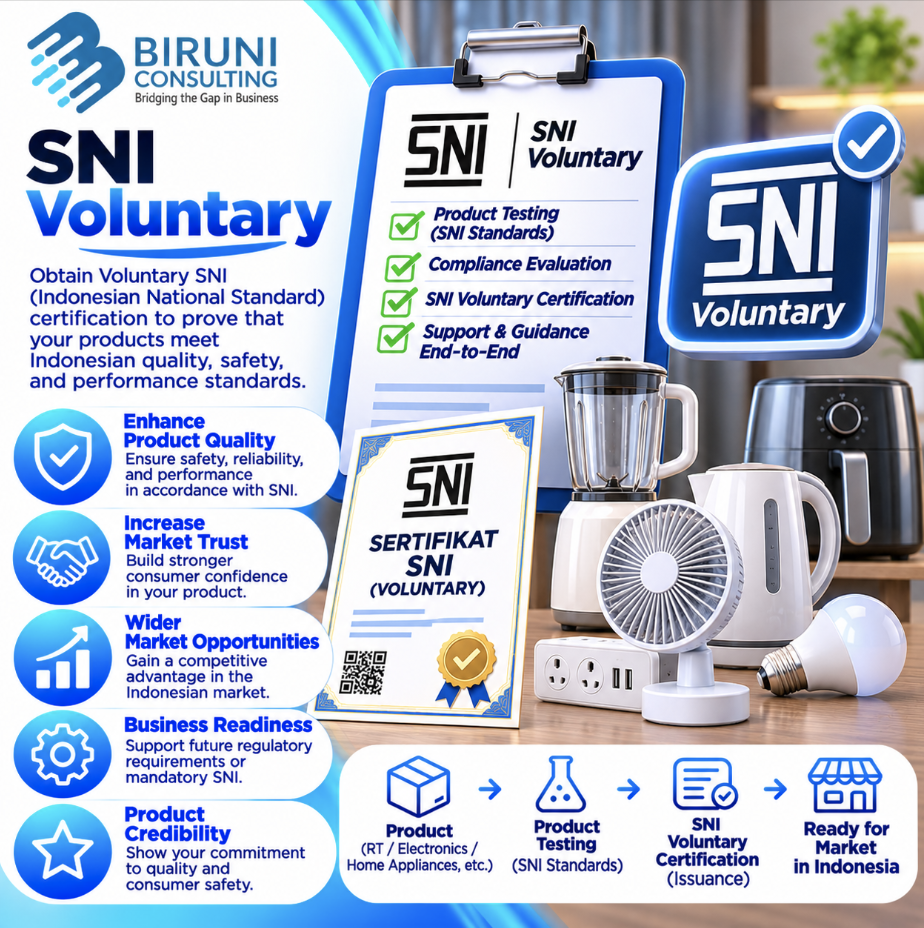
Guide to Voluntary SNI Application, Certification, SNI Marking, Product Certification Bodies, Testing, Product Families, and Imported Products
Voluntary SNI refers to the application of an Indonesian National Standard based on the needs of the party applying it where no technical regulation makes that standard mandatory for the relevant product scope. Businesses may use voluntary SNI to increase market confidence, demonstrate product quality or safety, satisfy customer or tender requirements, strengthen brand positioning, or establish a more structured quality-assurance framework.
Voluntary SNI application has a clear legal basis under Law No. 20 of 2014 concerning Standardization and Conformity Assessment. Articles 20–21 distinguish voluntary application from mandatory implementation and provide that parties capable of applying an SNI may seek certification from a conformity-assessment body accredited by KAN. The law remains in force. CRPG Law Database
These principles are further detailed in Government Regulation No. 34 of 2018 concerning the National Standardization and Conformity Assessment System, which also remains in force. The regulation confirms that SNI can generally be applied voluntarily according to need, while mandatory implementation occurs where requirements are established by a minister or the head of a non-ministerial government agency. CRPG Law Database
Before beginning voluntary SNI certification, companies should therefore identify the applicable standard, confirm its regulatory status and product scope, verify the availability of a conformity-assessment scheme and appropriately scoped certification body, and review the model list, product family, representative samples, and existing test evidence.
What Is Voluntary SNI?
Voluntary SNI is the application of an Indonesian National Standard based on the needs or decision of the party applying it rather than a technical regulation mandating that particular standard for the relevant product scope.
Government Regulation No. 34 of 2018 provides that SNI can be applied by businesses, government ministries or agencies, and regional governments according to their needs. The application can cover goods, services, processes or systems, and personnel. CRPG Law Database
Voluntary SNI is therefore not limited to physical products.
Businesses may consider standards for manufactured goods, services, systems, processes, or other conformity-assessment objects where relevant standards and schemes exist.
Difference Between Voluntary and Mandatory SNI
The principal difference is the legal basis of application.
Voluntary SNI is applied according to the needs of a business or other party. Mandatory SNI applies because the competent ministry or agency has issued a technical regulation requiring a standard for a defined scope. CRPG Law Database
| Aspect | Voluntary SNI | Mandatory SNI |
|---|---|---|
| Basis | Business or user need | Technical regulation |
| Initial status | Not required by the regulator for the relevant scope | Required for products within the scope |
| Certification | Pursued to formally demonstrate conformity | Must follow mandatory regulatory requirements |
| Certification body | Accredited body with appropriate scope | Regulatory designation may also be required |
| SNI Mark | Used after certification and marking approval | Subject to the mandatory scheme and regulation |
| HS Code | Can support classification but does not make voluntary certification mandatory | Frequently forms part of regulatory scope |
| Not applying | Normally not a violation of a mandatory-SNI requirement | Can restrict manufacture, importation, or market circulation according to regulation |
| Voluntary status therefore does not make the certification process informal. Once a company chooses formal certification and SNI marking, the applicable conformity-assessment requirements still need to be satisfied. |
Are SNI Standards Generally Voluntary?
Within Indonesia’s national system, SNI is applied voluntarily according to need unless a competent regulator makes an SNI or related requirements mandatory for a defined scope. Government Regulation No. 34 of 2018 expressly distinguishes voluntary application from mandatory implementation by a ministry or agency. CRPG Law Database
An official Ministry of Marine Affairs and Fisheries FAQ published in 2025 describes the same principle: businesses can voluntarily apply SNI and seek certification from a KAN-accredited conformity-assessment body, while mandatory implementation is established by government regulation for relevant public-interest purposes. E-PPID
A product should therefore not be treated as subject to mandatory certification merely because an SNI exists.
An Active SNI Is Not the Same as Mandatory SNI
An SNI with an active status remains a current Indonesian National Standard.
That status does not automatically indicate that the government requires certification for every associated product.
Mandatory status must be established from sector-specific regulations.
A standard can remain active and voluntary. Conversely, a regulator can make it mandatory only for particular ratings, HS classifications, applications, or constructions.
Assessment should therefore separate three questions: whether an SNI exists and remains active, whether a mandatory regulation exists, and whether the actual product falls within that regulation.
Does Voluntary SNI Have to Be Certified?
Voluntary application and voluntary SNI certification should be distinguished.
Law No. 20 of 2014 provides that parties capable of applying SNI may seek certification from a conformity-assessment body accredited by KAN. Government Regulation No. 34 of 2018 provides a corresponding mechanism and states that the accredited body issues certificates to applicants meeting the SNI requirements. CRPG Law Database
A company can therefore use an SNI internally as a technical reference without automatically holding an SNI certificate.
Where the company wishes to market the product as SNI-certified or use the SNI Mark, however, formal conformity assessment and applicable approval are required.
Why Do Companies Pursue Voluntary SNI?
Voluntary certification is generally driven by business needs.
A company may want independent evidence that a product meets a national standard, greater customer confidence, stronger quality positioning, or differentiation from competitors.
Certification can also become commercially important where a customer, project owner, distributor, marketplace, or tender requires conformity evidence even though the government has not made the SNI mandatory.
In such situations, something that remains voluntary under public regulation can effectively become a commercial or contractual requirement.
This is different from a government-mandated SNI.
Voluntary SNI for Tenders
Public or private tenders may establish specifications above minimum legal requirements.
Where tender documents reference an SNI, companies should determine whether they require technical compliance or a formal third-party certificate.
An internal test report may not be sufficient where a tender specifically requires certification.
Conversely, full certification should not automatically be commissioned before the tender wording is understood where technical compliance alone may be acceptable.
Voluntary SNI and Market Confidence
Third-party certification can demonstrate that a quality claim is not based solely on a manufacturer’s own declaration.
The conformity-assessment body evaluates requirements according to the applicable scheme.
For consumer products, certification can help customers understand that products have undergone a defined assessment process.
Marketing claims must nevertheless remain within the certificate scope. A certificate for one model or configuration should not be used to imply certification of unrelated products.
Voluntary SNI for New Products
New products that are not yet subject to mandatory regulation can still have relevant Indonesian standards.
Manufacturers can use these standards during product development.
This can support early decisions on materials, construction, performance targets, markings, and testing.
If the standard later becomes mandatory for a defined product scope, prior voluntary application can improve readiness. An existing voluntary certificate should nevertheless not automatically be assumed to satisfy a new mandatory scheme, because the regulation can introduce different applicant, testing, manufacturing, marking, or administrative requirements.
Who Can Apply Voluntary SNI?
Law No. 20 of 2014 and Government Regulation No. 34 of 2018 provide for voluntary application by businesses, ministries or non-ministerial government agencies, and regional governments. CRPG Law Database
For commercial certification, eligible applicants can depend on the conformity-assessment scheme.
Manufacturers, brand owners, or other parties may have defined roles depending on the product.
For OEM and imported products, applicant and certificate-holder eligibility should therefore be confirmed from the scheme rather than assumed from the commercial relationship.
What Is a Conformity Assessment Body?
A conformity-assessment body performs conformity-assessment activities.
For voluntary SNI, Indonesian law and regulation specifically refer to certification through a body accredited by KAN. CRPG Law Database
Different types of bodies can participate depending on the required activity, including certification bodies, testing laboratories, and inspection bodies.
Product-certification projects generally involve a Product Certification Body or LSPro.
What Is an LSPro?
An LSPro or Product Certification Body conducts product certification within defined schemes and scopes.
An LSPro does not automatically certify every SNI.
It needs competence and the relevant certification scope. SNI ISO/IEC 17065:2012 concerning requirements for bodies certifying products, processes, and services remains active in the BSN catalogue. Pesta
Companies should therefore identify the product and applicable SNI before requesting certification quotations.
Role of KAN
KAN or the National Accreditation Committee forms an important part of the accreditation framework for conformity-assessment bodies.
For voluntary SNI, the law and Government Regulation No. 34 of 2018 expressly refer to certification by KAN-accredited conformity-assessment bodies. CRPG Law Database
Companies do not generally submit product-certification applications directly to KAN.
They apply through an appropriately scoped certification body, while KAN provides accreditation of conformity-assessment competence.
Conformity Assessment Schemes
Identifying an SNI number is not sufficient to begin a certification project.
Companies also need an applicable Conformity Assessment Scheme.
BSN Regulation No. 9 of 2023 concerning procedures for developing SNI conformity-assessment schemes remains in force. It provides that schemes can include reference requirements, administrative procedures, conformity-assessment activities, evidence of conformity, and supervision by conformity-assessment bodies. Database Peraturan | JDIH BPK
Different voluntary standards can therefore have different certification procedures.
Can Every Active SNI Be Immediately Certified?
Not necessarily in practical terms.
An active standard may exist, while businesses still need to establish whether an applicable conformity-assessment scheme and appropriately scoped body are available.
BSN Regulation No. 9 of 2023 confirms that schemes establish the methods used to demonstrate conformity and can be developed for goods, services, systems, processes, or personnel according to relevant characteristics. Database Peraturan | JDIH BPK
A feasibility review should therefore examine the SNI, applicable scheme, and certification-body scope before certification timing and cost are committed.
SNI Marking under Voluntary Certification
Obtaining a certificate does not permit uncontrolled use of the SNI Mark.
Government Regulation No. 34 of 2018 provides that businesses receiving certification use the SNI Mark and/or conformity mark after obtaining approval for use of the mark. For voluntary SNI, that approval is provided by BSN. CRPG Law Database
BSN Regulation No. 2 of 2017 concerning procedures for use of the SNI Mark and SNI-based conformity marks also remains listed as in force. Database Peraturan | JDIH BPK
Businesses should therefore avoid printing the SNI logo on mass-production goods simply because laboratory testing has been completed.
The SNI Mark Cannot Be Used Outside the Certified Scope
Businesses cannot use the SNI Mark or SNI number outside certificate conditions.
Government Regulation No. 34 of 2018 also prohibits continued use where a voluntary certificate has expired, been suspended, or been revoked. CRPG Law Database
Law No. 20 of 2014 contains the same principle regarding expired, revoked, or suspended voluntary certificates. CRPG Law Database
Certification maintenance therefore remains important even though the underlying SNI application is voluntary.
Voluntary Certification Is Not Self-Declaration
A company may accurately state that its internal design references an SNI where that claim is not misleading, but SNI-certified carries a different meaning.
Certification involves third-party conformity assessment by a competent body.
Internal testing, supplier declarations, or laboratory reports therefore do not necessarily create a right to claim formal SNI certification.
Product marketing, packaging, and catalogues should use terminology corresponding to the actual certification status.
Testing for Voluntary SNI
Testing depends on the standard.
Electrical products can require insulation, electric-strength, temperature-rise, abnormal-operation, mechanical, and electric-shock-protection tests.
Materials can require chemical composition, dimensions, tensile strength, durability, or performance testing.
Food, textiles, machinery, and other sectors use different test parameters.
Testing cost and timing therefore cannot be established simply from the phrase “voluntary SNI”.
Existing Test Reports
Manufacturers may already hold IEC, ISO, ASTM, EN, JIS, CB, CE-related, or other laboratory reports.
These should be collected during initial assessment.
Where an SNI adopts or closely follows the same international standard, existing evidence can support a gap assessment.
Acceptance for certification nevertheless depends on the scheme, certification body, standard edition, laboratory competence, model coverage, and technical differences.
Existing reports should not automatically be assumed to replace SNI testing.
Product Family
Companies frequently seek to include several models in one certification project.
This requires product family assessment.
Family criteria depend on the product and can include materials, ratings, voltage, power, construction, circuits, enclosures, dimensions, critical components, manufacturing processes, or additional functions.
Different colors may use identical technical construction, while externally similar models can have materially different internal components.
Family grouping should therefore be based on technical configuration rather than series names.
Representative Samples
Representative samples are selected after family assessment.
The highest-capacity or highest-wattage product is not necessarily always the only required sample.
Critical conditions depend on the applicable standard.
Thermal conditions may be critical for an electrical product, composition or thickness for a material, and dimensions or loading for mechanical products.
Sample selection should therefore be completed before products are sent to a laboratory.
Factory Audit or Production Evaluation
Some product-certification schemes include manufacturing-process evaluation.
The objective is to verify that mass production remains consistent with the evaluated product.
Assessment can include incoming inspection, supplier controls, manufacturing processes, testing equipment, calibration, final inspection, traceability, nonconforming-product control, and engineering changes.
Not every voluntary SNI automatically requires an identical factory audit.
The applicable certification scheme determines the method.
Is ISO 9001 Mandatory?
There is no general rule requiring ISO 9001 for every voluntary SNI certification.
An ISO 9001 certificate can provide useful management-system evidence, but the product-certification scheme can establish its own manufacturing controls.
Companies should therefore not obtain ISO 9001 solely because they assume every SNI certificate requires it.
Voluntary SNI for Imported Products
Imported products can pursue voluntary SNI certification where an applicable standard, conformity-assessment scheme, and applicant structure are available.
Country of origin does not prevent voluntary application.
Manufacturers in China, Vietnam, Thailand, Malaysia, South Korea, Japan, India, Europe, the United States, and other markets can have products corresponding to Indonesian standards.
Applicant structure, certificate holder, factory assessment, brands, and authorization arrangements nevertheless need scheme-specific review.
Assessment should ideally take place before mass production and shipment.
Is Voluntary SNI an Import Requirement?
Not automatically.
Where an SNI has genuinely not been made mandatory for the relevant product and scope, voluntary certification does not become an import requirement merely because the standard exists.
Other import regulations can nevertheless still apply.
HS Codes can be associated with quality-policy requirements, registrations, permits, or other sectoral controls independent from voluntary SNI.
Companies therefore need to distinguish SNI certification requirements from import requirements.
Voluntary SNI and HS Codes
An HS Code does not make voluntary SNI certification mandatory by itself.
It remains useful during regulatory assessment because it can help identify whether a mandatory regulation has been overlooked.
Before concluding that an SNI is voluntary, businesses should review the technical product description, HS classification, sector regulator, and current mandatory regulations.
This is particularly important for broad commercial descriptions such as lighting, chargers, sockets, machinery, household appliances, and chemical products.
Voluntary SNI and NPB
The Goods Registration Number or NPB is a separate quality-policy instrument for covered products and is not the same as an SNI Certificate.
Where a product falls within an NPB quality-policy scope, that requirement needs separate assessment.
A voluntary SNI status should not automatically be interpreted as meaning no NPB or other requirement can apply.
Conversely, the existence of NPB for another category does not make every SNI mandatory.
Product and HS classification need to be assessed specifically.
Voluntary SNI for OEM and Private-Label Products
An OEM factory may produce the same platform for several brands.
Voluntary certification can potentially cover one or more brands where the scheme permits, but the certificate scope and authorization structure need to be correct.
Companies should not simply replace labels after certification without assessment.
Brand, manufacturer, factory, model, applicant, and certificate holder need to remain consistent with the scheme and certificate.
Private-label strategy should therefore be planned before application.
Voluntary SNI for MSMEs
Micro, small, and medium enterprises can also apply voluntary SNI where relevant standards exist.
Conformity-assessment schemes can take the conditions of micro and small enterprises into account. BSN Regulation No. 9 of 2023 provides that scheme implementation for micro and small enterprises can consider business scope and location, number of personnel, nonconformity risk, and complexity of production or services. Database Peraturan | JDIH BPK
The technical requirements of the SNI nevertheless remain relevant.
Scheme facilitation does not mean product quality or safety requirements are ignored.
Voluntary SNI for Electrical Products
Many active electrical standards are not mandatory for every possible product.
Special luminaires, electronic controls, appliances, components, and accessories can have applicable SNI standards even where the mandatory regulatory scope is narrower.
The relevant sector regulation needs to be reviewed before voluntary status is concluded.
For products using WiFi, Bluetooth, Zigbee, or other radio technologies, voluntary electrical SNI also does not remove telecommunications-device certification obligations where applicable.
Voluntary SNI for Industrial Products
Steel, textiles, machinery, construction materials, chemicals, rubber products, foods, and other industrial goods can also have voluntary SNI standards.
Many of these sectors contain a mixture of mandatory standards and standards that remain voluntary.
Assessment therefore needs to reach the level of product, grade or type, technical parameters, HS Code, and applicable regulation.
Old general lists should not be the sole basis for determining current mandatory status.
Voluntary SNI Can Become Mandatory
Regulatory status can change.
A standard that is voluntary today can later be made mandatory for a defined product scope.
Law No. 20 of 2014 and Government Regulation No. 34 of 2018 establish the distinction and mechanisms between voluntary application and mandatory implementation. CRPG Law Database
Where a new mandatory regulation is issued, companies should conduct a gap assessment against the new certification scheme.
An older voluntary certificate should not automatically be assumed to satisfy every requirement of the new mandatory framework.
Is a Voluntary Certificate “Lower” Than a Mandatory Certificate?
It is not accurate to describe one as inherently higher or lower.
Both can use an SNI as the technical reference, while the legal basis and certification schemes differ.
Voluntary certification can still involve significant testing, production evaluation, surveillance, and technical evidence.
The principal distinction is whether government regulation requires the application for the product scope or the company chooses it according to its needs.
Validity of a Voluntary SNI Certificate
There is no universal validity period applying to every voluntary SNI certificate.
Certification cycles, surveillance, renewal, and recertification depend on the applicable scheme and certification body.
Companies need to review their certificate and scheme requirements.
Government Regulation No. 34 of 2018 provides that the SNI Mark or conformity mark cannot continue to be used when a voluntary certificate has expired, been revoked, or been suspended. CRPG Law Database
Certificate validity should therefore be included in a company’s compliance calendar.
Voluntary SNI Surveillance
Voluntary certification does not necessarily end when the initial certificate is issued.
Where a scheme uses surveillance, certification bodies can conduct periodic factory, product, documentation, or sample assessment.
Companies need to maintain the production configuration covered by certification.
Approved-component lists, raw-material specifications, supplier data, quality records, test results, and engineering-change histories should be properly controlled.
Product Changes After Certification
Suppliers can change materials, components, factories, formulations, ratings, PCBs, motors, drivers, cables, resins, packaging configurations, or manufacturing processes.
Such changes can affect conformity.
Companies should therefore maintain a change-control procedure.
Significant changes should be assessed with the certificate holder and certification body before entering mass production.
Voluntary certification still requires production consistency after certification.
Adding Models
A new model does not automatically fall under an existing certificate.
Product-family assessment needs to be updated.
Where an additional model uses the same technical platform and remains within family criteria, an additional assessment route may be possible.
Substantially different construction can require additional samples, testing, or separate certification.
Companies with extensive product roadmaps should plan family structures early.
Changing the Factory
A new manufacturing facility can change production even where drawings and brands remain identical.
Suppliers, equipment, tooling, quality controls, material handling, and final inspection can differ.
Where the certification scheme links a certificate to a manufacturing facility, factory changes need to be reported and assessed.
Manufacturers using several facilities should therefore identify the intended factory before certification begins.
Documentation to Prepare
Documentation depends on the product, but initial assessment needs enough information to identify the standard, product family, and scheme.
Useful documents include product catalogues, datasheets, model lists, photographs, technical drawings, material or critical-component information, label artwork, manuals, manufacturer and factory information, existing test reports, and brand or authorization documentation where necessary.
Complete documentation helps prevent testing of unsuitable representative models.
Voluntary SNI Certification Process
The first step is to establish the technical product name and intended use. The potentially applicable SNI is then identified and checked to confirm whether it remains voluntary or has already become mandatory for some part of the product scope.
Once regulatory status is confirmed, the company verifies the available conformity-assessment scheme and appropriately scoped certification body.
The model list is then analyzed through product-family assessment and representative samples are selected.
Technical documentation and samples are prepared for testing and other conformity-assessment activities. Where the scheme includes manufacturing evaluation, the factory is prepared accordingly.
After requirements are fulfilled and a certification decision is made, use of the SNI Mark or other conformity marks follows the applicable approval procedure. CRPG Law Database
How Long Does Voluntary SNI Certification Take?
There is no universal processing period.
Timing depends on document readiness, number of models, family complexity, test duration, laboratory capacity, sample availability, manufacturing location, audit requirements, corrective action, and certification review.
A realistic timeline can therefore only be prepared after an initial assessment.
How Much Does Voluntary SNI Certification Cost?
Cost also depends on project scope.
Components can include certification applications, laboratory testing, sampling, manufacturing evaluation, auditor travel where required, number of families, additional testing, and surveillance.
A straightforward single model can have a very different cost structure from a series containing dozens of models and several manufacturing facilities.
Quotations should therefore follow review of the datasheet, product list, applicable standard, and factory.
Common Mistakes
One mistake is assuming an active SNI is automatically mandatory.
Another is assuming voluntary SNI means that self-declaration is sufficient for formal certification.
Companies may also send samples before product-family and representative-model assessment.
Existing IEC or ISO reports are sometimes assumed to be automatically acceptable without scheme review.
Another common mistake is printing the SNI Mark before certification and marking approval have been completed.
For imported goods, companies should not wait until mass production or shipment before checking whether a supposedly voluntary SNI has actually become mandatory for the relevant product scope.
Why Is Voluntary SNI Pre-Assessment Important?
Voluntary certification should create business value rather than become an unnecessary administrative exercise.
Pre-assessment helps determine whether certification is relevant, which standard applies, whether an appropriate scheme exists, which certification body has the required scope, which models can be grouped, which tests are required, and which existing reports may be useful.
It also helps confirm that a standard assumed to be voluntary has not already become mandatory for part of the product scope.
For imported or OEM products, assessment should ideally occur before mass production and shipment, allowing manufacturers to adjust construction, materials, labels, components, brands, and documentation where necessary.
Contact Us
Biruni Consulting assists companies with Voluntary SNI assessment and certification, including standard identification, mandatory or voluntary status assessment, product family assessment, testing, and certification assistance.
Our services include:
- Consultation on Voluntary SNI status and assessment of potential mandatory-SNI requirements.
- Identification of SNI numbers, standard scope, product specifications, HS Codes where relevant, and product lists.
- Assessment of conformity-assessment scheme availability, certification bodies, laboratories, and certification routes.
- Review of technical documentation, existing IEC/ISO/CB Test Reports, labels, critical components, manufacturers, and factories.
- Product family assessment, representative-sample selection, and preparation for factory evaluation where required.
- Testing, corrective-action, Voluntary SNI certification, surveillance, and SNI Mark assistance.
Contact Biruni Consulting for information regarding Voluntary SNI certification services, Voluntary SNI applications, Indonesian standard consultation, SNI testing, SNI product families, imported-product SNI Certificates, and SNI Mark requirements according to your product type, brand, model, specifications, HS Code, factory, and country of origin.