
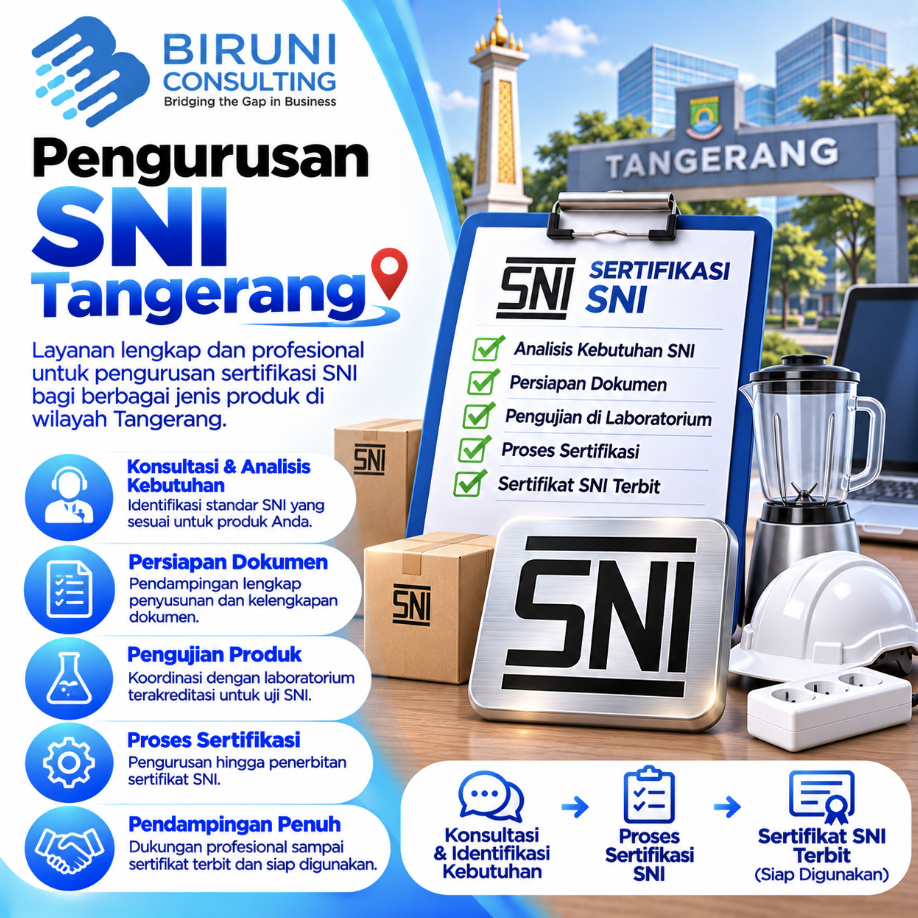
SNI Consultation, Product Testing, Product Family Assessment, Factory Evaluation, and Certification Assistance in Tangerang
SNI certification services in Tangerang assist manufacturers, importers, brand owners, distributors, and other businesses in identifying and meeting Indonesian National Standard requirements for their products. The process can include standard identification, mandatory or voluntary SNI assessment, regulatory review, product family assessment, documentation preparation, certification-body and laboratory selection, product testing, factory audit or production evaluation, certification, and ongoing compliance management.
Indonesia’s general standardization framework includes Law No. 20 of 2014 concerning Standardization and Conformity Assessment and Government Regulation No. 34 of 2018 concerning the National Standardization and Conformity Assessment System. Government Regulation No. 34 of 2018 remains in force and forms part of the national framework for SNI implementation and conformity assessment. Database Peraturan | JDIH BPK
SNI certification should not begin simply by sending a product to a laboratory. Companies should first establish the applicable SNI, mandatory or voluntary status, regulatory scope, HS Code where relevant, product family, factory, model list, representative samples, and certification scheme.
For businesses located in Tangerang City, Tangerang Regency, South Tangerang, and the wider Tangerang area, an early assessment can reduce the risk of selecting the wrong standard, testing unsuitable samples, repeating tests, or modifying products after mass production.
What Is the SNI Certification Process?
SNI certification is a conformity-assessment process used to demonstrate that a product or other object meets the applicable Indonesian National Standard.
For product certification, activities can include regulatory assessment, documentation review, sampling, laboratory testing, production-process evaluation, certification review, and surveillance.
The same process does not apply identically to every product. Conformity-assessment schemes are developed according to the product and SNI application requirements. BSN Regulation No. 9 of 2023 provides the framework for preparing SNI conformity-assessment schemes. Database Peraturan | JDIH BPK
“SNI certification” should therefore not be understood as simply registering one document. The correct standard and certification scheme need to be identified first.
SNI Services in Tangerang
Biruni Consulting provides SNI assistance for businesses across Greater Tangerang, including Tangerang City, Tangerang Regency, and South Tangerang.
Services can support local manufacturers, trading companies, importers, distributors, foreign-investment companies, brand owners, and businesses using OEM or contract manufacturing.
For imported products, assessment should ideally begin while products are still being sourced and before mass-production purchase orders and shipments are issued.
For local manufacturers, early assessment can help identify required changes before tooling, materials, packaging, or large-volume production has been finalized.
Is SNI Mandatory for Every Product?
No.
The existence of an SNI does not automatically mean that every product associated with that standard requires mandatory certification.
Law No. 20 of 2014 establishes the framework under which competent ministries and agencies can make particular SNI standards mandatory through technical regulations. Companies therefore need to distinguish between an available or active SNI and an SNI made mandatory for a defined product scope. Database Peraturan | JDIH BPK
Products outside mandatory scope may in certain circumstances pursue voluntary certification where an applicable standard and conformity-assessment scheme are available.
The first stage of an SNI project should therefore be a mandatory-SNI assessment.
Mandatory SNI
Mandatory SNI applies where the competent ministry or regulator has issued a technical regulation making a particular standard mandatory for a defined product scope.
The obligation may not be based solely on the commercial product name.
HS Code, voltage, wattage, capacity, size, materials, construction, intended use, and other technical characteristics can determine regulatory coverage.
A product category may, for example, be mandatory only within specified ratings or construction parameters.
Technical datasheets are therefore important during initial regulatory assessment.
Voluntary SNI
SNI can also be applied voluntarily where it has not been made mandatory.
Businesses may consider voluntary certification to demonstrate conformity, support tenders, provide quality assurance to customers, or strengthen product positioning.
Voluntary certification nevertheless remains a formal conformity-assessment process.
A company cannot properly market a product as SNI-certified merely because it has reviewed the standard or performed internal testing.
An Active SNI Is Not Automatically Mandatory
A common certification mistake is finding an SNI in the BSN catalogue and assuming that certification is mandatory.
An active standard does not by itself establish a regulatory certification obligation.
The competent ministry’s technical regulation needs to be reviewed.
Assessment should therefore answer three separate questions:
- Does an active SNI exist for the product?
- Has that SNI been made mandatory?
- Does the actual product fall within the mandatory regulatory scope?
Separating these issues helps prevent companies from pursuing an inappropriate certification route.
SNI Certificate
The term SNI Certificate is commonly used to refer to the certification document demonstrating conformity with the applicable SNI and certification scheme.
Law No. 20 of 2014 regulates certification and conformity-assessment activities within Indonesia’s national standardization system. Database Peraturan | JDIH BPK
A certificate should not be treated as an administrative document separated from the product itself.
Models, brands, manufacturers, factories, and technical scope need to remain consistent with the products manufactured and marketed.
Post-certification changes can require further assessment.
What Is an LSPro?
An LSPro is a Product Certification Body performing product certification according to an applicable conformity-assessment scheme and within its approved scope.
Companies should not select a certification body solely on price or location.
It is more important to confirm that the LSPro has an appropriate scope for the relevant product and SNI number.
Mandatory product regulations can also impose additional requirements concerning conformity-assessment bodies.
LSPro selection should therefore follow standard mapping rather than precede it.
KAN’s Role
KAN, the National Accreditation Committee, performs the national accreditation function for conformity-assessment bodies.
Competence of conformity-assessment bodies is an important part of Indonesia’s standardization framework for ensuring reliable testing, inspection, and certification. Law No. 20 of 2014 provides the legal basis for this national accreditation and conformity-assessment framework. Database Peraturan | JDIH BPK
Companies generally do not submit their product-certification applications directly to KAN.
Certification applications are made through an appropriately scoped LSPro.
Product Assessment Before Certification
Product assessment should identify the technical product name, function, construction, ratings, materials, models, intended use, manufacturing facility, and standards already used by the manufacturer.
Imported products may already have CE documentation, CB Certificates, IEC reports, UL reports, TÜV reports, or certifications from other markets.
These documents can support assessment but do not automatically replace Indonesian SNI requirements.
Existing reports should ideally be reviewed before the company decides which samples to test.
Product Family Assessment
Manufacturers frequently have many models with similar external designs.
Products may differ in wattage, voltage, dimensions, materials, color, pole configuration, capacity, or another characteristic.
Not every model necessarily requires a completely independent certification project, but models cannot automatically be grouped simply because they look alike.
Product family assessment determines which models share an appropriate technical platform and which representative samples should be selected.
Family criteria depend on the product and applicable standard.
The complete model list should therefore be reviewed before testing samples are selected.
Representative Samples
A representative sample is selected to represent one or more models within a product family.
The product carrying the highest rating is not necessarily the only critical sample.
Depending on the standard, different construction, materials, or ratings can create different critical conditions.
More than one sample may therefore be required.
Proper sample selection can reduce the risk of discovering after testing that the original sample does not cover the intended model range.
SNI Testing
Laboratory testing forms an important part of many product-certification schemes.
Testing parameters depend on the applicable SNI.
Electrical products may be tested for insulation, electric strength, temperature rise, protection against electric shock, mechanical strength, abnormal operation, wiring, terminals, earthing, and other characteristics.
Non-electrical products can require material, composition, dimensional, mechanical, chemical, performance, or other tests.
Testing requirements therefore cannot be determined solely from a product’s commercial name.
Laboratory Selection
The laboratory needs appropriate competence and test scope for the required methods.
Under some schemes, the certification body determines or approves which laboratories may be used.
Companies should therefore avoid independently conducting testing and assuming that the resulting report will automatically be accepted for certification.
Existing reports should first be reviewed to establish whether they can be accepted or whether additional or new testing is required.
Factory Audit or Production Evaluation
Many product-certification schemes include evaluation of the factory’s ability to consistently manufacture conforming products.
The evaluation can cover incoming materials, production control, equipment, calibration, testing, final inspection, traceability, control of nonconforming products, quality records, and engineering changes.
Not every product uses the same factory-audit format.
The applicable certification scheme determines the production-evaluation requirements.
Manufacturers in Tangerang should therefore prepare their factory documentation early where production assessment applies.
SNI Certification for Tangerang Manufacturers
Manufacturers operating factories in Tangerang should ensure that certification samples are representative of mass production.
Factories should control raw materials, suppliers, critical components, production processes, inspections, testing, and engineering changes.
Special samples prepared only for certification but differing from normal mass production can create problems during later surveillance.
SNI certification should therefore involve engineering, purchasing, quality assurance, production, and regulatory teams where appropriate.
SNI Certification for Tangerang Importers
Importers have a different certification challenge because manufacturing takes place overseas.
They need sufficient technical documentation from their suppliers.
Manufacturer name, factory address, model lists, datasheets, drawings, component information, labels, existing reports, and quality documentation may be required.
Where factories are located in China, Vietnam, Thailand, Malaysia, South Korea, Japan, India, Europe, or elsewhere, overseas production evaluation should also be planned where required by the applicable scheme.
SNI Certification for Products from China
Many Tangerang businesses source products from China.
Chinese suppliers frequently have CE documentation, CB reports, CCC or CQC certificates, IEC reports, or international laboratory reports.
These can support initial assessment but do not automatically constitute Indonesian SNI certification.
Standard edition, models, factories, critical components, and testing scope need to be compared.
Assessment should ideally be completed before a mass-production purchase order is issued so that labeling, components, materials, or construction can still be modified if necessary.
SNI for OEM Products
OEM factories frequently produce the same platform for multiple brands.
Certification assessment should identify the manufacturer, factory, brand owner, applicant, certificate holder, importer, and distributor.
One manufacturing facility does not automatically mean that every brand can use one certificate.
Additional-brand arrangements depend on the applicable scheme.
Brand structure should therefore be planned before labels and packaging enter production.
Private-Label Products
Private-label companies also need to consider regulatory ownership.
The brand appearing on a product needs to remain consistent with the applicable certification and registration documentation.
Companies should not simply use a supplier’s certificate for a new brand without confirming that the scheme permits that arrangement.
Businesses seeking greater control over their brand and certification should establish this structure early in their relationship with the OEM manufacturer.
HS Code and SNI
For some mandatory products, technical regulations use HS Codes in defining the product scope.
However, SNI and HS Codes perform different functions.
An HS Code classifies goods for customs and trade purposes, while SNI provides technical standards.
An HS Code appearing in a mandatory regulation does not necessarily mean every product under that tariff heading is mandatory where the regulation uses an ex designation or a more specific technical description.
For imported products, HS classification and SNI assessment should therefore be reviewed together.
NIB and Business Licensing
Businesses operating in Indonesia also need appropriate business licensing.
The OSS system currently treats NIB as the official business identification number, while risk-based licensing requirements depend on the level of business risk. OSS has also implemented the Government Regulation No. 28 of 2025 risk-based licensing framework. OSS RBA
NIB does not replace an SNI certificate where product certification is mandatory.
Business licensing and product compliance are separate requirements that need to be addressed where applicable.
Products That May Require SNI Assessment
The range of products requiring SNI assessment is broad.
Businesses in Tangerang may require assistance for electrical and electronic equipment, luminaires, MCBs, plugs and socket outlets, cables, household appliances, steel products, machinery, pumps, construction products, building materials, consumer goods, and many other categories.
Each category, however, has its own standards, regulators, HS classifications, and certification schemes.
The applicable SNI should therefore be established from technical product information rather than commercial terminology alone.
Electrical Product SNI Services in Tangerang
Electrical products are among the categories frequently requiring regulatory assessment.
Certain luminaires, MCBs, plugs, socket outlets, cables, and other electrical products can fall under mandatory SNI regulations where their technical characteristics meet the defined scope.
Assessment can involve voltage, current, wattage, construction, intended use, HS Code, and regulatory exclusions.
Smart products with WiFi, Bluetooth, Zigbee, or another radio technology may also have telecommunications-device requirements that are separate from electrical certification.
SNI for Lighting and Luminaires
Lighting products contain numerous technical subcategories.
Ceiling lights, recessed lights, floodlights, road lights, portable luminaires, garden lights, table lamps, decorative luminaires, and underwater lights can require different standard mapping.
Companies should provide installation drawings and product photographs in addition to datasheets.
Drivers, LED modules, lamp holders, cables, earthing, IP ratings, sensors, batteries, and wireless modules can also affect product-family grouping and testing.
MCB SNI Services
MCBs need to be differentiated according to AC, DC, AC/DC capability, household or industrial use, rated voltage, rated current, breaking capacity, and standard basis.
A household AC MCB does not necessarily use the same standard as a DC or industrial circuit breaker.
Datasheets and existing IEC test reports are therefore useful before certification routes are selected.
Plug and Socket Outlet SNI Services
Plug and socket products can include wall sockets, portable outlets, extension sockets, smart sockets, USB sockets, switched sockets, and universal designs.
Family grouping can depend on rated current, earthing, terminals, shutters, mounting methods, cable connection, and additional electronic functions.
Assessment before testing helps prevent technically different models from being incorrectly grouped.
Electronic Product SNI Services
Electronic products need to be assessed according to function and sectoral regulations.
Not all electronic products are subject to mandatory SNI.
Some products have particular safety standards, while WiFi and Bluetooth products may also require separate telecommunications compliance.
Product-safety certification should therefore be distinguished from radio-device certification.
Documentation Requirements
Documentation requirements vary by product, but initial assessment generally requires sufficient information to identify the product and manufacturing facility.
Typical documentation includes:
- Product catalogues, datasheets, model lists, and photographs.
- Technical drawings, construction information, and specifications.
- Label artwork, manuals, packaging information, and brand information.
- Manufacturer and factory information.
- Existing IEC, CB, ISO, or other test reports where available.
- Material or critical-component information and documentation connecting the applicant, brand owner, manufacturer, and factory where relevant.
Complete documentation helps streamline standard mapping and product-family assessment.
Product Labels
Labels should ideally be reviewed before mass production.
Models, brands, ratings, manufacturer information, standard references, conformity markings, and other required information need to remain consistent with certification documentation.
Changing a model code after testing can create inconsistencies between physical products, test reports, certificates, packaging, and commercial documentation.
Label artwork should therefore be part of document review before final printing.
Existing Test Reports
Existing manufacturer test reports can be valuable.
IEC reports, CB Test Reports, laboratory reports, CE technical documentation, or other international certificates can provide information about product construction and prior testing.
Acceptance nevertheless depends on the standard edition, laboratory, models, factory, certification scheme, and regulator.
Existing evidence should be reviewed to determine whether full, partial, or additional testing is necessary.
Can CE Replace SNI?
Not automatically.
CE relates to European product-regulatory requirements, while SNI forms part of Indonesia’s national standardization system.
A CE mark does not automatically establish compliance with mandatory Indonesian SNI requirements.
CE technical documentation can nevertheless assist assessment where relevant standards and test evidence are available.
Can a CB Certificate Be Used?
CB Certificates and CB Test Reports can be valuable for electrotechnical products using IEC standards.
They do not automatically replace Indonesian SNI certification.
National differences, standard editions, product scope, manufacturing facilities, and acceptance under the Indonesian certification scheme still need assessment.
Existing CB documentation should therefore be reviewed before new testing is commissioned.
SNI Mark
Use of the SNI Mark is subject to applicable requirements and should not begin simply because certification is in progress.
BSN Regulation No. 2 of 2017 concerning procedures for the use of the SNI Mark and SNI-based conformity marks remains in force. Database Peraturan | JDIH BPK
Companies should therefore confirm applicable marking requirements before printing the SNI Mark on mass-production products or packaging.
Product Changes After Certification
Certification does not end compliance responsibilities.
Changes to materials, drivers, motors, cables, plugs, terminals, batteries, PCBs, enclosures, formulas, suppliers, ratings, factories, or production processes can affect conformity.
Companies should maintain a change-control procedure so that product changes are assessed before they enter mass production.
This is particularly important where businesses use multiple suppliers or frequently implement cost-reduction programs.
Adding Models
Companies with existing certification may want to add new models later.
New models need comparison against the established product family.
Where the same technical platform is maintained, the required process may differ from a substantially redesigned product.
The final route still depends on the applicable certification scheme and certification-body assessment.
Planning the product roadmap from the beginning can simplify later additions.
Adding Brands
OEM manufacturers may supply the same product platform under multiple brands.
Additional brands should not be introduced simply by changing labels at the factory.
Certificate scope, authorization, trademark arrangements, applicants, and registration structures need review.
Companies using a private-label strategy should identify planned brands during the initial certification stage.
Factory Changes
Changing manufacturing locations is a significant certification issue.
Even where model and brand remain identical, production processes, quality controls, equipment, suppliers, and final inspection can differ.
Where certification is linked to the manufacturing facility, a new factory may require further evaluation.
The intended Indonesian-market factory should therefore be selected before certification begins.
Surveillance
Product certification may involve surveillance or maintenance activities according to the applicable scheme.
These can include audits, sampling, testing, document review, or other evaluation.
Companies should maintain quality records, approved-component information, supplier information, test records, and engineering-change histories.
Strong documentation supports both surveillance and future product changes.
How Long Does SNI Certification Take?
There is no universal processing period for every product.
Timing depends on document readiness, the number and complexity of product families, sample preparation, laboratory capacity, testing requirements, test results, corrective actions, factory location, audits, and certification review.
Products supported by comprehensive technical documentation are generally easier to assess than products presented only with photographs and commercial names.
Pre-assessment is therefore important for reducing avoidable delays.
How Much Does SNI Certification in Tangerang Cost?
There is no single certification fee applicable to every product.
Costs can depend on the applicable SNI, certification body, laboratory tests, number of product families, sample quantities, manufacturing location, audit or production evaluation, number of models, and additional testing.
A single straightforward model naturally has a different project scope from a product range containing dozens of models and multiple factories.
A meaningful quotation should therefore follow review of the datasheet, model list, factory, and applicable standard.
SNI Certification Process in Tangerang
The process should begin with initial assessment. The technical product name, function, intended use, HS Code where relevant, and potentially applicable standard are identified.
The mandatory or voluntary SNI status is then established, followed by product-family assessment and representative-sample selection.
The company prepares legal documentation, product information, model lists, labels, technical drawings, materials or component data, existing test reports, and factory documentation.
The application proceeds through an LSPro with the appropriate scope. Depending on the certification scheme, sampling, laboratory testing, factory or production evaluation, corrective action, review, and certification decisions may follow.
After certification, businesses need to manage marking, surveillance, models, product changes, and additional registrations where applicable.
Common Mistakes
One frequent mistake is ordering laboratory testing before confirming the appropriate standard.
Another is sending samples before the model list and product family have been finalized.
Companies also sometimes begin mass production before critical components and labels have been confirmed.
Importers may only investigate SNI after the container is ready to ship or after the goods have arrived.
Regulatory assessment should ideally be completed before mass-production purchase orders and shipment.
Benefits of Pre-Assessment
Pre-assessment provides clarity regarding standards, regulators, mandatory status, product families, representative samples, certification bodies, laboratories, existing-report acceptance, factory requirements, and missing documentation.
For businesses in Tangerang, this can also help coordinate procurement, engineering, quality, warehouse, import, and overseas suppliers.
The earlier construction differences are identified, the easier they are to correct before production is complete.
The objective is to reduce avoidable rework, retesting, and late-stage documentation changes.
Assistance for Tangerang Businesses
SNI assistance can support companies with offices, warehouses, factories, or import activities across Greater Tangerang.
A company’s location does not change the national technical standard that applies, but structured assistance can help coordinate documentation, product assessment, sampling, testing, and factory preparation.
Where manufacturing facilities are outside Tangerang or outside Indonesia, activities can also be coordinated according to the certification scheme.
Assessment therefore does not need to wait until products physically arrive in Tangerang.
Why Use SNI Certification Assistance?
SNI certification combines technical product information with regulatory requirements.
Problems frequently arise not because the product is inherently unsuitable, but because model lists, product families, test samples, standard editions, certificate-holder structures, factories, or technical documentation were not established correctly at the beginning.
Certification assistance helps coordinate the requirements of regulators, certification bodies, laboratories, manufacturers, importers, and internal company teams.
The objective is to establish an appropriate certification structure before substantial expenditure is committed to mass production, testing, and shipment.
Contact Us
Biruni Consulting assists companies with SNI certification services in Tangerang, including SNI consultation, regulatory assessment, product family assessment, testing, and certification assistance.
Our services include:
- Mandatory and voluntary SNI consultation for companies in Tangerang.
- Regulatory, HS Code where relevant, product-specification, and product-list assessment.
- Identification of applicable standards, certification bodies, laboratories, and certification schemes.
- Review of technical documentation, labels, existing test reports, critical components, manufacturers, and factories.
- Product family assessment, representative-sample selection, and preparation for factory evaluation.
- Testing, corrective-action, factory-audit or production-evaluation assistance where required, SNI certification, and related follow-up processes.
Contact Biruni Consulting for information regarding SNI certification services in Tangerang, SNI consultation in Tangerang, SNI testing, imported-product SNI certification, and SNI assistance for Tangerang manufacturersaccording to your product type, brand, model, specifications, HS Code, factory, and country of origin.