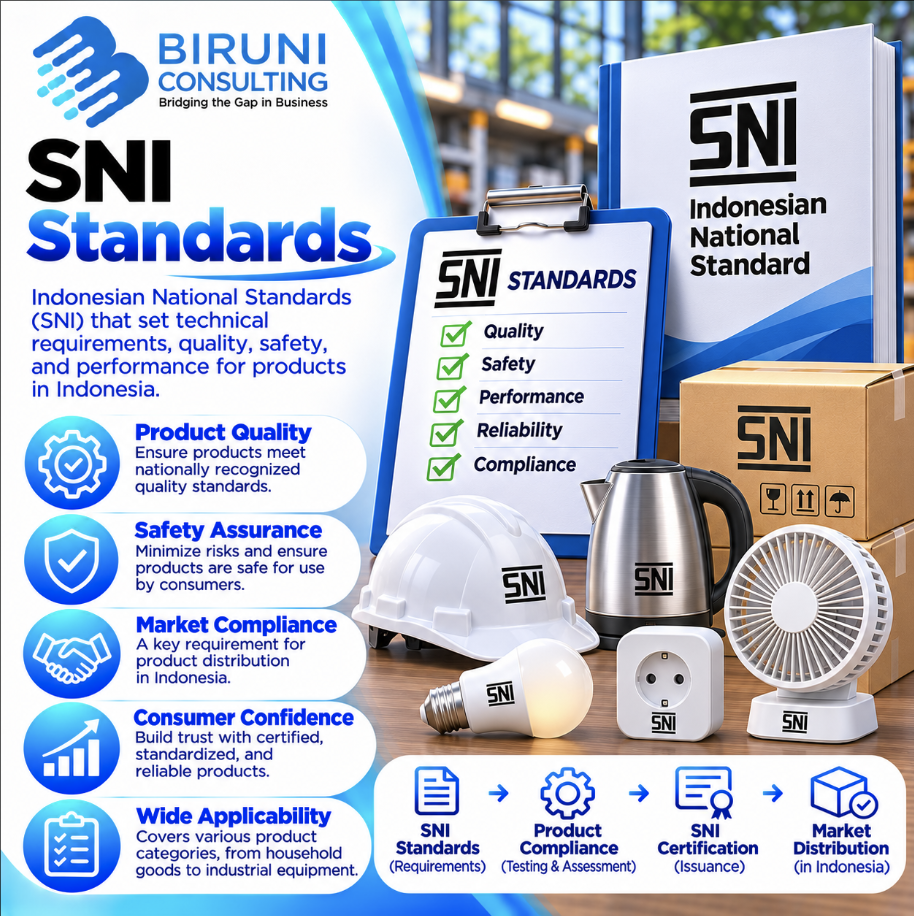
Guide to Indonesian National Standards, Mandatory and Voluntary SNI, Standard Status, Certification, Testing, and the SNI Mark
SNI Standards form an important part of Indonesia’s standardization and conformity-assessment framework. They are used across electrical and electronic products, machinery, construction, steel, textiles, food, consumer products, medical devices, management systems, information technology, and many other technical sectors.
Officially, Standar Nasional Indonesia or SNI is a standard established by the National Standardization Agency of Indonesia, or BSN, and applicable within the territory of the Republic of Indonesia. This definition is used in Indonesia’s standardization framework and is restated in BSN Regulation No. 9 of 2023. Database Peraturan | JDIH BPK
A critical distinction, however, exists between an SNI that exists or remains active and an SNI that has been made mandatory by technical regulation. Finding an SNI in the BSN catalogue does not automatically mean that every product associated with that standard requires SNI certification.
Companies should therefore complete standard mapping and regulatory assessment before testing, certification, mass production, or importing goods into Indonesia.
What Is an SNI Standard?
A standard establishes technical requirements or other agreed specifications, including methods and procedures, while taking safety, security, health, environmental protection, technological development, experience, and future needs into account. Within Indonesia, a standard established by BSN and applicable nationally is an SNI. Gatrik ESDM
SNI can establish requirements covering product safety, performance, dimensions, materials, test methods, terminology, management systems, manufacturing processes, competence, and many other technical areas.
“SNI” therefore does not refer to one universal product standard. Each product needs to be mapped to the standard corresponding to its construction, function, and intended use.
Who Establishes SNI?
SNI is established by Badan Standardisasi Nasional or BSN, Indonesia’s National Standardization Agency.
BSN is the government institution responsible for standardization and conformity assessment. Its role is recognized under Indonesia’s national standardization regulations, including Government Regulation No. 34 of 2018 and BSN Regulation No. 9 of 2023. Database Peraturan | JDIH BPK
SNI development also involves Technical Committees and relevant stakeholders. An SNI is therefore not simply a specification created by one company or regulator.
How Are SNI Standards Developed?
SNI development includes planning, drafting, establishment, and maintenance through periodic review. Indonesia also uses the National Standards Formulation Program or PNPS, under which proposed SNI projects are planned and developed systematically. Peraturan.go.id
Draft standards pass through defined development stages involving technical drafting, committee discussion, consensus, public inquiry, validation, and final establishment. Peraturan.go.id
This process supports broader stakeholder participation and helps ensure that national standards do not reflect only one party’s interests.
Who Participates in SNI Development?
SNI development can involve government and regulators, businesses and industry associations, consumers, academics, research institutions, practitioners, and other technical experts.
The stakeholder structure is intended to balance different perspectives and reduce the possibility of one interest dominating the standardization process. BPS Indonesia
Standards can therefore consider industrial practicality together with consumer safety, technological development, testability, and national interests.
What Is the Purpose of SNI?
The purpose of an SNI depends on the sector.
For consumer products, standards can establish expected safety and quality levels. For industry, standards can provide consistent technical specifications, support interoperability, improve quality control, and provide manufacturers with technical benchmarks.
Standardization can also facilitate communication between manufacturers, suppliers, importers, regulators, laboratories, and customers.
SNI is not limited to physical goods. Indonesia’s conformity-assessment framework also covers services, systems, processes, and personnel. Gatrik ESDM
Are All SNI Standards Mandatory?
No.
The existence of an SNI does not automatically make its application mandatory.
An SNI can be active without any regulation requiring every related product to obtain certification.
Mandatory implementation is established through technical regulations issued by the competent ministry or government agency for a defined scope. Law No. 20 of 2014 provides the primary legal framework for Indonesian standardization and conformity assessment, while Government Regulation No. 34 of 2018 governs the national system and remains in force. Database Peraturan | JDIH BPK
Companies should therefore never conclude that a product is subject to mandatory SNI merely because an SNI number appears in the BSN catalogue.
What Is Mandatory SNI?
Mandatory SNI means that all or part of an SNI’s requirements have been made compulsory through a technical regulation for a defined product scope.
The regulatory scope can be narrower than the title of the standard.
It can depend on technical product descriptions, HS Codes, voltage, current, capacity, wattage, dimensions, materials, construction, intended use, and exclusions.
One HS Code therefore does not necessarily mean that every good within that tariff heading is subject to the same SNI requirement. Similarly, two products marketed under the same commercial name can have different regulatory treatment.
What Is Voluntary SNI?
Where an SNI has not been made mandatory, it may generally be applied voluntarily where an appropriate conformity-assessment scheme is available.
Manufacturers can consider voluntary certification for quality assurance, tender requirements, customer expectations, market confidence, or product positioning.
Voluntary application does not mean that a company can place the SNI Mark on a product through self-declaration.
Formal conformity assessment still applies. Government Regulation No. 34 of 2018 provides that conformity assessment can involve testing, inspection, and/or certification under schemes defining reference requirements and evidence of conformity. Database Peraturan | JDIH BPK
What Does “Active” SNI Mean?
The BSN catalogue can show an SNI with the status Active.
This indicates that the document remains an applicable Indonesian national standard, but it does not by itself establish mandatory certification.
The BSN catalogue includes active SNI standards adopted identically from international standards as well as standards adopted with modifications. Pesta
Companies should therefore separate the question “Is this standard active?” from “Is this standard mandatory for my product?”
Superseded and Revised SNI Standards
Standards can be revised, replaced, reconfirmed, or otherwise updated as technology and national requirements develop.
An older edition may be replaced by a newer standard. In some cases an SNI can also be reconfirmed following review.
The BSN catalogue can provide information on standard status, number, title, technical committee, ICS classification, establishment date, and related standards. Examples in the current catalogue show both revised standards and standards reconfirmed after review. Pesta
For mandatory SNI, however, companies also need to check the edition actually referenced by the relevant regulation or certification scheme. A newer BSN edition does not necessarily replace the regulatory edition automatically.
Understanding SNI Numbers
SNI numbers appear in different formats.
Some are nationally developed standards, such as SNI 9368:2025. Others adopt international standards and use designations such as SNI ISO, SNI IEC, or SNI ISO/IEC.
For example, BSN established SNI 9368:2025 as a modified adoption of ISO 21782-5:2021, while other BSN standards use identical ISO/IEC adoption. Pesta
The appearance of ISO or IEC in an SNI designation therefore does not mean that the document remains merely a foreign standard. Once established as an SNI, it forms part of Indonesia’s national standards system.
SNI Adoption of ISO Standards
Indonesia can adopt ISO standards as SNI.
Adoption can use different levels of alignment depending on the standards-development process. The BSN catalogue contains examples of both identical and modified international-standard adoption. Pesta
An ISO certificate or test report does not automatically constitute SNI certification.
Even where the technical standard is identical, Indonesia can have different certification schemes, regulatory requirements, marking rules, certificate-holder structures, and administrative requirements.
SNI Adoption of IEC Standards
Many Indonesian electrical standards are based on IEC standards and use designations such as SNI IEC.
A manufacturer may already possess a CB Test Report based on the underlying IEC standard.
This evidence can be highly useful during technical assessment.
However, an IEC test report is not automatically an SNI Certificate. Companies still need to check whether the IEC standard has been adopted as SNI, the applicable edition, any modifications or national differences, and the Indonesian certification scheme.
IDT and MOD in SNI
Adopted SNI standards can show identifiers such as IDT and MOD.
IDT indicates an identical level of alignment with the source standard, while MOD indicates a modified adoption.
The BSN catalogue contains examples of both identical ISO/IEC adoption and modified ISO adoption. Pesta
This information can be particularly useful when a manufacturer already has international testing evidence.
Acceptance of that evidence for certification nevertheless remains subject to the applicable Indonesian scheme.
SNI Standard vs SNI Certificate
An SNI Standard is the technical reference document.
An SNI Certificate or conformity certificate is evidence resulting from conformity-assessment activities demonstrating that a particular object has been evaluated against defined requirements.
Government Regulation No. 34 of 2018 defines certification as conformity-assessment activities providing written assurance that goods, services, systems, processes, or personnel comply with standards and/or regulations. Gatrik ESDM
Purchasing an SNI document therefore does not mean that a product is SNI-certified.
SNI Standard vs SNI Mark
The SNI Mark is a certification mark established to indicate that SNI requirements have been fulfilled. Peraturan.go.id
Companies cannot simply identify an SNI and print the SNI logo on their products.
Use of the mark must follow the applicable conformity-assessment and approval process.
BSN Regulation No. 2 of 2017 regulates procedures for the use of the SNI Mark and SNI-based conformity marks and remains listed as in force. Database Peraturan | JDIH BPK
SNI Standards and SPPT SNI
The term SPPT SNI is commonly encountered in product certification and relates to approval or product certification for use of the SNI Mark under applicable schemes and regulations.
Administrative terminology can differ between sectors.
Companies should therefore follow the technical regulation and certification scheme applicable to the particular product rather than assuming one administrative document format applies universally.
The key requirement is that conformity with the appropriate SNI is demonstrated through the applicable assessment route.
What Is Conformity Assessment?
Conformity assessment determines whether goods, services, systems, processes, or personnel satisfy reference requirements.
Government Regulation No. 34 of 2018 states that conformity assessment can be performed through testing, inspection, and/or certification, with the detailed approach defined through conformity-assessment schemes. Gatrik ESDM
Different SNI therefore can have different conformity-assessment procedures.
What Is a Conformity Assessment Scheme?
A conformity-assessment scheme contains the rules, procedures, and management arrangements used to assess conformity against particular reference requirements.
BSN Regulation No. 9 of 2023 provides the framework for developing these schemes. Database Peraturan | JDIH BPK
For product certification, a scheme can define applicant eligibility, documentation, sampling, testing, production evaluation, surveillance, acceptance of laboratory reports, representative models, and certification decisions.
Knowing the SNI number alone is therefore not sufficient; companies also need to understand the certification scheme.
What Is an LSPro?
An LSPro is a Product Certification Body operating a product-certification scheme.
BSN regulations describe LSPro as a third-party conformity-assessment body providing written assurance that products, processes, or services comply with standards and/or regulations. Database Peraturan | JDIH BPK
Not every LSPro covers every SNI.
Companies therefore need to ensure the selected certification body has the appropriate product and standard scope and meets any additional requirements imposed by the sector regulator.
What Is KAN?
KAN, the National Accreditation Committee, is responsible for accreditation of conformity-assessment bodies.
Accreditation provides formal recognition that an institution or laboratory has the competence to perform defined conformity-assessment activities. Gatrik ESDM
Product companies normally apply for certification through an appropriately scoped LSPro rather than applying directly to KAN.
SNI Standards and Laboratory Testing
A standard can contain many individual test requirements.
Electrical products may require evaluation of protection against electric shock, insulation, electric strength, temperature rise, mechanical strength, abnormal operation, terminals, earthing, internal wiring, and other safety characteristics.
Construction products, food, machinery, and other sectors can have entirely different test requirements.
Laboratory selection should therefore be based on the technical scope and applicable certification scheme rather than simply whether a laboratory advertises “SNI testing”.
SNI Standards and Product Families
Product-family assessment is important where one certification project covers several models.
Products with similar appearances can have very different internal construction, while commercially different models can sometimes use the same technical platform.
Family criteria can include voltage, wattage, current, materials, dimensions, circuits, critical components, enclosures, and additional functions depending on the standard and scheme.
The complete model list should therefore be reviewed before representative samples are selected.
Representative Samples
A representative sample is selected to represent a product family during testing or conformity assessment.
The highest-rated model is not necessarily always the only critical sample.
Critical conditions can depend on thermal performance, materials, electrical loading, construction, mechanical configuration, or other factors.
Sending samples before family assessment is complete can therefore result in additional testing.
SNI Standards for Imported Products
Imported products can be subject to mandatory SNI where the relevant Indonesian regulation includes them.
Country of origin does not determine mandatory status.
Products manufactured in China, Vietnam, Thailand, Malaysia, Japan, South Korea, Europe, the United States, or elsewhere need to be assessed against Indonesian product scope and regulations.
Existing CE, CB, UL, TÜV, CCC, CQC, JIS, KS, or other foreign certification does not automatically replace an Indonesian SNI Certificate.
Existing reports should nevertheless be reviewed before mass production and shipment because they can provide useful technical evidence.
SNI Standards and HS Codes
SNI is a technical standard, while the HS Code is a customs and trade classification.
The two systems are different, but mandatory-SNI regulations frequently use HS Codes to help define product scope.
Companies should therefore review both the technical description and the tariff classification.
Where a regulation uses an ex designation, only specified goods within that tariff code are generally intended to be covered.
The same HS Code does not automatically mean the same SNI, and the same commercial description does not automatically mean the same HS Code.
Electrical SNI Standards
Indonesia has numerous electrical SNI standards, including nationally developed standards and IEC-based standards.
They cover luminaires, circuit breakers, plugs, socket outlets, cables, household appliances, transformers, controlgear, and other electrical equipment.
Not all electrical standards are mandatory.
Mandatory status needs to be assessed against technical regulation, product scope, voltage, current, power, construction, intended use, and HS Code.
Smart products containing WiFi, Bluetooth, Zigbee, or other radio functions can also require telecommunications compliance separate from electrical SNI.
SNI Standards for Lighting and Luminaires
Lighting products illustrate why correct standard mapping matters.
SNI IEC 60598-1 provides general luminaire requirements, while particular luminaire types can use additional Part 2 standards.
Fixed luminaires, recessed luminaires, floodlights, road-lighting luminaires, portable luminaires, emergency luminaires, decorative products, and underwater luminaires can require different assessments.
Companies should therefore provide installation drawings, product photographs, datasheets, driver information, and intended use when identifying the applicable SNI.
SNI Standards for MCBs and Circuit Breakers
Products commercially called MCBs also need technical classification.
Household AC MCBs, DC MCBs, AC/DC breakers, industrial circuit breakers, RCCBs, RCBOs, and MCCBs are not technically identical product categories.
Standard selection should consider rated voltage, rated current, breaking capacity, number of poles, intended application, and existing IEC reports.
Selecting the standard solely because a product is marketed as an “MCB” can lead to an incorrect certification route.
SNI Standards for Plugs and Socket Outlets
Plugs and socket outlets also use standards based on construction and intended use.
Wall outlets, portable sockets, extension products, USB sockets, smart sockets, universal outlets, and industrial connectors may require different assessment.
Rated current, voltage, earthing arrangements, shutters, terminal types, wiring methods, installation methods, and electronic features need consideration.
External appearance alone is therefore insufficient for identifying the correct SNI.
SNI Standards for Electronic Products
Electronic products can be subject to safety, performance, EMC, or other standards depending on the product category.
The mere presence of electronics does not mean one generic electronics standard applies.
The principal function and intended use need to drive classification.
Wireless modules can also introduce telecommunications-device requirements separate from product-safety standards.
SNI Standards for Industrial Products
SNI is also widely used for steel, pipes, cement, glass, cables, machinery, construction materials, and other industrial goods.
Some sectors are subject to mandatory technical regulations.
Because regulatory requirements and standard editions can change, companies should check current regulations when beginning new certification, renewal, model-addition, or product-launch projects.
An old certificate or old regulation should not be the sole reference for a new product.
Is ISO 9001 an SNI?
Indonesia has adopted many ISO standards as SNI, including standards relating to management systems.
However, the terms “ISO” and “SNI” are not generally interchangeable.
An international ISO standard becomes an SNI only after it is formally adopted and established by BSN.
Product certification is also different from management-system certification. Holding ISO 9001 certification does not mean that a company’s products are automatically SNI-certified.
Is CE the Same as SNI?
No.
CE relates to European conformity requirements for products falling within the relevant European framework, while SNI forms part of Indonesia’s national standardization system.
CE marking does not automatically establish conformity with Indonesian SNI.
CE technical documentation can nevertheless provide useful test reports, construction information, and technical evidence for initial assessment.
Is a CB Certificate the Same as SNI?
No.
CB Certificates and CB Test Reports form part of the IECEE CB Scheme for specified electrotechnical products.
They can be highly useful where Indonesian SNI adopts the same or a similar IEC standard.
However, companies still need to assess the standard edition, national modifications, certification scheme, laboratory acceptance, factory, and model coverage.
A CB Certificate is therefore valuable technical evidence but not an automatic replacement for Indonesian SNI certification.
How to Identify the Correct SNI Standard
SNI identification should begin with the technical product name and intended use, rather than simply the marketing name.
The datasheet, construction, function, ratings, materials, installation method, electrical supply, and existing manufacturer standards should then be reviewed.
The BSN catalogue can be used to review the standard number, title, status, technical committee, ICS classification, establishment information, international-standard basis, and level of alignment. Pesta
Once a candidate standard is identified, the relevant technical regulations should be checked separately to determine whether mandatory application exists.
Do Not Select an SNI Solely from the HS Code
An HS Code can support regulatory mapping but should not be the sole basis for selecting a standard.
One tariff heading can contain goods with significantly different technical construction.
Conversely, commercially similar goods can have different classifications depending on materials, construction, or import condition.
A better approach is to assess the product, HS Code, technical regulation, and standard scope together.
Do Not Select an SNI Solely from the Product Name
Commercial product names can be much broader than technical classifications.
Descriptions such as “smart lamp”, “power adapter”, “circuit breaker”, “socket”, “charger”, or “machine” are usually insufficient for selecting a standard.
Manufacturers should provide actual technical specifications.
Incorrect classification can lead to the wrong certification body, laboratory, sample, and additional testing costs.
Documentation for Standard Mapping
Useful documentation can include product catalogues, datasheets, model lists, photographs, technical drawings, intended use, rated specifications, material information, existing IEC/ISO or other test reports, manufacturer information, factory information, and installation manuals where applicable.
This information helps establish whether different models genuinely use the same standard and whether an item is the principal product, a component, accessory, or multifunction product.
SNI Standards and Product Changes
Products can change after certification.
Suppliers may replace drivers, motors, PCBs, cables, plugs, batteries, resins, enclosure materials, transformers, compressors, safety components, or material suppliers.
Such changes can affect conformity.
Certificate holders and manufacturers should therefore maintain a change-control procedure so changes are assessed before entering mass production.
SNI Standards and Factory Changes
Changing manufacturing locations can also affect certification.
The same model may be produced using different equipment, tooling, suppliers, and quality-control processes at another factory.
Some certification schemes connect certification to the manufacturing facility.
Foreign manufacturers using several factories should therefore determine which facility will supply the Indonesian market before certification begins.
SNI Standards and Surveillance
Certification schemes can include surveillance after initial certification.
Surveillance may involve documentation review, factory assessment, sampling, testing, or other activities.
Mass-production goods need to remain consistent with the certified configuration.
Approved-component lists, supplier records, test records, complaint records, engineering changes, and quality documentation should therefore be properly maintained.
Why Is SNI Standard Assessment Important?
Selecting the correct standard is the foundation of a successful certification project.
An incorrect standard can lead to the wrong certification body, laboratory, test sample, or even a certificate that does not correspond to the actual product category.
For imported goods, these errors are often discovered only after mass production has been completed or goods are ready for shipment.
Assessment should therefore take place before mass production and shipment, allowing manufacturers to adjust components, construction, markings, model lists, packaging, and technical documentation before significant production costs are committed.
Contact Us
Biruni Consulting assists companies with SNI Standard identification and application, including regulatory assessment, mandatory or voluntary SNI assessment, HS Code review, product family assessment, testing, and certification assistance.
Our services include:
- Identification of applicable SNI Standards according to product type, function, construction, and intended use.
- Review of standard status, mandatory or voluntary SNI, regulations, and HS Codes where relevant.
- Review of product lists, datasheets, existing IEC/ISO/CB Test Reports, and applicable standard editions.
- Identification of certification bodies, laboratories, certification schemes, manufacturers, factories, and critical components.
- Product family assessment, representative-sample selection, and certification-document preparation.
- Testing, corrective-action, factory-audit or production-evaluation assistance where required, SNI certification, and SNI Mark assistance.
Contact Biruni Consulting for information regarding SNI product standards, mandatory-SNI consultation, SNI-number identification, SNI certification services, SNI testing, imported-product standard mapping, and SNI Certificate assistance according to your product type, brand, model, specifications, HS Code, factory, and country of origin.