
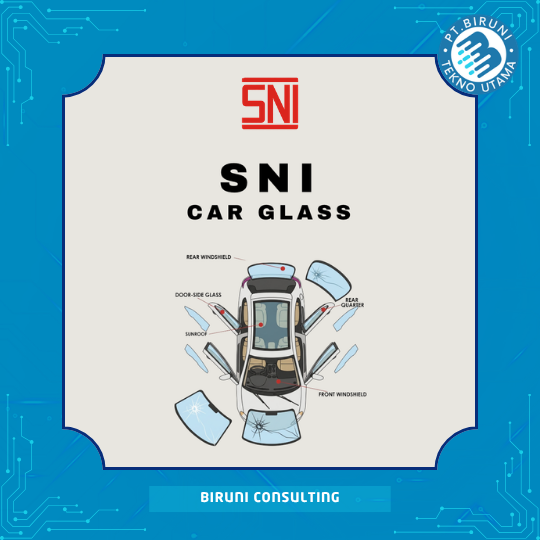
Requirements and SNI Certification Process for Car Glass in Indonesia
Car glass is one of the vehicle components that plays an important role in supporting driver and passenger safety. In addition to providing protection from wind, dust, and environmental conditions, glass used in vehicles must have certain safety characteristics so that it can be used in accordance with applicable requirements.
In Indonesia, safety glass used on motor vehicles is a product subject to mandatory Indonesian National Standard (SNI) implementation. These requirements are currently regulated through Minister of Industry Regulation No. 15 of 2025 concerning the Mandatory Implementation of Indonesian National Standards for Safety Glass for Motor Vehicles.
The applicable standard is SNI 8210:2018 Safety Glass for Motor Vehicles. Therefore, manufacturers and companies importing and marketing car glass need to ensure that their products fall within the standard scope and comply with the established certification requirements.
What Is SNI for Car Glass?
SNI for car glass is a standard used to ensure that safety glass installed in motor vehicles meets technical and safety requirements. Under SNI 8210:2018, vehicle safety glass includes laminated safety glass and tempered safety glass for certain vehicle categories.
SNI certification is conducted through a conformity assessment process involving document review, product testing, and assessment of production facilities according to the applicable certification scheme.
Through certification, manufacturers can demonstrate that their car glass products meet the standard requirements. For companies marketing imported products, SNI compliance also needs to be considered before products are distributed in Indonesia if the products fall within the scope of mandatory SNI implementation.
SNI 8210:2018 for Car Glass
SNI 8210:2018 is the standard specifically governing safety glass for motor vehicles. This standard covers two main types of safety glass, namely laminated safety glass and tempered safety glass.
Laminated safety glass generally consists of several layers of glass joined using an interlayer material. Meanwhile, tempered safety glass is glass that undergoes special treatment to improve its strength and safety characteristics.
The implementation of the standard needs to correspond to the type of glass and its application in the vehicle. Not all glass products used in vehicles automatically have the same scope, making product identification an important stage before certification.
Types of Car Glass Covered by SNI
Car glass products within the scope of SNI 8210:2018 include laminated safety glass and tempered safety glass according to the requirements of the standard.
The glass may be used in vehicles according to the categories and functions specified. During certification, companies need to explain product characteristics completely, including glass type, construction, dimensions, design, application, and technical specifications.
SNI 8210:2018 also has several exclusions within its scope, including special bullet-resistant glass and double glazing. Therefore, companies need to first ensure whether the product to be certified is actually included within the scope of the standard.
Vehicle Categories Covered
SNI for safety glass covers glass used in vehicles in categories L, M, N, O, and T according to the scope of the standard.
For passenger car glass products, the most relevant vehicle category is generally category M. However, the vehicle category must still be determined based on the applicable classification rather than simply based on marketing terms such as “car glass.”
Determining the category is important because it may affect the certification scope and the type of product submitted.
Why Must Car Glass Comply with SNI?
Car glass has a function directly related to vehicle safety. Glass quality may affect driver visibility, passenger protection, and the behavior of glass when an impact or damage occurs.
Mandatory SNI implementation for motor vehicle safety glass aims to provide assurance regarding human security, health, and safety. In addition, implementation of the standard also supports quality and competitiveness improvements in the motor vehicle safety glass industry.
Therefore, SNI compliance is not only an administrative requirement but also part of efforts to ensure that car glass distributed in Indonesia meets safety and quality requirements.
SNI Car Glass Certification Requirements
Companies applying for certification need to prepare administrative and technical documents. Requirements may differ depending on company type, production facility location, product type, and certification scheme applied.
Documents that generally need to be prepared include:
- Company legality documents.
- Company and production facility profile.
- Glass brand and type information.
- Product technical specifications.
- Engineering drawings.
- Raw material information.
- Production process flowchart.
- Quality control procedures.
- Production machinery and equipment data.
- Inspection and testing equipment data.
- Measuring equipment calibration records where relevant.
- Production and quality control records.
The documents must correspond to actual factory conditions and meet the requirements of the LSPro used for certification.
How to Obtain SNI Car Glass Certification
Product Identification
The first stage is to determine the type of car glass to be certified. The company needs to identify the glass type, construction, dimensions, function, vehicle category, brand, and product type.
Identification is conducted to ensure that the product falls within the scope of SNI 8210:2018 and to determine the certification scope accurately.
Document Preparation
After the product has been determined, the company prepares all administrative and technical documents. Product data must be consistent among the documents, samples, and production conditions.
For products manufactured overseas, the company also needs to consider requirements concerning overseas manufacturers and official representatives according to applicable regulations.
Certification Application
The certification application is submitted to the LSPro according to the applicable certification mechanism. The company needs to ensure that administrative requirements have been fulfilled before the assessment process begins.
The certification scheme also includes surveillance activities, meaning manufacturers must be able to maintain product conformity after certification is obtained.
Laboratory Testing
Car glass samples are tested based on the requirements of SNI 8210:2018. Testing is conducted to ensure that the glass characteristics meet the specified technical requirements.
The types of testing may differ depending on the glass type and product scope. Samples tested must represent the products that will be manufactured or marketed.
Factory Audit
A factory audit is conducted to ensure that the production facility has the capability to manufacture car glass consistently.
Auditors may examine raw materials, production processes, machinery, inspection and testing equipment, quality control, storage, traceability, and production records.
Evaluation and Certificate Issuance
Test and audit results are then evaluated by the LSPro. If all requirements are fulfilled, the process may proceed to the certification decision and certificate issuance according to applicable requirements.
SNI Car Glass Testing
Testing is an important part of the car glass certification process. Testing is conducted on representative samples based on the parameters established in SNI 8210:2018.
Companies need to ensure that sample specifications correspond to the products that will be routinely manufactured. Differences in materials, construction, dimensions, or designs may need to be considered when determining the product scope.
The testing laboratory used must also have appropriate competence and scope for the certification requirements.
SNI Car Glass Factory Audit
A factory audit is conducted to assess the manufacturer’s ability to maintain consistent car glass quality.
Several aspects that may be assessed include:
- Raw material control.
- Production process.
- Production machinery and equipment.
- Process control.
- Product inspection.
- Testing equipment.
- Measuring equipment calibration.
- Nonconforming product control.
- Product traceability.
- Quality control records.
Production facility conditions must correspond to the documents and product scope submitted during the certification process.
SNI Car Glass for Imported Products
Companies importing car glass need to ensure whether their products fall within the scope of mandatory SNI implementation. If included, certification requirements must be fulfilled according to applicable provisions.
Overseas manufacturers need to prepare technical documents and production facility information. Importers or official representatives must also ensure that all product information corresponds to the products actually manufactured.
Consistency between products manufactured overseas and products submitted for certification is an important aspect to consider during the assessment process.
Cost of SNI Car Glass Certification
SNI car glass certification costs may vary for each company. Costs are influenced by factors such as glass type, number of types or variants, number of samples, laboratory testing, factory location, and audit or assessment activities.
In addition to certification costs, companies may also need to consider laboratory testing, sampling, surveillance, and travel expenses if the factory is located outside Indonesia.
To obtain a more accurate cost estimate, information regarding the car glass type, number of types, production location, and product scope needs to be known first.
How Long Does SNI Car Glass Certification Take?
The certification process may take different amounts of time for different companies. Factors affecting the duration include document completeness, sample readiness, laboratory schedules, testing processes, factory readiness, and audit results.
If nonconformities are identified, the company may require additional time to make corrections and fulfill the established requirements.
Therefore, companies should prepare documents, samples, production facilities, and quality control systems before the certification process begins.
Things to Consider Before Applying for SNI Car Glass
Before applying for certification, companies need to ensure that:
- The glass type has been identified.
- The vehicle category has been determined.
- The product corresponds to the scope of SNI 8210:2018.
- Technical specifications are available.
- Samples represent the products to be marketed.
- Production documents have been prepared.
- Production facilities are ready for audit.
- Inspection and testing equipment is available.
- Quality control has been implemented.
- The manufacturer or importer understands the certification stages.
These preparations can help companies conduct the SNI car glass certification process in a more structured manner and reduce the potential for nonconformities.
Contact Us
Biruni Consulting helps companies with SNI car glass certification professionally and in accordance with applicable regulations in Indonesia.
Our services include
- Consultation on SNI car glass regulations.
- Identification of applicable standards.
- Certification document preparation.
- Laboratory testing assistance.
- Factory audit preparation and assistance.
- Certification evaluation process assistance.
- Certification processing until certificate issuance.
With extensive experience in product certification in Indonesia, Biruni Consulting helps ensure products comply with applicable safety, quality, and standard requirements so that they are ready for legal distribution in Indonesia.
Contact Us for consultation, testing assistance, factory audit, and SNI car glass certification processing according to the product type and company requirements.