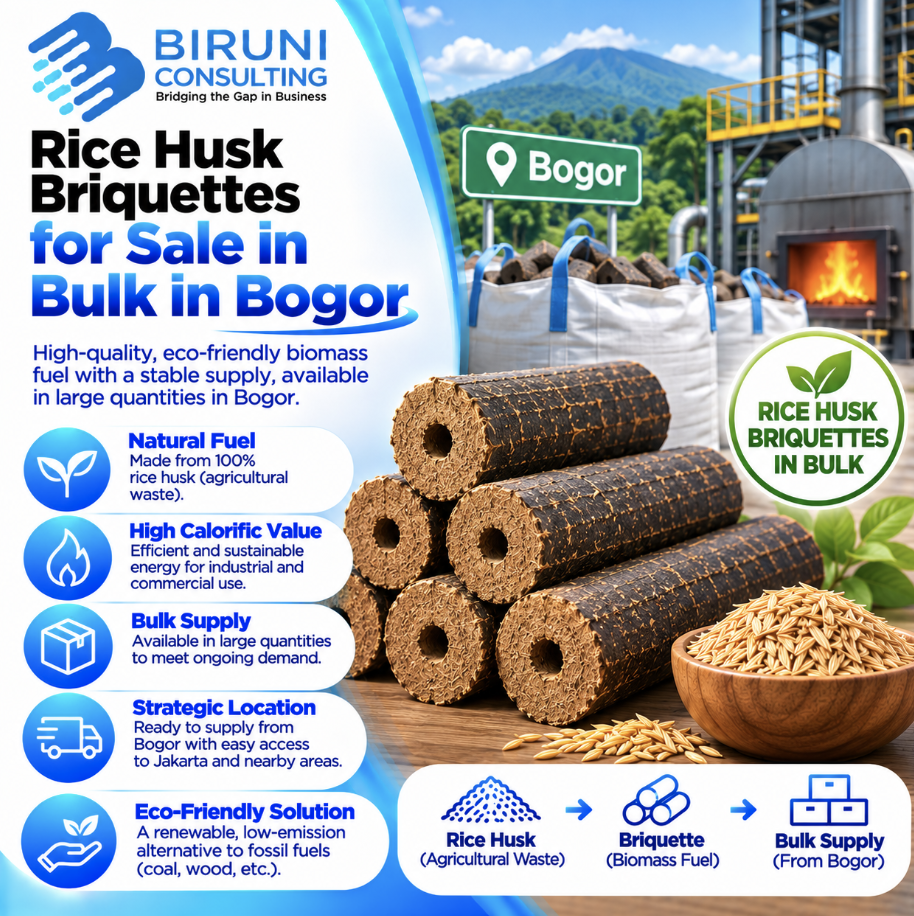
Bulk Rice Husk Briquettes for Industrial Applications in Bogor
Industrial demand for biomass fuel can involve substantial recurring volumes for steam boilers, dryers, furnaces, biomass burners, and other thermal systems. One potential fuel is the rice husk briquette, produced by densifying husks generated during rice milling.
Bogor combines agricultural activity with a significant industrial base. BPS-Statistics Indonesia recorded approximately 299,676 metric tons of paddy production in Bogor Regency in 2024, from about 50,169 hectares of harvested area. This indicates substantial rice-related activity capable of generating milling residues such as rice husk, although not all husk is necessarily commercially available for briquette manufacturing. BPS Bogor Kabupaten
On the demand side, Bogor Regency’s spatial-planning regulations identify industrial-estate areas in parts of Klapanunggal, Cileungsi, Cibinong, Babakan Madang, and Citeureup, together with industrial zones in several other districts including Gunung Putri, Jonggol, Gunung Sindur, Jasinga, and Parung Panjang. JDIH Bogor Kabupaten
This combination makes rice husk briquettes for sale in bulk in Bogor relevant to industrial buyers requiring tens or hundreds of metric tons on a recurring basis.
What Are Rice Husk Briquettes?
Rice husk briquettes are solid biomass fuels produced by densifying rice-milling husks.
Indonesia’s agricultural post-harvest research agency explains that densification improves the physical characteristics and energy per unit volume of rice residues while making the material easier to store and transport. Biobriquettes can also be used as an industrial energy source. BRMP Pascapanen
Compared with loose rice husk, briquettes provide a more compact and consistent physical form.
For bulk industrial purchasing, these characteristics can improve transportation, warehousing, unloading, and fuel-handling planning.
Rice Husk Briquettes as Non-Woody Biomass
Rice husk originates from cereal crops and is categorized as non-woody biomass.
ISO 17225-7:2021 establishes fuel-quality classes and specifications for graded non-woody briquettes. Its scope includes herbaceous biomass and by-products originating from cereal production and processing. As of November 2026, the standard remains published and is under systematic review. ISO
The standard can provide a useful reference for non-carbonized products, although actual purchasing requirements should match the buyer’s equipment and application.
Thermally treated briquettes such as torrefied products are excluded from its scope. ISO
Why Buy Rice Husk Briquettes in Bulk?
Industrial boilers can consume several metric tons of fuel every day.
Monthly demand can therefore quickly reach tens or hundreds of tons.
Bulk purchasing can support:
- More reliable fuel availability.
- Planned delivery schedules.
- Volume-based commercial terms.
- Better inventory management.
- Recurring monthly supply contracts.
However, large purchases also create greater technical and financial risk if the product is unsuitable.
Samples and combustion trials should therefore precede major purchase commitments.
Industrial Applications in Bogor
Rice husk briquettes can be considered for compatible steam boilers, biomass boilers, dryers, selected furnaces, process-heating equipment, food processing, agricultural processing, and other thermal applications.
Indonesia’s agricultural post-harvest agency also identifies biobriquettes as a potential industrial-energy source. BRMP Pascapanen
Compatibility still needs to be confirmed.
Engineering teams should review fuel dimensions, feeding systems, grate configuration, combustion-air distribution, furnace design, and ash-removal systems.
A boiler operating on coal, palm kernel shell, wood chips, or pellets should not automatically be assumed to perform equally well on rice husk briquettes.
Carbonized vs. Non-Carbonized Products
Buyers should confirm the product category before requesting a final quotation.
Non-Carbonized Rice Husk Briquettes
Rice husk is dried and densified without carbonization.
More of the original biomass characteristics remain.
Carbonized Rice Husk Briquettes
The material undergoes carbonization, changing characteristics such as fixed carbon, volatile matter, ignition, and combustion behavior.
Carbonized and non-carbonized products should therefore not be compared using price per kilogram alone.
Specifications for Bulk Purchases
Wholesale buyers should define technical requirements before commercial negotiations.
| Parameter | Information to Confirm |
|---|---|
| Raw Material | Rice husk / actual composition |
| Product Type | Carbonized / non-carbonized |
| Calorific Value | GCV/HHV and/or NCV/LHV |
| Moisture | Maximum percentage |
| Ash | Maximum percentage |
| Proximate Analysis | Volatile matter and fixed carbon |
| Dimensions | Diameter, length and shape |
| Physical Quality | Density, strength, fines |
| Packaging | Bags, big bags or jumbo bags |
| Monthly Capacity | Available MT/month |
Acceptance ranges can also be included for recurring shipments.
Calorific Value
Calorific value indicates the amount of energy contained in the fuel.
Buyers should determine whether suppliers report:
GCV / HHV
or:
NCV / LHV.
The reporting basis is equally important.
Dry-basis figures should not be compared directly with as-received results.
For bulk procurement, representative laboratory reports or Certificates of Analysis are more useful than a single marketing figure.
Moisture Content
Moisture affects useful combustion energy.
Water contained in the fuel needs energy to evaporate, which can increase fuel consumption.
Variation in moisture can also make boiler performance less consistent between shipments.
Recurring contracts may therefore establish a maximum moisture specification.
Covered warehousing and appropriate transportation are also important to prevent the product from absorbing water before delivery.
Ash Content
Ash requires particular attention when evaluating rice-husk-based fuels.
Rice husk has different mineral characteristics from woody biomass.
Ash can influence cleaning schedules, residue handling, maintenance, and combustion conditions.
Industrial procurement should therefore evaluate:
calorific value + ash + actual boiler performance
rather than calorific value alone.
More detailed ash analysis may be appropriate for technically sensitive combustion systems.
Dimensions, Strength and Fines
Briquettes need to move reliably through hoppers, conveyors, feeders, and combustion systems.
Oversized products can interfere with feeding.
Weak briquettes may break during trucking and unloading and create excessive fines.
With purchases reaching hundreds of tons, even a relatively small percentage of breakage can result in a significant quantity of fines.
Physical quality should therefore be evaluated after representative transportation whenever possible.
Certificate of Analysis
Industrial buyers may request a Certificate of Analysis or CoA.
Useful information can include:
- Calorific value and reporting basis.
- Moisture and ash.
- Volatile matter and fixed carbon.
- Relevant physical parameters.
- Batch or sample identification.
The report should be reasonably current and relevant to the product being offered.
An old laboratory certificate does not automatically represent current shipments.
What Counts as a Bulk Order?
There is no single volume that applies to every supplier.
For industrial buyers, purchasing may begin with several tons for technical trials before moving to recurring commercial quantities.
For example:
8 MT/day × 25 operating days
equals:
200 MT/month.
A plant consuming 15 MT/day over the same operating period would require approximately:
375 MT/month.
Actual demand depends on boiler consumption, production schedules, and required safety stock.
Minimum Order Quantity
Supplier MOQ can vary according to manufacturing capacity, transportation configuration, packaging, and commercial economics.
For domestic delivery, MOQ may be based on one truckload or multiple loads.
Buyers should distinguish between:
trial MOQ and regular monthly MOQ.
A supplier willing to support smaller technical trials can make qualification easier before the buyer commits to larger volumes.
Supplier Capacity
Bulk purchasing requires sufficient production capacity.
However, installed capacity does not equal commercially available capacity.
A supplier may have:
500 MT/month production capacity
while:
350 MT/month
is already committed to existing customers.
Only:
150 MT/month
would remain available.
Buyers should therefore ask for available capacity for new contracts, not simply maximum plant capacity.
Feedstock Continuity
Briquette production depends on reliable rice-husk availability.
Bogor Regency recorded approximately 299,676 tons of paddy production in 2024, confirming ongoing rice-production activity in the region. BPS Bogor Kabupaten
Indonesia’s agricultural post-harvest agency also identifies rice husk as a milling by-product that can be used as fuel and processed into biobriquettes. BRMP Pascapanen
A supplier serving Bogor does not necessarily need to source all feedstock locally.
For larger monthly contracts, rice husk may also come from other rice-producing areas in West Java or beyond where transportation economics remain viable.
Why Bogor Is Relevant for Industrial Distribution
Bogor Regency has a substantial industrial footprint.
Regional planning regulations identify industrial estates in parts of Klapanunggal, Cileungsi, Cibinong, Babakan Madang, and Citeureup, with additional industrial zones in areas including Gunung Putri, Jonggol, Gunung Sindur, Jasinga, and Parung Panjang. JDIH Bogor Kabupaten
Factories in these areas can potentially be supplied by local distribution bases or manufacturers located elsewhere.
Because biomass fuel is bulky, warehouse and production locations can materially affect delivered cost.
The Manufacturer Does Not Need to Be in Bogor
A seller serving Bogor does not necessarily need to manufacture the briquettes within Bogor itself.
Products may be produced near larger feedstock sources and transported to industrial customers.
For buyers, the more important combination is:
technical quality + delivered price + available capacity + delivery reliability.
A more distant manufacturer with larger production capacity and efficient logistics can sometimes be more competitive than a smaller local supplier.
Bulk Rice Husk Briquette Pricing
Wholesale pricing depends on several variables, including:
technical specification, product type, monthly volume, packaging, delivery distance, loading arrangement, and contract duration.
There is therefore no single price per kilogram applicable to every industrial order.
A more useful RFQ might state:
Rice husk briquette, 200 MT/month, delivered Bogor, maximum moisture X%, maximum ash X%, packaging Y.
This gives suppliers enough information to prepare comparable quotations.
Ex-Factory vs. Delivered Bogor
An ex-factory price represents the product price at the supplier’s facility before transportation.
A delivered price includes transportation to the agreed customer location.
For factories in Bogor, delivered pricing often provides a more useful comparison.
Buyers should still confirm whether packaging, loading, toll charges, unloading, and other logistics costs are included.
Do Not Compare Price per Ton Alone
Consider two example fuels:
Supplier A
Delivered price: IDR 3,000/kg
Consumption: 190 kg/ton of steam
Fuel cost:
IDR 570,000/ton of steam
Supplier B
Delivered price: IDR 3,350/kg
Consumption: 165 kg/ton of steam
Fuel cost:
IDR 552,750/ton of steam
In this illustration, the more expensive fuel produces a lower fuel cost per ton of steam.
These figures are illustrative only.
Actual consumption should be measured during a boiler trial.
Total Cost of Use
For high-volume procurement, buyers can consider:
Fuel Price + Transportation + Storage + Fuel Consumption + Ash Handling + Cleaning + Maintenance + Downtime
This produces a broader Total Cost of Use.
Small operational differences can become financially significant when hundreds of tons are consumed each month.
The lowest price per metric ton is therefore not always the most economical option.
Trial Before Purchasing Hundreds of Tons
Industrial buyers should conduct technical testing before committing to major volumes.
Qualification may begin with physical samples and laboratory analysis, followed by a larger boiler trial.
Important indicators include:
- Fuel consumption and fuel-to-steam ratio.
- Steam output and combustion stability.
- Feeding performance.
- Ash generation.
- Cleaning and maintenance requirements.
If the product performs satisfactorily, the parties can proceed toward recurring supply.
Monthly Supply Contracts
Bulk requirements are often easier to manage under regular supply agreements.
Contracts can establish:
monthly quantity + specifications + delivered price + delivery schedule + payment terms + quality-control procedures + off-specification handling.
A 200 MT/month requirement, for example, can be split across several scheduled deliveries.
This reduces warehouse pressure while helping suppliers plan production and transportation.
Packaging for Bulk Supply
Packaging should match the customer’s receiving facilities.
Standard bags may be appropriate for some operations.
Big bags or jumbo bags can reduce manual handling where forklifts and suitable unloading equipment are available.
For high-volume supply, packaging decisions should balance:
cost + handling efficiency + moisture protection + storage requirements.
Packaging can also influence vehicle payload and delivered cost.
Safety Stock
Factories dependent on biomass boilers should maintain suitable fuel reserves.
For example, consumption of:
8 MT/day
with four days of buffer requires approximately:
32 MT
of safety stock.
The appropriate level depends on lead time, warehouse capacity, road conditions, and supplier reliability.
Longer supply chains may require larger buffers.
Primary and Backup Suppliers
Large fuel demand increases the impact of supply interruptions.
Machine breakdowns, raw-material shortages, transport delays, or quality problems can affect deliveries.
Where boiler operation is critical, buyers may maintain a primary supplier and an approved backup source.
The backup supplier should ideally complete technical qualification before an emergency occurs.
Shipment-to-Shipment Consistency
An industrial supplier needs to deliver more than one good sample.
Quality should remain reasonably stable throughout recurring supply.
Variations in feedstock, drying, compression, and production conditions can alter moisture, ash, calorific value, density, and dimensions.
Contracts can therefore establish specification ranges and periodic testing procedures.
Consistency is one of the most important requirements for long-term industrial purchasing.
Manufacturer, Trader or Aggregator?
High-volume buyers may purchase through manufacturers, traders, or aggregators.
Manufacturers directly control production.
Traders can provide sourcing flexibility.
Aggregators may combine production from several facilities to support larger contracts.
No business model is inherently superior.
Buyers should prioritize traceability, specification consistency, available capacity, quality control, and delivery reliability.
Comparing Suppliers
A supplier-comparison matrix can simplify procurement.
| Parameter | Supplier A | Supplier B | Supplier C |
|---|---|---|---|
| Product Type | Data | Data | Data |
| GCV/NCV | CoA | CoA | CoA |
| Moisture | CoA | CoA | CoA |
| Ash | CoA | CoA | CoA |
| Delivered Price | Quote | Quote | Quote |
| Available Capacity | Data | Data | Data |
| Trial Result | Result | Result | Result |
Technically unsuitable products can be eliminated before detailed commercial negotiations.
Price comparisons can then focus only on fuels that meet the buyer’s requirements.
Information to Include in an RFQ
Buyers can provide:
- Briquette type and intended application.
- Target calorific value, moisture, and ash.
- Dimensions or feeding requirements.
- Trial quantity and monthly volume.
- Delivery location in Bogor.
- Packaging, CoA, and delivery schedule.
This allows suppliers to assess technical suitability, capacity, and logistics before quoting.
How to Select a Bulk Rice Husk Briquette Supplier
Supplier qualification can follow five stages.
1. Technical Screening
Review specifications, CoA, raw materials, dimensions, and product type.
2. Capacity Verification
Confirm monthly available capacity and feedstock security.
3. Sample and Boiler Trial
Verify physical quality and actual combustion performance.
4. Commercial Evaluation
Compare delivered cost together with useful output such as cost per ton of steam.
5. Supply Performance
Evaluate several deliveries before relying heavily on one supplier.
This staged approach can significantly reduce bulk-purchasing risk.
Red Flags in Bulk Procurement
Additional verification is appropriate when suppliers cannot clearly explain specifications, feedstock sources, or available capacity.
Major quality variations, irrelevant CoAs, uncertain delivery schedules, and unusually low prices without technical justification should also receive attention.
Because high-volume orders increase financial and operational exposure, supplier selection should be based on technical performance and total economics, not initial price alone.
Are Rice Husk Briquettes Suitable for Factories in Bogor?
Rice husk briquettes can be considered as a biomass fuel for industrial facilities in Bogor where equipment and product specifications are compatible.
Bogor Regency produced approximately 299,676 tons of paddy in 2024 and also includes several designated industrial-estate and industrial-zone areas. BPS Bogor Kabupaten
This combination makes regional biomass supply commercially relevant to evaluate.
Bulk buyers should nevertheless consider calorific value, moisture, ash, physical quality, boiler performance, delivered price, available capacity, and long-term supply reliability.
The strongest supplier is not necessarily the one offering the lowest price per ton, but the one capable of maintaining both quality and volume throughout the contract.
Contact Us
Biruni Consulting can assist companies that require information and support regarding product requirements, documentation, and compliance processes related to product importation, marketing, or use according to business requirements in Indonesia.
The services that can be supported include:
- Consultation on product requirements for industrial needs.
- Initial assessment of product specifications and applications.
- Technical document review.
- Review of product specifications and information.
- Consultation on applicable regulatory requirements according to the product type and business activities.
- Assistance in preparing required documents.
- Consultation on certification or licensing processes when required based on the product characteristics and intended use.
Contact Biruni Consulting for information regarding product requirements, documentation, certification, and compliance needs to support business activities and product marketing in Indonesia.