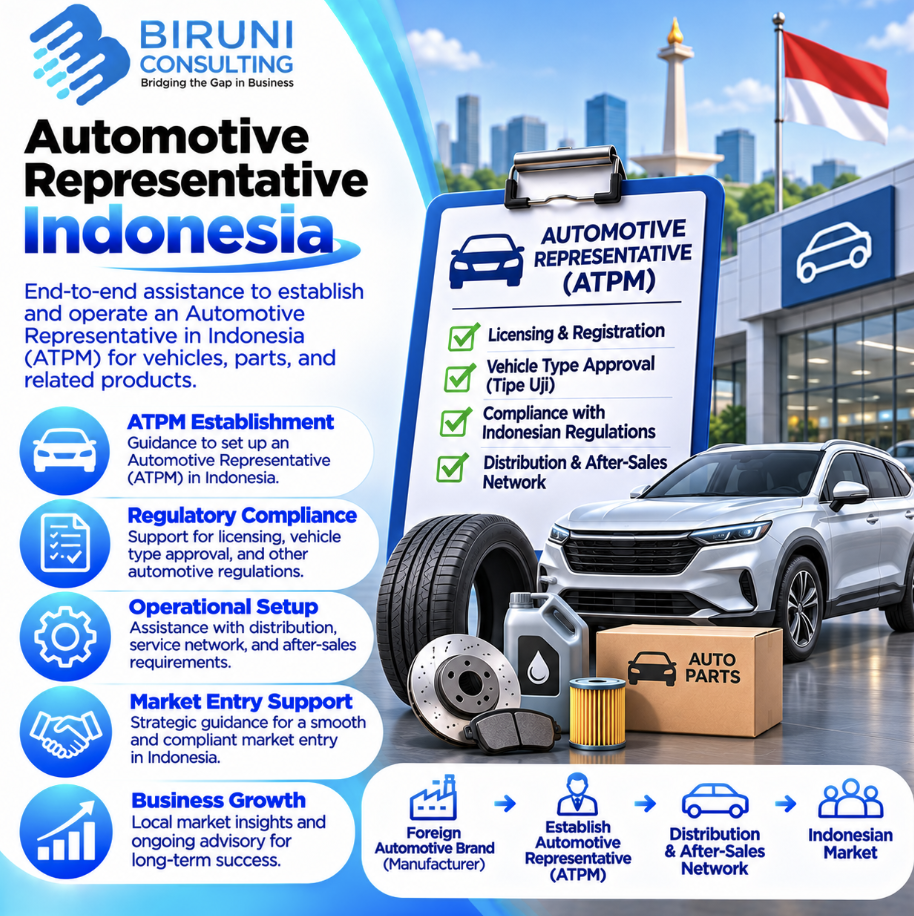
Automotive Representative Services for Overseas Manufacturers
Automotive Representative Indonesia helps Overseas Manufacturers establish a local representation structure for certification, regulatory compliance, importation, and market entry of automotive products in Indonesia.
The term Automotive Representative Indonesia is not a single universal license covering all vehicles, components, spare parts, tires, safety glass, lubricants, and automotive accessories. The need for an Official Representative needs to be determined from the regulation applicable to the actual product. Under several Mandatory SNI automotive-product schemes, an Overseas Manufacturer is specifically required to maintain an Official Representative in Indonesia subject to prescribed requirements.
For example, Minister of Industry Regulation No. 9 of 2025 currently imposes Mandatory SNI requirements on tires and has applied since July 24, 2025. Regulation No. 15 of 2025 imposes Mandatory SNI requirements on motor-vehicle safety glass and has applied since October 25, 2025. Lubricating oil is also subject to Mandatory SNI under Regulation No. 8 of 2025, effective July 24, 2025. Database Peraturan | JDIH BPK
An Overseas Manufacturer should therefore conduct regulatory assessment before appointing its Distributor or Importer. The Automotive Representative can be directly connected with the SNI Certificate, SIINas, trademarks, warehousing, Importer appointments, SPPT SNI, and post-certification compliance depending on the product regulation.
What Is an Automotive Representative Indonesia?
An Automotive Representative Indonesia is an Indonesian company performing local-representation functions for an overseas automotive manufacturer according to the regulatory and commercial structure required for its products.
Within specific Mandatory SNI regulations, the more precise regulatory term is Official Representative.
The Official Representative can perform functions including:
- Representing the Overseas Manufacturer during certification.
- Managing applications through SIINas.
- Acting as the local party for LSPro and regulatory coordination.
- Managing trademark licensing and warehousing requirements.
- Acting as Importer or appointing an Importer where the regulation permits.
The exact scope remains product specific.
Automotive Representative Is Not One Universal License
There is no single “Automotive Representative License” automatically covering every automotive product.
A tire manufacturer can face a different local-party structure from a safety-glass manufacturer. A complete-vehicle manufacturer can also have a different approval pathway from an aftermarket component supplier.
Before establishing local representation, companies should identify whether their product is:
- a complete motor vehicle;
- a tire;
- safety glass;
- lubricating oil;
- a vehicle component;
- a spare part;
- an accessory;
- automotive electrical/electronic equipment; or
- another separately regulated product.
The classification determines the regulator, approval, certification, and local-party structure.
Why Does an Overseas Manufacturer Need an Automotive Representative?
An Overseas Manufacturer can need a local party because certain Indonesian regulatory processes involve an Indonesian business entity or because a product-specific Mandatory SNI regulation expressly requires an Official Representative.
Under Mandatory SNI schemes, the Representative can form the connection among the Overseas Manufacturer, SIINas, LSPro, Testing Laboratory, Importer, and regulator.
The Representative should therefore not be selected solely because of its sales capabilities.
Its regulatory capabilities and long-term suitability also matter.
Automotive Representative for SNI Products
Mandatory SNI is one of the principal areas in which Automotive Representative Indonesia becomes relevant.
BBSPJIKKP explains that Mandatory SNI is an SNI made compulsory by government regulation and that certification applications for Ministry of Industry Mandatory SNI products are submitted through SIINas. bbkkp.kemenperin.go.id
Simply identifying an SNI number is therefore not sufficient.
The company still needs to determine whether the standard has actually been made mandatory for the product being marketed.
Automotive Representative for Tires
Motor-vehicle tires are one automotive product category currently governed by Minister of Industry Regulation No. 9 of 2025 concerning Mandatory SNI for tires.
The regulation has applied since July 24, 2025 and replaced the previous Mandatory SNI framework for tires. Database Peraturan | JDIH BPK
For an overseas tire manufacturer, the local-representation structure should be assessed before certification and importation begin.
The brand, manufacturing site, product category, Importer, warehouse, certification, and post-market obligations should be mapped as one regulatory project.
Automotive Representative for Motor-Vehicle Safety Glass
Motor-vehicle safety glass is subject to a Mandatory SNI framework under Minister of Industry Regulation No. 15 of 2025, effective October 25, 2025 and currently in force. Database Peraturan | JDIH BPK
For an Overseas Manufacturer, the regulation establishes an Official Representative structure. The Overseas Manufacturer submits the SNI Certificate application through its Official Representative electronically through SIINas, and where the manufacturer operates more than one production location, applications are required for each production site. Database Peraturan | JDIH BPK
The Representative is therefore more than a sales agent.
It can be directly connected with certification administration.
Requirements for a Safety-Glass Automotive Representative
Under the Mandatory SNI safety-glass framework, Official Representative documentation includes Business Licensing, evidence of appointment, specified trademark documentation, and evidence of warehouse control. Database Peraturan | JDIH BPK
The regulation also provides that an Overseas Manufacturer can appoint only one Official Representative, subject to specified group-company structures. Database Peraturan | JDIH BPK
Selection of the Representative therefore has long-term implications.
Changing the Automotive Representative Can Affect Certification
Under the Mandatory SNI safety-glass framework, replacing the Official Representative before the SNI Certificate expires causes the Certificate to expire. Database Peraturan | JDIH BPK
An Overseas Manufacturer should therefore not select a Representative only to obtain an initial Certificate quickly.
Exit strategy and regulatory continuity should be considered before the appointment is made.
Automotive Representative and Importer
An Automotive Representative is not automatically the Importer.
The Representative performs regulatory representation according to the applicable product regulation.
The Importer performs importation and needs to satisfy Indonesia’s general import framework.
Minister of Trade Regulation No. 16 of 2025 requires Importers to hold an NIB functioning as API. The import framework has subsequently been amended, including through Minister of Trade Regulation No. 18 of 2026 effective June 4, 2026. Database Peraturan | JDIH BPK
Official Representative appointment therefore does not replace Importer eligibility.
Can the Automotive Representative Be the Importer?
Yes, where the product regulation and Business Licensing permit the arrangement.
Several Mandatory SNI automotive structures allow a Representative to perform an Importer function.
This should not, however, be assumed for every automotive product.
Companies need to assess:
- the product regulation;
- NIB/API;
- KBLI and Business Licensing;
- Customs Access;
- product-specific Import Approvals; and
- the Representative’s role in certification.
Can the Automotive Representative Appoint an Importer?
Under certain automotive SNI regulations, this is also possible.
A clear example exists for motor-vehicle safety glass. Where safety glass is imported as raw material for four-wheeled or larger motor-vehicle assembly under KBLI 29101, the Official Representative can appoint an Importer. That Importer needs to meet specified requirements concerning Business Licensing, appointment, corporate affiliation, use of the imported product, and warehousing arrangements. Database Peraturan | JDIH BPK
A separate Importer structure can therefore exist but remains highly product specific.
Automotive Representative for Lubricating Oil
Lubricating oil is also relevant to automotive regulatory planning because numerous lubricants are used in engines, transmissions, and drivetrains.
Minister of Industry Regulation No. 8 of 2025 imposes Mandatory SNI requirements on lubricating oil, has applied since July 24, 2025, and replaced Regulation No. 25 of 2018. Database Peraturan | JDIH BPK
For Overseas Manufacturers, the Representative, Importer, warehouse, certification, and SIINas structure should be assessed before market launch.
The SNI Certificate Holder Is Not Necessarily the Automotive Representative
Certificate ownership is a frequent source of confusion.
The Automotive Representative should not automatically be described as the SNI Certificate Holder.
The applicable product regulation determines which party can legally hold the SNI Certificate.
The Representative can function as the application channel or local regulatory party while the Certificate remains associated with the Overseas Manufacturer.
Commercial agreements should therefore use terminology corresponding with the actual regulation and Certificate.
SPPT SNI Is Also Different
The SNI Certificate and SPPT SNI are not identical instruments.
The SNI Certificate concerns conformity assessment against the applicable standard, while under specified Mandatory SNI schemes, SPPT SNI represents approval to use the SNI Mark.
An automotive manufacturer should therefore map:
- the Certificate Holder;
- the Official Representative;
- the SPPT SNI party;
- the Importer; and
- the Distributor.
The arrangement can differ between product categories.
Automotive Representative and SIINas
SIINas, the National Industrial Information System, plays an important role in Ministry of Industry Mandatory SNI schemes.
BBSPJIKKP states that certification applications for products within Ministry of Industry Mandatory SNI schemes are submitted through SIINas. bbkkp.kemenperin.go.id
Under the Mandatory SNI safety-glass regulation, an Overseas Manufacturer submits its application through the Official Representative electronically through SIINas. Database Peraturan | JDIH BPK
Control and responsibility for SIINas should therefore form part of the regulatory-ownership discussion.
Automotive Representative and LSPro
An LSPro or Lembaga Sertifikasi Produk / Product Certification Body performs a different function from the Automotive Representative.
The LSPro conducts conformity assessment and makes certification decisions according to its accreditation, scope, and the applicable scheme.
The Representative can prepare documentation, communicate with the LSPro, coordinate factory audits and testing, manage corrective actions, and support SIINas processes.
It cannot replace the LSPro or guarantee certification.
Laboratory Testing
Automotive SNI certification can require testing against applicable technical standards.
The exact testing scope depends on the product category.
Tires, safety glass, lubricants, and other automotive components have different technical parameters.
Existing overseas reports can support assessment, but acceptance depends on the applicable regulation, certification scheme, LSPro, and laboratory requirements.
A test-gap analysis should therefore be conducted before samples are submitted.
Factory Audits
Certain product-certification schemes use Type 5 certification and can involve factory assessments.
The audit commonly concerns manufacturing processes, quality controls, production facilities, testing capabilities, product consistency, and quality-management documentation.
The Automotive Representative can operate as the Indonesian coordination point between the Overseas Manufacturer and LSPro.
The actual manufacturing facility nevertheless remains the subject of the relevant conformity assessment.
Manufacturing Sites
Manufacturing sites are particularly important for imported automotive products.
Under the safety-glass regulation, an Overseas Manufacturer operating more than one production location needs a separate SNI Certificate application for each production location through its Official Representative. Database Peraturan | JDIH BPK
One global brand therefore does not automatically mean all factories are covered by one Indonesian regulatory approval.
Supply-chain teams should involve regulatory teams before changing production sources.
Trademarks and the Automotive Representative
Product-specific Mandatory SNI regulations can impose trademark requirements between the Overseas Manufacturer and its Official Representative.
For safety glass, the Official Representative documentation includes specified trademark licensing and registration evidence. Database Peraturan | JDIH BPK
Trademark ownership, trademark licensing, Official Representative appointment, Importer appointment, and SNI Certificate ownership are different legal concepts.
Commercial agreements should distinguish them clearly.
Warehousing
A warehouse can be a regulatory requirement for the Automotive Representative.
Under the Mandatory SNI safety-glass framework, evidence of warehouse control forms part of the Official Representative documentation. Database Peraturan | JDIH BPK
Under the separate-Importer scenario for certain safety glass imported as automotive-assembly raw material, the appointed Importer also needs a joint warehouse-control arrangement with the Representative. Database Peraturan | JDIH BPK
Warehousing is therefore not always merely a logistics decision.
Automotive Representative and Distributor
The Official Representative is not automatically the Distributor.
The Distributor focuses on sales, dealer networks, customer relationships, and domestic distribution.
The Representative focuses on regulatory representation where required.
A structure can therefore be:
Overseas Manufacturer → Official Representative → Importer → Distributor
or, where legally permitted:
Overseas Manufacturer → Official Representative + Importer + Distributor
The appropriate structure depends on regulation and commercial strategy.
Automotive Representative and Dealer
A Dealer is also not automatically an Official Representative.
Dealers normally operate as downstream sales channels.
Authorization to sell a vehicle or automotive product does not itself establish eligibility to act as the Official Representative for Mandatory SNI certification.
The manufacturer needs to assess the legal entity, Business Licensing, regulatory appointment, trademark arrangements, warehousing, and product-specific requirements.
Automotive Representative and Brand-Holding Agent
For complete vehicles, terminology such as Agen Pemegang Merek or APM also appears in Indonesia’s automotive sector.
An APM or complete-vehicle market representative should not automatically be treated as identical to an SNI Official Representative for component certification.
As of 2026, the Ministry of Transportation’s public-information listing continues to include SOPs for vehicle type-test applications, Type Test Certificates or SUT, and Type Test Registration Certificates or SRUT for APMs and coachbuilders. PPID Kementerian Perhubungan
Complete-vehicle homologation and component SNI certification therefore need to be managed as separate regulatory workstreams.
SNI Does Not Replace Vehicle Type Approval
Where a company markets complete vehicles, obtaining SNI certification for specified components does not automatically complete vehicle approval.
Vehicle regulatory planning can involve type testing, SUT, SRUT, and other vehicle requirements, while Mandatory SNI applies to specified product or component categories.
The Ministry of Transportation continues to maintain type-test, SUT, and SRUT procedures, including for APM applicants. PPID Kementerian Perhubungan
An Automotive Representative for a complete-vehicle manufacturer therefore needs to understand more than SNI.
Automotive Representative for Spare Parts
Not every automotive spare part is subject to Mandatory SNI.
A product assessment is still required.
Companies should check:
- product function;
- applicable SNI;
- Mandatory SNI status;
- HS classification;
- Ministry of Industry regulations;
- import restrictions;
- electrical or radio functions where applicable; and
- any other sector-specific approval.
The existence of a technical standard alone does not automatically mean certification is mandatory.
Automotive Electronics
Modern vehicles and aftermarket products increasingly contain wireless, telecommunications, electrical, battery, or other electronic functions.
These products can require additional assessment outside the automotive SNI framework.
Telematics devices, wireless trackers, connected dash cameras, head units, and other radio-enabled devices, for example, can involve telecommunications-device compliance.
An Automotive Representative should therefore use cross-regulatory assessment rather than assuming all approvals fall under one authority.
Importer Readiness
Where the products will be imported, Automotive Representative planning needs to align with Importer readiness.
Minister of Trade Regulation No. 16 of 2025 requires Importers to hold an NIB functioning as API. Regulation No. 18 of 2026 subsequently amended elements of the current framework involving Import Business Licensing, Import Approvals, Surveyor Reports, import-declaration documentation, reporting, and sanctions. Database Peraturan | JDIH BPK
Certification readiness is therefore different from import readiness.
Business Licensing and OSS
The Indonesian entity also needs Business Licensing corresponding with its actual activities.
Government Regulation No. 28 of 2025 is the current Risk-Based Business Licensing framework and has applied since June 5, 2025. It covers Business Licensing, PB UMKU, OSS, supervision, evaluation, and sanctions, and replaced Government Regulation No. 5 of 2021. Database Peraturan | JDIH BPK
Automotive Representative assessment should therefore consider actual business activities rather than simply the existence of an Indonesian company and NIB.
KBLI
KBLI is relevant to the classification of the Indonesian entity’s business activities.
Where the Automotive Representative will also import, distribute, warehouse, or conduct specified industrial activities, KBLI and Business Licensing need to support those functions.
A product regulation can also use KBLI as an eligibility requirement.
The safety-glass regulation, for example, uses KBLI 29101 within its specified separate-Importer arrangement for vehicle assembly. Database Peraturan | JDIH BPK
Automotive Representative and Customs
A Representative that does not act as Importer does not automatically conduct customs clearance.
Where the Representative also acts as Importer, the company needs the appropriate importer and customs structure.
The customs workstream can involve:
- PIB;
- Commercial Invoice;
- Packing List;
- Bill of Lading or Air Waybill;
- HS classification;
- customs valuation;
- Customs Duty and import taxes; and
- applicable prohibitions and restrictions.
Certification and customs should therefore be managed as separate but connected compliance layers.
Product Classification
An Automotive Representative project should begin with product classification.
The manufacturer should normally prepare:
- Product name.
- Intended use.
- Brand.
- Model/type.
- Manufacturer.
- Manufacturing country/site.
- Technical specifications.
- Materials or formulations.
- Proposed HS code.
- Existing Certificates and test reports.
This information supports development of the regulatory map.
HS Code Is Not the Only Basis
HS classification is important for import and customs analysis, but it does not by itself establish the complete automotive compliance pathway.
Mandatory SNI scope can depend on a combination of product definitions, technical characteristics, referenced standards, and tariff classifications.
Companies should therefore avoid assuming that one HS code answers every certification question.
Regulatory Gap Analysis
Following classification, the manufacturer can conduct regulatory gap analysis.
Typical gaps can include:
- Mandatory SNI status not confirmed;
- Official Representative not appointed;
- Representative warehouse requirements incomplete;
- trademark documentation unavailable;
- LSPro not identified;
- testing incomplete;
- manufacturing site outside Certificate scope;
- Importer not eligible;
- SIINas structure incomplete; or
- complete-vehicle approval pathway not established.
These gaps can then become an implementation plan.
Regulatory Ownership
One of the most important decisions in Automotive Representative Indonesia is regulatory ownership.
An Overseas Manufacturer should establish:
- Who holds the SNI Certificate?
- Who serves as Official Representative?
- Who controls SIINas?
- Who receives SPPT SNI?
- Who acts as Importer?
- Who acts as Distributor?
- Who manages renewal and surveillance?
- Who retains regulatory records?
- What happens if the Distributor or Importer changes?
- What happens if the Representative changes?
These questions should be answered before a long-term appointment is finalized.
Why Regulatory Ownership Matters
Where all regulatory assets are controlled by a Distributor, an Overseas Manufacturer can face difficulties when changing commercial partners.
A properly designed local structure can instead preserve certification continuity while allowing the Importer or Distributor arrangement to change where the regulation permits.
Regulatory ownership is therefore both a compliance issue and a market-entry strategy.
Letter of Appointment
Appointment documentation should correspond with the actual role.
An Official Representative appointment is different from Distributor authorization or an Importer appointment.
The documentation should clearly identify:
- the parties;
- product or brand scope;
- authority;
- responsibilities;
- territorial scope;
- effective period; and
- termination mechanism.
Where the product regulation requires specified formalities, a generic commercial letter may not be sufficient.
Multiple Products from One Manufacturer
Automotive manufacturers and component suppliers frequently maintain broad portfolios.
One company can supply:
- tires;
- safety glass;
- lubricants;
- replacement parts;
- electronic accessories; and
- complete vehicles.
Not every product line can necessarily use the same regulatory pathway.
Portfolio mapping should therefore occur by product family rather than assuming one Representative structure applies universally.
Multiple Models
Automotive products frequently contain numerous models, sizes, variants, ratings, materials, or formulations.
A model matrix helps connect:
- Certificates;
- standards;
- test reports;
- manufacturing sites;
- trademarks;
- Importers;
- commercial SKUs; and
- actual shipments.
Model mapping should be completed before bulk commercial shipments begin.
Multiple Manufacturing Sites
Global manufacturers often produce the same model at several factories.
Certification scope can be directly connected with the production site.
The safety-glass regulation, for example, requires applications for each production location where an Overseas Manufacturer operates more than one production site. Database Peraturan | JDIH BPK
Supply-chain changes should therefore undergo regulatory impact assessment.
Product Changes
Product changes can affect certification.
Automotive manufacturers should maintain a change-control process for:
- materials;
- design;
- formulations;
- dimensions;
- manufacturing processes;
- factories;
- models;
- brands;
- trademarks; and
- packaging.
The Representative should receive the relevant information before changed products are supplied into Indonesia.
Sample Importation
Certification can require samples for laboratory testing.
Sample shipments should be planned according to LSPro and laboratory requirements.
Commercial quantities should not simply be described as “samples” without evaluating the applicable import treatment.
The Representative can support sample documentation, testing schedules, and coordination with conformity-assessment bodies.
Pre-Shipment Compliance Review
Before commercial shipment, the Automotive Representative and Importer should conduct a final review.
A practical checklist can include:
- Product classification confirmed.
- Mandatory SNI status established.
- SNI Certificate available where required.
- SPPT SNI available where applicable.
- Official Representative appointment valid.
- Manufacturing site and model within approval scope.
- Importer ready.
- Warehouse requirements satisfied.
- Required labeling or marking complete.
- Shipping documents consistent.
A pre-shipment review can prevent regulatory mismatches after cargo arrives in Indonesia.
Product Traceability
Automotive products benefit from strong traceability.
Records should connect:
- the manufacturer;
- manufacturing site;
- model;
- batch or lot;
- Certificate;
- Representative;
- Importer;
- PIB;
- Distributor; and
- customer channel.
Traceability supports surveillance, complaint investigations, corrective actions, and recalls.
Post-Market Compliance
The responsibilities of the Automotive Representative can continue after product launch.
SNI certification can include maintenance, surveillance, change control, suspension, restoration, scope reduction/extension, or withdrawal procedures. BBSPJIKKP explains that the certification system includes mechanisms for maintaining, suspending, restoring, extending/reducing, and withdrawing certification. bbkkp.kemenperin.go.id
The Representative should therefore not be viewed merely as a party needed for the first Certificate.
Regulatory Monitoring
Automotive regulations can change while a product remains on the market.
The current tire and safety-glass Mandatory SNI regulations became effective in 2025, while Indonesia’s general import framework has also been amended through Minister of Trade Regulation No. 18 of 2026. Database Peraturan | JDIH BPK
The Representative should maintain a process for monitoring new standards, amendments, surveillance requirements, importer rules, and product changes.
Automotive Representative Indonesia Roadmap
An Overseas Manufacturer can generally use the following roadmap:
- Product classification.
- Regulatory assessment.
- Mandatory SNI identification.
- Determine whether an Official Representative is required.
- Select the Representative and establish regulatory ownership.
- Prepare trademark, warehouse, and corporate documentation.
- Determine the LSPro and testing pathway.
- Complete factory audit and certification.
- Establish the Importer and distribution structure.
- Complete SPPT SNI and other applicable approvals.
- Conduct pre-shipment compliance review.
- Launch the product and manage surveillance.
Where complete vehicles are involved, the vehicle-type approval workstream should be managed in parallel where applicable.
Automotive Representative Indonesia Timeline
There is no single timeline applicable to every automotive product.
Timing can depend on:
- product category;
- Representative appointment;
- trademark documentation;
- warehouse setup;
- SIINas;
- LSPro availability;
- factory audits;
- laboratory testing;
- corrective actions;
- Certificate issuance;
- Importer setup; and
- other automotive approvals.
The Representative should therefore be selected sufficiently early before the intended commercial shipment.
Automotive Representative Indonesia Cost
Total market-entry costs can include:
- regulatory assessment;
- Representative services;
- trademark documentation;
- warehousing;
- LSPro;
- laboratory testing;
- factory audits;
- auditor travel;
- sample shipments;
- SIINas coordination;
- Importer services;
- customs;
- duties and import taxes; and
- surveillance.
The manufacturer should evaluate total compliance cost rather than Representative fees alone.
Risks of Selecting the Wrong Automotive Representative
An unsuitable Representative can create:
- certification delays;
- Certificate dependency;
- SIINas-access issues;
- incomplete warehousing requirements;
- trademark problems;
- Importer mismatches;
- difficulty changing Distributors;
- manufacturing-site mismatches; and
- disruption when the appointment terminates.
Long-term regulatory capability should therefore carry similar weight to commercial capability.
Common Automotive Representative Indonesia Mistakes
Common mistakes include:
- assuming every automotive product requires the same Representative structure;
- appointing the Distributor before regulatory assessment;
- assuming the Importer automatically becomes Official Representative;
- assuming the Representative automatically holds the SNI Certificate;
- assuming SNI replaces complete-vehicle type approval;
- ignoring manufacturing sites;
- failing to establish SIINas control;
- having no exit mechanism; and
- shipping before product compliance is complete.
Most of these problems can be reduced through early regulatory mapping.
Benefits of Automotive Representative Indonesia Services
Professional representative support can help Overseas Manufacturers integrate certification, local representation, import structures, and market-entry planning.
Benefits can include:
- Identifying the regulatory pathway early.
- Determining whether an Official Representative is actually required.
- Reducing the risk of an unsuitable local-party structure.
- Coordinating LSPro, testing, factory audits, and SIINas.
- Establishing Importer and Distributor structures.
- Protecting regulatory ownership.
- Supporting surveillance and regulatory monitoring.
A service provider does not replace the regulator, LSPro, or Testing Laboratory.
How to Select an Automotive Representative Indonesia
An Overseas Manufacturer should select a Representative based on regulatory capability and long-term suitability.
Areas to evaluate include:
- Legal entity and Business Licensing.
- Experience with automotive regulation.
- SIINas capability.
- SNI certification coordination.
- Warehouse readiness.
- Trademark-document capability.
- Importer coordination.
- Document-control systems.
- Surveillance support.
- Transition and exit mechanisms.
The appropriate Representative should support compliance without unnecessarily reducing the manufacturer’s long-term commercial flexibility.
Conclusion
Automotive Representative Indonesia is an important structure for Overseas Manufacturers introducing specified automotive products into Indonesia, particularly where the applicable product regulation requires an Official Representative.
Indonesia currently maintains separate automotive-related Mandatory SNI frameworks across several product categories. Tires are governed by Minister of Industry Regulation No. 9 of 2025, motor-vehicle safety glass by Regulation No. 15 of 2025, and lubricating oil by Regulation No. 8 of 2025. Each framework needs to be assessed according to its actual product scope rather than treated as one generic automotive rule. Database Peraturan | JDIH BPK
Under the Mandatory SNI safety-glass scheme, an Overseas Manufacturer applies for the SNI Certificate through the Official Representative using SIINas, and the Representative is subject to documentation involving appointment, trademarks, Business Licensing, and warehousing. Replacing the Representative before Certificate expiration also causes the Certificate to expire under that scheme. Database Peraturan | JDIH BPK
The Automotive Representative is also not automatically the Importer, Distributor, or SNI Certificate Holder. An Importer remains subject to the current import framework, including an NIB functioning as API, while complete vehicles can have separate type-test, SUT, and SRUT workstreams under the Ministry of Transportation. Database Peraturan | JDIH BPK
By establishing the Official Representative, Certificate Holder, SPPT SNI party, Importer, Distributor, SIINas control, manufacturing-site scope, and post-market responsibilities from the beginning, an Overseas Manufacturer can create a more stable automotive market-entry structure and preserve greater flexibility as its commercial strategy develops.
Contact Us
Biruni Consulting assists companies with Automotive Representative Indonesia professionally and in accordance with applicable regulations in Indonesia.
Our services include:
- Regulatory consultation.
- Identification of applicable standards.
- Preparation of certification documents.
- Assistance with laboratory testing.
- Certification processing until certificate issuance.
Biruni Consulting assists Overseas Manufacturers with Automotive Representative assessment, Official Representative structures, SNI certification, SIINas, LSPro, laboratory testing, factory audits, warehousing, Importer structures, and regulatory ownership for automotive products before they enter the Indonesian market.
Contact Us for Automotive Representative Indonesia, SNI Official Representative Indonesia, Automotive SNI Certification, Indonesia Importer Service, and automotive-product regulatory compliance assistance.