
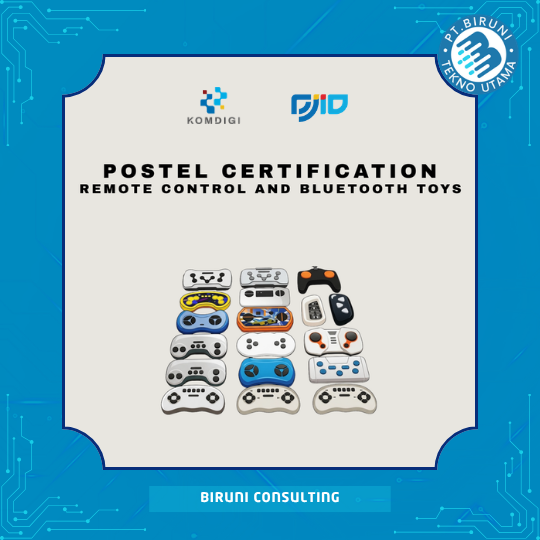
Guide to DJID/SDPPI Certification Requirements for Remote Control and Bluetooth Toys
Remote control toys are widely used by children and collectors, including remote-controlled cars, airplanes, helicopters, boats, robots, and various types of toy vehicles. These products are operated through a remote controller that communicates wirelessly with the main device.
Because wireless communication is used, an important question is whether remote control toys and Bluetooth-enabled toys are required to obtain Postel or DJID/SDPPI Certification before being imported and marketed in Indonesia.
The answer cannot be determined solely based on the product name. The assessment needs to consider the communication technology used, operating frequency, transmission power, wireless module, and technical characteristics of the device.
Under the current regulatory framework, telecommunications equipment and/or device certification is regulated by Minister of Communication and Informatics Regulation No. 3 of 2024 concerning Certification of Telecommunications Equipment and/or Devices. This regulation revoked and replaced Minister of Communication and Informatics Regulation No. 16 of 2018.
Why Are Remote Control Toys Related to Postel Certification?
Remote control toys generally have a transmitter in the remote controller and a receiver in the toy. The transmitter sends radio signals to provide commands to the receiving device.
These commands may include:
- Moving forward and backward.
- Turning right and left.
- Stopping.
- Moving upward and downward.
- Adjusting speed.
- Activating lights or sounds.
- Operating other additional functions.
When communication between the remote controller and the toy uses radio waves, the product has a wireless communication function that needs to be assessed under telecommunications regulations.
Therefore, being a children’s toy does not automatically mean that a remote control toy is exempt from Postel assessment when it incorporates radio communication functions.
Are All Remote Control Toys Required to Obtain Postel Certification?
Not all remote control toys can automatically be classified as requiring certification solely based on their product category.
An assessment needs to be carried out based on the technology used. For example, a toy may use:
- Proprietary RF.
- Bluetooth.
- WiFi.
- Short Range Device (SRD) technology.
- Other wireless technologies.
Minister of Communication and Informatics Regulation No. 2 of 2023 concerning Radio Frequency Spectrum Use Based on Class License includes Bluetooth IEEE 802.15.1, NFC, RFID, UWB, LR-WPAN, devices with transmission power below 10 mW, and other SRDs according to technical standards established by the Minister as SRD groups.
However, classification as an SRD or the use of low transmission power should not automatically be interpreted as an exemption from certification. Certification requirements and technical standards still need to be assessed based on the device’s characteristics.
Postel Certification for Bluetooth Remote Control Toys
Bluetooth is a technology commonly used in modern toys. Examples include toy cars or robots that can be controlled through smartphones.
Bluetooth is specifically included in the SRD group under Minister of Communication and Informatics Regulation No. 2 of 2023.
For Bluetooth toys, the following information needs to be assessed:
- Bluetooth version.
- Operating frequency.
- Transmit power.
- Bluetooth module.
- Antenna.
- Modulation.
- Communication configuration.
- Module datasheet.
This information is required to determine the communication characteristics of the device and the applicable technical requirements.
Does a 2.4 GHz Remote Control Toy Require Postel Certification?
Many remote control toys operate at 2.4 GHz. However, information stating only “2.4 GHz” is not sufficient to determine whether the product requires certification.
The frequency can be used by various technologies, including:
- Bluetooth.
- WiFi.
- Proprietary RF.
- Other SRD technologies.
Therefore, the assessment needs to consider the frequency together with the technology, transmission power, bandwidth, modulation, and transmitter characteristics.
For example, two toys may both operate at 2.4 GHz but use different RF modules. The applicable technical requirements may therefore differ depending on the characteristics of each device.
Remote Control Toys with RF Below 10 mW
Transmission power is one of the important parameters when assessing remote control toys.
Minister of Communication and Informatics Regulation No. 2 of 2023 includes telecommunications equipment and/or devices with transmission power below 10 mW within the SRD group.
However, transmission power below 10 mW does not automatically mean that the product does not require certification.
Minister of Communication and Informatics Regulation No. 3 of 2024 provides that telecommunications equipment and/or devices subject to Technical Standards demonstrate compliance through a Certificate. The regulation also contains specific provisions for other devices with telecommunications features using transmission power below 10 mW and having only one telecommunications feature of the same type.
Therefore, a complete review of the product specifications is still required to determine the certification requirement accurately.
Remote Control Toys with WiFi
In addition to Bluetooth, some toys may use WiFi and be controlled through smartphone applications.
WiFi is included in the Radio Local Area Network (RLAN) group. Minister of Communication and Informatics Regulation No. 2 of 2023 includes IEEE 802.11 or WLAN standards within the RLAN group.
For toys with WiFi, the following specifications need to be assessed:
- WiFi standard.
- Operating frequency.
- Channel.
- Bandwidth.
- Transmission power.
- Antenna.
- Wireless module.
If the product uses both WiFi and Bluetooth, both wireless functions need to be assessed based on their respective characteristics.
Differences Between RF, Bluetooth, and WiFi Toys
Although all three use wireless communication, they do not necessarily have the same technical configuration.
Proprietary RF toys generally use dedicated transmitters and receivers designed to communicate between the remote controller and the toy.
Bluetooth toys use Bluetooth technology to communicate with compatible devices, including smartphones or specific controllers.
WiFi toys use a WLAN network and, in some products, can be controlled through a smartphone application.
These technological differences are important because they determine the applicable technical standards and testing parameters that need to be assessed.
Regulatory Basis for Postel Certification of Remote Control Toys
Minister of Communication and Informatics Regulation No. 3 of 2024
Minister of Communication and Informatics Regulation No. 3 of 2024 regulates certification of telecommunications equipment and/or devices. The regulation provides that compliance with Technical Standards for each brand, type, and country of manufacture is generally carried out through testing. Devices that comply with the applicable Technical Standards are demonstrated through a Certificate.
Minister of Communication and Informatics Regulation No. 2 of 2023
Minister of Communication and Informatics Regulation No. 2 of 2023 regulates radio frequency spectrum use based on Class License. It covers RLAN, LPWAN, SRD, Class-License-based IMT, and PMR groups. For SRD, one of the technologies specifically mentioned is Bluetooth IEEE 802.15.1.
Therefore, assessment of remote control toys using Bluetooth or other wireless technologies needs to consider both spectrum usage requirements and device certification requirements.
Documents Required for Remote Control Toy Postel Assessment
Before determining the certification requirement, importers should prepare the product’s technical documentation.
The required documents may include:
- Toy photographs.
- Remote controller photographs.
- Product label photographs.
- Brand.
- Model or type.
- Datasheet.
- User manual.
- Remote controller specifications.
- Receiver specifications.
- RF module datasheet.
- Operating frequency.
- Transmission power.
- Bandwidth.
- Modulation.
- Antenna specification.
- Bluetooth specification, where available.
- WiFi specification, where available.
- Block diagram, where available.
- Manufacturer test report, where available.
These documents can be used for the initial assessment before determining the certification process.
Postel Certification Process for Remote Control and Bluetooth Toys
The process begins with identifying the product, brand, model, remote controller, and receiver incorporated into the toy.
The communication technology is then identified. If the device uses RF, Bluetooth, WiFi, or another wireless technology, the communication module specifications are reviewed.
The frequency, transmission power, bandwidth, modulation, antenna, and other technical parameters are then assessed.
If the assessment determines that the device falls into a category subject to Technical Standards, the process continues with testing according to the applicable Technical Standard. Minister of Communication and Informatics Regulation No. 3 of 2024 provides that compliance with Technical Standards is carried out through testing and demonstrated through a Certificate.
Once the technical requirements have been fulfilled, the certification process can continue until the Certificate is issued.
Is Certification Required for the Toy or the Bluetooth Module?
This needs to be assessed based on the product configuration and applicable certification requirements.
Minister of Communication and Informatics Regulation No. 3 of 2024 provides for Technical Standard compliance based on the brand, type, and country of manufacture of the telecommunications equipment and/or device.
Therefore, the certification requirement should not be determined solely based on a component name such as “Bluetooth module.” The way the module is used and integrated into the product intended for trade or use in Indonesia needs to be assessed.
Risks of Selling Wireless Toys Without Meeting the Requirements
If a product is classified as telecommunications equipment and/or a telecommunications device subject to Technical Standards but is marketed without the required Certificate, it may become subject to regulatory supervision.
Minister of Communication and Informatics Regulation No. 3 of 2024 regulates supervision of Certificates, labels, and conformity of devices with the Technical Standards referenced by the Certificate.
Therefore, assessment should be completed before importation and marketing, particularly for toys incorporating RF transmitters, Bluetooth, WiFi, or other wireless technologies.
Conclusion
Remote control and Bluetooth toys cannot automatically be classified as requiring or being exempt from Postel Certification solely based on their product name.
The certification requirement must be determined based on the communication technology used and its technical specifications.
For products using RF, Bluetooth, WiFi, or other wireless technologies, the main parameters that need to be assessed include:
- Operating frequency.
- Transmission power.
- Bandwidth.
- Modulation.
- Antenna.
- Wireless communication module.
- Device configuration.
Bluetooth itself is included in the SRD group referred to in Minister of Communication and Informatics Regulation No. 2 of 2023, while the current certification framework for telecommunications equipment and/or devices includes Minister of Communication and Informatics Regulation No. 3 of 2024.
Therefore, to determine whether a remote control toy or Bluetooth toy requires Postel/DJID certification, the most appropriate approach is to conduct a technical assessment based on the product datasheet and RF specifications, rather than relying only on the product name or HS Code.
Contact Us
Biruni Consulting assists with DJID/SDPPI assessment and certification for various wireless products, including remote control toys, Bluetooth toys, WiFi toys, and products incorporating RF modules.
We assist with:
- DJID/SDPPI certification requirement analysis.
- RF specification assessment.
- Frequency and transmission power assessment.
- Bluetooth and WiFi technology identification.
- RF module assessment.
- Certification document preparation.
- Laboratory testing coordination where required.
- Certification assistance until the Certificate is issued.
If you have a remote control toy that will be imported or marketed in Indonesia, prepare the product photographs, remote controller photographs, brand, type/model, frequency, and RF module datasheet for an initial assessment of the DJID/SDPPI certification requirements