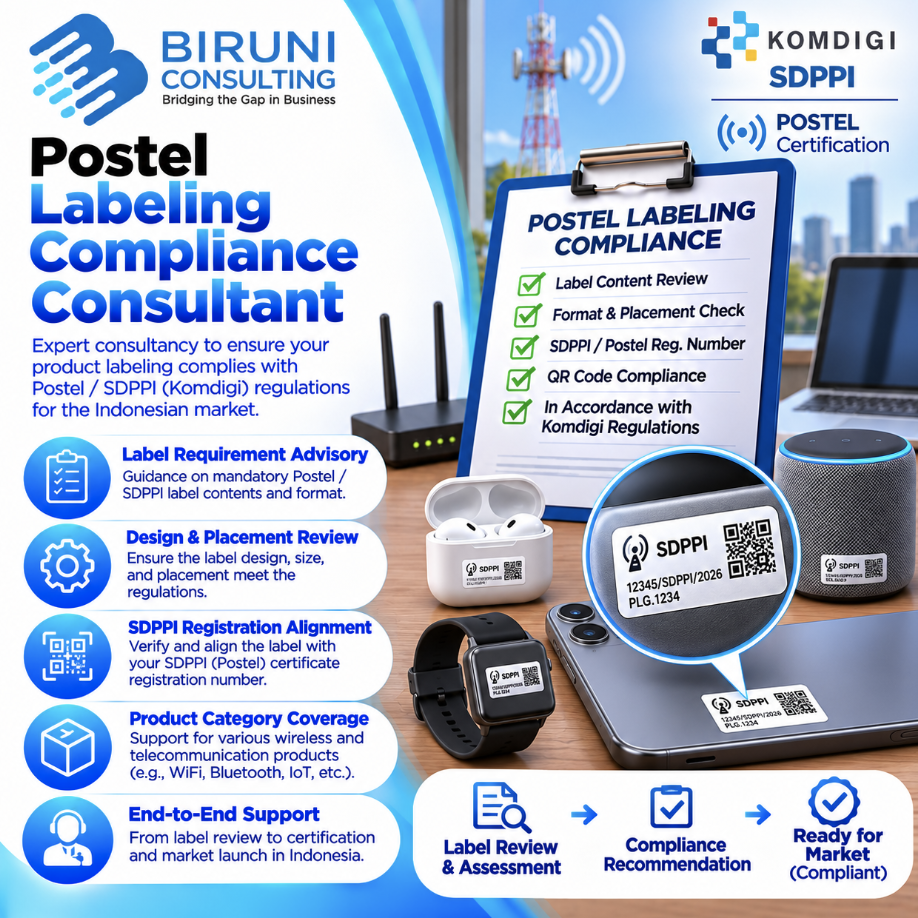
Consulting services for DJID/SDPPI Certificate labels, PLG ID, QR Codes, warning signs, product artwork, and labeling compliance in Indonesia
Obtaining a DJID/SDPPI Certificate is not the final compliance step. Certificate holders must also implement the required certification marking on the equipment and its packaging, including the Certificate number, PLG ID, QR Code, and Warning Sign in accordance with the applicable requirements.
Minister of Communication and Informatics Regulation Number 3 of 2024 requires Certificate holders to apply certification labels to certified telecommunications equipment. The required labeling elements include the Certificate number and PLG ID, QR Code, and Warning Sign. JDIH Komdigi
Labeling problems can arise when the wrong Certificate number is used, the PLG ID belongs to another Certificate holder, a printed QR Code cannot be scanned, the marking is placed incorrectly, or mass-production artwork is approved before the final Certificate information is available.
What Is Postel Labeling?
Postel labeling is the application of DJID/SDPPI certification information to certified telecommunications equipment.
Regulation Number 3 of 2024 requires the label to display the Certificate number and PLG ID, a QR Code, and a Warning Sign. JDIH Komdigi
The QR Code itself contains at least the Certificate number, PLG ID, equipment brand, equipment type, and other data contained in the Certificate.
Postel labeling is therefore more than simply placing a certification logo or the words “Postel Certified” on the product.
Certificate Number and PLG ID
The Certificate number identifies the individual Certificate issued for the equipment.
PLG ID is the unique registration identity of the Certificate holder within the certification-service system.
Both are required elements of the official label format.
The annex to Regulation Number 3 of 2024 allows the size and colour of the text to be adapted to the labeling medium, provided that the information remains clearly readable. JDIH Komdigi
This allows some flexibility in product artwork without removing the readability requirement.
Certification QR Code
The certification QR Code should not be recreated from estimated or manually entered data.
Regulation Number 3 of 2024 states that the QR Code is generated by the Certification Service Facility for every Certificate issued. Its size and colour may be adapted to the labeling medium provided that it remains readable by a scanner. JDIH Komdigi
Before final production approval, the printed QR Code should be checked for scanability.
Very small dimensions, poor contrast, low-resolution printing, or modification of the QR pattern can create practical problems.
Warning Sign
The Warning Sign is also part of the labeling framework.
Under Regulation Number 3 of 2024, it contains information prohibiting specification changes that could cause physical and/or electromagnetic interference to the surrounding environment. JDIH Komdigi
Its size and colour can be adapted to the labeling medium as long as the warning remains readable.
Manufacturers should therefore use the applicable official format rather than inventing an unrelated warning statement.
Where Should the Label Be Applied?
As a general rule, certification labeling is applied to both:
- the telecommunications equipment; and
- its packaging or wrapping.
Where the equipment is too small to accommodate the label, Regulation Number 3 of 2024 allows the label to be applied only to the packaging or wrapping. JDIH Komdigi
This can be particularly relevant for compact products such as trackers, dongles, sensors, earbuds, modules, and wearable devices.
The small-product provision should nevertheless be evaluated against the actual physical product rather than treated as an automatic labeling shortcut.
Permitted Labeling Methods
The regulation provides flexibility in how the labeling is implemented.
The marking may be embossed, debossed, printed, attached or affixed, or implemented digitally on the equipment. JDIH Komdigi
The appropriate method depends on the physical design of the product and its packaging.
A permanent rating plate may incorporate the certification information, while another device may use a dedicated sticker or a permitted digital implementation.
Artwork Review Before Mass Production
Imported products are frequently manufactured overseas, and packaging artwork may be locked several weeks before commercial production.
It is useful to reserve sufficient space for Indonesian regulatory information at the design stage.
However, the final Certificate number, PLG ID, and QR Code must correspond to the actual Certificate.
Because the certification QR Code is generated for the issued Certificate, a temporary or internally generated QR Code should not be treated as the final regulatory QR Code. JDIH Komdigi
Product labels, retail boxes, cartons, stickers, engravings, rating plates, and digital-label arrangements can therefore be reviewed before final printing approval.
Brand and Model Consistency
Labeling should remain consistent with the equipment covered by the Certificate.
The certification QR Code includes the equipment brand and type recorded in the Certificate. JDIH Komdigi
Changes to the brand, model number, product suffix, or regional version should therefore be reviewed carefully.
A visually similar model should not use another product’s Certificate number or QR Code merely because its enclosure or radio specifications appear similar.
OEM and Private-Label Products
OEM/private-label products require particular attention to artwork control.
One factory may manufacture similar hardware for several commercial brands, but each final product can have different certification identification.
Certificate numbers, PLG IDs, QR Codes, brand information, and product types need to match the appropriate certification configuration.
Controlled artwork should therefore be maintained for every certified brand and model produced by the factory.
Multiple Product Variants
A product family can contain different colours, capacities, dimensions, or cosmetic variants.
Before one certification label is used across all variants, the actual Certificate coverage should be confirmed.
Labeling cannot be used to extend certification to a model that is not actually covered.
Brand, type/model, country of manufacture, Certificate scope, and relevant technical configuration should be checked before artwork is released across multiple variants.
Reporting Label Implementation
Label implementation must also be reported after Certificate issuance.
The current e-Sertifikasi NextGen portal states that Certificate holders must report implementation of the Label, QR Code, and Warning Sign within 30 working days after Certificate issuance by uploading photographs of the marked equipment. e-Sertifikasi NextGen
The text of Regulation Number 3 of 2024 itself refers to reporting proof of label implementation within 30 days after Certificate issuance through the Certification Service Facility. JDIH Komdigi
For operational compliance, Certificate holders should follow the current e-Sertifikasi instructions and avoid delaying the submission.
Photographic Evidence
Label reporting requires evidence of implementation.
Regulation Number 3 of 2024 specifies the uploading of photographs of equipment on which the label has been applied. JDIH Komdigi
The photographs should therefore show the relevant marking clearly enough for the implementation to be verified.
For imported equipment, the Certificate holder and overseas manufacturer should coordinate so that appropriately marked production samples are available for this documentation.
Risks of Non-Compliance
Labeling is part of the Certificate holder’s regulatory obligations and is subject to supervision.
Regulation Number 3 of 2024 provides for supervision through Certificate checks, label checks, and checks of product conformity with the Technical Standards referenced in the Certificate. JDIH Komdigi
Failure to apply the required label can lead to written warnings and, under the escalation mechanism in the regulation, suspension of certification services for six months. Failure to submit the required labeling report is also subject to an administrative-warning and escalation process. JDIH Komdigi
Labeling should therefore be treated as a compliance requirement rather than simply a packaging-design task.
Common Labeling Issues
Typical issues include an incorrect Certificate number, a PLG ID belonging to another Certificate holder, a mismatched QR Code, an unreadable printed QR Code, a product brand or model that does not match the Certificate, or packaging artwork copied from a previous model.
Problems can also arise when a supplier changes the production factory, model variant, or product configuration while continuing to use old certification artwork.
A controlled artwork-approval process linked to the exact Certificate helps reduce these risks.
Labeling Before Importation
For commercial imports, labeling compliance should ideally be planned before shipment.
Once the final Certificate information is available, the overseas manufacturer can implement the correct marking during production.
This is generally easier to control than relabeling a large commercial shipment after arrival.
However, mass-production artwork should not be released using provisional Certificate data that has not been verified.
Our Postel Labeling Compliance Process
The assessment normally begins with a review of the DJID/SDPPI Certificate and the exact product identity.
The Certificate number, PLG ID, QR Code, Warning Sign, brand, model/type, product label, and packaging artwork are then checked.
The proposed placement and labeling method are compared with Regulation Number 3 of 2024.
Once the artwork is aligned, the company can prepare production samples, photographic evidence, and the required implementation reporting through e-Sertifikasi.
Conclusion
Postel labeling compliance is an important obligation after DJID/SDPPI Certification.
Regulation Number 3 of 2024 requires labeling that includes the Certificate number and PLG ID, QR Code, and Warning Sign. Marking is generally required on both the equipment and packaging, with a specific provision for equipment that is too small. The regulation also permits several implementation methods, including printing, affixing, embossing/debossing, and digital labeling. JDIH Komdigi
The current e-Sertifikasi portal additionally requires Certificate holders to report implementation of the Label, QR Code, and Warning Sign by uploading photographs of the marked equipment. e-Sertifikasi NextGen
Reviewing labeling before mass production can help ensure that the artwork, Certificate number, PLG ID, QR Code, brand, model, label placement, and packaging are correctly aligned before commercial production or shipment.
Contact Us
Biruni Consulting assists with DJID/SDPPI assessment and certification for Postel labeling compliance and various wireless products that will be imported or marketed in Indonesia.
Our services include:
- Assessment of DJID/SDPPI certification requirements.
- Label and QR Code format assessment.
- RF specification review.
- Frequency and transmission power analysis.
- Technical document review.
- Certification document preparation.
- Testing coordination where required.
- DJID/SDPPI Certification assistance.
If you have a product that has received or will receive DJID/SDPPI Certification, you can prepare product photos, brand, model, datasheet, RF specifications, and labeling artwork for an initial assessment of the Postel labeling requirements.