
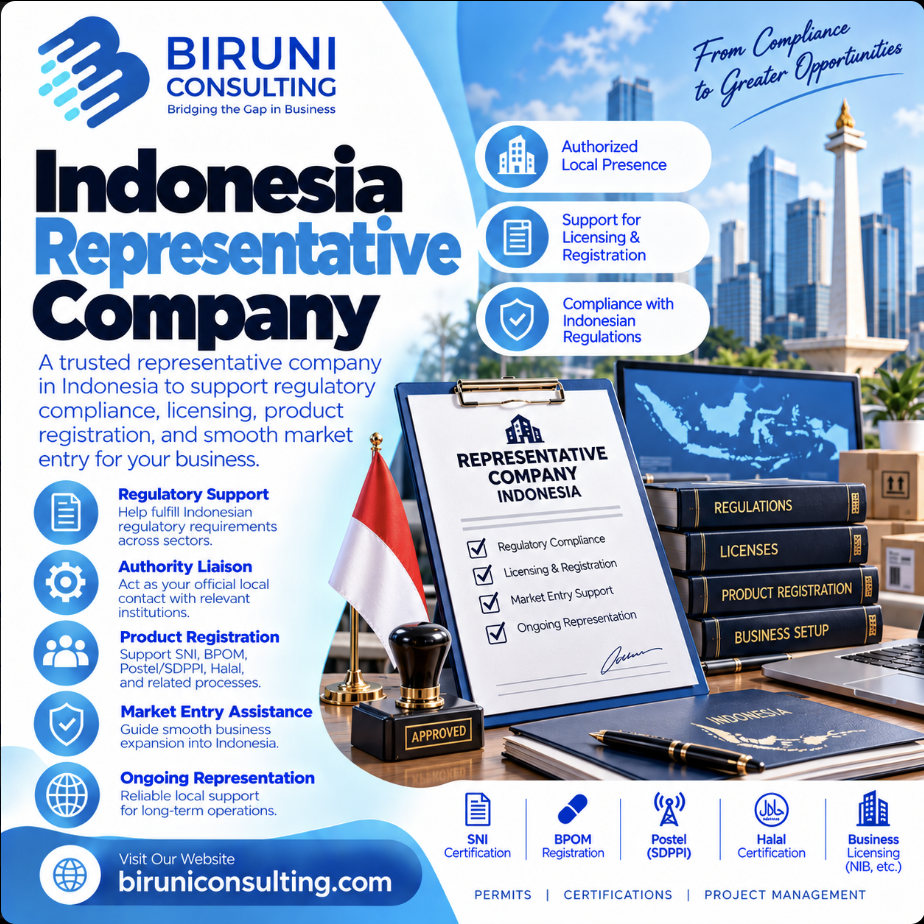
Representative Company in Indonesia for Overseas Manufacturers and SNI Certification
An Indonesia Representative Company is an Indonesian legal entity that may be appointed by an Overseas Manufacturer to perform representation functions according to the applicable product regulations. In the context of several mandatory SNI regulations issued by the Ministry of Industry, the official term used for this function is Perwakilan Resmi, or Official Representative.
A Representative Company may be an important part of the certification process for imported products. Depending on the product, an Official Representative may be involved in SNI Certificate applications, trademark licensing, warehouse management, SIINas, coordination with importers, SPPT SNI processing, certification surveillance, and fulfillment of obligations concerning products distributed in Indonesia.
However, not all imported products require the same Indonesia Representative Company structure. Requirements must be reviewed according to the product and its regulation. For example, mandatory SNI regulations for lubricating oils, tires, motor vehicle wheels, and motor vehicle safety glass all use the concept of an Official Representative for Overseas Manufacturers, although their detailed obligations are not identical.
What Is an Indonesia Representative Company?
In the context of SNI certification, an Indonesia Representative Company can be understood as an Indonesian legal entity officially appointed to represent an Overseas Manufacturer in fulfilling certain regulatory obligations.
Commercial terms such as Representative Company, Local Representative, and Official Representative are commonly used in business communication. Under mandatory SNI regulations, companies need to pay attention to the legal terminology used in the applicable regulation, namely Perwakilan Resmi.
For example, motor vehicle wheel SNI requirements specify Official Representative documentation including the company’s deed of establishment, business licensing, evidence of Official Representative appointment, trademark licensing, evidence of license registration, and evidence of warehouse control.
Therefore, the function of a Representative Company is considerably broader than merely providing a local address or acting as a correspondence party for a foreign manufacturer.
Does a Foreign Company Need a Representative Company in Indonesia?
The need for a Representative Company must be determined according to the product regulation.
For certain products subject to mandatory SNI, an Overseas Manufacturer is required to have an Official Representative. Lubricating oil is one example under Minister of Industry Regulation No. 8 of 2025, which is currently in force and replaced Minister of Industry Regulation No. 25 of 2018.
Similar requirements apply to other automotive products. Tires are regulated under Minister of Industry Regulation No. 9 of 2025, while motor vehicle safety glass is regulated under Minister of Industry Regulation No. 15 of 2025. Both regulations are currently in force.
Foreign companies should therefore conduct a regulatory assessment before appointing a Representative Company. The assessment determines whether the product actually requires an Official Representative and what requirements need to be fulfilled.
Functions of an Indonesia Representative Company
Representative Company functions may differ depending on the product, but under mandatory SNI schemes for imported products the main functions may include:
- Representing the Overseas Manufacturer in Indonesia.
- Supporting SNI Certificate applications.
- Managing official appointment documentation.
- Holding or managing trademark-use licenses.
- Fulfilling warehouse requirements.
- Maintaining and using an SIINas account.
- Coordinating with Product Certification Bodies.
- Coordinating with testing laboratories.
- Coordinating with importers.
- Processing SPPT SNI where required.
- Supporting surveillance and factory audits.
- Managing certification data amendments.
These functions demonstrate that a Representative Company may have responsibilities throughout the certification life cycle rather than only during the initial application.
Indonesia Representative Company Requirements
Requirements need to follow the Minister of Industry Regulation applicable to the relevant product. Several elements frequently found in mandatory SNI regulations are described below.
1. Indonesian Legal Entity
Under several certification schemes, an Official Representative is required to be a legal entity established and domiciled in Indonesia.
Therefore, appointing an individual, an agent without an appropriate legal structure, or merely a correspondence address may not satisfy the Official Representative requirement.
Companies need to review the entity structure, legality, NIB, and relevant business licensing before making the appointment.
2. Appointment by the Overseas Manufacturer
The Representative Company must have an appointment relationship with the Overseas Manufacturer that can be properly demonstrated.
The form of evidence may be regulated in detail. Under the motor vehicle wheel requirements, for example, evidence of appointment as Official Representative must take the form of an authentic deed executed before a notary within the jurisdiction of Indonesia.
Companies should therefore not assume that a simple appointment letter is sufficient for every SNI scheme.
3. Trademark-Use License
The trademark is an important part of the relationship between the Overseas Manufacturer and Representative Company.
Where required, the manufacturer needs to grant the Official Representative a license to use the trademark. Regulations may also require the licensing agreement to be registered with the Directorate General of Intellectual Property.
For motor vehicle wheels, for example, the required documentation includes a class 12 trademark licensing agreement from the Overseas Manufacturer to the Official Representative and evidence that the license has been registered with the Directorate General of Intellectual Property.
Trademark class requirements differ by product and should not be generalized.
4. Warehouse Control
A warehouse is an important requirement under several Official Representative schemes.
For motor vehicle wheels, evidence of warehouse control in the same regency/city or the nearest regency/city to the Official Representative’s registered location is among the required documents.
The motor vehicle safety glass regulation also uses the Official Representative warehouse concept. Under certain conditions, the relationship between the Official Representative, importer, and warehouse is specifically regulated by Minister of Industry Regulation No. 15 of 2025.
Therefore, warehouse arrangements should not be postponed until certification has been completed.
5. SIINas Account
SIINas, or the National Industrial Information System, is used for various mandatory SNI processes administered by the Ministry of Industry.
For several products, SNI Certificate and SPPT SNI processes are submitted electronically through SIINas. The Representative Company needs to ensure that company information and system access are available before starting the application.
Information entered into SIINas must also be consistent with company, manufacturer, trademark, warehouse, and certification documents.
Indonesia Representative Company and SNI Certification
A Representative Company may have a direct role in certification for products manufactured outside Indonesia.
Product Identification
The first stage is to identify the product intended for the market.
Information to review may include:
- Product name.
- Product function.
- Trademark.
- Model or type.
- Material.
- Technical specifications.
- HS code.
- Country of origin.
- Manufacturer name.
- Factory location.
This information is used to determine whether the product falls within the mandatory SNI scope.
Regulatory Identification
After identifying the product, the company needs to determine the SNI and mandatory implementation regulation that applies.
This is important because the existence of an SNI does not automatically mean product certification is mandatory. The obligation must be based on the applicable mandatory regulation.
For automotive products, for example, tires, wheels, safety glass, and lubricating oils are regulated separately.
Appointment of the Representative Company
Where the regulation requires an Official Representative, the Overseas Manufacturer appoints an Indonesian legal entity that satisfies the requirements.
Appointment documentation must be prepared according to the form and conditions applicable to the product.
Trademark Document Preparation
The manufacturer needs to ensure that the trademark used for the product has a clear legal basis.
Where the Representative Company is required to obtain a trademark license, the licensing agreement and its registration need to be completed according to the applicable provisions before or during certification.
Warehouse Preparation
Where warehouse control is required, the company needs to determine the warehouse location and prepare evidence of control.
The warehouse address needs to remain consistent with certification information and the actual product distribution structure.
Certification Application
The application is then submitted through the applicable mechanism.
Information concerning the Representative Company, Overseas Manufacturer, factory, trademark, products, and other relevant details needs to remain consistent between SIINas, application documents, and supporting documentation.
Product Testing
Product samples may be taken and sent to a qualified laboratory for testing according to the applicable SNI.
The Representative Company may assist with coordination between the Overseas Manufacturer, Product Certification Body, laboratory, and other involved parties.
Factory Audit
For products using a type 5 certification system, the process may include an audit of the overseas production facility.
The audit may assess production processes, raw materials, facilities, quality controls, testing equipment, traceability, and quality management systems.
SNI Certificate Issuance
If the conformity assessment results satisfy the requirements, the Product Certification Body may issue an SNI Certificate according to the approved scope.
Under several imported-product schemes, Official Representative and warehouse information may form part of the certificate or associated certification data.
SPPT SNI Processing
After the SNI Certificate has been issued, certain products still require approval for use of the SNI Mark in the form of SPPT SNI.
For lubricating oils, for example, the regulation provides for electronic SPPT SNI applications through SIINas and specifically refers to the Official Representative within the application mechanism.
Indonesia Representative Company Documents
Document requirements depend on the product, but may generally include:
- Company deed of establishment and amendments.
- NIB.
- Business licensing.
- Company tax documentation.
- Evidence of appointment by the Overseas Manufacturer.
- Overseas Manufacturer legal documents.
- Trademark ownership documents.
- Trademark licensing agreement.
- Evidence of trademark license registration.
- Evidence of warehouse control.
- SIINas account.
- Product list.
- Importer information.
- Product technical documents.
- Additional documents required by the regulation and Product Certification Body.
Under certain schemes, Overseas Manufacturer documents may require legalization and Indonesian-language translation. Companies should therefore complete a document review before submitting the certification application.
Are a Representative Company and an Importer the Same?
A Representative Company and an importer are not always the same business entity.
The Representative Company performs the function of Official Representative of the manufacturer under the relevant product regulation, while an importer conducts importation activities according to its licenses and trade requirements.
Certain regulations allow the Official Representative to act as the importer. Under other circumstances, the Official Representative may appoint an importer if specified conditions are fulfilled.
Minister of Industry Regulation No. 15 of 2025 concerning motor vehicle safety glass, for example, establishes specific circumstances in which an Official Representative may appoint an importer for glass used as raw material by the motor vehicle assembly industry. The importer must satisfy specific requirements concerning corporate relationships, appointment documentation, and joint warehouse control.
Therefore, having an importer does not necessarily mean that the company has an Official Representative that fulfills regulatory requirements.
Are a Representative Company and Distributor the Same?
A distributor and Representative Company also perform different functions.
A distributor primarily focuses on selling and distributing products. An Official Representative has a direct regulatory relationship with the Overseas Manufacturer.
One legal entity may perform both functions where permitted by regulation and supported by appropriate licenses. However, distributor status does not automatically mean that a company qualifies as an Official Representative.
Before appointing an existing distributor as Representative Company, the manufacturer needs to review its legality, licenses, warehouse, trademark arrangements, SIINas access, and ability to perform certification obligations.
Representative Company for Automotive Parts
An Indonesia Representative Company is particularly relevant to automotive-component manufacturers because several automotive products are subject to mandatory SNI.
Representative Company for Tires
Motor vehicle tires are currently regulated under Minister of Industry Regulation No. 9 of 2025 concerning mandatory SNI for tires. The regulation has been in force since July 24, 2025 and revoked the previous mandatory regulation.
Overseas tire manufacturers falling within the scheme need to consider Official Representative, trademark, documentation, warehouse, importation, and certification requirements.
Representative Company for Motor Vehicle Wheels
Motor vehicle wheels in categories M, N, O, and L are subject to Official Representative requirements under Minister of Industry Regulation No. 71 of 2024.
Required Official Representative documents include company legality, appointment through an authentic deed, trademark license, license registration, and evidence of warehouse control.
Representative Company for Safety Glass
Motor vehicle safety glass is currently regulated under Minister of Industry Regulation No. 15 of 2025, which has been effective since October 25, 2025.
The regulation also limits the Official Representative structure. An Overseas Manufacturer may appoint only one Official Representative, while an Official Representative generally represents only one manufacturer, subject to specified exceptions for qualifying corporate-group relationships.
Representative Company for Lubricants
Lubricating oils are regulated under Minister of Industry Regulation No. 8 of 2025 concerning mandatory SNI for lubricating oils, which has been effective since July 24, 2025.
The imported-product scheme uses an Official Representative and includes obligations involving SNI Certificates, SPPT SNI, trademarks, importation, and specified import realization information.
Can One Representative Company Represent Multiple Manufacturers?
This should not be assumed.
Under several mandatory SNI regulations, the general principle is that one Overseas Manufacturer may appoint only one Official Representative and one Official Representative represents only one manufacturer.
However, specified exceptions may apply for companies belonging to the same corporate group.
Minister of Industry Regulation No. 15 of 2025 concerning motor vehicle safety glass, for example, permits an Official Representative to represent more than one Overseas Manufacturer where the manufacturers have qualifying parent-company, common-parent subsidiary, or subsidiary relationships under the conditions established by the regulation.
Companies therefore need to demonstrate the corporate-group structure before using one Representative Company for several manufacturers.
Can an Indonesia Representative Company Be Replaced?
Replacement of a Representative Company may have significant certification consequences.
Under several regulations, changing the Official Representative before the SNI Certificate expires results in the SNI Certificate being considered expired.
Minister of Industry Regulation No. 15 of 2025 concerning motor vehicle safety glass expressly provides that where an Overseas Manufacturer changes its Official Representative before the SNI Certificate expires, the validity of the SNI Certificate ends.
Selection of a Representative Company should therefore consider the representative’s ability to support long-term regulatory compliance.
Responsibilities After the SNI Certificate Is Issued
Representative Company responsibilities do not necessarily end when the SNI Certificate is issued.
The company may remain involved in:
- SPPT SNI processing and renewal.
- Certification surveillance.
- Factory audit coordination.
- Product sampling and sample shipment.
- Trademark changes.
- Model or type changes.
- Importer information changes.
- Warehouse changes.
- Coordination with the Product Certification Body.
- Control of SNI Mark use.
Because type 5 certification includes surveillance mechanisms, the relationship between the manufacturer and Representative Company needs to continue while the certificate is in use.
Indonesia Representative Company for Imported Products
Foreign manufacturers planning to enter the Indonesian market should establish their regulatory structure before commercial shipments begin.
The initial assessment should include HS code, SNI, technical regulations, mandatory or voluntary status, Representative Company requirements, importer requirements, and other product-specific obligations.
After this structure has been identified, the manufacturer can determine whether the Representative Company will also act as importer or only perform the Official Representative function.
This approach helps prevent situations where the SNI Certificate process has already started but the trademark, importer, or warehouse structure does not meet regulatory requirements.
Indonesia Representative Company Cost
There is no single official fee applicable to all Indonesia Representative Company services.
Costs may vary according to:
- Product type.
- Applicable regulation.
- Scope of responsibility.
- Cooperation period.
- Trademark licensing requirements.
- Warehouse requirements.
- SIINas administration.
- Number of importers.
- SPPT SNI processing.
- Surveillance and certification amendments.
Representative Company costs also need to be distinguished from Product Certification Body fees, laboratory testing, factory audits, auditor travel, warehouse expenses, translation, document legalization, and importation costs.
Therefore, cost estimates should be prepared after the product and applicable regulatory requirements have been identified.
How Long Does It Take to Prepare an Indonesia Representative Company?
The preparation period depends on the conditions of each project.
Where an Indonesian legal entity is already available, preparation may focus on appointment documentation, trademark licensing, license registration, warehouse arrangements, SIINas, and certification documents.
Where this structure does not yet exist, preparation may take longer because all regulatory elements need to be fulfilled before the SNI Certificate application can proceed effectively.
The Representative Company should ideally be prepared at the beginning of the regulatory assessment rather than after product auditing or testing has started.
Things to Consider When Selecting a Representative Company in Indonesia
An Overseas Manufacturer should conduct an evaluation before appointing a representative company.
Important considerations include:
- Indonesian legal-entity status.
- Company legality and licensing.
- Experience with product regulations.
- Ability to manage SIINas.
- Ability to manage trademark licensing.
- Availability or control of a warehouse.
- Understanding of the SNI Certificate process.
- Understanding of SPPT SNI.
- Ability to coordinate with Product Certification Bodies.
- Ability to coordinate with laboratories.
- Ability to support overseas factory audits.
- Understanding of importer requirements.
- Ability to manage surveillance.
- Ability to process certificate amendments.
- Ability to maintain compliance throughout the certificate validity period.
Selecting a Representative Company is not merely an administrative decision. For certain products, changing the Official Representative may cause the SNI Certificate to expire, making stability of the cooperation an important consideration.
Conclusion
An Indonesia Representative Company is an Indonesian legal entity that may function as an Official Representative for an Overseas Manufacturer according to the applicable product regulation.
In the context of mandatory SNI, a Representative Company may have responsibilities involving official appointment, trademark licensing, warehouses, SIINas, SNI Certificates, SPPT SNI, importers, audits, surveillance, and certification amendments.
These requirements are not identical for every product. Regulations concerning tires, motor vehicle wheels, safety glass, and lubricating oils demonstrate that Official Representative requirements need to be assessed specifically for each product.
Overseas Manufacturers should establish their Indonesia Representative Company structure before starting certification and importation because the selection or replacement of an Official Representative may affect the certification process and validity of the SNI Certificate.
Contact Us
Biruni Consulting assists companies with Indonesia Representative Company requirements professionally and in accordance with applicable regulations in Indonesia.
Our services include:
- Regulatory consultation.
- Identification of applicable standards.
- Preparation of certification documents.
- Assistance with laboratory testing.
- Certification processing until certificate issuance.
Biruni Consulting can assist Overseas Manufacturers in understanding Representative Company, Official Representative, trademark licensing, warehouse, SIINas, importer, and SNI certification requirements for products intended for the Indonesian market.
Contact Biruni Consulting for Indonesia Representative Company, Official Representative, Local Representative, and imported-product certification assistance in Indonesi