
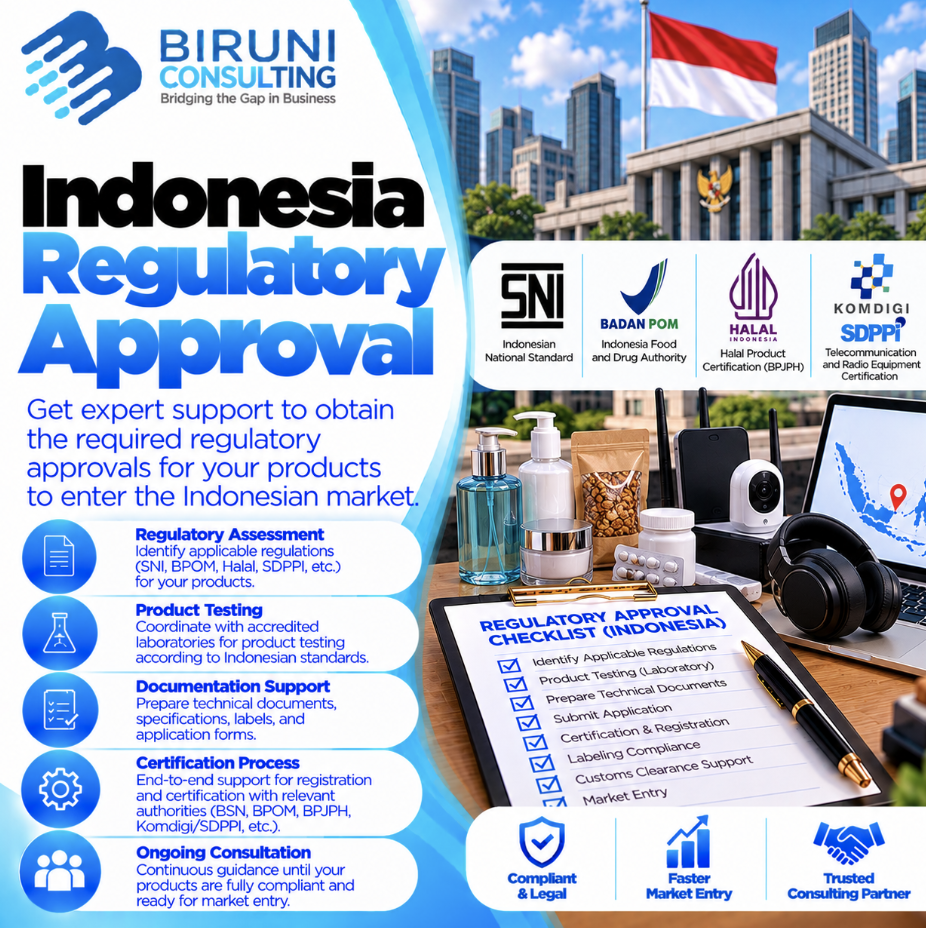
Regulatory Approval Services for Indonesian and Overseas Manufacturers
Indonesia Regulatory Approval is the process of ensuring that companies and products satisfy applicable licensing, certification, registration, testing, labeling, and regulatory-compliance requirements before conducting business or marketing products in Indonesia.
Regulatory approval in Indonesia does not consist of a single permit applicable to every product. The pathway depends on business activities, product category, intended use, technical specifications, manufacturing sites, importer structures, and the regulator with jurisdiction.
A company can require Business Licensing through OSS while its products separately require SNI certification, BPOM registration, halal certification, laboratory testing, technical approval, or another product-specific authorization.
Indonesia’s current Risk-Based Business Licensing framework is governed by Government Regulation No. 28 of 2025. The regulation has been effective since June 5, 2025, revoked Government Regulation No. 5 of 2021, and covers Basic Requirements, Business Licensing, PB UMKU, OSS system services, supervision, evaluation, and sanctions. Database Peraturan | JDIH BPK
Indonesia Regulatory Approval should therefore begin with regulatory assessment to determine which approvals are genuinely required before importation, distribution, commercial launch, or investment decisions.
What Is Indonesia Regulatory Approval?
Indonesia Regulatory Approval covers the overall process for obtaining the legal authorizations required for business activities and products to operate or enter the Indonesian market in accordance with applicable regulations.
Approvals can apply at company level and product level.
At company level, requirements can involve:
- NIB and OSS.
- KBLI.
- Business Licensing.
- PB UMKU.
- Importer or distribution activities.
At product level, requirements can involve SNI certification, BPOM registration, halal certification, technical testing, labeling, or other product-specific approvals.
Regulatory approval should therefore be managed as a roadmap rather than viewed as one certificate.
Why Should Regulatory Assessment Start Early?
One of the most common market-entry mistakes is beginning commercial activity before the regulatory pathway is understood.
A company can appoint a distributor, ship samples, print packaging, or issue purchase orders before discovering that the product requires specified certification or registration.
This can result in duplicated testing, packaging changes, shipment delays, or restructuring of the importer arrangement.
Early regulatory assessment helps determine:
- Which regulator has jurisdiction?
- Which approvals are required?
- Who can serve as applicant?
- Is a local entity or Representative required?
- What obligations apply after approval?
The answers can then be converted into a regulatory roadmap.
Product Classification
Product classification forms the foundation of Indonesia Regulatory Approval.
Companies need to determine what the product is technically and how it is intended to be used.
Information commonly reviewed includes:
- product name;
- intended use;
- materials or ingredients;
- technical specifications;
- models or variants;
- HS code;
- manufacturing site; and
- country of origin.
HS codes support customs and trade assessment but may not be sufficient to determine the complete regulatory pathway.
Two products sharing the same HS code can have different functions or regulatory scopes, while models within one product family can also fall under different approval structures.
Identifying the Appropriate Regulator
After product classification, the relevant regulator needs to be identified.
Certain industrial products can fall within Ministry of Industry frameworks. Food, cosmetics, medicines, traditional medicines, health supplements, and specified product categories are supervised by BPOM. Products within halal requirements fall under the BPJPH framework.
Other products can fall under different ministries or technical authorities.
BPOM itself maintains separate licensing pathways for medicine registration, traditional medicine and health-supplement registration, cosmetic notification, processed-food registration, certain import/export permits, and good manufacturing or distribution practice certifications. Pom Indonesia
“BPOM approval” or “product approval” should therefore not be treated as one universal procedure.
Business Licensing and OSS
Indonesia Regulatory Approval also needs to consider the legal status of the Indonesian entity conducting the activity.
Government Regulation No. 28 of 2025 applies a risk-based approach to Business Licensing and regulates Business Licensing and PB UMKU through the OSS framework. Business Operators need the applicable Business Licensing to conduct their activities. Database Peraturan | JDIH BPK
Regulatory assessment generally needs to review consistency among:
- Business activities.
- KBLI.
- NIB.
- Risk level.
- Business Licensing and PB UMKU.
Having an Indonesian company or NIB does not necessarily mean all product approvals have been completed.
Business licensing and product approval are interconnected but distinct areas.
KBLI and Regulatory Approval
KBLI classifies business activities.
Correct KBLI selection can affect whether an entity is eligible to act as importer, distributor, applicant, or holder of particular approvals.
Changes in KBLI can also affect regulator systems. BPOM, for example, implemented KBLI 2025 in its Risk-Based Processed Food Registration system during July 2026. New account registrations use an NIB with KBLI 2025, while the relevant food category needs to correspond with the KBLI used when obtaining the OSS permit ID. Direktorat Registrasi Pangan Olahan
Business-licensing review should therefore take place before product registration progresses too far.
Difference Between Business Approval and Product Approval
Business approvals provide the legal basis for conducting specified activities.
Product approvals determine whether a particular product satisfies regulatory requirements before production, importation, trading, or circulation.
A company can hold an NIB and Business Licensing while its product still requires an SNI Certificate, BPOM registration, halal certification, or another technical approval.
Conversely, a product approval can require an applicant holding specified Business Licensing.
Both areas therefore need to be managed together.
SNI in Indonesia Regulatory Approval
For many industrial products, Indonesian National Standards can form an important part of regulatory approval.
The existence of an SNI, however, does not automatically make certification mandatory.
Mandatory status arises where the government imposes the standard through a product-specific regulation.
BBSPJIKKP explains that its product certification services cover both Mandatory and Voluntary SNI. Applications for products under Ministry of Industry Mandatory SNI schemes are submitted through SIINas. Kemenperin
An SNI assessment should therefore establish:
- Applicable SNI.
- Standard version.
- Mandatory or voluntary status.
- Product scope under the regulation.
- Applicable certification scheme.
Finding a relevant SNI number alone is not sufficient to conclude that certification is mandatory.
LSPro and Product Certification
An LSPro or Lembaga Sertifikasi Produk / Product Certification Body conducts conformity assessment and certification within its approved scope.
An LSPro performs a different function from a consultant or Testing Laboratory.
BBSPJIKKP explains that product certification is a conformity-assessment process used to confirm that a company maintains an appropriate quality system and can consistently manufacture products meeting applicable standards. Products satisfying requirements can receive a Product Certificate through the LSPro. Kemenperin
LSPro selection should be based on product scope, SNI scope, certification scheme, accreditation, and regulatory appointment where applicable.
SIINas for Mandatory SNI
For many Ministry of Industry Mandatory SNI schemes, SIINas or the National Industrial Information System forms an important part of the application process.
BBSPJIKKP states that certification applications for products under Ministry of Industry Mandatory SNI schemes are submitted through SIINas. Kemenperin
Detailed requirements still depend on the product regulation.
Certain regulations can include specific provisions concerning applicants, Overseas Manufacturers, Official Representatives, importers, manufacturing sites, sampling, SNI Certificates, and SPPT SNI.
A general SNI process should therefore not be applied without reviewing the regulation for the particular product category.
Laboratory Testing
Laboratory testing can form part of various Indonesia Regulatory Approval processes.
Testing can be required for SNI certification, BPOM registration, technical conformity assessment, or another authorization.
Before submitting samples, companies should review:
- Applicable testing parameters.
- Test methods.
- Laboratory scope.
- Sampling procedures.
- Acceptance of test reports.
Existing international test reports cannot necessarily be used automatically.
Under certain schemes, samples can also need to be selected or witnessed by the LSPro, auditor, or another specified party.
Testing should therefore follow confirmation of the regulatory pathway.
Factory Audit
Certain product-certification schemes can involve factory audits.
Audits can review manufacturing processes, incoming-material control, quality assurance, internal testing, calibration, traceability, document control, and corrective actions.
For an Overseas Manufacturer, the audit can take place at a production facility outside Indonesia.
Pre-audit gap analysis can help manufacturers identify readiness issues before formal assessment and reduce corrective actions that could extend the certification process.
Not every product approval includes a factory audit, so the requirement needs to be determined from the applicable scheme.
BPOM Regulatory Approval
BPOM maintains multiple regulatory-approval pathways according to product category.
Its current public licensing services include Medicine Registration, Traditional Medicine and Health Supplement Registration, Cosmetic Notification, Processed Food Registration, specified import/export licensing, and manufacturing or distribution practice certifications. Pom Indonesia
BPOM Regulation No. 27 of 2025 also establishes business-activity and product standards for Risk-Based Business Licensing in the drug and food subsectors as an implementation of Government Regulation No. 28 of 2025. It covers medicines, traditional medicines–health supplements–quasi-drugs–cosmetics, and processed food while integrating licensing processes with OSS. Standar Otskk
The product category therefore needs to be established before developing a BPOM approval strategy.
Processed Food Registration
Processed food produced domestically or imported for retail distribution is generally required to hold the applicable PB UMKU, subject to specified exclusions.
BPOM also explains that processed food still undergoing registration and not yet holding a distribution authorization number cannot be commercially sold or circulated. Registration is conducted electronically through e-Reg RBA integrated with OSS RBA. Direktorat Registrasi Pangan Olahan
An Overseas Food Manufacturer should therefore complete the applicable registration pathway before commercial distribution.
Processed-food requirements should not automatically be applied to cosmetics, supplements, or other BPOM categories.
Cosmetics, Supplements, and Other BPOM Products
Products supervised by BPOM follow different approval mechanisms according to classification.
Cosmetics use a notification mechanism, while traditional medicines, quasi-drugs, and health supplements have their own registration pathways.
BPOM also distinguishes which parties are eligible to apply according to product type, including manufacturers, importers, and qualifying marketing entities in specified circumstances. Direktorat Registrasi OTSKK
Companies should therefore avoid using the same applicant structure across every BPOM product category without product-specific review.
Halal in Indonesia Regulatory Approval
Halal compliance needs to be assessed according to product category and the latest implementation schedule.
The framework changed materially in October 2026. Government Regulation No. 40 of 2026 amended Government Regulation No. 42 of 2024 concerning Halal Product Assurance and became effective on October 14, 2026. JDIH BPJPH
BPJPH subsequently explained that several implementation periods were adjusted. Food, beverages, slaughtered products, and slaughtering services from medium and large businesses remain mandatory halal from October 18, 2024. Several other categories have been extended until October 17, 2028, while foreign food, beverages, slaughtered products, and slaughtering services become subject to mandatory certification from October 18, 2028 after taking mutual-recognition arrangements into account. BPJPH
Companies should therefore not rely on the outdated assumption that every relevant category automatically became mandatory on October 18, 2026.
Foreign Halal Products
Products already holding halal certification outside Indonesia still need to be assessed against the Indonesian halal framework.
BPJPH Regulation No. 4 of 2026 concerning Assurance of Conformity for Foreign Halal Products Entering Indonesia was enacted on August 7, 2026 and is listed as in force in the BPJPH legal database. JDIH BPJPH
Government Regulation No. 40 of 2026 issued in October 2026 also changed the implementation schedule. Recognition, registration, product category, origin, importer structure, and the applicable mandatory date therefore need to be reviewed using the latest framework. BPJPH
A foreign halal certificate should not automatically be treated as completing every Indonesian regulatory requirement.
Labeling Approval and Compliance
Labeling forms an important component of product regulatory approval.
Requirements can include Bahasa Indonesia, product names, ingredients or materials, manufacturer information, importer information, instructions, warnings, registration numbers, halal information, and technical markings.
The exact requirements depend on product category.
Labels should ideally be reviewed before final artwork is mass printed.
Where certification or registration changes required information, packaging already produced can require relabeling.
Importers in Regulatory Approval
Imported products can require an importer meeting applicable Business Licensing and product-specific requirements.
The importer is not automatically the distributor, product-registration holder, or Official Representative.
Regulatory planning should establish:
- Who performs importation.
- Who acts as registration applicant.
- Who holds the approval.
- Who conducts commercial distribution.
- Who manages post-market compliance.
One entity can perform more than one function where regulations and licensing permit, but responsibilities still need to be clearly allocated.
Distributors and Regulatory Control
A distributor generally focuses on commercial distribution, sales, logistics, and market development.
Under certain product categories, the distributor can also act as importer or applicant.
An Overseas Manufacturer needs to understand the consequences where a distributor becomes holder of a regulatory approval.
If the commercial relationship ends, the approval may not always be immediately transferable.
Regulatory ownership should therefore be considered before an exclusive distribution agreement is signed.
Official Representative Indonesia
Under certain product regulations, an Overseas Manufacturer can be required to maintain an Official Representative in Indonesia.
The Official Representative performs a different role from a consultant, importer, distributor, LSPro, or Testing Laboratory.
Requirements can involve an Indonesian legal entity, manufacturer appointment, trademark arrangements, warehouses, SIINas, or importer structures.
Not every imported product requires an Official Representative.
The requirement needs to be established from the specific product regulation.
Regulatory Approval for Overseas Manufacturers
An Overseas Manufacturer can face a more complex regulatory pathway because product approvals often connect an overseas production facility with an Indonesian regulatory structure.
A project can involve:
- Overseas Manufacturer.
- Official Representative where required.
- Importer.
- Distributor.
- LSPro, laboratory, or regulator.
Not every product requires all these parties.
Regulatory assessment is intended to establish the minimum compliant structure without unnecessarily complicating commercial arrangements.
Product Registration Holder
One important Indonesia Regulatory Approval issue is identifying the approval holder.
An Overseas Manufacturer should understand which party legally controls the registration or certificate.
Questions that should be addressed before application include:
- who is the applicant;
- who becomes the holder;
- who controls the regulator account;
- who manages renewal;
- whether the approval can be transferred; and
- what happens when a commercial partner changes.
Regulatory ownership can have a significant impact on business continuity.
Multiple Products and Regulatory Mapping
Companies managing multiple product lines should develop a regulatory map.
The map can identify:
- Product category.
- Regulator.
- Applicable standard.
- Mandatory approval.
- Applicant or local-party requirements.
- Current status.
- Target launch.
Regulatory mapping helps management prioritize projects.
Products requiring factory audits or extensive testing can be started earlier than products following simpler registration pathways.
Multiple Models and Variants
A product family can include numerous models or variants.
Regulatory approval does not necessarily cover every model automatically.
Grouping can depend on design, formulation, materials, intended use, capacity, ratings, or manufacturing processes.
Model mapping before testing can reduce unnecessary testing and ensure that commercial models remain within the approved scope.
This becomes particularly important where certificates or registrations list models individually.
Multiple Manufacturing Sites
Global manufacturers can operate several production facilities for the same products.
Certain regulatory schemes can connect certification or registration to specified manufacturing sites.
Companies need to establish whether each facility requires separate applications, audits, testing, or approvals.
Moving production from one factory to another can also trigger regulatory impact assessment.
Manufacturing flexibility should therefore be considered before initial application.
Regulatory Gap Analysis
Once the regulatory pathway is established, companies can conduct gap analysis.
Common gaps include:
- unsuitable Business Licensing;
- applicable SNI not yet identified;
- incomplete mandatory certification;
- unavailable BPOM registration;
- unclear halal pathway;
- unacceptable laboratory reports;
- non-compliant labeling;
- unsuitable importer or Representative structures.
Gap analysis should result in an action plan with clear priorities and dependencies.
Indonesia Regulatory Approval Roadmap
A regulatory-approval project can generally be managed through five stages:
- Product classification and regulatory assessment.
- Business Licensing and local structure.
- Certification, testing, or product registration.
- Importation and commercial-launch preparation.
- Post-market compliance and regulatory monitoring.
The detailed sequence varies according to product category.
Certain activities can proceed in parallel where the regulatory framework permits.
A roadmap allows companies to understand responsibilities, costs, timing, and potential bottlenecks before launch.
Indonesia Regulatory Approval Timeline
There is no single timeline applicable to every approval.
Timing can be affected by:
- product category;
- regulator;
- number of models;
- documentation readiness;
- laboratory testing;
- factory audits;
- local-party structures;
- corrective actions; and
- regulator review.
A straightforward approval can have a very different timeline from a scheme involving overseas factory audits, extensive testing, and multi-stage registration.
A realistic timeline should therefore be developed after regulatory assessment.
Indonesia Regulatory Approval Cost
Cost also depends on the applicable regulatory pathway.
Components can include:
- regulatory assessment;
- Business Licensing;
- product registration;
- SNI or other product certification;
- laboratory testing;
- factory audits;
- auditor travel;
- sample shipment;
- halal procedures;
- importer arrangements; and
- Official Representative or other local services.
Companies should evaluate the total regulatory approval cost, not only one application fee.
Incorrect classification at the beginning can result in testing, registrations, or packaging having to be repeated.
Product Changes After Approval
An issued approval does not mean that companies can make unlimited product changes without review.
Changes can involve:
- Specifications.
- Ingredients or materials.
- Models or variants.
- Manufacturing sites.
- Brands and packaging.
- Importers, distributors, or Representatives.
Not every change requires a new approval.
Some can use administrative amendments or variations, while others can require additional testing, audits, notifications, or re-registration.
Regulatory impact assessment should be completed before implementing changes.
Post-Market Compliance
Indonesia Regulatory Approval does not end when a certificate or registration is issued.
Certain products can remain subject to surveillance, renewals, reporting, periodic testing, post-market monitoring, or other obligations.
For product certification, BBSPJIKKP provides procedures covering certification maintenance, suspension, restoration, reduction or extension, and withdrawal. Kemenperin
Companies need to ensure certificate validity, product consistency, quality records, local-party information, and labeling remain compliant while products are marketed.
Regulatory Monitoring Indonesia
Indonesia’s regulatory framework continues to change.
Government Regulation No. 28 of 2025 replaced Government Regulation No. 5 of 2021 for Risk-Based Business Licensing. BPOM implemented KBLI 2025 within processed-food registration during 2026. The halal framework was also adjusted through Government Regulation No. 40 of 2026 in October 2026. Database Peraturan | JDIH BPK
Regulatory monitoring should therefore cover:
- Business Licensing;
- product standards;
- certification schemes;
- BPOM registration;
- halal;
- labeling; and
- post-market requirements.
Monitoring allows companies to prepare transitions before regulatory changes affect market access.
Benefits of Indonesia Regulatory Approval Services
Regulatory approval services help companies combine multiple requirements into one roadmap.
Key benefits can include:
- Identifying approvals before launch.
- Reducing the risk of using an incorrect regulator or scheme.
- Coordinating certification and laboratory testing.
- Supporting importer or Representative structures.
- Maintaining compliance after approval.
This approach is particularly useful for an Overseas Manufacturer without a dedicated regulatory team in Indonesia.
Common Regulatory Approval Mistakes
A common mistake is seeking a certificate before product classification is complete.
Other mistakes include assuming one approval covers every model, relying on international test reports without checking acceptance, appointing a distributor before establishing regulatory ownership, or printing packaging before completing label review.
Companies can also incorrectly assume that a consultant issues approvals.
A consultant does not replace regulators, LSPro, Testing Laboratories, BPOM, or BPJPH.
The consultant’s role is to support assessment, document preparation, coordination, and regulatory project management.
How to Select an Indonesia Regulatory Approval Consultant
Companies should select a provider capable of performing regulatory assessment before recommending a specific approval service.
The provider should understand the relationship among OSS, NIB, KBLI, SNI, LSPro, SIINas, laboratories, BPOM, halal, importers, distributors, Official Representatives, and post-market compliance.
Important factors can include:
- Product-classification capability.
- Understanding of current regulations.
- Experience supporting Overseas Manufacturers.
- Ability to coordinate testing and certification.
- Post-approval support.
The consultant should also be transparent about the limits of its authority and should not promise approval without the conformity-assessment process required by regulation.
Conclusion
Indonesia Regulatory Approval is the process of ensuring that business activities and products hold the legal status, certification, registration, testing, and compliance structure required before entering the Indonesian market.
The current Business Licensing framework is governed by Government Regulation No. 28 of 2025, effective since June 5, 2025 and replacing Government Regulation No. 5 of 2021. Database Peraturan | JDIH BPK
For industrial products, SNI needs to be assessed against applicable Mandatory product regulations, while Ministry of Industry Mandatory SNI certification applications use SIINas. Kemenperin
For BPOM-regulated products, the approval pathway depends on the product category. BPOM maintains separate processes for medicines, traditional medicines and health supplements, cosmetics, processed food, and other regulated activities. Pom Indonesia
Halal compliance also needs to follow the latest schedule. Government Regulation No. 40 of 2026 adjusted several mandatory-halal implementation stages, including extending specified categories until October 17, 2028 and setting October 18, 2028 as the start of mandatory certification for foreign food, beverages, slaughtered products, and slaughtering services under the applicable conditions. BPJPH
By developing regulatory assessment and a roadmap from the beginning, companies can reduce risks involving incorrect approvals, duplicated testing, unsuitable local structures, product-launch delays, and loss of market access after products enter circulation.
Contact Us
Biruni Consulting assists companies with Indonesia Regulatory Approval professionally and in accordance with applicable regulations in Indonesia.
Our services include:
- Regulatory consultation.
- Identification of applicable standards.
- Preparation of certification documents.
- Assistance with laboratory testing.
- Certification processing until certificate issuance.
Biruni Consulting assists Indonesian manufacturers and Overseas Manufacturers with regulatory assessment, OSS, SNI, BPOM, halal, laboratory testing, SIINas, importer structures, Official Representative requirements, and post-market compliance for products marketed in Indonesia.
Contact Us for Indonesia Regulatory Approval, Market Entry Indonesia, Market Access Services Indonesia, SNI Regulatory Services Indonesia, and product-compliance assistance in Indonesia.