
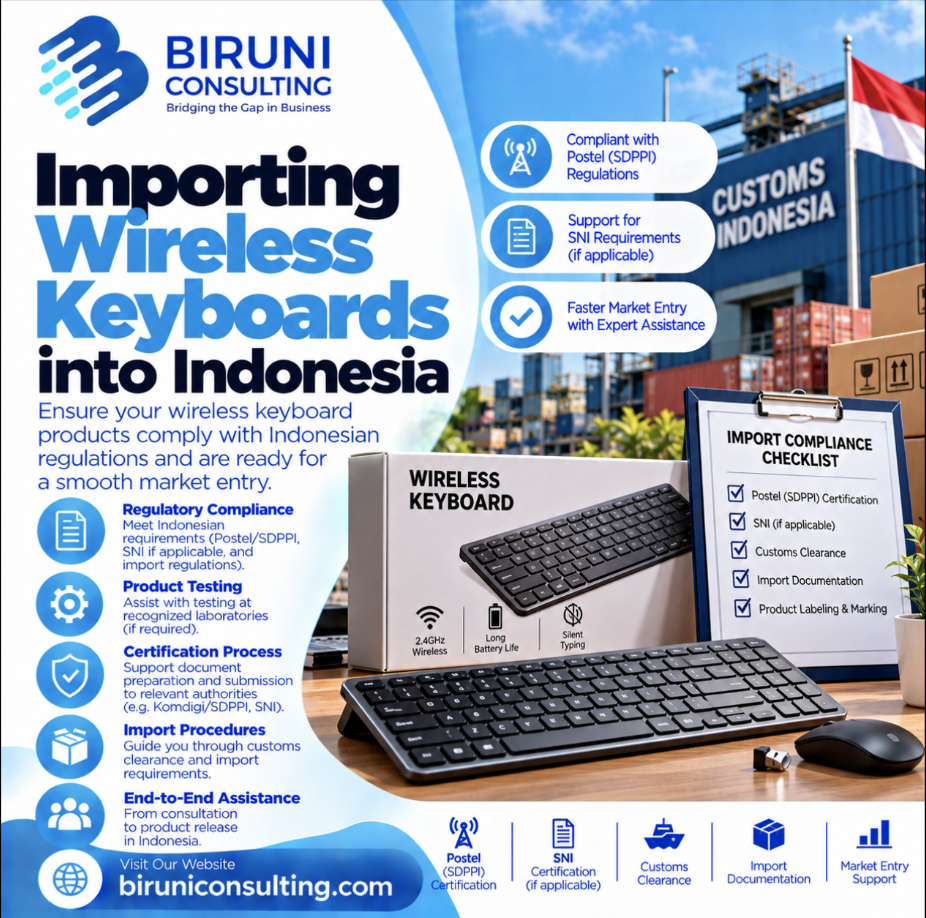
Guide to importing wireless keyboards and meeting Postel/DJID requirements in Indonesia.
A wireless keyboard is a computer input device that communicates with a computer, laptop, tablet, or other equipment without a physical data cable. Common technologies include Bluetooth and proprietary RF communication through a USB receiver or dongle.
For importation into Indonesia, the product should not be assessed only as a computer keyboard. Its wireless technology, operating frequency, transmission power, radio module, receiver, antenna, and overall configuration also need to be reviewed.
Official Indonesian tariff schedules identify HS 8471.60.30 as computer keyboards, although the final customs classification should always be confirmed against the exact product configuration. Insw API
Do Wireless Keyboards Require Postel Certification?
A wired USB keyboard and a wireless keyboard have different telecommunications characteristics.
A conventional wired keyboard without Bluetooth or radio transmission does not have the same wireless configuration as a Bluetooth or RF keyboard.
When a keyboard transmits data through Bluetooth or another RF system, the telecommunications function needs to be assessed against the applicable Indonesian requirements.
Indonesia’s current certification framework is established under Minister of Communication and Informatics Regulation Number 3 of 2024, which replaced Regulation Number 16 of 2018. The regulation provides for certification as evidence of conformity with the applicable Technical Standards. JDIH Kemkomdigi
Important information includes the wireless technology, operating frequency, transmission power, radio module, antenna, receiver, product model, and country of manufacture.
Bluetooth Wireless Keyboards
Bluetooth is commonly used in keyboards for laptops, tablets, smartphones, smart TVs, and other devices.
The keyboard contains a Bluetooth transmitter that sends keystroke data to the connected device.
Bluetooth falls within Indonesia’s Short Range Device technical framework. Minister of Communication and Informatics Decision Number 260 of 2024 establishes the Technical Standards for Short Range Devices and includes Bluetooth within its scope. Postel
A Bluetooth keyboard assessment normally reviews the Bluetooth version, frequency range, RF output power, module model, and antenna configuration.
If a keyboard supports different Bluetooth modes or Bluetooth Low Energy functionality, the available radio configurations should be identified in the technical documentation.
Wireless Keyboards with USB Receivers
Many wireless keyboards use proprietary RF communication through a USB receiver or dongle rather than Bluetooth.
In this configuration, the keyboard transmits wireless data to the receiver, which is connected to the computer through USB.
The receiver may be physically very small, but it is still part of the wireless communication system.
Therefore, the assessment should review both the keyboard and receiver, including their operating frequency, RF technology, transmission characteristics, and technical documentation.
This is particularly important for keyboard-and-mouse packages where one receiver communicates with more than one device.
Dual-Mode Bluetooth and RF Keyboards
Some keyboards support multiple wireless connection modes.
For example, the same keyboard may use Bluetooth with a tablet and proprietary RF through a USB dongle with a desktop computer.
Both functions need to be considered during technical assessment.
The review should determine whether Bluetooth and RF communication use the same chipset or separate modules, their operating frequencies, transmission power levels, and antenna configuration.
A dual-mode keyboard should therefore not be assessed only from one of its available connection methods.
Frequency and Transmission Power
Operating frequency and transmission power are important parameters for wireless keyboard certification.
Indonesia’s class-license spectrum framework is regulated under Minister of Communication and Informatics Regulation Number 2 of 2023 as amended by Minister of Communication and Digital Regulation Number 2 of 2025. The 2025 regulation is currently in force and updates class-license spectrum provisions, including those applicable to Short Range Devices. JDIH Kemkomdigi
Frequency and output-power information can generally be found in product datasheets, wireless-module datasheets, RF specifications, user manuals, or laboratory reports.
Low transmission power does not automatically mean that a wireless keyboard is exempt from certification.
Regulation Number 3 of 2024 contains a specific provision for certain equipment with a telecommunications feature below 10 mW and only one identical telecommunications feature. Under defined conditions, one Certificate may cover more than one variant. This is a variant-certification provision rather than a general exemption for all devices below 10 mW. JDIH Kemkomdigi
Does the USB Dongle Need to Be Assessed?
Yes, when the USB receiver is part of the communication system.
The receiver receives wireless data from the keyboard and passes that information to the computer through USB.
Its model, radio frequency, chipset or module, and relationship with the keyboard should therefore be identified during assessment.
When one receiver is supplied for both a keyboard and mouse, the complete product configuration should be reviewed before determining the certification approach.
Documents to Prepare Before Importation
Importers should request technical documentation from the manufacturer or supplier before commercial shipment.
The main documents normally include product and receiver photos, product datasheets, user manuals, wireless-module information, operating frequency, transmission power, antenna specifications, and RF test reports where available.
The exact product model, manufacturer, and country of manufacture should also be confirmed.
For dual-mode keyboards, documentation covering both Bluetooth and proprietary RF communication should be prepared.
Foreign RF Test Reports
An RF test report issued for the product or wireless module may be useful during certification assessment.
However, the report needs to be checked against the actual keyboard model, wireless technology, frequency, output power, module, antenna, and applicable Indonesian Technical Standards.
Regulation Number 3 of 2024 provides that conformity with Technical Standards is established through testing and demonstrated by a Certificate. JDIH Kemkomdigi
Therefore, having an overseas RF report does not automatically eliminate the need for technical review or additional certification steps.
Who Can Apply for the Certificate?
Regulation Number 3 of 2024 specifies the parties that may apply for certification.
For business applicants, this may include the registered brand holder in Indonesia, an appointed representative or distributor, manufacturers or assemblers in specified circumstances, and businesses using the equipment for their own purposes as provided by the regulation. JDIH Kemkomdigi
Certificates under the applicable route are issued electronically through the OSS system after the required certification process is completed. JDIH Kemkomdigi
Importers should therefore determine the appropriate certificate holder and commercial structure before beginning the application.
Small Quantities for Personal Use
The regulation also provides specific exemptions from the requirement to demonstrate compliance through a Certificate.
One exemption covers customer-premises telecommunications equipment brought as passenger goods or sent through postal operators for personal use, not for trade and not for commercial purposes, with a maximum quantity of two units, whether the brand and type are identical or different. JDIH Kemkomdigi
This personal-use provision should not be confused with commercial importation for distribution or resale.
Importing one keyboard for personal use is therefore different from importing commercial quantities for sale in Indonesia.
HS Code for Computer Keyboards
Official Indonesian tariff schedules list 8471.60.30 for computer keyboards. Insw API
However, final customs classification should always reflect the actual product.
For example, a standalone keyboard may need to be considered differently from a multifunction device, keyboard case, keyboard-and-mouse package, or another combined product.
HS classification and Postel requirements should therefore be reviewed as separate but related parts of the import process.
Can Several Keyboard Models Use One Certificate?
Potential model grouping depends on the technical configuration.
Similar colors or external designs alone are not sufficient.
The assessment should compare the brand and type, wireless module, frequency, transmission power, Bluetooth or RF function, USB receiver, antenna, and country of manufacture.
Regulation Number 3 of 2024 provides a specific mechanism under defined conditions for one Certificate to cover more than one variant for certain equipment with transmission power below 10 mW and one identical telecommunications feature. JDIH Kemkomdigi
Model grouping should therefore be reviewed before the certification application is submitted.
Import Process for Wireless Keyboards
For commercial shipments, technical assessment should ideally be completed before the goods are shipped to Indonesia.
The process normally includes product and HS-code identification, wireless assessment, review of the keyboard and receiver, examination of RF test documentation, identification of applicable Technical Standards, certification, and preparation of labeling and import documents.
Certificate data is also transmitted to Indonesia’s National Single Window system. The regulatory data set includes information such as the certificate holder, Certificate number, import-use period, HS code, country of origin, brand, and device type. JDIH Kemkomdigi
Consistency between certification information and import documentation is therefore important.
Certificate Period for Importation
Under Regulation Number 3 of 2024, the Certificate itself does not expire.
However, the Certificate holder may manufacture, assemble, or import the relevant telecommunications equipment or device for trade and/or use in Indonesia for up to three years from the Certificate issuance date.
If those activities continue after the three-year period, compliance with the Technical Standards needs to be demonstrated through testing and a new Certificate under the applicable provisions. JDIH Kemkomdigi
Companies planning long-term imports of the same wireless keyboard model should therefore keep track of the Certificate issuance date.
Postel Labeling for Wireless Keyboards
Certified equipment is also subject to labeling requirements.
Regulation Number 3 of 2024 requires the label to display the Certificate number and PLG ID, QR Code, and warning sign. The regulation also specifies placement requirements for the equipment and packaging, with specific treatment where the device is too small for normal labeling. JDIH Kemkomdigi
Label planning should therefore be considered before mass production or commercial shipment.
Why Pre-Shipment Assessment Is Important
Wireless keyboard importers should ideally complete regulatory assessment before placing a large purchase order or shipping commercial quantities.
Two keyboards that look almost identical may use different Bluetooth modules, RF chipsets, output power levels, or USB receivers.
A pre-shipment assessment helps identify certification requirements, applicable technical standards, required manufacturer documents, testing requirements, possible model grouping, and labeling obligations.
It also reduces the risk of inconsistencies between the invoice, packing list, product model, RF report, and DJID/SDPPI Certificate.
Conclusion
Importing wireless keyboards into Indonesia requires attention to the radio technology incorporated into the product.
Bluetooth keyboards and keyboards using RF USB receivers should be assessed based on their operating frequency, transmission power, wireless module, antenna, receiver, and overall configuration.
HS Code 8471.60.30 is listed for computer keyboards in Indonesian tariff schedules, but the HS Code alone does not determine Postel requirements. Telecommunications certification needs to be assessed based on the actual wireless functions and technical specifications. Insw API
Conducting an assessment before shipment helps importers prepare certification, testing, technical documentation, labeling, and import requirements more accurately.
Contact Us
Biruni Consulting assists with DJID/SDPPI assessment and certification for wireless keyboards and various wireless products that will be imported or marketed in Indonesia.
Our services include:
- Assessment of DJID/SDPPI certification requirements.
- Bluetooth module assessment.
- RF specification review.
- Frequency and transmission power analysis.
- Technical document review.
- Certification document preparation.
- Testing coordination where required.
- DJID/SDPPI Certification assistance.
If you have a wireless keyboard, you can prepare product photos, brand, model, datasheet, RF specifications, and wireless module datasheet for an initial assessment of the Postel Certification requirements.