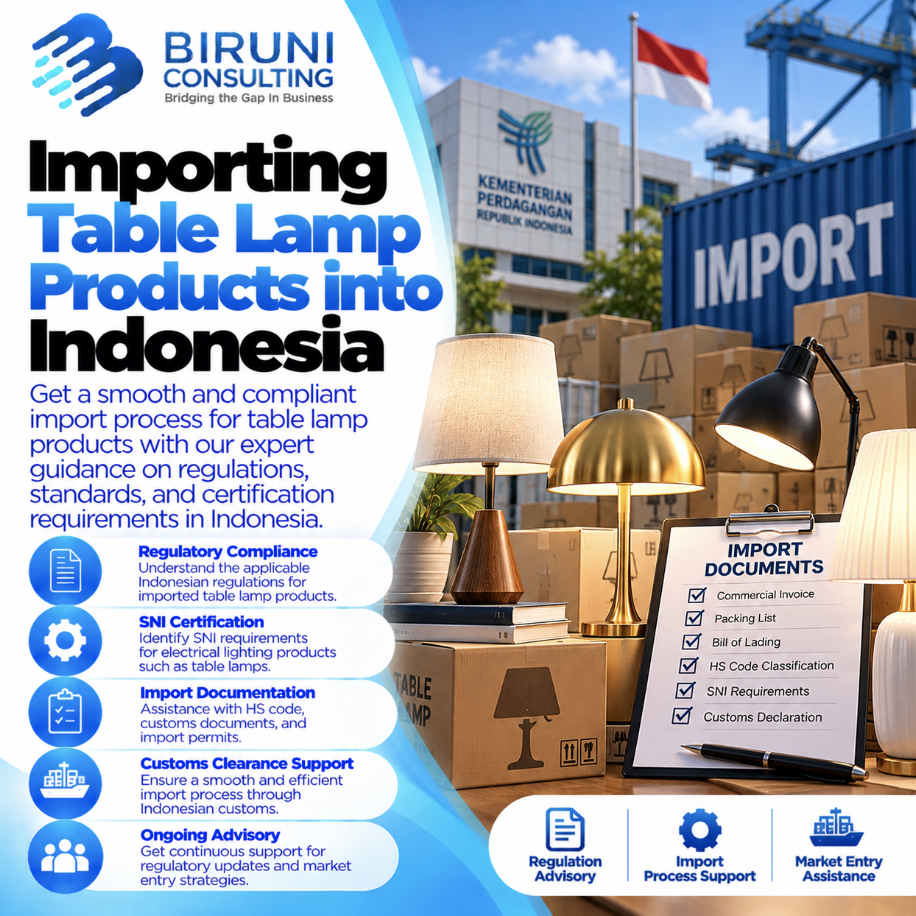
Guide to Import Requirements, SNI, NPB, HS Code, Testing, and Table Lamp Certification
Importing table lamp products into Indonesia requires an assessment of luminaire construction, power supply, voltage, wattage, lamp holder or LED module, driver, adapter, cable, plug, battery, HS Code, and applicable SNI standards. The term table lamp may cover conventional 220–240 V AC lamps, LED table lamps with adapters, rechargeable table lamps, USB desk lamps, bedside lamps, and smart table lamps.
Technically, table lamps are generally classified as general-purpose portable luminaires because they can normally be moved from one location to another. Minister of Energy and Mineral Resources Regulation No. 7 of 2021 includes general-purpose portable luminaires with supply voltages not exceeding 250 V within mandatory SNI requirements, subject to several exclusions based on product characteristics. JDIH ESDM
The Ministry of Trade’s LAMANSITU currently also lists general-purpose portable luminaires with SNI IEC 60598-1:2016, SNI IEC 60598-2-4:2012, and the Goods Registration Number or NPB for several HS Codes under heading 9405. LAMANSITU
Importers should therefore conduct a product assessment before mass production or shipment to determine whether a table lamp falls within mandatory SNI scope or qualifies for an applicable exclusion.
What Is a Table Lamp?
A table lamp is a portable luminaire designed to be placed on a desk, cabinet, bedside table, work desk, reception desk, or other furniture.
Products may be used for reading, task lighting, bedside lighting, decorative illumination, or general work lighting.
Common imported types include:
- Table lamps with E14 or E27 lamp holders.
- Integrated LED desk lamps.
- Table lamps using 12 V or 24 V adapters.
- USB and rechargeable table lamps.
- Touch, dimmable, RGB, and smart table lamps.
Although these products may all be described as table lamps, their electrical constructions can differ significantly, so certification scope needs to be reviewed using the actual specifications.
Are Imported Table Lamps Required to Have SNI?
Table lamps that fall within the general-purpose portable luminaire scope of Minister of Energy and Mineral Resources Regulation No. 7 of 2021 are included in the mandatory SNI group. The portable luminaire scope covers products with supply voltages not exceeding 250 V and may also include luminaires receiving DC power through adapters, drivers, chargers, DC plugs, or similar means. JDIH ESDM
The regulation nevertheless provides exclusions. One of them covers portable luminaires with rated power not exceeding 3 W, supplied through an AC-to-DC conversion device with a DC supply rating not exceeding 6 V. Portable luminaires intended as children’s toys and hand lamps are also listed among the exclusions for this group. RegulasiEnergi.com
A small rechargeable or USB table lamp should therefore not automatically be considered either mandatory-SNI or SNI-exempt solely because it operates at low voltage. Rated power, DC voltage, charger configuration, and actual intended use need to be assessed.
SNI IEC 60598-1:2016
An important general luminaire standard is SNI IEC 60598-1:2016 – Luminaires – Part 1: General requirements and tests. BSN currently lists this standard as active. Pesta
The standard provides general safety requirements covering areas such as construction, marking, protection against electric shock, terminals, wiring, earthing, insulation resistance, electric strength, resistance to heat, and other luminaire safety characteristics.
For table lamps falling within the portable-luminaire category, the general standard is applied together with the relevant particular standard.
SNI IEC 60598-2-4 for Table Lamps
The relevant particular standard for general-purpose portable luminaires is the SNI IEC 60598-2-4 series.
LAMANSITU currently lists SNI IEC 60598-2-4:2012 together with SNI IEC 60598-1:2016 and NPB for general-purpose portable luminaires. LAMANSITU
Meanwhile, the BSN catalogue also lists SNI IEC 60598-2-4:2017 as active, while the 2012 edition also remains listed as active. Pesta
Importers should therefore not select an edition merely because it is newer. The standard edition used for certification needs to follow the applicable regulation, certification scheme, and certification body’s scope.
220–240 V AC Table Lamps
Conventional table lamps may connect directly to mains electricity through a cord and plug.
They may use E14, E27, or another lamp holder, allowing users to install replaceable lamps.
For these products, information should include rated voltage, maximum lamp wattage, lamp holder, cable, switch, plug, housing, electrical class, and earthing configuration.
Where the base or other accessible components are made of metal, protection against electric shock requires particular attention. Depending on the design, the product may use protective earthing or an appropriate insulation system.
The plug and flexible cable should also be finalized before testing so that the test configuration matches mass production.
Integrated LED Table Lamps
Modern table lamps frequently incorporate non-user-replaceable LED modules.
Products may contain an LED PCB, driver, dimming circuit, switch or touch sensor, diffuser, and housing.
In this configuration, the LED driver is an important component because changing it can affect output current, temperature, insulation, power consumption, and safety performance.
Importers should request driver information such as manufacturer, model, input and output voltage, output current, rated power, and available test reports.
Changes to the LED PCB or driver after testing should also be assessed before implementation in mass production.
Table Lamps with Adapters
Many LED table lamps operate through external AC/DC adapters providing outputs such as 5 V, 12 V, or 24 V DC.
Using an adapter does not automatically place a table lamp outside the portable-luminaire scope. Minister of Energy and Mineral Resources Regulation No. 7 of 2021 also covers relevant luminaires supplied with DC through adapters, drivers, chargers, DC plugs, or similar devices unless a specific exclusion applies. RegulasiEnergi.com
Assessment should determine whether the adapter is supplied in the package, the adapter model, output voltage, output current, connector configuration, and whether the user can replace the adapter.
Where several adapter models are intended for one table lamp, these variants should be identified before certification.
USB Table Lamps
USB table lamps typically receive 5 V DC through USB-A or USB-C.
Their regulatory status still needs to be assessed using the combination of rated power and rated DC supply voltage. Minister of Energy and Mineral Resources Regulation No. 7 of 2021 excludes portable luminaires rated at no more than 3 W where the AC/DC-converted DC supply does not exceed 6 V. RegulasiEnergi.com
A 2 W, 5 V USB table lamp may therefore have a different assessment outcome from a 10 W desk lamp operating from 5 V or 12 V.
Product wattage needs to be assessed together with input voltage and charger configuration rather than relying only on the USB connector.
Rechargeable Table Lamps
Rechargeable table lamps are widely used on bedside tables, in restaurants, hotels, cafés, dining areas, and hospitality environments.
Products commonly contain LED modules, lithium-ion or other rechargeable batteries, charging PCBs, protection circuits, USB-C charging ports, touch switches, and dimmers.
Importers should confirm the lamp’s rated power, charging voltage, battery capacity, battery chemistry, supplied charger or adapter, and whether the lamp can operate while charging.
Where the product operates while connected to a charger, this configuration should be clearly described in the user manual and technical documentation.
Battery-Operated Table Lamps
Not every battery-operated table lamp follows the same regulatory pathway.
Minister of Energy and Mineral Resources Regulation No. 7 of 2021 also lists an exclusion for luminaires intended to operate completely without connection to a fixed electrical installation or low-voltage generating set. RegulasiEnergi.com
However, the complete configuration needs to be assessed. A lamp with an internal rechargeable battery that is regularly charged through a mains-connected adapter differs from a product designed to operate entirely from primary batteries.
The datasheet and user manual are therefore important for determining the actual use configuration.
Touch and Dimmable Table Lamps
Touch table lamps use electronic touch sensors for ON/OFF control or dimming.
Products may provide several brightness levels or stepless dimming.
These functions should be identified in the product specification because the electronic control circuit forms part of the luminaire construction.
Minister of Energy and Mineral Resources Regulation No. 7 of 2021 also includes luminaires incorporating electronic controls, sensors, remote-control devices, or similar systems within the relevant luminaire scope. RegulasiEnergi.com
A basic model and a touch-dimming model should therefore not automatically be treated as identical for product-family purposes.
Table Lamps with Wireless Charging
Some desk lamps and bedside lamps incorporate wireless charging pads for smartphones.
These products combine lighting with an additional electronic power-transfer system.
Companies should ideally provide a circuit or block diagram, input ratings, wireless charging output, driver information, and the adapter model used.
Where a USB charging output is also provided, its electrical rating should be identified.
The charging function does not automatically mean that the product is no longer a luminaire, but the additional function may affect product construction and testing.
Smart Table Lamps with WiFi or Bluetooth
Smart table lamps may incorporate Bluetooth, WiFi, Zigbee, or other radio communication technology, allowing users to control lighting through an application.
Functions can include ON/OFF, dimming, RGB color, color temperature, timers, scenes, and voice-assistant integration.
From an electrical-safety perspective, the product still needs to be assessed as a luminaire according to its construction. Where an active radio transmitter is included, telecommunications-device requirements should also be reviewed separately.
Importers should request information on the wireless module manufacturer, model, frequency band, transmit power, antenna, and available RF test reports.
Table Lamps for Children
Products with children’s characters or playful designs require careful classification because a product that looks like a toy is not necessarily legally classified as a toy.
Minister of Energy and Mineral Resources Regulation No. 7 of 2021 lists portable luminaires intended for use as children’s toys among the exclusions for the general portable-luminaire group. RegulasiEnergi.com
If a product is genuinely classified as a toy, however, toy-product regulations and standards may become relevant.
Intended use, target age, design, packaging, instructions, and marketing claims should therefore be assessed together rather than classifying a product solely from its appearance.
Table Lamps and Night Lights Are Not Always the Same
Table lamps are often placed beside beds and commercially described as bedside lamps or night lamps.
However, a portable table lamp is not automatically the same technical category as a mains socket-outlet mounted nightlight, which is installed directly into a wall socket.
A table lamp standing on furniture and connected through a cable or adapter should therefore be distinguished from a nightlight that plugs directly into the socket outlet.
The difference in construction may lead to a different applicable particular standard.
HS Code for Table Lamps
HS Code classification should take account of the light source, material, construction, and condition of the goods at importation.
LAMANSITU currently lists the following HS Codes for general-purpose portable luminaires:
- 94052190 and 94052990.
- 94054140 and 94054190.
- 94054260 and 94054290.
- 94054960 and 94054990. LAMANSITU
This does not mean that every table lamp automatically falls under one of these codes without further classification. Materials, light source, product function, and configuration need to be reviewed to select the appropriate tariff classification.
Incorrect HS classification can result in import requirements being applied that do not match the actual product.
NPB for Table Lamps
In addition to SNI, the Goods Registration Number or NPB needs to be considered.
LAMANSITU currently lists NPB as a quality-policy requirement for general-purpose portable luminaires together with SNI IEC 60598-2-4:2012 and SNI IEC 60598-1:2016. LAMANSITU
Where product assessment confirms that a table lamp falls within this category and its listed HS scope, importers should review NPB processing after SNI certification.
Products that qualify for an exclusion or fall outside a particular scope still need individual assessment before concluding whether NPB applies.
Importer Requirements for Table Lamps
Indonesia’s current import-policy framework is based on Minister of Trade Regulation No. 16 of 2025 concerning Import Policy and Regulation, subsequently amended, most recently through Minister of Trade Regulation No. 18 of 2026. Regulation No. 18 of 2026 was established on June 3, 2026, promulgated on June 4, 2026, and is currently in force. JDIH Kementerian Perdagangan
Minister of Trade Regulation No. 16 of 2025 provides that business importers are required to hold an NIB functioning as an API. JDIH Kementerian Perdagangan
The NIB and API are not, however, the only requirements. Product-specific obligations still need to be reviewed based on HS Code, technical regulations, and the type of goods being imported.
Documents to Prepare
For table-lamp assessment, companies should obtain complete technical documentation from the supplier before shipment.
Basic documentation may include the product catalogue, datasheet, model list, product photographs, technical drawings, user manual, and label artwork. Electrical data should also cover rated voltage, rated power, frequency, electrical class, light source, LED module or lamp holder, driver, adapter, cable, plug, switch, and earthing.
For rechargeable table lamps, battery specifications, charging voltage, charging current, battery capacity, and protection-circuit information should be added. For smart table lamps, wireless-module datasheets and RF information should also be prepared.
This information allows product classification and representative-sample selection to take place before testing.
Table Lamp Testing
Table-lamp testing depends on the applicable standards and product construction. Portable-luminaire testing may address marking, construction, protection against electric shock, terminals, earthing, internal and external wiring, insulation resistance, electric strength, resistance to heat, and mechanical characteristics.
Because a table lamp stands on a surface, product stability can also be an important aspect. The construction should not create an unacceptable tipping risk under the applicable test conditions.
For models incorporating touch controls, dimming, drivers, adapters, batteries, or other electronics, the tested components need to remain consistent with the marketed configuration.
Table Lamp Product Family
A supplier may offer many table-lamp models with different housing designs while using nearly identical electrical systems.
Conversely, products that look the same may use different drivers, LED modules, adapters, batteries, or wiring.
Product-family assessment may therefore consider rated voltage, rated power, electrical class, light source, power supply, driver, lamp holder, cable, plug, housing, and control system.
All models should ideally be organized in a product list before certification so that appropriate representative models can be identified.
Component Changes After Certification
One issue to avoid is changing components after test samples have already been evaluated.
Suppliers may substitute adapters, drivers, LED PCBs, cables, plugs, switches, batteries, or insulation materials due to price or component availability.
Although the external appearance of the table lamp may remain unchanged, different internal components can affect the safety characteristics previously tested.
Companies should therefore maintain an approved component list and require suppliers to notify them before making critical-component substitutions.
Stages of Importing Table Lamps into Indonesia
The process begins by identifying the product construction, power supply, rated voltage, rated power, and intended use. The HS Code can then be reviewed together with whether the product falls within or outside the mandatory portable-luminaire SNI scope.
Next, all models are organized in a product list for product-family assessment. The manufacturer prepares datasheets, drawings, labels, component information, and other required documentation.
Where the product is subject to mandatory SNI, certification proceeds through an appropriately scoped certification body, including testing and production evaluation according to the applicable scheme. NPB requirements should then be reviewed before the product is marketed.
Mistakes to Avoid Before Shipment
One mistake is assuming that all table lamps require mandatory SNI without reviewing ratings and regulatory exclusions. The opposite mistake is assuming that every USB or rechargeable lamp is exempt simply because it uses low voltage.
Another problem is providing only product photographs without wattage, voltage, adapter, battery, and model-list information. These details can determine how the product should be assessed.
Companies should also avoid beginning mass production before the adapter, driver, plug, label, and other critical components have been finalized.
Why Is Assessment Before Import Important?
A table lamp may appear to be a simple product, but current designs can use very different technologies.
A table lamp may connect directly to 220–240 V AC, operate through a 24 V adapter, receive 5 V through USB, use an internal rechargeable battery, or combine wireless charging and Bluetooth in one product.
These differences can affect SNI scope, exclusions, product family, HS Code, testing, NPB, and other applicable requirements.
Assessment based on the datasheet and product list should therefore be carried out before mass production and shipment so that Indonesian regulatory requirements can be identified from the beginning.
Contact Us
Biruni Consulting assists companies with importing table lamp products into Indonesia, including SNI consultation, HS Code identification, luminaire-category assessment, product family assessment, testing, and certification assistance.
Our services include:
- Consultation on table-lamp import requirements and applicable SNI standards.
- HS Code, product specification, and product-list assessment.
- Identification of AC table lamps, LED desk lamps, rechargeable lamps, USB table lamps, and smart table lamps.
- Review of drivers, adapters, LED modules, lamp holders, cables, plugs, batteries, and critical components.
- Product family assessment and certification-document preparation.
- Testing, factory-audit or production-evaluation assistance where required, SNI certification, and NPB assistance.
Contact Biruni Consulting for information regarding table lamp SNI services, table lamp certification, desk lamp certification, rechargeable table lamp certification, luminaire NPB, and table lamp import requirements in Indonesia according to your product’s brand, model, construction, specifications, HS Code, and country of origin.