
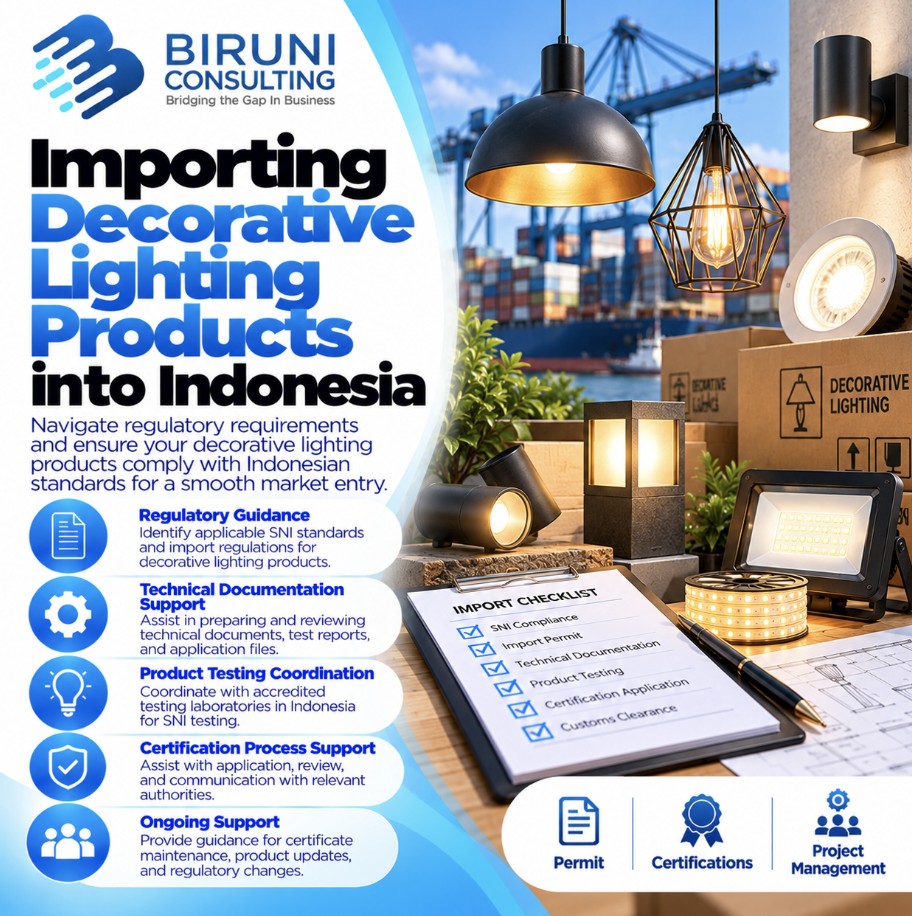
Guide to Import Requirements, SNI, NPB, HS Code, Testing, and Decorative Lighting Certification
Importing decorative lighting products into Indonesia requires an assessment of construction, lighting function, installation method, voltage, power, light source, driver, HS Code, and applicable standards. The term decorative lighting can cover a very broad range of products, including chandeliers, pendant lamps, wall lamps, table lamps, floor lamps, recessed decorative lights, string lights, and smart decorative lights.
These construction differences are important because not every decorative lighting product follows the same standard or certification pathway. A portable table lamp has different characteristics from a chandelier permanently installed on a ceiling. A string light also differs from an LED strip or a decorative wall luminaire.
Minister of Energy and Mineral Resources Regulation No. 7 of 2021 implements mandatory SNI requirements for several luminaire groups, including general-purpose fixed luminaires, recessed luminaires, road-lighting luminaires, general-purpose portable luminaires, and floodlights. The requirements also apply to imported products falling within the relevant HS classifications and regulatory scope. JDIH ESDM
Companies should therefore conduct a product assessment before mass production or shipment to determine the appropriate luminaire category, SNI, HS Code, NPB, product family, and documentation requirements.
What Is Decorative Lighting?
Decorative lighting refers to lighting products designed both to provide illumination and contribute aesthetic value to interior or exterior spaces. These products are widely used in houses, apartments, hotels, restaurants, cafes, retail stores, shopping malls, lobbies, ballrooms, exhibition areas, and commercial buildings.
Common decorative lighting products include:
- Chandeliers, pendant lamps, ceiling lights, and wall lamps.
- Table lamps and floor lamps.
- Recessed decorative lights and decorative spotlights.
- String lights, lighting chains, LED strips, and flexible decorative lighting.
- Rechargeable lamps, RGB lamps, and smart decorative lights.
Although all these products may be marketed as decorative lighting, SNI requirements are not determined solely by their commercial name. Function, construction, installation method, power source, and HS Code need to be assessed.
Are Imported Decorative Lights Required to Have SNI?
Decorative lighting products falling within the scope of Minister of Energy and Mineral Resources Regulation No. 7 of 2021 need to comply with the applicable mandatory SNI requirements. The regulation states that mandatory SNI compliance applies to domestic products, products manufactured in ASEAN countries, and imported products based on the relevant HS classification. JDIH ESDM
For luminaires, the regulation covers general-purpose fixed luminaires, recessed luminaires, road-lighting luminaires, portable luminaires, and floodlights. SNI IEC 60598-1:2016 serves as the general standard, while particular standards apply according to product category. JDIH ESDM
A chandelier, pendant lamp, table lamp, recessed decorative light, and decorative spotlight may therefore have different requirements even though all are decorative lighting products.
SNI IEC 60598-1 for Decorative Lighting
One of the principal standards for luminaires is SNI IEC 60598-1:2016 – Luminaires – Part 1: General requirements and tests. Under Minister of Energy and Mineral Resources Regulation No. 7 of 2021, this standard provides the general requirements for luminaire groups within the mandatory scope. JDIH ESDM
The Ministry of Trade’s LAMANSITU currently also lists a Luminaire category with SNI IEC 60598-1:2016 and the Goods Registration Number or NPB as quality-policy requirements for several HS Codes under heading 9405. LAMANSITU
The general standard may be supplemented by a particular standard, making correct product classification important before testing begins.
Fixed Decorative Luminaires
Fixed decorative luminaires are designed to be permanently installed on a ceiling, wall, or another part of a building. Chandeliers, pendant lamps, decorative ceiling lights, and fixed wall lamps are common examples.
Minister of Energy and Mineral Resources Regulation No. 7 of 2021 lists general-purpose fixed luminaires with SNI IEC 60598-1:2016 and a particular standard for general-purpose fixed luminaires within the mandatory group. JDIH ESDM
For product assessment, information regarding mounting brackets, canopies, terminal blocks, cables, lamp holders or LED modules, drivers, earthing, and housing materials should be available. Metal housings also require particular attention to earthing and protection against accessible live parts.
Chandeliers and Pendant Lamps
Chandeliers and pendant lamps are widely used in homes, hotels, restaurants, ballrooms, lobbies, and commercial buildings.
These products may use E14 or E27 lamp holders with replaceable lamps, or integrated LED modules with electronic drivers. The distinction is important because their electrical construction is different.
For integrated LED chandeliers, the driver, LED PCB, wiring, insulation, and earthing are important parts of the assessment. For replaceable-lamp chandeliers, lamp-holder specifications, terminals, wiring, maximum lamp rating, and mounting arrangements need to be reviewed.
Two chandeliers that appear nearly identical may therefore not belong to one product family if their electrical systems or critical components differ.
Decorative Ceiling and Wall Lights
Decorative ceiling lights are generally mounted directly to a ceiling, while wall lamps are installed on wall surfaces. Products may use metal, aluminium, glass, acrylic, crystal, resin, wood, or combinations of materials.
For indoor models, assessment primarily concerns electrical construction, terminals, wiring, earthing, mounting, and the light source. For outdoor decorative wall lights, protection against water and dust also needs to be considered.
Where products claim IP44, IP54, IP65, or another protection rating, manufacturers should ideally provide supporting technical data or test reports.
Portable Decorative Lighting
Table lamps and floor lamps are examples of decorative luminaires that can normally be moved without modifying the fixed electrical installation. These products may fall within the general-purpose portable luminaire category where they meet the applicable technical scope.
LAMANSITU currently lists general-purpose portable luminaires with SNI IEC 60598-1:2016, SNI IEC 60598-2-4:2012, and NPB. Several listed HS Codes fall under heading 9405. LAMANSITU
Portable lighting may use AC cords and plugs, DC adapters, USB power, or rechargeable batteries. These differences in power supply should be included in the product list because they can affect assessment and product-family grouping.
Table Lamps and Floor Lamps
A decorative table lamp normally consists of a base, shade or diffuser, lamp holder or LED module, switch, cable, and plug. Modern models may also include touch controls, dimmers, rechargeable batteries, USB ports, or wireless charging.
Floor lamps are also generally portable luminaires but have larger mechanical constructions. In addition to electrical safety, product stability becomes important because the luminaire needs to remain stable during normal use.
Importers should ensure that plug type, cable, switch, driver, LED module, and electrical class are finalized before test samples are submitted.
Recessed Decorative Lighting
Recessed decorative lighting is installed within ceilings, walls, furniture, or other structures. For recessed luminaires, Minister of Energy and Mineral Resources Regulation No. 7 of 2021 lists SNI IEC 60598-1:2016 together with SNI IEC 60598-2-2:2016. JDIH ESDM
Importers should prepare information such as cut-out dimensions, installation depth, driver position, mounting arrangement, wiring, and clearance from surrounding materials.
A decorative recessed light with an external driver should also identify whether the driver is installed within the ceiling space, remotely, or supplied as an integral part of the product.
Decorative Spotlights
Decorative spotlights are commonly used to illuminate artwork, merchandise, furniture, sculptures, displays, or architectural features.
For floodlight products falling within the relevant scope, Minister of Energy and Mineral Resources Regulation No. 7 of 2021 lists SNI IEC 60598-1:2016 together with SNI IEC 60598-2-5:2016. JDIH ESDM
Products described by suppliers as “accent lights” or “designer spotlights” therefore still need to be assessed according to their actual technical function and construction rather than only their marketing description.
Decorative String Lights and Lighting Chains
Decorative string lights, fairy lights, Christmas lights, and similar products normally consist of multiple light sources connected in series, parallel, or a combination.
Minister of Energy and Mineral Resources Regulation No. 7 of 2021 specifically lists lighting-chain luminaires and SNI IEC 60598-2-20:2012. Its scope includes certain indoor and outdoor products and lighting chains supplied with DC through adapters and DC connectors. JDIH ESDM
Decorative string lights should therefore not automatically be treated as general luminaires without reviewing the number of lamps, wiring arrangement, adapter, controller, rated voltage, and intended use.
Decorative Strip and Flexible Lighting
Decorative lighting may also include LED strips, neon flex, rope lights, flexible lights, or linear decorative lighting systems. These products require careful assessment because they may be supplied as LED modules only or as complete lighting products.
A flexible PCB containing LEDs and requiring a separate power supply may have a different classification from a product supplied with an enclosure, connector, driver, diffuser, and complete installation system.
The commercial term “LED strip” or “neon flex” is therefore not sufficient to determine mandatory SNI, NPB, or HS classification. Technical datasheets and construction photographs should be reviewed first.
Decorative Lighting with Adapters
Many decorative lights use AC/DC adapters and operate at 5 V, 12 V, or 24 V DC. Minister of Energy and Mineral Resources Regulation No. 7 of 2021 also covers certain luminaires supplied with DC through adapters, drivers, chargers, DC plugs, DC sockets, or similar devices. JDIH ESDM
Importers should clarify whether the adapter is included in the package, sold separately, or permanently attached. Manufacturer, model, input and output voltage, output current, rated power, and available test reports should also be documented.
A common problem is testing one adapter and later using another adapter in mass production. Such substitutions should be assessed because they can change the certified product configuration.
Rechargeable Decorative Lamps
Rechargeable decorative lamps are increasingly used in restaurants, hotels, bedside applications, dining tables, and hospitality environments. They commonly contain rechargeable batteries, LED modules, charging PCBs, USB-C inputs, touch switches, and dimming controls.
Not every rechargeable product is treated identically. Rated voltage, rated power, charging method, battery chemistry, adapter configuration, and intended use need to be assessed against the applicable scope and exemptions.
Where lithium batteries are used, importers should also request battery datasheets, cell information, capacity, protection-circuit information, and available manufacturer test documentation.
Smart Decorative Lighting
Smart decorative lights may incorporate WiFi, Bluetooth, Zigbee, or other radio communication technologies. Users may control ON/OFF, dimming, color temperature, RGB colors, timers, scenes, and automation through an application.
Minister of Energy and Mineral Resources Regulation No. 7 of 2021 includes luminaires equipped with lighting controls, remote controls, electronic controls, sensors, or similar devices within the relevant luminaire scope. JDIH ESDM
Where a product contains a radio transmitter, regulatory assessment does not end with luminaire certification. Companies also need to review applicable telecommunications-device requirements for WiFi, Bluetooth, or other radio technology used by the product.
LED Drivers and Critical Components
For integrated LED decorative luminaires, the driver is an important critical component. Changing a driver can affect output current, temperature, insulation, power consumption, and safety characteristics.
Relevant information should include the driver manufacturer, model, input voltage, output voltage, output current, rated power, dimming method, and any available certificates or test reports.
LED modules, lamp holders, cables, terminals, switches, plugs, transformers, and insulation materials can also form important parts of the evaluated construction.
Determining the HS Code for Decorative Lighting
HS Code classification should be based on the actual goods at the time of import. The description “decorative lamp” alone is not sufficient to determine a single HS Code.
LAMANSITU currently lists the general luminaire category with HS Codes including 94051191, 94051199, 94051991, 94051992, 94051999, 94054140, 94054220, 94054250, 94054920, and 94054950. This category lists SNI IEC 60598-1:2016 and NPB as quality-policy requirements. LAMANSITU
The general-purpose portable luminaire category separately lists codes including 94052190, 94052990, 94054140, 94054190, 94054260, 94054290, 94054960, and 94054990. LAMANSITU
Chandeliers, pendant lamps, table lamps, floor lamps, string lights, and LED strips should therefore not automatically use the same HS classification.
NPB for Decorative Lighting
In addition to SNI, importers need to consider the Goods Registration Number or NPB where the product falls within a quality-policy category requiring NPB.
LAMANSITU lists SNI IEC 60598-1:2016 and NPB for the general luminaire category. For general-purpose portable luminaires, LAMANSITU lists SNI IEC 60598-2-4:2012, SNI IEC 60598-1:2016, and NPB. LAMANSITU
Companies should therefore not stop after determining that an SNI certificate is required. The applicable NPB registration should also be confirmed according to the product category and HS Code.
Importer Requirements for Decorative Lighting
Indonesia’s general import-policy framework is currently based on Minister of Trade Regulation No. 16 of 2025 concerning Import Policy and Regulation, as amended, including through Minister of Trade Regulation No. 37 of 2025 and the second amendment through Minister of Trade Regulation No. 18 of 2026. Regulation No. 18 of 2026 was established on June 3, 2026, promulgated on June 4, 2026, and is currently in force. jdih.kemendag.go.id
Under Minister of Trade Regulation No. 16 of 2025, business importers are required to have an NIB functioning as an API, consisting of API-U or API-P. Certain goods may also have specific import-licensing or technical-verification requirements, so assessment should continue to be based on the product and HS Code. jdih.kemendag.go.id
Before shipment, decorative lighting importers should review:
- HS Code, luminaire category, SNI, and NPB.
- Product family, model list, and representative models.
- Drivers, adapters, LED modules, cables, plugs, and other critical components.
- Labels, technical drawings, datasheets, and test reports.
- Manufacturer and factory documentation.
Documents from Overseas Manufacturers
Manufacturers should provide technical information before certification begins. Basic documentation generally includes product catalogues, datasheets, model lists, product photographs, technical drawings, installation instructions, user manuals, and label artwork.
Electrical information should also be complete, including rated voltage, frequency, power, electrical class, light source, LED module, driver, lamp holder, switch, plug, cable, earthing, and housing materials.
Where the manufacturer already has IEC or CB test reports, component certificates, IP reports, or other testing documentation, these should ideally be included in the initial assessment.
Decorative Lighting Testing
Testing requirements depend on product category and applicable standards. Luminaire evaluation generally addresses marking, construction, protection against electric shock, terminals, earthing, internal and external wiring, insulation resistance, electric strength, temperature, heat resistance, and mechanical construction.
For table lamps and floor lamps, mechanical stability may also be important. For outdoor decorative lighting, IP protection needs to be evaluated where a specific protection level is claimed.
Test samples should represent the products that will ultimately be mass-produced. Changes to drivers, LED modules, cables, plugs, insulation materials, or construction after testing should be reviewed before implementation.
Decorative Lighting Product Family
Decorative lighting often involves a large number of models. One supplier may offer dozens of chandeliers, pendant lamps, wall lamps, and table lamps in a single catalogue.
Product-family assessment considers whether models can be grouped based on common technical construction. Parameters may include luminaire category, installation method, rated voltage, rated power, electrical class, light source, driver, wiring, earthing, housing, lamp holder, and control system.
Models that appear almost identical may not belong to one family if their electrical construction differs. Conversely, products with different decorative appearances may use similar technical platforms and can be assessed further according to the applicable certification scheme.
Stages of Importing Decorative Lighting into Indonesia
The first stage is to identify the product and determine whether it is a fixed luminaire, portable luminaire, recessed luminaire, spotlight, lighting chain, flexible light, or another category. The HS Code and applicable SNI can then be reviewed.
All models should then be organized in a product list for product-family assessment. Manufacturer documentation, technical drawings, labels, datasheets, and critical-component information should be reviewed before certification and testing begin.
Where the certification scheme requires factory evaluation or an audit, manufacturers also need to prepare their production facilities and quality documentation. Once certification is completed, NPB and other applicable import requirements should be addressed before marketing.
Mistakes to Avoid Before Importing
A common mistake is assuming that all products in one decorative-lighting catalogue can use one certificate. Chandeliers, table lamps, recessed lights, string lights, and rechargeable lamps may not belong to the same certification category.
Another mistake is beginning mass production before the model list, drivers, cables, plugs, labels, and final construction have been confirmed. If these elements change after testing, the production product may no longer correspond to the evaluated configuration.
Product assessment should therefore ideally be completed before placing a mass-production purchase order and before shipment to Indonesia.
Why Is Assessment Before Shipment Important?
Pre-shipment assessment helps importers determine whether a product requires SNI, a particular luminaire standard, NPB, or another additional requirement.
The process also helps determine the HS Code, product family, representative samples, drivers, LED modules, model lists, labels, and documents that need to be prepared by the factory.
By reviewing these matters early, companies have time to correct construction or documentation before production is completed. This reduces the risk of goods being shipped while certification or registration requirements remain unresolved.
Contact Us
Biruni Consulting assists companies with importing decorative lighting products into Indonesia, including SNI consultation, HS Code identification, luminaire-category assessment, product family assessment, testing, and certification assistance.
Our services include:
- Consultation on decorative-lighting import requirements and applicable SNI standards.
- HS Code, product specification, and product-list assessment.
- Identification of chandeliers, pendant lamps, table lamps, wall lamps, floor lamps, string lights, and other decorative luminaires.
- Review of drivers, LED modules, lamp holders, cables, adapters, and critical components.
- Product family assessment and certification-document preparation.
- Testing, factory-audit assistance where required, SNI certification, and NPB assistance.
Contact Biruni Consulting for information regarding decorative lighting SNI services, decorative lighting certification, chandelier certification, pendant-lamp certification, luminaire NPB, and decorative lighting import requirements in Indonesia according to your product’s brand, model, construction, specifications, HS Code, and country of origin.