
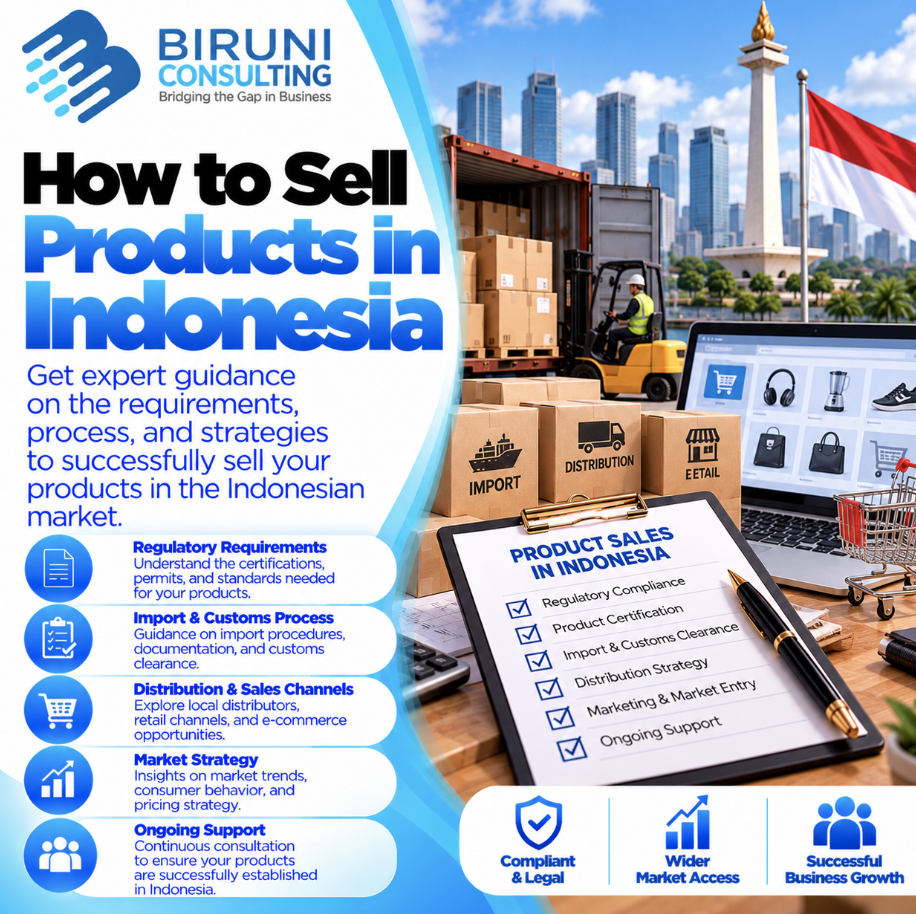
Guide for Overseas Manufacturers and Companies Selling Products in Indonesia
How to Sell Products in Indonesia is an important question for Overseas Manufacturers seeking to make Indonesia a target market. Selling products in Indonesia involves more than finding an importer, distributor, or customer. Companies also need to ensure that products, business structures, licensing, certification, registration, labeling, and import activities comply with applicable requirements.
The regulatory pathway differs by product category. Certain industrial products can require SNI, food and other specified categories can require BPOM approval, while several product categories also need to consider mandatory halal requirements. Companies also need to determine which party will serve as importer, distributor, registration holder, or Official Representative where required.
Indonesia’s current Risk-Based Business Licensing framework is governed by Government Regulation No. 28 of 2025. The regulation has been in force since June 5, 2025, remains effective, and revoked Government Regulation No. 5 of 2021. It covers Basic Requirements, Business Licensing, PB UMKU, OSS services, supervision, evaluation, and other aspects of Risk-Based Business Licensing. Database Peraturan | JDIH BPK
The OSS system also identifies the Business Identification Number or NIB as the official identity for starting or operating a business in Indonesia. Business activities are divided into four risk levels that determine the applicable licensing and obligations. OSS RBA
Understanding How to Sell Products in Indonesia should therefore begin with regulatory assessment and market-entry planning before commercial shipments or exclusive distribution rights are established.
Start with Regulatory Assessment
The first stage is understanding the product in detail.
A product name or HS code alone may not be sufficient to establish the regulatory pathway. A consultant or regulatory team needs to understand function, intended use, materials, ingredients, specifications, models, ratings, manufacturing sites, country of origin, and how the product will be sold in Indonesia.
Initial information commonly required includes:
- Product catalogue and technical specifications.
- Model or variant lists.
- Material or ingredient information.
- HS code and manufacturing-site information.
- Existing certificates or test reports where available.
The assessment helps determine whether certification, registration, labeling approval, laboratory testing, halal compliance, or another requirement applies.
An HS code can provide an important customs and trade reference, but product regulation also needs to be reviewed against the actual scope and technical characteristics of the product.
Identify the Product Regulator
Once the product is classified, companies need to identify the ministry or regulator with authority over the relevant category.
Certain industrial products can be subject to Mandatory SNI under the Ministry of Industry framework. Processed food and several other categories can fall under BPOM supervision. Products subject to mandatory halal requirements need to consider BPJPH requirements.
Other categories can fall under different technical authorities.
Companies should therefore avoid applying one regulatory checklist to every product.
Identifying the correct regulator at the beginning helps avoid unnecessary applications, testing, certifications, or packaging preparation.
Determine How the Product Will Be Sold in Indonesia
After the regulatory pathway is understood, the company can determine the commercial structure.
Imported products can enter Indonesia under different structures depending on business strategy and product regulations.
The structure can involve:
- Overseas Manufacturer as manufacturer.
- Importer bringing goods into Indonesia.
- Distributor managing commercial distribution.
- Official Representative where required by regulation.
- Indonesian business entity where the company intends to conduct specified activities directly.
Not every company requires every structure.
An effective market-entry strategy establishes a compliant structure while preserving the level of commercial control the company requires.
Is an Indonesian Company Required?
An Overseas Manufacturer does not necessarily need to immediately establish its own Indonesian company simply to begin selling products.
Under certain scenarios, market entry can be managed through importers and distributors that satisfy the applicable licensing and product-specific requirements.
However, establishing a local entity can become relevant where the company wants direct control over sales operations, distribution, regulatory approvals, licensing, or other business activities.
The decision needs to consider the business model, investment strategy, regulatory requirements, and the desired level of long-term control.
Establishing a company too early can create unnecessary costs and administrative structures. Conversely, delegating every function to a distributor can create dependencies that become difficult to change later.
OSS, NIB, and Business Licensing
Where activities are conducted through an Indonesian company, those activities need to correspond with Business Licensing through OSS.
Government Regulation No. 28 of 2025 establishes the current Risk-Based Business Licensing framework and requires Business Operators to hold the applicable Business Licensing according to the level of risk and sector requirements. Database Peraturan | JDIH BPK
OSS identifies NIB as the official identity for starting or operating a business. The system also groups activities into four risk levels that determine the licensing and obligations required. OSS RBA
Market-entry planning therefore needs to review:
- Business activity.
- KBLI.
- NIB.
- Risk level.
- Business Licensing and PB UMKU where required.
Holding an NIB does not automatically mean that every necessary product approval has been completed.
Business licensing and product compliance need to be planned together.
Ensure the KBLI Matches the Activity
KBLI is used to classify business activities and is connected with licensing through OSS.
Correct KBLI selection becomes important where an Indonesian entity will act as importer, distributor, applicant, or holder of a particular product approval.
Regulatory systems can also adjust when KBLI changes. BPOM, for example, announced implementation of KBLI 2025 for processed-food registration beginning July 6, 2026. New e-Reg RBA account registrations must use an NIB with KBLI 2025, and the selected food category needs to correspond with the KBLI version used when obtaining the permit ID from OSS. Direktorat Registrasi Pangan Olahan
The business structure should therefore be established before product registration progresses too far.
Select the Appropriate Importer
For imported products, the importer is an important party because it manages the entry of goods into Indonesia according to applicable licensing and import requirements.
An importer is not automatically the distributor, Official Representative, or registration holder.
Before appointing an importer, an Overseas Manufacturer needs to understand:
- Importer Business Licensing.
- Eligibility for the relevant product category.
- The importer’s role in product registration.
- Its relationship with the distributor.
- The consequences if the importer is replaced.
Importer selection should not be based solely on freight, customs, or logistics capability.
Regulatory control and long-term commercial flexibility also need to be considered.
Select the Distributor
A distributor helps companies develop sales channels, customer networks, logistics, and commercial distribution.
However, the relationship between the distributor and regulatory approvals should be reviewed from the beginning.
For certain product categories, the distributor can also act as importer or applicant where requirements permit.
Where the distributor becomes the product-registration holder, the Overseas Manufacturer should understand what happens if the distribution agreement ends.
Changing distributors can become considerably more complex when the same partner controls regulatory approvals.
Commercial capability and regulatory structure should therefore be evaluated together.
Consider Regulatory Ownership
Regulatory ownership is an important element of How to Sell Products in Indonesia.
An Overseas Manufacturer needs to know which party legally acts as the applicant or holder of product registrations and approvals.
Before signing an exclusive distribution agreement, companies should establish:
- Who holds the approval.
- Who controls the regulator account.
- Who manages renewal.
- Whether the approval can be transferred.
- What happens if the importer or distributor changes.
Poorly planned regulatory ownership can reduce the manufacturer’s flexibility to change commercial partners.
Check Whether SNI Applies
For many industrial products, companies need to determine whether a relevant Indonesian National Standard applies.
Finding an applicable SNI does not automatically mean that certification is mandatory.
BBSPJIKKP explains that its certification services cover both Mandatory and Voluntary SNI. Mandatory SNI is established as compulsory by the government. Applications for products under Ministry of Industry Mandatory SNI schemes are submitted through SIINas. BBSPJIKKP
An SNI assessment should cover:
- SNI number and title.
- Standard version and status.
- Mandatory or voluntary status.
- Product scope.
- Applicable product regulation.
The existence of an SNI in a catalogue alone is not sufficient to conclude that an SNI Certificate is mandatory.
Select the Appropriate LSPro
Where product certification is required, companies need to identify an LSPro or Lembaga Sertifikasi Produk / Product Certification Body.
An LSPro performs a different role from a consultant and Testing Laboratory.
The LSPro performs certification assessment and makes certification decisions within its approved scope.
BBSPJIKKP explains that product certification is a conformity-assessment process intended to ensure that companies implement appropriate quality systems and can consistently manufacture products according to applicable standards. Its official certification information also demonstrates that LSPro scope differs according to products and SNI numbers. BBSPJIKKP
Before selecting an LSPro, companies need to review product scope, SNI scope, accreditation, regulatory appointment where required, and the applicable certification scheme.
Prepare for Laboratory Testing
Laboratory testing can form part of SNI certification, product registration, or another technical approval.
Testing should not automatically begin simply because the manufacturer already has product samples.
Companies need to establish:
- Parameters to be tested.
- Applicable test methods.
- Laboratory scope.
- Sampling mechanisms.
- Models or variants to be tested.
Existing international test reports cannot necessarily be used automatically for Indonesian regulatory approval.
Acceptance needs to be reviewed according to the applicable regulation and certification scheme.
Testing before the regulatory pathway is established can result in duplicated testing.
Prepare for Factory Audit Where Required
Certain certification schemes can include factory audits.
For an Overseas Manufacturer, the audit can take place at a production facility outside Indonesia.
Companies need to prepare both quality documentation and actual factory implementation.
Areas that can be reviewed include:
- Incoming-material control.
- Production and process control.
- Quality inspection and internal testing.
- Calibration and measuring equipment.
- Traceability and corrective action.
Audit preparation should include gap analysis so potential nonconformities can be identified before formal assessment.
Check BPOM Requirements for Relevant Products
Companies selling products under BPOM supervision need to determine the applicable product-registration pathway before commercial distribution.
For processed food, BPOM operates Risk-Based Processed Food Registration or e-Reg RBA integrated with OSS RBA. BPOM also states that processed-food registration is conducted electronically through the system. Direktorat Registrasi Pangan Olahan
For imported processed food, company structures, Business Licensing, manufacturing information, appointment documents, and specified quality-system documentation can form part of the requirements.
Processed-food requirements should not automatically be applied to cosmetics, medicines, supplements, or other BPOM-regulated product categories.
Each category needs to follow its own regulatory pathway.
Check Halal Requirements
Halal compliance now needs to be considered early for product categories falling within mandatory-halal scope.
BPJPH confirmed that Mandatory Halal implementation began on October 18, 2026 without postponement. The government also stated that special provisions were being prepared for certain circumstances, including micro and small enterprises and some imported products. BPJPH
BPJPH previously explained that the October 18, 2026 stage covers categories including food and beverages, slaughtered products, cosmetics, certain chemical and genetically engineered products, traditional medicines, quasi-drugs, health supplements, food-related materials, and specified consumer goods and class-A medical devices. The stage also covers foreign or imported products according to the applicable requirements. BPJPH
Because that implementation date has now passed, companies planning to sell in Indonesia should include halal assessment in the initial regulatory review where their products fall within relevant categories.
Foreign Halal Certificates
An Overseas Manufacturer already holding halal certification in its home country still needs to assess the Indonesian mechanism.
A foreign halal certificate should not automatically be assumed to complete all Indonesian halal requirements.
Companies need to review recognition, registration, product categorization, importer structures, and other applicable mechanisms.
This assessment should take place before packaging and commercial shipment decisions so halal information can be aligned with labeling and product-registration requirements.
Official Representative Indonesia
Under certain product regulations, an Overseas Manufacturer can be required to maintain an Official Representative in Indonesia.
This requirement does not apply universally to every imported product.
The Official Representative is also not automatically the importer or distributor.
Under particular regulatory schemes, requirements can concern an Indonesian legal entity, manufacturer appointment, trademark arrangements, warehouses, SIINas, or importer relationships.
The need for a Representative should therefore be established according to the product-specific regulation before a local appointment is made.
Prepare the Product Label
Products using international packaging cannot necessarily use the same label in Indonesia without modification.
Labeling requirements differ according to product category.
Review can involve:
- Bahasa Indonesia.
- Product identity.
- Ingredients or materials.
- Manufacturer and importer information.
- Warnings, instructions, registration, or halal information.
Companies should avoid mass printing final packaging until regulatory label review has been completed.
Changing labels after production can add cost and delay product launch.
Conduct Regulatory Gap Analysis
Once all requirements have been mapped, companies can conduct regulatory gap analysis.
The purpose is to compare current readiness against requirements that need to be completed before commercial launch.
Typical gaps can include:
- unsuitable Business Licensing;
- missing product certification;
- incomplete BPOM registration;
- incomplete halal procedures;
- non-compliant labeling;
- unacceptable laboratory reports; or
- unsuitable importer and Representative structures.
The findings should be converted into an action plan with priorities and dependencies.
This allows company resources to focus on requirements that genuinely affect market entry.
Build a How to Sell Products in Indonesia Roadmap
After regulatory assessment, companies should establish a market-entry roadmap.
A general roadmap can include:
- Product classification and regulatory assessment.
- Business licensing and local-partner structure.
- Certification, registration, and laboratory testing.
- Importation, labeling, and launch preparation.
- Post-market compliance and regulatory monitoring.
The detailed sequence can differ according to product category.
Certain processes can also proceed in parallel where the regulatory framework permits, reducing the overall project timeline.
Selling Multiple Products in Indonesia
Companies managing several product lines should consider regulatory mapping.
Each category can be recorded according to regulator, applicable standards, mandatory approvals, local-party requirements, current status, and target launch.
Regulatory mapping gives management better visibility when setting priorities.
Products requiring factory audits, lengthy testing, or multiple approvals can be started earlier than products following simpler pathways.
The approach also supports budgeting and resource planning.
Selling Multiple Product Models
A single product family can contain numerous models or variants.
Before testing or registration begins, companies need to determine whether all models require separate assessment or whether family/grouping mechanisms can be used.
Grouping can depend on:
- Design or formulation.
- Materials.
- Function and intended use.
- Capacity or ratings.
- Manufacturing processes.
Early model mapping can reduce unnecessary testing while ensuring that the models eventually marketed remain within the approved scope.
Importing Samples Before Sales
Companies frequently need to ship samples to Indonesia before commercial sales for laboratory testing, certification, registration, exhibitions, or research.
Sample shipments still need planning.
Under certain certification schemes, sampling needs to be performed or witnessed by specified parties and can require particular sealing and identification.
Where a company ships samples before the sampling mechanism is known, those samples may not be usable for formal testing.
Sampling requirements should therefore be established before shipment.
Prepare for Commercial Launch
Obtaining approval is not the final stage of How to Sell Products in Indonesia.
Before commercial launch, companies still need to confirm operational readiness.
Important areas commonly include:
- Final compliant labels and packaging.
- Import documentation.
- Inventory and warehouse readiness.
- Distributor and sales-channel readiness.
- Regulatory records and product traceability.
Internal processes should also be established for complaint handling, product recall where relevant, renewals, product changes, and regulator communications.
Post-Market Compliance
Products that have already entered the market can remain subject to continuing compliance obligations.
Certain certifications, registrations, and approvals can have validity periods, surveillance, renewals, reporting, or post-market monitoring.
For product certification, BBSPJIKKP maintains procedures covering certification maintenance, suspension, restoration, reduction or extension, and withdrawal. This demonstrates that certification has a lifecycle extending beyond initial approval. BBSPJIKKP
Companies need to maintain quality systems, regulatory records, certificate validity, product consistency, and local-party information while products remain on the market.
Product Changes After Sales Begin
Manufacturers can change products or supply chains following commercial launch.
Changes can involve:
- Materials or ingredients.
- Models or formulations.
- Suppliers.
- Manufacturing sites.
- Brands, packaging, importers, distributors, or Representatives.
Not every change has the same regulatory impact.
Some changes may require administrative updates, while others can trigger notification, additional testing, auditing, variation applications, or re-registration.
Regulatory impact assessment should be performed before changes are implemented.
Regulatory Monitoring
Regulatory requirements can change after a company has successfully entered the market.
Government Regulation No. 28 of 2025 replaced Government Regulation No. 5 of 2021 as the Risk-Based Business Licensing framework. BPOM implemented KBLI 2025 within its processed-food registration system beginning in July 2026. The broader Mandatory Halal stage then began on October 18, 2026. Database Peraturan | JDIH BPK
Regulatory monitoring should cover changes in Business Licensing, standards, certification schemes, product registration, halal requirements, labeling, and post-market obligations.
Monitoring gives companies time to develop transition plans before changes affect sales.
How Long Until Products Can Be Sold in Indonesia?
There is no single timeline applicable to every product.
Timing depends on product category, regulator, certification scheme, number of models, laboratory testing, factory auditing, document readiness, Business Licensing, and local structures.
Products with simpler regulatory pathways can reach the market more quickly than products requiring SNI certification, overseas factory audits, BPOM registration, halal procedures, or extensive testing.
A timeline should therefore be established after regulatory assessment and gap analysis.
This provides a realistic launch date based on actual requirements rather than assumptions.
Cost of Selling Products in Indonesia
Market-entry cost also varies according to the regulatory pathway.
Cost components can include:
- regulatory consulting;
- business licensing;
- product registration;
- SNI or other product certification;
- laboratory testing;
- factory audits and auditor travel;
- sample shipment;
- halal procedures; and
- Official Representative or other local services.
Companies should evaluate the total cost of market entry, not only distributor margins or application fees.
A regulatory error at the beginning can result in repeated testing, registration, labeling, or commercial arrangements.
Common Mistakes When Selling Products in Indonesia
One of the most common mistakes is assuming that having an importer or distributor means a product can automatically be sold.
A commercial agreement does not replace mandatory regulatory approvals.
Other mistakes include using outdated regulations, relying solely on HS codes, beginning testing before confirming sampling requirements, or assuming international certificates are automatically accepted in Indonesia.
An Overseas Manufacturer should also be careful about transferring regulatory ownership to a commercial partner without understanding the consequences if that partnership ends.
Regulatory planning before appointing a distributor can reduce these risks.
Is a Market Entry Consultant Necessary?
Companies can use a market-entry consultant where they need support combining multiple regulatory requirements into one roadmap.
A consultant can assist with product classification, regulatory assessment, SNI review, LSPro selection, BPOM pathways, halal assessment, importer or Representative structures, and post-market planning.
However, consultants have limits to their authority.
A consultant is not a regulator, is not an LSPro, does not issue SNI Certificates, and does not determine laboratory-test results.
The primary value of a consultant is helping companies understand requirements, prepare documentation, and coordinate the process more systematically.
Conclusion
How to Sell Products in Indonesia begins with regulatory assessment before appointing importers, distributors, or making commercial shipments.
Companies need to determine product classification, regulators, OSS and Business Licensing, NIB and KBLI, SNI, LSPro, laboratory testing, BPOM registration, halal compliance, labeling, importers, distributors, Official Representatives, and applicable post-market obligations.
Government Regulation No. 28 of 2025 is currently the Risk-Based Business Licensing framework and has been in force since June 5, 2025 after revoking Government Regulation No. 5 of 2021. OSS also identifies NIB as the official identity for starting or operating a business in Indonesia. Database Peraturan | JDIH BPK
For industrial products, companies need to determine whether SNI implementation is mandatory or voluntary and whether the product genuinely falls within the regulated scope. Applications for Ministry of Industry Mandatory SNI products are submitted through SIINas. BBSPJIKKP
For relevant product categories, halal assessment should now also form part of planning because Mandatory Halal implementation began on October 18, 2026, while applicable special provisions need to be reviewed based on current regulatory developments. BPJPH
Developing a regulatory roadmap from the beginning can reduce risks involving regulator selection, certification routes, importers, distributors, laboratories, and Indonesian local structures while creating a more controlled path for selling products in Indonesia.
Contact Us
Biruni Consulting assists companies with How to Sell Products in Indonesia professionally and in accordance with applicable regulations in Indonesia.
Our services include:
- Regulatory consultation.
- Identification of applicable standards.
- Preparation of certification documents.
- Assistance with laboratory testing.
- Certification processing until certificate issuance.
Biruni Consulting assists Indonesian manufacturers and Overseas Manufacturers with regulatory assessment, market-entry planning, SNI, BPOM, OSS, halal compliance, importer and distributor selection, Official Representative requirements, product testing, and post-market compliance for products intended for the Indonesian market.
Contact Us for guidance on How to Sell Products in Indonesia, Market Entry Indonesia, Indonesia Market Entry Consultant, Market Access Services Indonesia, and product-sales assistance in Indonesia.