
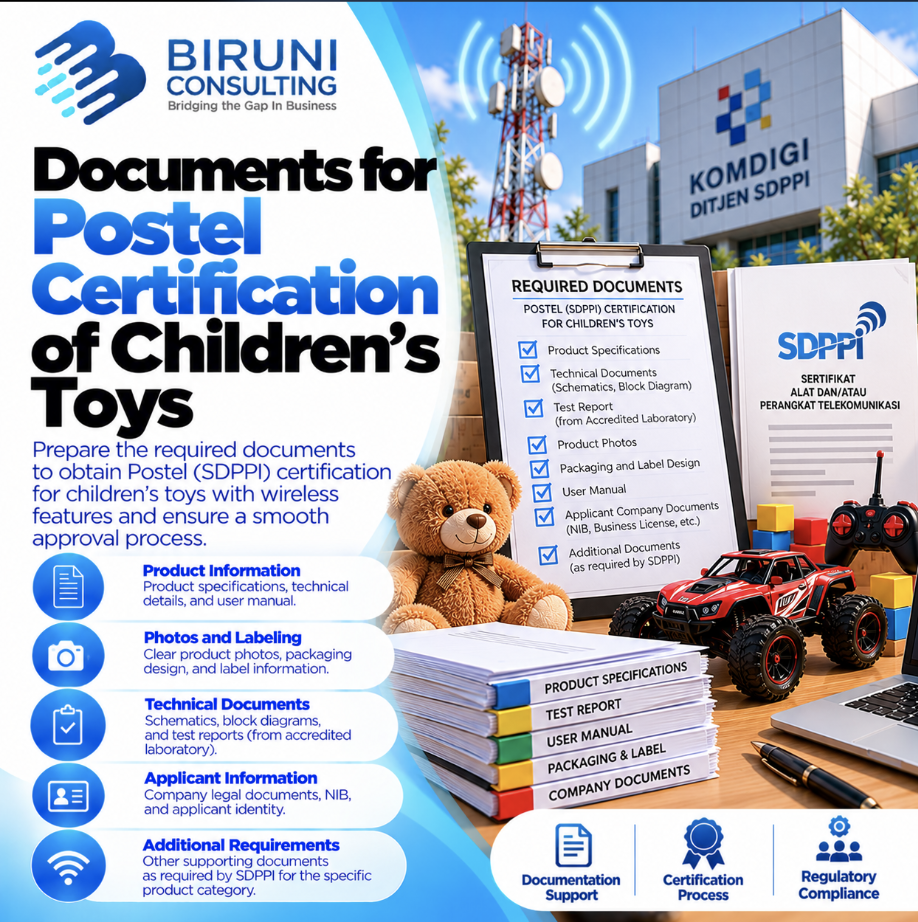
Guide to documentation required for DJID/SDPPI Certification of wireless children’s toys in Indonesia.
Children’s toys incorporating RF remote controls, Bluetooth, WiFi, Zigbee, or other wireless technologies require appropriate technical and administrative documentation before the Postel/DJID Certification process can be completed.
The required documentation goes beyond a basic product datasheet. Businesses may need to prepare test reports, technical specifications, a Declaration of Conformity, product photographs, brand and model information, and additional module-integration documents where module test reports are used.
DJID’s current e-Sertifikasi NextGen requirements list NIB and OSS access for business applicants, a test report, technical specifications, a Declaration of Conformity, colour photographs showing the brand and model/type, and a declaration that the submitted data and documents are true and complete. e-Sertifikasi
Main Documents for Toy Certification
Documentation should ideally be collected before the certification application begins.
Typical documentation includes:
- Laboratory test report.
- Product technical specifications.
- Declaration of Conformity.
- Colour photographs showing the brand and model/type.
- Product datasheet and user manual.
- Wireless-module datasheet, where applicable.
- Operating-frequency and transmission-power information.
- Manufacturer and country-of-manufacture information.
DJID’s current certification page states that the test report must be issued by a designated domestic laboratory or an overseas laboratory recognised under the applicable framework. e-Sertifikasi
NIB and OSS Access
For business applicants, NIB and access to the OSS service form part of the current administrative requirements.
New Certificate applications are submitted online through the OSS and e-Sertifikasi NextGen framework together with the required supporting documents. e-Sertifikasi
Companies should therefore ensure that their corporate and OSS information is ready before the technical certification application begins.
Laboratory Test Report
The RF test report is one of the most important technical documents for a wireless toy.
It can demonstrate parameters such as operating frequency, RF output power, bandwidth, modulation, unwanted emissions, and other characteristics required by the relevant Technical Standard.
The report should correspond to the exact product or wireless module used in the commercial toy.
For an RF remote-controlled toy, the transmitter inside the controller needs to be considered. For toys containing Bluetooth or WiFi, the supporting reports for those radio technologies also need to be reviewed.
A test report is explicitly listed among the general requirements for a new Certificate on DJID’s current certification service. e-Sertifikasi
Product Datasheet and Technical Specifications
Technical specifications help demonstrate that the tested radio configuration corresponds to the product being certified.
The datasheet should ideally identify the brand, model, product functions, wireless technologies, operating frequencies, transmission power, and other relevant technical information.
For a remote-controlled toy, documentation should also identify the controller.
Where a general commercial datasheet does not contain sufficient RF information, additional documentation such as an RF specification, module datasheet, schematic summary, or block diagram may be required.
Technical specifications are part of the current general certification documentation requirements. e-Sertifikasi
Declaration of Conformity
A Declaration of Conformity or DoC confirms conformity with the applicable Technical Standards.
Under the current e-Sertifikasi NextGen requirements, the Declaration of Conformity is signed by the applicant. e-Sertifikasi
Brand, model, and device information on the DoC should remain consistent with the laboratory report, datasheet, photographs, and other application documents.
Inconsistent model numbers or product descriptions can create difficulties during document review.
Product and Controller Photographs
Product photographs form an important part of the certification file.
Current DJID requirements call for colour photographs showing the equipment’s brand and model/type. e-Sertifikasi
For remote-controlled toys, businesses should ideally provide photographs of both the toy and its controller.
Useful photographs can include the full product, controller, product label, model number, packaging, and other identifying marks.
DJID’s testing requirements also include photographs of test samples from multiple sides and label photographs showing information such as brand, type, country of manufacture, and serial number. Pelayanan SDPPi
Remote Controller Documentation
For RC cars, toy tanks, motorcycles, trucks, trains, robots, dinosaur toys, and similar products, the controller is an important part of the radio system.
Controller documentation should ideally identify:
- Controller model or part number.
- Operating frequency.
- Transmission power.
- RF chipset or module.
- Antenna information.
- Technical relationship with the receiver inside the toy.
Where one controller is shared across several toy models, this relationship should also be documented.
A certification assessment should not rely only on the toy datasheet when the primary radio transmitter is located in the controller.
Bluetooth Module Documentation
For Bluetooth-enabled toys, the manufacturer should provide documentation for the Bluetooth module or chipset incorporated into the product.
Useful information includes the Bluetooth version, operating-frequency range, RF output power, antenna, and exact module model.
Minister of Communication and Informatics Decision Number 260 of 2024 continues to be listed by DJID as the Technical Standard for Short Range Devices and includes Bluetooth IEEE 802.15.1 within its SRD framework. Postel
Bluetooth documentation should therefore be reviewed against the final toy configuration and applicable technical requirements.
WiFi Documentation for Toys
Some smart toys incorporate WiFi for cameras, video streaming, smartphone applications, or other network functions.
Where WiFi is present, businesses should prepare the WiFi-module datasheet, RF specifications, operating frequencies, transmission power, antenna information, and relevant laboratory reports.
For RLAN/WiFi, Minister of Communication and Digital Decision Number 12 of 2025 is currently in force and establishes the relevant class-licensed spectrum and Radio Local Area Network Technical Standards. JDIH Kemkomdigi
Where a toy contains WiFi together with Bluetooth and proprietary RF, documentation for every enabled radio function should be prepared.
Using a Module Test Report
Additional integration documents are required where certification relies on the test results of a telecommunications module.
DJID’s current e-Sertifikasi NextGen requirements state that equipment using a module LHU/test result must provide:
- A block diagram.
- A photograph showing where the module is installed in the equipment.
- A module-use declaration stating the module brand and type and identifying the brand, type, and variant of the final equipment in which it is installed. e-Sertifikasi
This is especially relevant to toys incorporating Bluetooth, WiFi, Zigbee, or other pre-tested RF modules.
Providing only a module datasheet or module certificate may therefore be insufficient.
Block Diagrams
A block diagram helps explain how the wireless components are integrated into the product.
For a remote-controlled toy, it may show the controller transmitter, RF chipset, antenna, receiver, microcontroller, motor controller, and other components.
For products containing several radios, the diagram can also distinguish between Bluetooth, WiFi, and proprietary RF functions.
DJID testing requirements may require wiring diagrams, installation diagrams, or configuration block connections as part of the technical package. Pelayanan SDPPi
Obtaining a block diagram from the manufacturer early can therefore simplify technical assessment.
User Manual and Operating Instructions
A user manual helps explain how consumers use the wireless functions.
For an RC toy, it can describe pairing between the controller and toy. For Bluetooth products, it can explain smartphone pairing. For WiFi toys, it can document network or application configuration.
DJID’s testing service currently lists a manual in Indonesian or English and operating instructions among the technical materials used for equipment testing. Pelayanan SDPPi
The manual should therefore be prepared together with the datasheet and RF documentation.
Overseas Test Reports
International manufacturers often provide CE, FCC, RED, or other overseas laboratory reports.
These reports can be useful, but their suitability for Indonesian certification still needs to be assessed.
DJID currently permits LHU/test reports from designated domestic laboratories or recognised overseas laboratories. Where an RF LHU from an overseas laboratory is submitted, the current requirements also include an LHU summary declared to be true and consistent. e-Sertifikasi
An overseas laboratory report should therefore not automatically be assumed to be sufficient without review.
Brand, Model, and Manufacturer Information
Brand and model information should remain consistent across every document.
The test report, datasheet, product photographs, Declaration of Conformity, module declaration, and application data should not identify conflicting models.
The manufacturer and country of manufacture should also be confirmed early.
Differences in model suffixes, part numbers, manufacturers, or production locations can affect the certification assessment.
Importers should therefore finalise the exact commercial model before beginning certification.
Documentation for Multiple Toy Variants
A single toy family may include many colours, characters, sizes, or body designs.
Where several variants are being considered together, businesses should prepare technical comparisons showing their similarities and differences.
Important parameters include RF modules, controllers, operating frequencies, transmission power, antennas, firmware, wireless functions, brands, types, and countries of manufacture.
Model grouping should be based on technical configuration rather than appearance alone.
Documents for Laboratory Testing
Where local or additional testing is required, the documentation can be more technical than the normal certification package.
DJID’s current testing requirements list test-sample technical data, manuals, operating instructions, wiring or block diagrams, test instructions, technical specifications, photographs, label photographs, and a technical declaration among the materials required for a testing application. Pelayanan SDPPi
Manufacturers should therefore be willing to provide technical support where a special test mode or particular radio configuration is required by the laboratory.
Applicant and Brand-Owner Documents
Documentation relating to the applicant can also be important.
DJID’s current requirements state that an Indonesian company appointed as the official representative or distributor of an overseas brand owner must provide an appointment letter as the official representative or distributor. e-Sertifikasi
Where the applicant is an Indonesian legal entity that owns the brand, documents demonstrating compliance with applicable trademark-ownership requirements may also be required. e-Sertifikasi
The applicant structure should therefore be determined before certification begins.
Documentation After Certification
Documentation obligations continue after the Certificate is issued.
DJID’s current certification information states that Certificate holders are required to apply the prescribed Label, QR Code, and Warning Sign and report implementation within 30 working days after Certificate issuance by uploading photographs of the labeled equipment. e-Sertifikasi
Certificate information, PLG ID, QR Code files, labeling photographs, and packaging documentation should therefore be properly maintained.
Postel and Toy SNI Documents Are Different
DJID/SDPPI documents focus on telecommunications and wireless functions.
Toy safety or SNI documentation addresses a different area of product compliance.
An RF test report for Postel does not automatically replace a toy-safety laboratory report, and toy SNI documents do not automatically demonstrate compliance with radio Technical Standards.
For wireless toys, these documentation sets should therefore be managed separately.
Document Checklist Before Certification
Before starting an application, a company should at minimum have a clearly identified product, product photographs, datasheet, wireless specifications, RF test documentation, and module information.
For remote-controlled products, controller documentation should also be available. For Bluetooth or WiFi products, the relevant module information should be reviewed.
Where a module test result will be used, the block diagram, photograph showing module placement, and module-use declaration should also be prepared in accordance with current DJID requirements. e-Sertifikasi
Early document review can identify inconsistencies before the formal application begins.
Conclusion
Documents for Postel Certification of children’s toys consist of more than a single RF test report.
Businesses should prepare test reports, technical specifications, a Declaration of Conformity, product photographs, brand and model information, datasheets, wireless-module documentation, and the applicable applicant documentation. These general requirements are currently listed on DJID’s official e-Sertifikasi NextGen service. e-Sertifikasi
Where module test results are used, additional documentation such as a block diagram, module-location photograph, and module-use declaration also needs to be considered. e-Sertifikasi
Preparing these documents before importation or mass production can make the DJID/SDPPI assessment and certification process more structured and reduce inconsistencies between the actual product, test reports, datasheets, and Certificate information.
Contact Us
Biruni Consulting assists with DJID/SDPPI assessment and certification for wireless children’s toys and various wireless products that will be imported or marketed in Indonesia.
Our services include:
- Assessment of DJID/SDPPI certification requirements.
- Transmitter and receiver assessment.
- RF specification review.
- Frequency and transmission power analysis.
- Technical document review.
- Certification document preparation.
- Testing coordination where required.
- DJID/SDPPI Certification assistance.
If you have a wireless children’s toy, you can prepare product photos, brand, model, datasheet, RF specifications, and wireless module datasheet for an initial assessment of the Postel Certification requirements.