
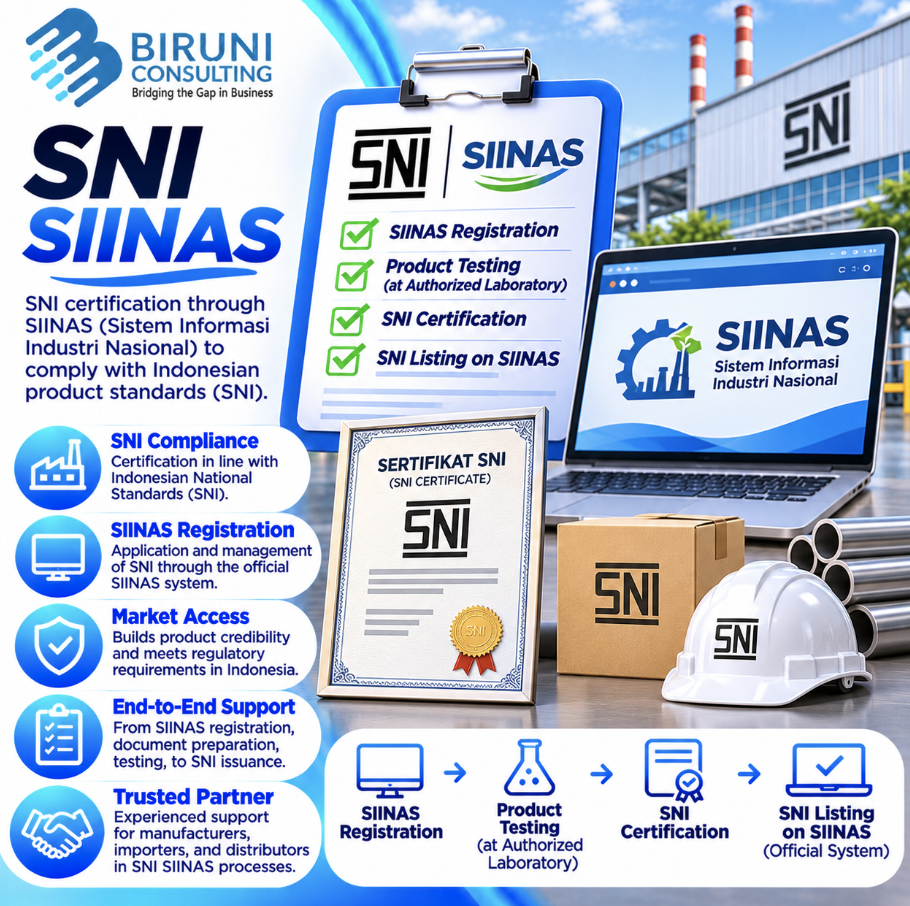
Guide to Mandatory Ministry of Industry SNI Applications, SIINas, Product Certification Bodies, Testing, SNI Certificates, SPPT SNI, and Imported Products
SNI certification through SIINas generally refers to the application and administration of SNI certification through Indonesia’s National Industrial Information System or SIINas, particularly for products subject to mandatory SNI under the Ministry of Industry. SIINas is not a standard and is not the organization that tests products. It is the Ministry of Industry’s information and electronic-service system used for numerous industrial functions, including certification administration for mandatory Ministry of Industry SNI schemes.
The Ministry of Industry describes SIINas as an integrated information system used to collect, manage, and present national industrial data and used by industrial companies, government bodies, associations, and other stakeholders. kpaii.kemenperin.go.id
Official Ministry certification information updated on May 6, 2026 confirms that products falling under mandatory Ministry of Industry SNI schemes submit certification applications through SIINas. Another Ministry certification unit similarly states that companies within mandatory-SNI scope need a SIINas account and submit their certification applications through the system. BBSPJIKKP
Companies should therefore understand that “SNI through SIINas” involves several separate components: SIINas as the administrative system, an LSPro as the certification body, laboratories performing product testing, Ministry regulations establishing mandatory requirements, and separate documents such as an SNI Certificate and, for certain products, SPPT SNI.
What Is SIINas?
SIINas stands for the National Industrial Information System.
The system is not used exclusively for SNI certification. It forms part of the Ministry of Industry’s infrastructure for industrial data collection, administration, services, and information management. kpaii.kemenperin.go.id
For mandatory SNI certification, SIINas functions as the electronic administrative route for relevant Ministry of Industry schemes.
SIINas itself is therefore not an SNI Certificate, not a certification body, and not a testing laboratory.
What Is the Relationship Between SNI and SIINas?
The connection primarily arises where a product falls within a mandatory SNI regulation administered by the Ministry of Industry.
Businesses whose products fall within such regulations need to follow the product-specific Ministerial Regulation. Current Ministry information confirms that mandatory Ministry of Industry SNI certification applications are processed through SIINas. BBSPJIKKP
SIINas provides the electronic administrative pathway, while conformity assessment continues to be performed through the relevant certification body and laboratory.
Completing the electronic application therefore does not itself complete certification.
Does Every SNI Certification Use SIINas?
No.
This distinction is important.
SIINas is particularly relevant to Ministry of Industry services, including mandatory SNI administered by the Ministry of Industry. Official Ministry information specifically refers to products made mandatory by the Ministry when describing SIINas certification applications. BBSPJIKKP
Mandatory standards under other regulators can use different regulatory mechanisms.
Electrical products regulated by the Ministry of Energy and Mineral Resources, telecommunications devices regulated through Komdigi, and other sector-specific products can have separate compliance systems.
Companies should therefore not assume that every SNI certificate in Indonesia is obtained through SIINas.
Mandatory Ministry of Industry SNI
The Ministry of Industry makes SNI mandatory for specified industrial products through product-specific Ministerial Regulations.
Such regulations can define applicable SNI numbers, product scope, HS Codes, applicant eligibility, product families, sampling, testing, management-system requirements, factory or production evaluation, surveillance, marking, and SPPT SNI procedures.
For example, Minister of Industry Regulation No. 7 of 2025 governs mandatory SNI for Household Electronics and replaced several older regulations concerning products such as air conditioners, refrigerators, washing machines, and specified household appliances. It remains in force. Database Peraturan | JDIH BPK
Minister of Industry Regulation No. 9 of 2025 similarly introduced an updated mandatory framework for tires and replaced the previous tire regulation. Database Peraturan | JDIH BPK
Current regulations should therefore be reviewed before every new SIINas certification project.
Role of BSKJI
The Agency for Industrial Standardization and Services Policy or BSKJI has a central role within the Ministry of Industry’s standardization framework.
The current Ministry organization under Minister of Industry Regulation No. 1 of 2025 includes BSKJI as the body responsible for industrial standardization and related service policies. Database Peraturan | JDIH BPK
In July 2026, BSKJI also coordinated certification-service acceleration through SIINas covering domestic industry, imported raw materials, imported finished products for importers with factories, and imported finished products for importers without manufacturing facilities. BSPJI Banda Aceh
This confirms SIINas’s growing role in the Ministry’s digital certification services.
Does a Company Need a SIINas Account?
For mandatory Ministry of Industry SNI applications through SIINas, an active SIINas account is required.
Official Ministry certification information states that companies within mandatory-SNI scope need an account and submit their certification requests through SIINas. bbs.kemenperin.go.id
Company information should be prepared consistently.
Business name, NIB, address, business activity, factory, brands, and other information appearing in SIINas need to correspond with the legal and certification documentation.
NIB and SIINas
An NIB and a SIINas account are different but related elements of corporate administration.
The NIB forms part of business licensing, while SIINas is the Ministry of Industry’s industrial-information system.
In 2026, the Ministry also emphasized both NIB and SIINas registration as important administrative elements for industrial businesses. DJIKMA
Neither an NIB nor a SIINas account automatically provides an SNI Certificate.
The product must still complete the required conformity-assessment process.
Do Importers Need SIINas?
For imported products subject to mandatory Ministry of Industry SNI, the entity using SIINas depends on the product-specific regulation.
Certain schemes use an Official Representative structure for overseas manufacturers, while others can contain additional provisions concerning importers, brand owners, contract manufacturing, or brand cooperation.
BSKJI’s July 2026 coordination expressly included several imported-product and importer configurations within SIINas certification services. BSPJI Banda Aceh
Foreign manufacturers should therefore establish the applicant and certificate-holder structure before issuing appointments or beginning certification.
Official Representatives and SIINas
For overseas manufacturers, an Official Representative can play a significant role in mandatory Ministry certification.
Its precise authority depends on the product regulation.
An Official Representative is not automatically the same party as the importer. One company can potentially perform both functions where permitted, but the functions remain legally and operationally distinct.
Likewise, an importer should not automatically be assumed to qualify as the certificate holder solely because it has import licensing.
The relationship between the manufacturer, factory, brand owner, Official Representative, applicant, certificate holder, importer, and distributor should therefore be mapped before the SIINas application begins.
Does SIINas Issue the SNI Certificate?
It is not accurate to describe SIINas as the certification body issuing the SNI Certificate.
SIINas is an electronic administrative platform.
Product certification is conducted by an LSPro or Product Certification Body within the applicable scope and scheme. Official Ministry information explains that compliant companies receive a Product Certificate issued by the certification body as evidence that the product meets the applicable SNI or other recognized standard. BBSPJIKKP
SIINas, the certification body, the laboratory, and the regulator therefore perform different functions.
What Is an LSPro?
An LSPro is a Product Certification Body.
It performs conformity assessment according to the applicable certification scheme, potentially including document review, production evaluation or audits, sampling, coordination of testing, technical review, and certification decisions.
Not every LSPro covers every product.
For mandatory Ministry SNI, companies need to verify both the applicable standard scope and any regulator-appointment requirements. Recent Ministry guidance specifically notes that accreditation alone does not automatically authorize an LSPro to conduct every mandatory SNI scheme. BSPJI Pontianak
Selecting an LSPro
The certification body should be selected only after the applicable standard and regulation have been confirmed.
Location or price alone should not determine the decision.
Companies should review the SNI number, product scope, certification scheme, laboratory arrangements, product experience, and appointment status where applicable.
A SIINas account cannot compensate for selecting a certification body without the required scope.
Laboratories and SIINas
Laboratories perform a different function from SIINas and certification bodies.
They test samples against the parameters in the applicable SNI.
Testing differs significantly between product categories. Electronics, steel, food, tires, chemicals, and other products all use different methods.
Submitting a SIINas application therefore does not mean the product has already been tested.
Laboratory evaluation remains a separate part of conformity assessment.
Test Reports Are Not SNI Certificates
A frequent misunderstanding is treating a laboratory report as an SNI Certificate.
Current official Ministry guidance expressly states that test results do not by themselves constitute an SNI Certificate. Testing provides technical evidence, while certification is completed through the applicable certification scheme. BSPJI Pontianak
Conceptually, the process is:
testing and technical evidence → conformity assessment → certification decision → SNI Certificate.
Certain products then have an additional SPPT SNI stage.
SNI Certificate vs SPPT SNI
An SNI Certificate and SPPT SNI or Approval to Use the SNI Mark are not necessarily the same document.
Recent Ministry guidance explains that an SNI Certificate results from the certification process, while certain mandatory products additionally require SPPT SNI as the authorization to use the SNI Mark under the relevant regulation. BSPJI Pontianak
Businesses should therefore not assume that compliance is complete immediately after testing or initial certification.
The applicable product regulation needs to be reviewed for SPPT SNI requirements.
SPPT SNI and SIINas
Many newer mandatory Ministry regulations use SIINas not only for initial certification administration but also for SPPT SNI procedures.
This remains product-specific.
It would be incorrect to state that every SNI in Indonesia uses SPPT SNI through SIINas.
The regulation applicable at the time of application should always be checked.
SNI Mark
The SNI Mark should not be printed on mass-production goods merely because a SIINas application has been opened.
The conformity-assessment and marking requirements must first be completed.
Some newer mandatory Ministry regulations also provide for electronic marks in addition to the SNI Mark.
Label artwork should therefore be reviewed before mass production and should not simply copy a historical certification label.
Does Voluntary SNI Use SIINas?
Voluntary certification needs to be distinguished from mandatory Ministry certification.
Ministry certification bodies can provide both mandatory and voluntary SNI services, but official information specifically states that products made mandatory by the Ministry of Industry use SIINas for certification applications. BBSPJIKKP
Businesses should therefore not assume that every voluntary SNI project follows the same SIINas mandatory-certification workflow.
How to Determine Whether a Product Needs SNI through SIINas
The first step should be regulatory assessment, not system registration.
The technical product name, function, intended use, HS Code, capacity, rating, materials, models, manufacturer, factory, and existing standards should be reviewed.
Only then should the company determine whether the product falls under mandatory Ministry of Industry SNI.
If another regulator controls the product, another certification route may apply. If the standard remains voluntary, the mandatory SIINas workflow may not apply.
HS Codes and SIINas
HS Codes can play an important role in defining mandatory Ministry product scope.
Many regulations combine tariff codes with technical descriptions and parameters.
An HS Code alone is not enough.
A tariff heading may contain technically different products, and regulations can use an ex designation to cover only part of a tariff line.
HS classification and standard mapping should therefore be completed before the SIINas application.
Product Family before the SIINas Application
Product families should be considered before certification begins.
Manufacturers can have many models differing in dimensions, wattage, capacity, materials, motors, compressors, PCBs, housings, formulations, or performance.
Submitting an entire catalogue without family assessment can result in additional representative samples or separate certification scopes.
The model list should therefore be built from technical construction rather than copied directly from a sales catalogue.
Representative Samples
Representative samples are selected to represent the certification family.
The highest-rated model is not necessarily always the only critical sample.
Critical configurations vary by product and standard.
Sample-selection strategy should therefore be established before specimens are shipped for testing.
Corporate Legal Documents
SIINas applications require corporate data consistent with the applicant’s actual legal position.
Requirements can include NIB, business licensing, corporate information, and other documents defined by the product regulation.
The exact document list should not be generalized because requirements can differ significantly between product schemes.
For example, official Ministry guidance for one current steel scheme requires SIINas-generated application documentation, business legality, management-system documentation, manufacturing-process information, production facilities, test equipment, quality-control plans, and an SNI-marking illustration. This is a scheme-specific example rather than a universal list. bbkb.kemenperin.go.id
Technical Product Documentation
Companies also need a suitable technical file.
Documentation may include product specifications, model lists, drawings, material specifications, production flows, quality-control plans, labels, brand information, existing test reports, and critical-component information.
OEM and brand-cooperation structures can require additional relationship documents.
Imported products need manufacturer and factory information consistent with the application.
Quality Management Systems
Certain mandatory-SNI schemes include quality-management requirements.
Companies should not assume that ISO 9001 is universally mandatory for every SIINas SNI project.
The requirement needs to be read from the applicable Ministerial Regulation and certification scheme.
Some schemes use ISO 9001 or another relevant management system, while others can establish different production-control requirements.
Factory Audit or Production Evaluation
Once the administrative stage is accepted, the certification scheme can require a factory audit or production evaluation.
This can examine incoming materials, production controls, equipment, calibration, testing, quality records, traceability, nonconforming products, complaint handling, and engineering changes.
For imported products, the relevant factory may be located overseas.
Manufacturers should therefore understand that SNI certification can involve substantially more than sample testing.
Product Testing
Samples are tested according to the applicable standard and certification scheme.
Existing IEC, ISO, ASTM, EN, JIS, CB, or other international test reports can support initial assessment, but acceptance is not automatic.
The certification body needs to consider the standard edition, models, laboratory competence, national differences, factory, and scheme requirements.
Existing Test Reports and SIINas
Existing reports should ideally be reviewed before new applications and new testing.
Where relevant evidence already exists, a technical gap can be identified early.
A report should not be relied upon merely because its standard title appears similar.
Differences in editions, models, factories, critical components, or test scope can prevent it from supporting certification.
Products Imported from China
Many SIINas SNI projects involve Chinese manufacturers.
Suppliers can already hold CCC, CQC, CE documentation, IEC reports, CB Test Reports, or other international laboratory evidence.
Such documents can support initial assessment but do not automatically constitute an Indonesian SNI Certificate.
Overseas manufacturers should prepare model lists, factory information, brand documentation, authorizations, drawings, production information, critical components, and available test reports before mass production.
Assessment should ideally be completed before final purchase orders and shipment.
Imports from Other Countries
The same principle applies to products from Vietnam, Thailand, Malaysia, South Korea, Japan, Taiwan, India, Europe, the United States, and other countries.
Country of origin does not determine whether SIINas applies.
The regulator and product scope determine the certification route.
Where the goods fall under mandatory Ministry of Industry SNI, SIINas can form part of compliance. Other regulators can use different systems.
OEM, Contract Manufacturing, and Brand Cooperation
OEM products require additional planning because one factory can manufacture for several brands.
Newer Ministry regulations can contain specific provisions concerning brand cooperation and contract manufacturing.
Companies need to establish the brand owner, manufacturer, factory, applicant, Official Representative, and certificate holder before certification.
Additional brands should not simply be introduced at the end of the process without assessment.
Private-Label Products
Private-label companies should also plan regulatory ownership early.
Changing a label or logo does not automatically extend an existing certificate to a new brand.
Brand documentation, authorization, applicant structure, models, factories, and certificate scope need review.
This becomes particularly important where a business intends to work with multiple distributors or change importers later.
Importer Different from the Certificate Holder
For imported products, the importer and certificate holder do not always perform identical functions.
A product regulation may use an Official Representative structure for the foreign manufacturer while establishing separate arrangements for importation.
BSKJI’s 2026 certification-service coordination also expressly distinguishes several imported-product configurations. BSPJI Banda Aceh
Foreign manufacturers should therefore complete a certificate-holder and importer structure assessment before issuing appointments.
General SIINas SNI Application Flow
The process should begin by confirming that the product actually falls under current mandatory Ministry of Industry SNI.
The company then prepares its SIINas account, legal documentation, product list, brands, manufacturer and factory information, and technical documentation.
The application is submitted electronically and handled through the appropriately scoped certification body according to the scheme. Conformity assessment may include documentation review, production evaluation, sampling, and laboratory testing.
Once all requirements are satisfied, the certification body can issue the SNI Certificate. Where the product regulation requires SPPT SNI, the company then completes the approval process for use of the SNI Mark. Current Ministry guidance clearly distinguishes testing, the SNI Certificate, and SPPT SNI. BSPJI Pontianak
Is the SIINas Process the Same for Every Product?
No.
SIINas can be a common electronic platform, but regulatory requirements remain product-specific.
Tires can use a different scheme from household electronics. Steel differs from food products, and water meters differ from fertilizers or chemicals.
Minister of Industry Regulation No. 18 of 2025, for example, replaced the previous mandatory water-meter regime, while Regulation No. 9 of 2025 replaced the older tire regulation. Database Peraturan | JDIH BPK
Experience from one SIINas project should therefore not automatically be copied to another product category.
Regulations Can Change
Mandatory Ministry regulations continue to be updated.
Even relatively new regulations can be amended when implementation needs change.
For example, Minister of Industry Regulation No. 14 of 2026 amended Regulation No. 3 of 2025 concerning mandatory SNI for palm cooking oil, including provisions relating to industrial companies, SIINas, and regulatory annexes. The amendment took effect on June 23, 2026. Database Peraturan | JDIH BPK
Regulations should therefore be rechecked for new applications, renewals, model additions, factory changes, and certificate transfers.
Application Tracking
Electronic administration makes it easier to structure application data and status.
However, a system status does not replace technical communication with the certification body concerning samples, testing, audits, nonconformities, or product-family issues.
Businesses should designate a responsible person who understands both the SIINas account and the underlying certification project.
Corrective Action
Where audits or tests identify nonconformities, corrective action is required.
Corrections can involve documents, quality procedures, manufacturing processes, materials, components, or product design.
Products modified to address nonconformities need to remain consistent with later mass production.
Businesses should not prepare special test samples and then return to the original noncompliant construction after certification.
Certificate Validity
There is no universal validity period that should be assumed for every SNI Certificate.
Certification cycles, surveillance, renewal, and recertification depend on the applicable product scheme.
SPPT SNI can also have a validity arrangement different from the underlying certificate under particular regulations.
Companies should therefore maintain a compliance calendar based on their own certificate and product regulation.
Surveillance
Certification obligations can continue after the initial certificate is issued.
Surveillance can involve production evaluation, sampling, testing, document review, or other scheme-specific activities.
Mass-production goods should remain consistent with certified configurations.
Supplier information, critical materials, components, production processes, model lists, and factory changes therefore need continued control.
Product Changes after Certification
Suppliers frequently introduce changes for cost or availability reasons.
Motors, compressors, PCBs, cables, plugs, heaters, materials, resins, steel grades, formulations, safety devices, packaging, or suppliers can change.
Such substitutions should not automatically be implemented in certified products.
A change-control procedure should determine whether the certification body needs to be informed and whether additional assessment is required.
Adding Models
New models need assessment against the certification scheme and product-family criteria.
A color variation can be treated differently from a model using a new motor, wattage, material, capacity, or construction.
Adding a model to an electronic system does not automatically place that model within the certificate.
Technical assessment remains necessary.
Changing the Factory
Changing the manufacturing site can significantly affect certification.
Two factories making the same brand and model can use different suppliers, tooling, equipment, quality systems, and production controls.
Where certification is connected with a specific manufacturing site, a new factory can require additional assessment.
Foreign manufacturers should therefore identify the intended Indonesian-market factory before certification begins.
Common SIINas SNI Mistakes
One common mistake is submitting an SIINas application before confirming that the product actually falls under mandatory Ministry SNI.
Another is selecting the standard or certification body from the commercial product name rather than technical assessment.
Companies may also attempt to place an entire sales catalogue into one product family.
Other common errors include treating test reports as SNI Certificates or treating the SNI Certificate as automatically equivalent to SPPT SNI.
For imported products, another major risk is issuing an appointment letter or appointing an importer before establishing applicant and certificate-holder eligibility.
These issues should ideally be resolved through pre-assessment.
Why Is Pre-Assessment Important Before SIINas?
SIINas can digitalize administration, but it does not replace correct regulatory classification.
If a company selects the wrong standard, family, manufacturing site, or certificate-holder structure, the problem will still emerge during conformity assessment.
Pre-assessment identifies the regulator, Ministerial Regulation, SNI number, HS Code, applicant, Official Representative, importer, certificate holder, certification body, laboratory, product family, representative samples, and required documentation.
For imported products, this should ideally be completed before mass production and shipment.
Contact Us
Biruni Consulting assists companies with SNI certification through SIINas, including regulatory assessment, identification of mandatory Ministry of Industry SNI, HS Code review, product family assessment, testing, and certification assistance.
Our services include:
- Consultation on SIINas SNI certification and current mandatory Ministry of Industry regulations.
- Review of Ministerial Regulations, HS Codes, product specifications, model lists, and product scope.
- Review of SIINas accounts, applicant structures, Official Representatives, importers, certification bodies, and laboratory scope.
- Review of technical documentation, brands, labels, existing test reports, manufacturers, factories, and critical components.
- Product family assessment, representative-sample selection, and preparation for factory audit or production evaluation.
- SIINas application assistance, testing, corrective action, SNI Certificates, SPPT SNI where applicable, surveillance, and certification changes.
Contact Biruni Consulting for information regarding SIINas SNI certification services, mandatory Ministry of Industry SNI, SNI applications through SIINas, SNI Certificates, SPPT SNI, imported-product SNI, and Ministry of Industry SIINas consultation according to your product type, brand, model, specifications, HS Code, factory, and country of origin.