
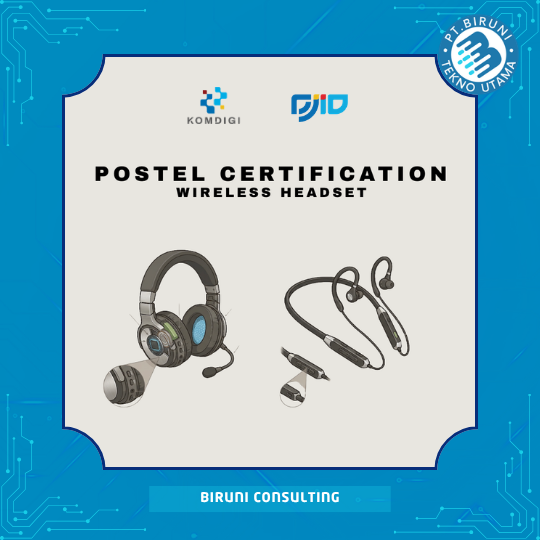
Guide to Wireless Headset Postel Certification in Indonesia
A Wireless Headset is an audio communication device that combines headphones and a microphone while connecting to other electronic devices without physical cables. Most wireless headsets use Bluetooth, WiFi, or other radio communication technologies to transmit and receive audio signals from smartphones, computers, tablets, smart TVs, gaming consoles, and various communication devices.
As wireless audio technology continues to grow in popularity, wireless headsets are widely used for business communication, entertainment, online learning, gaming, customer service, and professional applications. Since these products utilize radio frequency communication, they generally require DJID (formerly Postel/SDPPI) Certification before they can be legally imported, distributed, or marketed in Indonesia.
Understanding certification requirements early enables manufacturers, importers, distributors, and brand owners to accelerate product approval while ensuring compliance with Indonesian telecommunications regulations.
What Is a Wireless Headset?
A Wireless Headset is an audio device that integrates headphones and a microphone into a single product while using wireless communication technologies for audio transmission.
Most wireless headsets communicate through Bluetooth, while some models also support WiFi, proprietary 2.4 GHz USB wireless adapters, or other wireless communication technologies. They are available in various designs, including over-ear, on-ear, in-ear, gaming, office, true wireless, and industrial communication headsets.
Because these devices contain radio communication modules, every wireless technology incorporated into the product must comply with Indonesian telecommunications regulations.
Does a Wireless Headset Require DJID (Postel) Certification?
Yes. Wireless headsets utilizing Bluetooth, WiFi, or other radio communication technologies generally require DJID (Postel) certification before they can be legally imported, marketed, or distributed in Indonesia.
During certification, DJID evaluates radio characteristics, operating frequency, transmission power, electromagnetic compatibility (EMC), technical specifications, and other regulatory parameters to verify compliance with Indonesian telecommunications standards.
If the headset supports multiple wireless technologies, each communication module is typically included in the certification assessment.
Wireless Headset Certification Requirements
Companies applying for certification generally prepare the following documentation:
- Company legal documents.
- Business Identification Number (NIB).
- Technical product specifications.
- User Manual.
- Product Datasheet.
- Product Label.
- Product Photographs.
- Block diagrams and circuit schematics.
- Accredited laboratory test reports where applicable.
- Additional supporting documents required by DJID regulations.
Complete documentation helps accelerate certification while minimizing administrative revisions.
Wireless Headset Certification Process
The certification process begins by identifying the wireless communication technologies used in the headset.
Technical and administrative documentation is reviewed before laboratory testing is conducted where required. Testing may include Radio Frequency (RF), Electromagnetic Compatibility (EMC), Electrical Safety where applicable, and other technical evaluations depending on product characteristics.
After successful technical assessment and administrative review, DJID issues certification authorizing legal commercialization of the wireless headset in Indonesia.
Certification timelines vary according to communication technologies, product complexity, and documentation completeness.
Benefits of Wireless Headset Certification
Obtaining DJID certification provides significant advantages for manufacturers, importers, distributors, and brand owners.
Key benefits include:
- Compliance with Indonesian telecommunications regulations.
- Support for product importation and commercial distribution.
- Verification of technical conformity.
- Reduced regulatory risks.
- Increased customer and business partner confidence.
- Legal commercialization throughout Indonesia.
Certification also demonstrates compliance with national radio communication requirements while helping prevent interference with other wireless communication systems.
Types of Wireless Headsets Commonly Requiring Certification
Examples of wireless headsets commonly requiring DJID certification include:
- Bluetooth Headsets.
- Wireless Gaming Headsets.
- Office Wireless Headsets.
- True Wireless Stereo (TWS) Headsets.
- Over-Ear Wireless Headsets.
- On-Ear Wireless Headsets.
- In-Ear Wireless Headsets.
- USB Wireless Headsets.
- Call Center Wireless Headsets.
- Professional Wireless Communication Headsets.
Certification requirements depend on the communication technologies and technical specifications of each product.
Contact Us
Biruni Consulting provides professional consulting services for DJID (Postel) certification of wireless headsets and other wireless audio equipment in Indonesia.
We assist companies with:
- Regulatory analysis for wireless headset products.
- Identification of applicable DJID certification requirements.
- Preparation of technical and administrative documentation.
- Coordination with accredited testing laboratories.
- End-to-end certification support until approval is granted.
With extensive experience in Indonesian telecommunications certification, we help manufacturers, importers, distributors, and brand owners obtain certification efficiently while ensuring full regulatory compliance.
Contact us today for professional consultation regarding Wireless Headset Postel Certification and telecommunications equipment approval requirements in Indonesia