
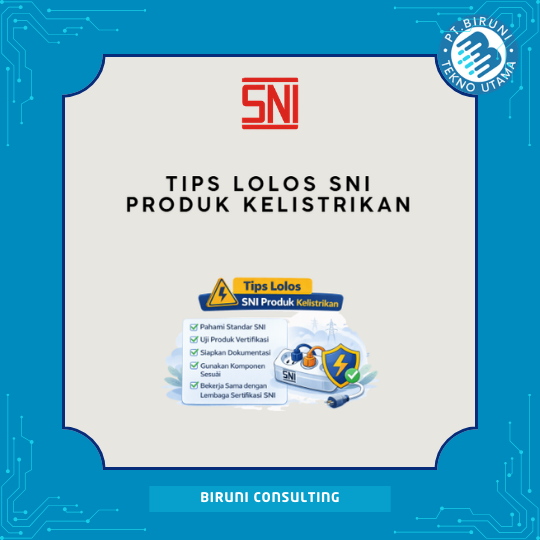
Practical Strategies to Comply with Indonesian Standards and Accelerate Approval
Electrical products are categorized as high-risk goods due to their direct impact on user safety. In Indonesia, many electrical products such as cables, LED lamps, circuit breakers, switches, sockets, and panels are subject to mandatory SNI certification. This certification ensures compliance with national safety and quality standards before products can be legally distributed.
The SNI framework is established by Badan Standardisasi Nasional and enforced through regulations issued by Kementerian Perindustrian, with technical supervision involving Kementerian Energi dan Sumber Daya Mineral. Understanding these regulatory foundations is essential for manufacturers and importers seeking certification approval.
Understand the Applicable SNI Regulations
Mandatory SNI requirements for electrical products are typically regulated through Minister of Industry Regulations. Certification generally involves:
-
Application submission to a Product Certification Body (LSPro)
-
Product testing in accredited laboratories
-
Factory audit and quality system assessment
-
Evaluation of compliance results
-
Issuance of SPPT-SNI certificate
A clear understanding of this process significantly increases approval success.
Conduct Internal Product Evaluation Before Testing
Many certification delays occur due to technical non-conformities discovered during laboratory testing. Companies are advised to perform internal assessments before submitting samples.
Key aspects to evaluate include:
-
Rated voltage and current compliance
-
Insulation and heat resistance
-
Short-circuit protection system
-
Mechanical strength and durability
-
Consistency between product design and technical documentation
Early evaluation reduces the risk of retesting and additional costs.
Prepare Complete Administrative and Technical Documents
Documentation plays a critical role in certification approval. Required documents commonly include:
-
Business registration number
-
Industrial or import license
-
Technical specifications and drawings
-
Product user manual
-
Quality management system documentation
-
Laboratory test reports
Inconsistent documentation often leads to processing delays.
Ensure Proper Factory Audit Preparation
Certain certification schemes require factory audits to assess production consistency and quality control systems. Companies should ensure documented production procedures, routine inspections, organized quality records, and staff awareness of compliance requirements.
Pay Attention to SNI Marking and Labeling Requirements
After certification approval, the SNI mark must be used according to official guidelines. Product labels must display manufacturer or importer identity, technical specifications, and certificate number. Incorrect labeling may result in administrative sanctions.
Conclusion
Passing SNI certification for electrical products requires thorough preparation in regulatory understanding, technical compliance, documentation, and audit readiness. With proper planning and systematic execution, companies can significantly improve their approval success rate.
Biruni Consulting is a professional consulting firm assisting companies in managing SNI certification for electrical products. We provide comprehensive support from regulatory analysis, document preparation, laboratory coordination, factory audit preparation, to SPPT-SNI issuance. Our expertise ensures a faster, compliant, and efficient certification process.
Contact Biruni Consulting today to streamline your SNI certification process with confidence.