
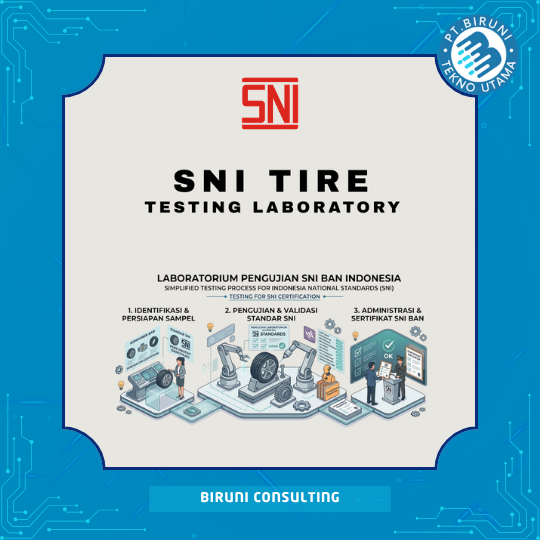
Role of Testing Laboratories in SNI Tire Certification in Indonesia
SNI tire testing laboratories play an important role in the certification process because test results are used to assess tire conformity with applicable standards. Testing is conducted on tire samples representing the products submitted for certification and must be performed by a laboratory that meets the requirements of the applicable certification scheme.
For tire products, the applicable standard may differ depending on the product category, such as motorcycle tires, passenger car tires, light truck tires, and truck and bus tires. Therefore, before selecting a testing laboratory, companies need to first confirm the tire type, applicable standard, size, type, and certification scope.
What Is an SNI Tire Testing Laboratory?
An SNI tire testing laboratory is a testing facility that examines and tests the technical characteristics of tires based on the standards used as certification references. The laboratory must have the appropriate capability and scope for the required testing parameters.
In the certification process, laboratory test results become one of the bases used by the Product Certification Body (LSPro) to conduct conformity assessment. Therefore, testing is not merely about obtaining a test report, but also about ensuring that the samples, testing methods, product identification, and tested parameters comply with the certification scheme.
Under the applicable mandatory SNI tire requirements, conformity assessment is conducted through a certification scheme that includes an audit of the production process and quality management system, as well as product quality conformity testing against the applicable SNI.
SNI Standards for Tire Testing
The selection of testing standards must be adjusted to the category of tire being certified. Several groups of SNI standards related to motor vehicle tires include standards for passenger car tires, light truck tires, truck and bus tires, and motorcycle tires.
Companies need to ensure that the applicable standard is current and appropriate for the product type. Using an inappropriate standard may result in testing parameters that do not fulfill certification requirements.
In addition to the tire type, identification should also consider tire construction, size, intended use, and other technical specifications. Early assessment helps determine the appropriate sample type and testing requirements.
Types of SNI Tire Testing
The types of testing performed depend on the applicable standard and tire category. Testing may cover physical, mechanical, and tire performance characteristics according to the requirements of the applicable standard.
In general, tire testing aspects may include:
- Inspection of tire dimensions and sizes.
- Inspection of construction characteristics.
- Testing of specific resistance or strength characteristics.
- Performance testing according to tire category.
- Testing of resistance to specified loads and pressures.
- Inspection of product markings and technical information.
Testing parameters and methods cannot be standardized for every tire type. Each standard has specific requirements and testing methods that must be reviewed individually.
SNI Tire Testing Process at the Laboratory
Product Identification
The first stage is to clearly identify the product to be tested. The company needs to prepare information regarding the brand, type, size, construction, vehicle application, and manufacturing factory.
This identification is important so that the laboratory and LSPro can determine the appropriate standard and testing parameters.
Sample Determination
After the product has been identified, the samples to be used for testing are determined. The samples must represent the products submitted for certification.
The number and type of samples depend on the standard and certification scheme. For companies with multiple tire sizes or types, sample selection needs to consider the product groups that will be covered by the certification.
Sample Shipment
The samples are then delivered to the laboratory according to the specified procedure. Sample identification must be clear and consistent with the certification documents.
For imported products, companies must also consider the sample origin and ensure that it corresponds to the factory stated in the certification documents.
Testing Implementation
The laboratory performs testing according to the methods and parameters required by the applicable standard. During this process, sample conditions, testing methods, equipment, and measurement results are controlled according to laboratory procedures.
If any parameter fails to meet the requirements, the company needs to evaluate the cause of the nonconformity before determining further action with the LSPro.
Test Report Issuance
After all testing has been completed, the laboratory issues a test report. The report contains sample identification, testing methods or standards, tested parameters, test results, and other required information.
The test report is then used as one of the documents in the conformity assessment process and certification decision-making.
SNI Tire Testing Sample Requirements
Samples used for testing must correspond to the products submitted for certification. Companies need to ensure that sample identification is traceable and consistent with the product documents.
Information that needs to be considered includes:
- Tire brand.
- Tire type or pattern.
- Tire size.
- Construction type.
- Load rating.
- Speed symbol where required.
- Manufacturer identity.
- Tire sidewall markings.
- Country of origin for imported products.
- Number of samples required for testing.
Inconsistencies between sample identification and certification documents may require clarification or correction during the testing or certification process.
Testing Laboratories for Imported Tires
For tires manufactured overseas and marketed in Indonesia, laboratory selection needs to comply with the requirements of the certification scheme and applicable regulations. Test results from overseas laboratories are not automatically accepted for certification in Indonesia.
Companies should first verify whether the selected laboratory has the required accreditation, scope, and recognition for the submitted testing parameters. This review should preferably be conducted before samples are shipped so the company does not incur testing costs at a laboratory whose results cannot be used for the certification process.
Must the Laboratory Be Accredited?
The laboratory’s accreditation status and scope are important aspects of the SNI testing process. The laboratory used must meet the requirements specified in the certification scheme and related regulations.
Companies should not only check whether the laboratory is accredited, but also whether its accreditation scope covers the tire testing methods and parameters required.
Therefore, companies should not select a laboratory solely based on its general ability to conduct automotive product testing. Specific verification of the testing scope is necessary.
Cost of SNI Tire Testing
The cost of SNI tire testing may vary depending on the tire type, number of sizes or types tested, number of samples, testing parameters, testing methods, and selected laboratory.
To obtain a more accurate cost estimate, companies should first provide product information such as:
- Tire type.
- Brand.
- Number of types or sizes.
- Country and factory location.
- Applicable standard.
- Whether the product is locally manufactured or imported.
With this information, testing requirements can be mapped before samples are submitted to the laboratory.
Difference Between SNI Tire Testing and SNI Certification
Laboratory testing and SNI certification are related but different activities. Testing is conducted to obtain technical data regarding sample conformity with the requirements of a standard, while certification is a conformity assessment process conducted by an LSPro based on various forms of evidence, including test results and audits.
Therefore, obtaining a test result that meets the standard does not automatically mean that the company has obtained SNI certification. The company must still fulfill other certification stages required under the applicable scheme, including production process and quality management system assessment where required.
Preparation Before SNI Tire Testing
Good preparation can help reduce the risk of repeated testing. Before samples are submitted to the laboratory, companies should review the product specifications and sample condition.
Several aspects that should be confirmed include:
- The applicable SNI standard is correct.
- The type and size of samples have been determined.
- Sample identification corresponds to the documents.
- Sample physical condition is suitable.
- Tire markings correspond to product data.
- The required number of samples is available.
- The laboratory has the appropriate testing scope.
- Product technical documents are available.
This preparation helps ensure that testing is conducted according to certification requirements and reduces the risk of repeated testing caused by administrative or technical issues.
Contact Us
Biruni Consulting helps companies with SNI tire testing and certification professionally and in accordance with applicable regulations in Indonesia.
Our services include
- Consultation on SNI tire regulations.
- Identification of standards and testing parameters.
- Identification of sample requirements.
- Testing document preparation.
- Laboratory testing assistance.
- Factory audit assistance.
- SNI certification process assistance.
- Certification processing until certificate issuance.
With experience in product certification in Indonesia, Biruni Consulting helps companies ensure that tire testing and certification processes comply with applicable requirements so that products can meet the regulations in Indonesia.
Contact Us for consultation, laboratory testing assistance, and SNI tire certification processing services.