
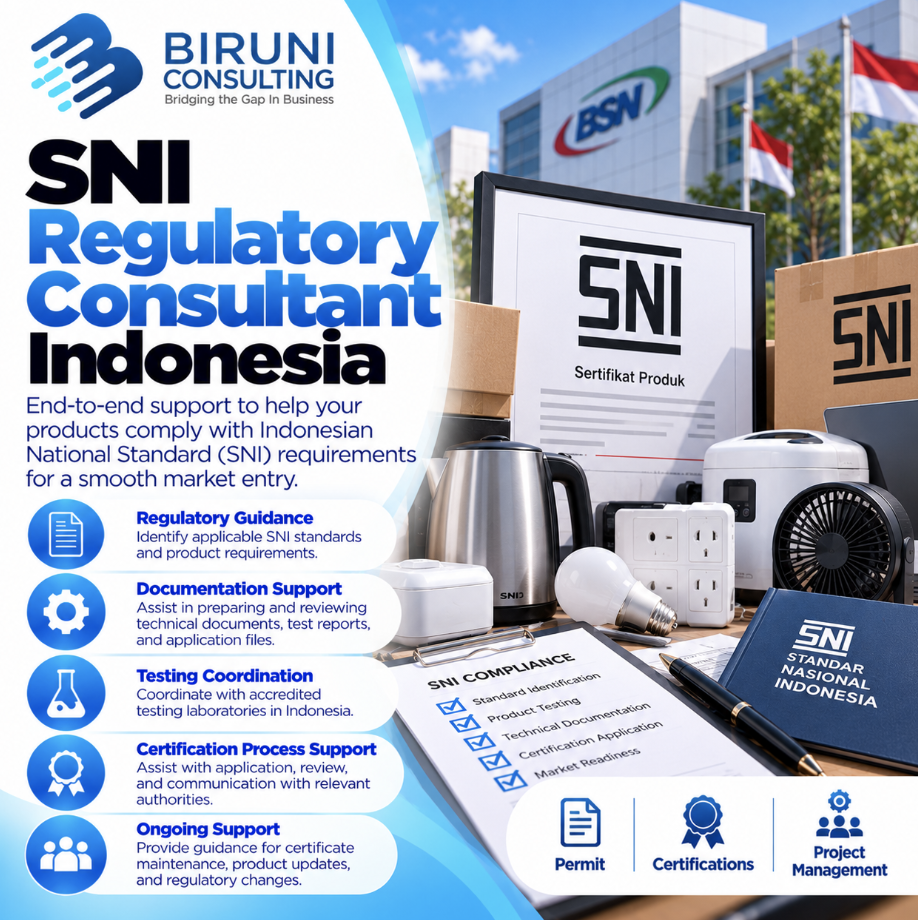
SNI Regulatory Consulting for Indonesian and Overseas Manufacturers
SNI Regulatory Consultant Indonesia is a consulting service for companies requiring assistance in understanding Indonesian National Standard regulations, determining certification obligations, and preparing regulatory compliance before products are manufactured, imported, or marketed in Indonesia.
SNI regulation involves more than identifying a standard number associated with a product. Companies need to understand whether the standard remains valid, whether implementation is mandatory or voluntary, which sector regulation applies, how conformity assessment is conducted, and which organizations are authorized to perform certification and testing.
At the national level, Law No. 20 of 2014 concerning Standardization and Conformity Assessment remains in force and forms one of the principal foundations of Indonesia’s standardization framework. Government Regulation No. 34 of 2018 concerning the National Standardization and Conformity Assessment System also remains in force and provides the national framework for standardization and conformity assessment. Database Peraturan | JDIH BPK
For an Overseas Manufacturer, regulatory assessment becomes even more important because certain product regulations can involve an Official Representative, SIINas, trademarks, warehouses, importers, overseas production-facility audits, and other administrative requirements.
SNI Regulatory Consultant Indonesia helps companies understand the entire regulatory landscape before starting certification so the process is not based solely on assumptions, outdated information, or generic checklists.
What Is an SNI Regulatory Consultant Indonesia?
SNI Regulatory Consultant Indonesia is a consulting service focusing on identifying, interpreting, and applying SNI regulations to products or business activities in Indonesia.
The consultant helps companies answer important questions:
- Does the product have a relevant SNI?
- Has that SNI been made mandatory?
- Which regulation is currently applicable?
- Which certification scheme applies?
- What obligations remain after certification?
The answers form the basis before a company selects an LSPro, Testing Laboratory, ships samples, prepares for a factory audit, or establishes an Indonesian representative structure.
An SNI Regulatory Consultant does not replace regulators, BSN, LSPro, Testing Laboratories, or government authorities. The consultant assists companies in understanding and preparing compliance with the applicable regulatory framework.
Why Is Regulatory Assessment Important Before SNI Certification?
A common problem is beginning certification before the regulatory scope is fully understood.
Companies may immediately contact laboratories, prepare samples, or select an LSPro simply because they have found an SNI relating to their product.
However, the existence of an SNI does not automatically make certification mandatory.
Official BBSPJIKKP information distinguishes Mandatory SNI from Voluntary SNI. Mandatory SNI is established as compulsory by the government, while Voluntary SNI is adopted voluntarily by companies. For products covered by Ministry of Industry Mandatory SNI schemes, certification applications are submitted through SIINas. BBSPJIKKP
Regulatory assessment should therefore be completed before technical certification activities begin.
Indonesian Standardization Regulatory Framework
The SNI system operates within Indonesia’s national standardization and conformity-assessment legal framework.
Law No. 20 of 2014 regulates institutional arrangements, standardization, conformity assessment, cooperation, guidance, supervision, and information systems relating to standardization and conformity assessment. The law is currently listed as in force. Database Peraturan | JDIH BPK
Government Regulation No. 34 of 2018 governs the National Standardization and Conformity Assessment System and is also currently in force. Within this framework, SNI is defined as a standard established by BSN and applicable within the territory of the Republic of Indonesia. Database Peraturan | JDIH BPK
For companies, this framework is important because certification compliance does not normally consist of one regulation alone. A product may be subject to technical standards, mandatory-SNI implementing regulations, conformity-assessment requirements, and ministry administrative procedures.
Scope of SNI Regulatory Consultant Indonesia
The service scope can be adapted to the product and company requirements. In general, assistance may include:
- Regulatory assessment and identification of the relevant SNI.
- Analysis of Mandatory or Voluntary SNI status.
- Review of LSPro, Testing Laboratory, and certification scheme.
- Review of SIINas, Official Representative, and imported-product structures.
- Regulatory monitoring after SNI Certificate issuance.
For companies managing several product lines, the assessment can also be developed as regulatory mapping so each product category has its own compliance roadmap.
Product Identification Before Regulatory Review
Regulatory analysis should begin with the product rather than with the name of a standard.
The SNI Regulatory Consultant needs to understand the product characteristics in sufficient detail to determine whether a regulation genuinely applies.
Basic information commonly reviewed includes:
- Product name and function.
- Materials and technical specifications.
- Model, type, or rating.
- HS code and intended use.
- Country of origin and manufacturing site.
Additional information such as trademarks, catalogues, technical drawings, manufacturing processes, or existing test reports may be needed depending on product complexity.
An HS code can assist regulatory assessment, but generally should not be treated as the sole basis for determining the applicable SNI.
Two products with similar trade classifications may have different technical characteristics and regulatory scopes.
Identifying the Applicable SNI
Once the product has been understood, the next stage is identifying the relevant technical standard.
Companies need to review the SNI number, standard title, version, status, and scope.
This is important because a standard can be revised, reconfirmed, or replaced.
BSN currently lists SNI ISO/IEC 17067:2013 Confirmation 2020 concerning the fundamentals of product certification and guidelines for product-certification schemes as valid. The standard provides an important general framework for understanding product-certification schemes. Pesta
However, each product still needs to comply with the specific technical SNI applicable to its own scope.
An SNI Regulatory Consultant helps ensure that a standard is selected because it genuinely matches the product and regulatory requirements, not merely because its title appears similar.
Mandatory and Voluntary SNI
One of the most important elements of regulatory assessment is determining whether an SNI is mandatory or voluntary.
Voluntary SNI can be adopted as part of quality assurance, improved competitiveness, customer requirements, or commercial positioning.
Mandatory SNI differs because implementation is established through government regulation.
Official BBSPJIKKP information explains that Mandatory SNI is established as compulsory by the government, meaning products within the applicable scope need to meet SNI requirements before being manufactured, traded, or distributed in accordance with the regulation. BBSPJIKKP
A regulatory consultant therefore needs to do more than provide an SNI number. The consultant needs to determine whether a regulation makes the standard mandatory and whether the specific product actually falls within its scope.
Reviewing Product Regulations
Once the SNI has been identified, the implementing regulation needs to be analyzed.
Regulatory review may cover:
- product scope;
- mandatory standards;
- certification scheme;
- LSPro and Testing Laboratory requirements;
- Overseas Manufacturer requirements; and
- obligations after SNI Certificate issuance.
Regulatory wording needs to be interpreted carefully because products that appear commercially similar do not necessarily fall within the same legal scope.
Companies also need to pay attention to effective dates, transitional provisions, revoked regulations, and subsequent amendments.
Selecting an LSPro Based on Regulation
An LSPro, or Lembaga Sertifikasi Produk / Product Certification Body, performs product certification within its approved scope.
Not every LSPro can certify every product.
The official BBSPJIKKP page demonstrates that LSPro scopes are organized according to SNI and product categories and may relate to KAN accreditation or regulatory appointment. The page also presents a general Type V certification process and was last updated on May 6, 2026. BBSPJIKKP
A regulatory consultant should therefore confirm:
- The LSPro has the relevant scope.
- Required accreditation is available.
- Regulatory appointment has been checked where required.
- The certification scheme corresponds with the product regulation.
Selecting an LSPro based only on price can create problems where the organization lacks the necessary regulatory scope.
Selecting the Testing Laboratory
The Testing Laboratory performs technical testing of product samples.
As part of regulatory planning, companies need to ensure the laboratory scope corresponds with the parameters required under the standard and certification scheme.
The review can include test methods, parameters, laboratory scope, sampling mechanisms, and acceptance by the relevant LSPro or regulator.
Existing test reports cannot always be used automatically.
Overseas Manufacturers in particular should confirm whether reports from laboratories in their country of origin can be accepted or whether testing needs to be conducted through a laboratory recognized within the Indonesian certification scheme.
A regulatory consultant helps review these requirements before the company ships samples or incurs testing costs.
SNI Regulatory Consultant and Factory Audit
Certain certification schemes include a production-facility audit as part of conformity assessment.
A regulatory consultant helps the company understand whether an audit is required, the assessment scope, and the preparation needed.
Important areas can include:
- Production and process control.
- Incoming material inspection.
- Quality control and internal testing.
- Calibration and measuring equipment.
- Traceability and corrective action.
The consultant can assist with pre-audit assessment but does not replace the official LSPro audit.
Formal audit results and certification decisions remain with the authorized certification body.
Preparing Documents According to Regulation
SNI documentation should be prepared according to regulatory requirements rather than only following a generic checklist.
Documents can include company legal records, factory information, product specifications, model lists, technical drawings, manufacturing flows, quality-control plans, testing equipment, calibration, and quality-management documentation.
For an Overseas Manufacturer, requirements may additionally include Official Representative documents, trademarks, warehouse information, importer relationships, or SIINas where required by the product regulation.
Data consistency is as important as completeness.
Legal-entity names, manufacturing-site addresses, trademarks, models, and application information should correspond across all records.
SNI Regulatory Consultant for Overseas Manufacturers
An Overseas Manufacturer requires particular attention because certification involves cross-border compliance.
The regulatory consultant needs to determine whether the company can follow the certification structure directly or requires an Official Representative in Indonesia.
For certain products, the structure may involve:
- Overseas Manufacturer as the manufacturer responsible for production.
- Official Representative in Indonesia where required.
- LSPro as the certification body.
- Testing Laboratory as the testing organization.
- Importer responsible for importation under the permitted structure.
This structure should not be generalized across all imported products.
Official Representative, importer, warehouse, and trademark requirements can differ depending on the applicable product regulation.
Official Representative and Regulatory Compliance
An Official Representative performs a different function from a regulatory consultant.
An SNI Regulatory Consultant performs regulatory assessment and helps prepare the company’s compliance process.
The Official Representative is an Indonesian legal entity formally representing an Overseas Manufacturer where required by the applicable product regulation.
One company may potentially provide both consulting and Representative Services where legally and regulatorily permitted, but the functions still need to be distinguished.
Companies should also avoid assuming that their distributor or importer can automatically serve as the Official Representative.
The entity’s eligibility should be checked against product-specific requirements.
SNI Regulatory Consultant and SIINas
SIINas, or the National Industrial Information System, plays an important role in various Ministry of Industry Mandatory SNI procedures.
BBSPJIKKP states that for products under Ministry of Industry Mandatory SNI schemes, certification applications are submitted through SIINas. BBSPJIKKP
Regulatory compliance therefore also involves administrative readiness.
Company data, manufacturing sites, product information, trademarks, and local structures need to be checked for consistency before submission.
An SNI Regulatory Consultant helps companies understand the SIINas-related process and prepare regulatory documentation before the application begins.
SNI Certificate and SPPT SNI
Companies need to understand that the terms SNI Certificate and SPPT SNI should not automatically be used interchangeably.
The SNI Certificate relates to the outcome of certification performed by the LSPro.
Under various more recent Ministry of Industry product regulations, SPPT SNI is used as approval to use the SNI Mark through the applicable government mechanism.
SNI Certificate issuance therefore does not necessarily mean that all administrative obligations have been completed.
An SNI Regulatory Consultant needs to review product-specific post-certification requirements so the company understands what needs to happen before commercial distribution.
Changes in SNI Regulations
One reason companies use regulatory consultants is that regulations can change.
Previous regulations may be revoked, replaced, or updated, meaning a compliance roadmap used several years earlier cannot automatically be reused.
Several automotive products provide recent examples of regulatory changes.
Lubricating oils are currently governed by Minister of Industry Regulation No. 8 of 2025, effective since July 24, 2025, which revoked Minister of Industry Regulation No. 25 of 2018. The regulation is currently listed as in force. Database Peraturan | JDIH BPK
Tires are governed by Minister of Industry Regulation No. 9 of 2025, also effective since July 24, 2025, which revoked the previous mandatory tire framework. The regulation is currently listed as in force. Database Peraturan | JDIH BPK
Motor vehicle safety glass is governed by Minister of Industry Regulation No. 15 of 2025, effective since October 25, 2025, which revoked Minister of Industry Regulation No. 80 of 2015. This regulation is also currently in force. Database Peraturan | JDIH BPK
These examples demonstrate the importance of verifying current regulations before starting certification.
SNI Regulatory Consultant for Automotive Products
Automotive products frequently have different regulatory frameworks even where they belong to the same industry.
Tires, lubricating oils, safety glass, vehicle wheels, and other components may be covered by separate standards and regulations.
Important elements to map for each product include:
- SNI number and product scope.
- Applicable mandatory regulation.
- LSPro and Testing Laboratory.
- Certification scheme and audit.
- Overseas Manufacturer requirements.
Regulatory mapping for each category helps companies avoid using one compliance checklist across the entire automotive portfolio.
Regulatory Gap Analysis
Regulatory gap analysis compares the company’s existing condition with applicable regulatory obligations.
Gaps can occur in technical, documentary, or administrative areas.
Examples can include:
- use of an outdated standard;
- product models not included in certification scope;
- an LSPro lacking the required scope;
- inconsistent document information;
- unsuitable Official Representative structures; or
- incomplete post-certification requirements.
Gap analysis should ideally be completed before application so the company has sufficient time for corrective preparation.
Regulatory Roadmap for SNI Certification
Once the assessment has been completed, the consultant can help establish a regulatory roadmap.
The roadmap provides a structured sequence from initial assessment to full certification compliance.
A simplified roadmap may include:
- Product classification and regulatory assessment.
- SNI and Mandatory SNI status confirmation.
- LSPro and laboratory selection.
- Documentation, audit, sampling, and testing preparation.
- Certification and post-certification compliance.
The roadmap should be adapted to each product line because certification requirements can differ significantly.
Regulatory Monitoring After Certification
Regulatory compliance does not stop when an SNI Certificate is issued.
Companies still need to monitor changes in standards, regulations, certification schemes, and administrative procedures.
These changes can affect surveillance, renewal, model additions, additional factories, or product modifications.
Monitoring is particularly important for companies managing numerous products because regulatory changes can occur at different times.
An effective monitoring system gives companies more time to plan transitions before new requirements affect commercial operations.
Surveillance and Compliance Maintenance
Certain certification schemes use surveillance to ensure that companies continue maintaining conformity.
BBSPJIKKP explains that product certification is intended to ensure companies implement appropriate quality systems and are capable of consistently manufacturing products meeting applicable standards. Its official page also presents a general Type V product-certification flow. BBSPJIKKP
Companies therefore need to maintain:
- Product consistency.
- Quality-control records.
- Internal testing.
- Calibration and traceability.
- Quality-management-system implementation.
A regulatory consultant can also review whether any regulatory changes have occurred before the next surveillance.
Product Changes After Certification
Companies frequently modify products after certification.
Changes can involve materials, suppliers, models, designs, trademarks, manufacturing sites, importers, or Official Representatives.
Not every change can be implemented without regulatory review.
Certain changes may only require an administrative amendment, while others can require additional testing, audits, or certification evaluation.
Conducting an impact assessment before implementation helps companies avoid placing products on the market outside the approved certification scope.
Multiple Models in One Certification Project
Companies with numerous models need to understand model grouping.
Grouping can depend on design, materials, function, ratings, dimensions, manufacturing processes, and the sampling scheme.
Different models do not necessarily require individual testing, but companies should also avoid assuming that all models can automatically be grouped together.
An SNI Regulatory Consultant can support regulatory and technical mapping before application so certification scope can be managed efficiently while remaining compliant.
Multiple Manufacturing Sites
Global manufacturers can operate several factories in different countries.
One certificate or certification project does not always automatically cover every production site within a corporate group.
Companies need to determine whether certification scope is linked to a particular manufacturing location.
Before application, it is useful to establish:
- Which factory will supply Indonesia.
- Which models are produced at each factory.
- Which audit is required.
- Which samples need to be tested.
- Whether separate certification is required.
This planning reduces the risk of major scope changes after the certification project has started.
Documents for SNI Regulatory Assessment
Initial regulatory assessment normally requires fewer documents than the complete certification process.
Useful documents can include:
- Product catalogues and technical specifications.
- Model lists.
- Technical drawings or datasheets.
- Manufacturing-site information.
- Existing test reports or certificates where available.
For an Overseas Manufacturer, information about the Indonesian importer, distributor, or proposed Official Representative can also assist the assessment.
Once the regulatory scope is established, a more precise certification-document list can be developed.
SNI Regulatory Consultant Indonesia Cost
There is no single fee applicable to every SNI Regulatory Consultant Indonesia project.
Cost depends on regulatory complexity, number of products, models, manufacturing sites, previous certification status, Overseas Manufacturer structure, and the scope of assistance.
Consulting fees are also separate from:
- LSPro fees;
- Laboratory Testing;
- factory audits;
- auditor travel;
- sample shipment;
- translation or legalization; and
- Official Representative or other Indonesian local requirements.
Conducting regulatory assessment at the beginning helps companies understand these cost components before starting certification.
How Long Does an SNI Regulatory Assessment Take?
Regulatory-assessment timing depends on product complexity and the completeness of available information.
A straightforward product with a clearly defined regulatory scope can generally be assessed more easily than a product with numerous models, functions, or production sites.
The certification timeline after assessment also depends on document readiness, LSPro schedules, factory audits, sampling, laboratory capacity, test results, and corrective actions.
For an Overseas Manufacturer, international factory audits and local-structure preparation can add additional complexity.
A regulatory consultant can establish a project roadmap but should not promise certificate issuance without taking the required conformity-assessment stages into account.
Benefits of Using an SNI Regulatory Consultant
A regulatory consultant can help companies make informed decisions before incurring larger certification expenses.
Key benefits can include:
- Reducing the risk of selecting an incorrect regulation or SNI.
- Helping identify an appropriate LSPro and laboratory scope.
- Identifying Overseas Manufacturer requirements early.
- Establishing a clearer certification roadmap.
- Supporting regulatory monitoring after certification.
The consultant’s principal value is not simply completing application forms but providing regulatory clarity throughout the certification project.
Common SNI Regulatory Compliance Mistakes
Several problems can be avoided when regulatory assessment is completed early.
Common mistakes include using outdated regulations, assuming that every product with an SNI requires mandatory certification, selecting a laboratory before confirming the certification scheme, and assuming an importer or distributor can automatically serve as Official Representative.
Another common problem is preparing only for initial certification while failing to consider surveillance and post-certification obligations.
Companies with many products can also encounter difficulties when they use one compliance template for every category despite differences between applicable regulations.
How to Select an SNI Regulatory Consultant Indonesia
Companies should select a consultant that understands the relationship between regulations, SNI, certification schemes, LSPro, Testing Laboratories, SIINas, Official Representatives, and import structures.
Factors that can be considered include:
- Product regulatory-assessment capability.
- Understanding of Mandatory SNI regulations.
- Experience with LSPro and laboratory processes.
- Ability to manage Overseas Manufacturer requirements.
- Support for post-certification regulatory monitoring.
The consultant also needs to be transparent about the limits of its authority.
A regulatory consultant cannot replace an LSPro certification decision, Testing Laboratory results, or regulatory authority decisions.
Conclusion
SNI Regulatory Consultant Indonesia helps companies understand regulatory requirements before, during, and after SNI certification.
The process begins with product identification, regulatory assessment, SNI identification, and determining whether implementation is mandatory or voluntary. Indonesia’s standardization and conformity-assessment framework is supported, among other instruments, by Law No. 20 of 2014 and Government Regulation No. 34 of 2018, both of which are currently listed as in force. Database Peraturan | JDIH BPK
For Ministry of Industry Mandatory SNI products, official BBSPJIKKP information explains that certification applications are submitted through SIINas. The same official source also distinguishes Mandatory SNI from Voluntary SNI. BBSPJIKKP
Companies also need to verify current product regulations before starting certification. Minister of Industry Regulation No. 8 of 2025 for lubricating oils, Regulation No. 9 of 2025 for tires, and Regulation No. 15 of 2025 for motor vehicle safety glass are currently listed as in force and replaced earlier regulatory frameworks. Database Peraturan | JDIH BPK
Using an SNI Regulatory Consultant Indonesia from the beginning can help companies build a clearer certification roadmap, reduce the risk of selecting an incorrect standard or conformity-assessment route, and maintain regulatory compliance while products are marketed in Indonesia.
Contact Us
Biruni Consulting assists companies with SNI Regulatory Consultant Indonesia professionally and in accordance with applicable regulations in Indonesia.
Our services include:
- Regulatory consultation.
- Identification of applicable standards.
- Preparation of certification documents.
- Assistance with laboratory testing.
- Certification processing until certificate issuance.
Biruni Consulting assists Indonesian manufacturers and Overseas Manufacturers with regulatory assessment, SNI identification, LSPro and laboratory selection, audit preparation, SIINas, Official Representative requirements, product testing, regulatory monitoring, and compliance maintenance for products intended for the Indonesian market.
Contact Us for SNI Regulatory Consultant Indonesia, SNI Consultant Indonesia, SNI Certification Service Indonesia, Official Representative, and product regulatory-compliance assistance in Indonesia.