
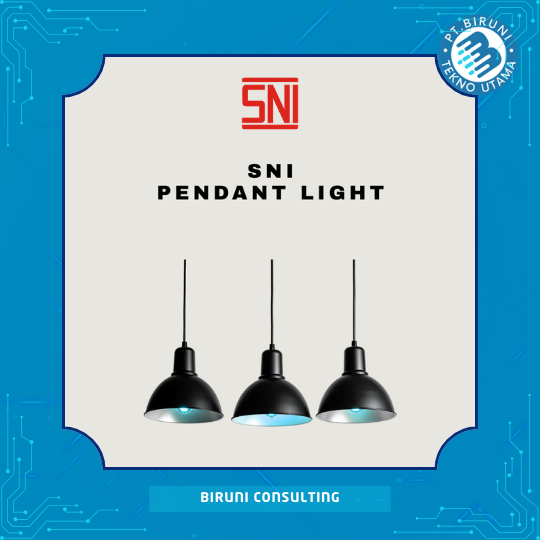
Indonesian National Standard for Safety, Performance, and Legal Distribution of Pendant Lighting Products in Indonesia
Pendant lights are one of the most popular lighting fixtures used in modern interior design. These lighting systems are installed by suspending the lamp from the ceiling using cables, rods, or chains. Pendant lights are commonly placed above dining tables, kitchen islands, living rooms, cafés, restaurants, hotels, and various commercial spaces such as boutiques and showrooms.
In addition to providing illumination, pendant lights also serve as decorative design elements. Their wide variety of shapes, materials, and styles makes them a significant component in interior aesthetics. Designers often use pendant lighting to create focal points within a room, enhance atmosphere, and complement architectural concepts.
Modern pendant lights often incorporate LED technology or other lighting sources such as CFL or halogen lamps. These fixtures include several electrical components including lamp holders, power cables, LED drivers, internal wiring systems, and structural hanging mechanisms. Because pendant lights are suspended above active areas where people gather or move, ensuring the safety of these products is extremely important.
If pendant lighting products are not manufactured according to recognized safety standards, they may pose several risks such as electrical short circuits, overheating, insulation failure, or mechanical instability that could lead to safety hazards. For this reason, pendant lighting products distributed in Indonesia must comply with the Indonesian National Standard (SNI).
SNI certification confirms that the product has undergone technical evaluation and meets the safety, quality, and performance requirements established by Indonesian regulatory authorities.
Importance of SNI Certification for Pendant Lighting
The Indonesian National Standard (SNI) is the official national standard system established by Badan Standardisasi Nasional. This institution develops national product standards to ensure safety, quality assurance, and consumer protection for products circulating within Indonesia.
For electrical and lighting equipment, mandatory SNI implementation is supported by technical policies issued by Kementerian Perindustrian Republik Indonesia. Market supervision and enforcement activities are conducted by Kementerian Perdagangan Republik Indonesia to ensure that only certified products are distributed in the Indonesian market.
Pendant lighting fixtures fall within the category of electrical lighting equipment that must comply with safety and performance standards before being sold in Indonesia. Through SNI certification, manufacturers and importers demonstrate that their products meet nationally recognized safety benchmarks.
The main objectives of implementing SNI certification for pendant lights include:
-
Protecting consumers from electrical hazards
-
Ensuring consistent lighting performance and durability
-
Promoting energy-efficient lighting technologies
-
Preventing the circulation of unsafe or low-quality products
-
Supporting fair competition within the lighting industry
By complying with SNI standards, lighting manufacturers and distributors strengthen consumer confidence and market credibility.
Technical Testing Scope for SNI Pendant Light Certification
To obtain SNI certification, pendant lighting products must undergo technical testing in accredited laboratories. These tests evaluate electrical safety, structural durability, and lighting performance.
The testing scope generally includes:
-
Electrical insulation resistance testing to prevent electric shock
-
Dielectric strength testing to verify electrical safety
-
Temperature rise testing to ensure safe thermal operation
-
Voltage and current stability evaluation during operation
-
Measurement of luminous output and energy efficiency
-
Mechanical strength testing of the hanging structure
-
Durability testing of wiring systems and connectors
-
Verification of product labeling, safety markings, and user instructions
These tests ensure that pendant lighting products remain safe during long-term use in both residential and commercial environments.
SNI Certification Process for Pendant Lighting Products
Manufacturers and importers must complete a structured certification process before distributing pendant lighting products in Indonesia.
Administrative Documentation Preparation
The first stage involves preparing administrative and technical documents such as:
-
Business Identification Number (NIB)
-
Technical specifications of the product
-
Product datasheets and engineering drawings
-
User manuals and installation instructions
-
Packaging and labeling design
These documents are reviewed by an authorized Product Certification Body (LSPro) to verify compliance with regulatory requirements.
Laboratory Testing of Product Samples
Representative samples of the pendant lighting product must be submitted to accredited laboratories for technical testing to verify compliance with safety and performance standards.
Factory Audit or Quality System Evaluation
Depending on the certification scheme applied, the certification body may conduct a factory audit to assess the manufacturer’s quality management system and ensure consistent production quality.
Issuance of SPPT SNI Certificate
Once all requirements have been fulfilled, the Product Certification Body issues the SPPT SNI certificate. This certificate authorizes the company to affix the SNI mark on the pendant lighting product and distribute it legally in Indonesia.
Risks of Distributing Lighting Products Without SNI Certification
Companies that distribute pendant lighting products without SNI certification may face several legal and business risks including:
-
Import rejection by customs authorities
-
Product confiscation during market inspections
-
Administrative sanctions and regulatory penalties
-
Mandatory product recalls from the market
-
Damage to brand credibility and distributor trust
Ensuring compliance with SNI certification is therefore critical for companies operating in the Indonesian lighting market.
Benefits of SNI Certification for Lighting Businesses
Obtaining SNI certification provides several important advantages for lighting manufacturers and importers:
-
Legal authorization for nationwide product distribution
-
Increased trust from distributors, contractors, and customers
-
Access to government procurement and large-scale projects
-
Improved brand reputation and credibility
-
Stronger competitiveness in the Indonesian lighting market
SNI certification demonstrates a company’s commitment to product safety, quality assurance, and regulatory compliance.
Conclusion
SNI certification for pendant lighting products is an essential regulatory requirement for manufacturers and importers who wish to distribute lighting products legally in Indonesia. The certification process includes documentation review, laboratory testing, and potential factory audits to ensure that products meet strict safety and quality standards.
Biruni Consulting provides professional consulting services to assist companies in obtaining SNI certification for pendant lighting products. Our team supports clients throughout the entire certification process, including regulatory consultation, preparation of technical documentation, coordination with accredited laboratories, and communication with certification bodies. With extensive experience in Indonesian product certification, Biruni Consulting is ready to become your trusted partner in achieving regulatory compliance and ensuring successful market distribution.