
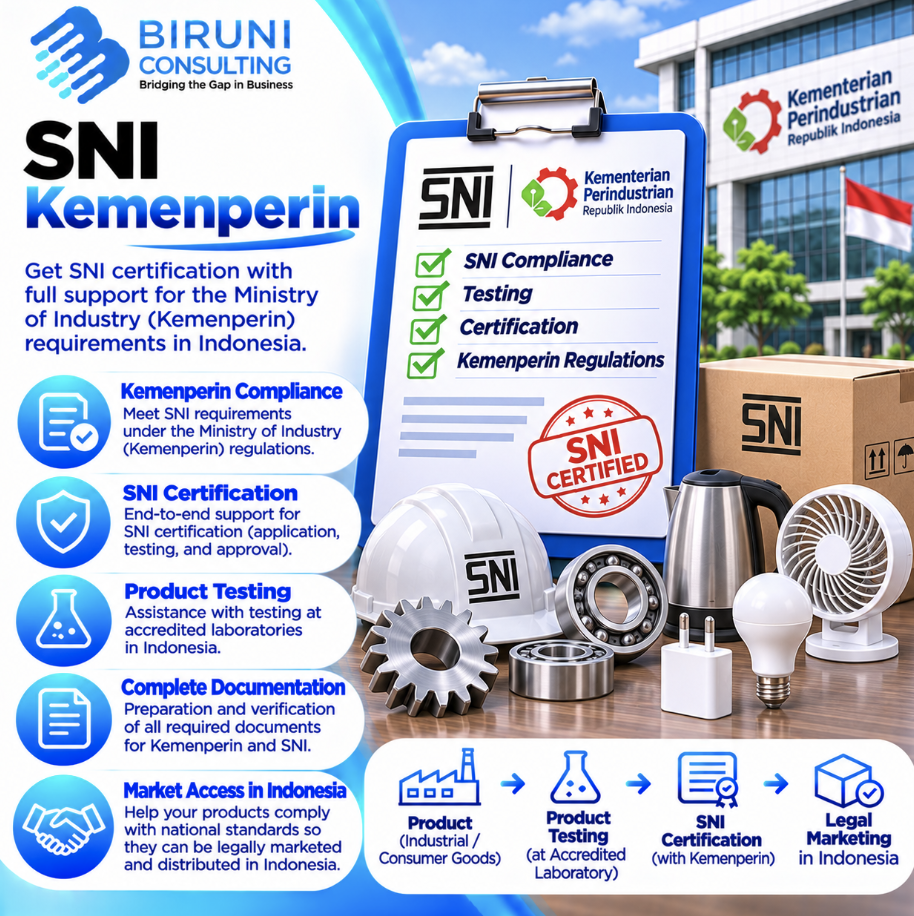
Guide to Mandatory SNI under the Ministry of Industry, SIINas, SNI Certificates, SPPT SNI, Product Certification Bodies, Testing, and Imported Products
The term Ministry of Industry SNI is commonly used to describe Indonesian National Standards whose implementation falls within the Ministry of Industry’s industrial-standardization framework, particularly standards made mandatory through Minister of Industry regulations for specified industrial products. The term requires careful interpretation because the Ministry of Industry does not establish every SNI and not every Indonesian National Standard falls within a Ministry of Industry mandatory regulation.
SNI standards are established through Indonesia’s national standardization system, while the Ministry of Industry can make particular standards mandatory for industrial goods and services within its regulatory authority. Minister of Industry Regulation No. 45 of 2022 concerning Industrial Standardization provides an important general framework for industrial standardization. Ministry information also explains that SNI can be voluntarily applied while regulators can make particular standards mandatory through regulation. imc.kemenperin.go.id
Under the current Ministry of Industry organization, the Agency for Industrial Standardization and Services Policy, or BSKJI, is responsible for coordinating the formulation, application, mandatory implementation, and supervision of industrial standardization. The current organizational structure is established by Minister of Industry Regulation No. 1 of 2025. Database Peraturan | JDIH BPK
Companies should therefore not merely ask whether a product “has an SNI.” The more important questions are whether the standard is active, mandatory under a Ministry of Industry regulation, applicable to the actual product and HS Code, and subject to a particular certification scheme.
What Does “SNI Kemenperin” Mean?
“SNI Kemenperin” is not one specific standard.
It is a practical term commonly used for industrial SNI requirements administered or made mandatory by the Indonesian Ministry of Industry.
Minister of Industry Regulation No. 45 of 2022 establishes the broader industrial-standardization framework. Under this framework, industrial standards can be made mandatory for reasons including safety, health, environmental protection, fair business competition, competitiveness, and industrial efficiency. API Law
A product should therefore not be described as subject to mandatory Ministry of Industry SNI unless an applicable product regulation establishes that requirement.
Different Roles of BSN and the Ministry of Industry
BSN and the Ministry of Industry perform different functions.
BSN forms part of Indonesia’s national standards establishment system, while the Ministry of Industry is one of the regulators that can make particular SNI standards mandatory within its sectoral authority.
Finding an active standard in the BSN catalogue does not automatically mean it is a mandatory Ministry of Industry SNI.
Companies need to identify the applicable Minister of Industry regulation and confirm that it remains in force.
Role of BSKJI
BSKJI plays a central role in the current Ministry of Industry standardization structure.
Minister of Industry Regulation No. 1 of 2025 provides that BSKJI coordinates the formulation, application, mandatory implementation, and supervision of industrial standardization, together with other industrial-policy functions. Database Peraturan | JDIH BPK
Its organizational structure includes units dealing with standard formulation and implementation as well as industrial-standardization supervision.
SNI compliance under the Ministry of Industry should therefore not be viewed solely as a certificate-issuance exercise. Ongoing application and supervision are also part of the framework.
Mandatory and Voluntary SNI
SNI can be voluntary or mandatory.
Ministry of Industry information explains that SNI normally operates voluntarily unless a competent regulator makes it mandatory through regulation. Regulation No. 45 of 2022 provides the industrial-policy framework for mandatory implementation. imc.kemenperin.go.id
Ministry certification bodies also provide both mandatory and voluntary SNI certification services. An official Ministry certification page updated on May 6, 2026 states that products subject to mandatory Ministry of Industry SNI are processed through SIINas. bbkkp.kemenperin.go.id
Mandatory and voluntary certification routes should therefore not be assumed to be identical.
An Active SNI Is Not Automatically a Mandatory Ministry Standard
A standard can remain active without being subject to a mandatory Ministry of Industry regulation.
Companies should determine whether there is a current product-specific Ministerial Regulation, whether it covers the relevant SNI edition, and whether the actual product falls within its technical and tariff scope.
Where there is no applicable mandatory regulation, the standard may remain voluntary or fall under another regulator.
Products Subject to Ministry of Industry Mandatory SNI
The range of products regulated by the Ministry is broad and continues to change.
Current mandatory regulations cover products in electronics, steel, chemicals, food industries, rubber, tires, construction materials, household products, and other sectors.
For example, Minister of Industry Regulation No. 7 of 2025 establishes mandatory SNI for Household Electronics and took effect on July 24, 2025. It replaced several earlier regulations covering household electronic products. Database Peraturan | JDIH BPK
Regulation No. 9 of 2025 establishes mandatory SNI for tires and also took effect on July 24, 2025. Database Peraturan | JDIH BPK
Other 2025 regulations include updated mandatory requirements for solid nitrogen, phosphorus and potassium fertilizers and for water meters. Database Peraturan | JDIH BPK
The framework continued to change in 2026. Regulation No. 1 of 2026 introduced mandatory SNI for compartmentalized stainless-steel food containers, while Regulation No. 4 of 2026 amended the 2025 mandatory regulation for refined crystal sugar. Database Peraturan | JDIH BPK
These examples demonstrate why current regulations should be reviewed for every new project.
Household Electronics
Household electronics provide an important example of a major regulatory update.
Minister of Industry Regulation No. 7 of 2025 is currently in force and replaced older regulations covering various products including air conditioners, refrigerators, washing machines, and certain kitchen and liquid-heating appliances. Database Peraturan | JDIH BPK
Companies still relying on older household-electronics regulations should therefore reassess their compliance basis.
Product model, rated voltage, function, capacity, HS Code, and technical scope need to be compared against the current regulation.
Tires
Tires provide another example of an updated mandatory SNI regime.
Minister of Industry Regulation No. 9 of 2025 replaced the previous mandatory tire regulation and has been in force since July 24, 2025. Database Peraturan | JDIH BPK
An official Ministry certification page updated in 2026 also lists several tire standards as mandatory under Regulation No. 9 of 2025 and identifies current Ministry appointment decisions for certification bodies. bbkkp.kemenperin.go.id
Companies therefore need to review both the product regulation and the current certification-body framework.
Food Industry Products
The Ministry also regulates mandatory SNI for various industrial food products.
Examples include wheat flour, refined crystal sugar, iodized consumption salt, cocoa powder, palm cooking oil, and other regulated categories.
Minister of Industry Regulation No. 61 of 2024 replaced the previous mandatory wheat-flour regulation. Regulation No. 2 of 2025 governs refined crystal sugar and was subsequently amended by Regulation No. 4 of 2026. Database Peraturan | JDIH BPK
Food manufacturers and importers should therefore avoid relying solely on historical SNI lists.
Chemicals and Industrial Materials
Chemical and industrial-material products can also fall within Ministry mandatory SNI requirements.
Recent regulations have addressed zinc oxide, aluminium sulfate, various steel products, and other industrial goods.
Steel regulation also continues to develop. Minister of Industry Regulation No. 22 of 2025 amended Regulation No. 64 of 2024 concerning mandatory SNI for hot- and cold-rolled steel sheet, plate, and coil products. Database Peraturan | JDIH BPK
Product classification should therefore be completed before selecting a standard or certification body.
SIINas
SIINas, the National Industrial Information System, plays an important role in Ministry of Industry mandatory-SNI certification.
An official Ministry certification page updated in May 2026 states that applications for products subject to mandatory Ministry of Industry SNI are submitted through SIINas. bbkkp.kemenperin.go.id
In July 2026, BSKJI also coordinated certification-service acceleration through SIINas, covering domestic production and several imported-product configurations. BSPJI Banda Aceh
SIINas therefore forms part of the regulatory workflow for many mandatory Ministry certification projects.
SNI Certificate and SPPT SNI
An SNI Certificate and SPPT SNI should be distinguished.
Product certification bodies evaluate conformity and issue product or SNI certificates where the applicable certification requirements have been fulfilled. The Ministry’s official certification information describes a product certificate as the formal document issued by a product certification body showing that the product complies with the referenced SNI or another recognized standard. bbkkp.kemenperin.go.id
Many newer mandatory Ministry regulations also provide a separate approval mechanism for using the SNI Mark through SPPT SNI.
The administrative details depend on the product regulation, so companies should not assume that the SNI Certificate and SPPT SNI are universally the same document or have identical validity periods.
SNI Mark
The SNI Mark is a conformity mark used after the applicable requirements have been fulfilled.
Some current Ministry regulations also use an electronic mark or other product-specific marking mechanism.
Companies should therefore not print the SNI Mark on mass-production goods merely because laboratory testing has been completed.
Certification decisions, regulatory approval, and product-specific marking rules need to be completed first.
Ministry of Industry Product Certification Bodies
A Product Certification Body or LSPro performs certification within its accredited or authorized scope.
The Ministry has various technical centers and standardization service units that provide testing and certification, but no single Ministry LSPro automatically covers every SNI.
For example, the BBSPJIKKP certification page identifies product-specific accredited scopes and separately lists mandatory SNI regulations and current Ministry appointment decisions. bbkkp.kemenperin.go.id
Companies should assess the SNI number, product, mandatory regulation, and LSPro scope together.
LSPro Selection Should Not Be Based Only on Location
A certification body should not be selected solely because it is geographically close to the applicant or factory.
Scope, accreditation, product expertise, and any current regulator appointment requirements are more important.
In 2023, the Ministry also revoked numerous older regulations specifically appointing conformity-assessment bodies for mandatory products. Database Peraturan | JDIH BPK
Old LSPro appointment lists should therefore not be used as the sole basis for a new certification project.
Role of KAN
KAN, the National Accreditation Committee, accredits conformity-assessment bodies.
Certification bodies and laboratories can have defined accreditation scopes that should correspond to the relevant certification project.
For mandatory Ministry products, accreditation may not be the only factor. Product-specific regulations and current Ministry appointment decisions may also be relevant.
An official Ministry certification page, for example, distinguishes KAN-accredited scope from mandatory-SNI products subject to specific Ministry appointment decisions. bbkkp.kemenperin.go.id
Product Testing
Mandatory products undergo conformity assessment according to the applicable scheme.
Testing can involve safety, performance, materials, composition, dimensions, mechanical characteristics, durability, efficiency, or other parameters depending on the product.
There is therefore no universal “Ministry of Industry SNI test”.
Tires, electronics, steel, water meters, food products, and chemicals all require different technical assessment.
Factory Audit or Production Evaluation
Many certification schemes evaluate manufacturing processes to verify consistent production.
Assessment can include raw-material controls, incoming inspection, production processes, testing equipment, calibration, final inspection, traceability, nonconforming-product control, and engineering changes.
Certification schemes nevertheless vary by product.
Companies should therefore review the certification scheme attached to or referred to by the applicable product regulation rather than assuming that procedures from one product apply universally.
Product Family
A regulatory project can cover numerous models.
Product-family assessment is used to determine whether models can be grouped within one certification structure.
Family criteria vary by product.
For electronics they may involve electrical construction, ratings, motors, heaters, compressors, enclosures, PCBs, and safety components. For other industrial goods they can involve materials, grades, dimensions, compositions, manufacturing processes, or performance classes.
The model list should therefore be finalized before representative testing is selected.
Representative Samples
Representative-sample selection directly affects testing efficiency.
The largest or highest-rated model is not necessarily always the only critical sample.
Critical conditions can depend on thermal loading, materials, dimensions, mechanical construction, chemical composition, or other factors defined by the applicable scheme.
Samples should ideally not be dispatched before family assessment is complete.
Imported Products
Mandatory Ministry SNI can apply both to domestically produced and imported goods where they fall within the regulatory scope.
The industrial-standardization framework can cover both domestically produced and imported industrial products marketed in Indonesia. API Law
In 2026, BSKJI’s certification-service coordination expressly included imported raw materials and finished products under several importer configurations. BSPJI Banda Aceh
Foreign manufacturers and importers should therefore conduct regulatory assessment before mass production and shipment.
Foreign Manufacturers
Products manufactured in China, Vietnam, Thailand, Malaysia, South Korea, Japan, Taiwan, India, Europe, the United States, or other countries can be subject to mandatory Ministry SNI where they fall within a regulated scope.
Country of origin does not remove the obligation.
Foreign manufacturers should prepare technical documentation, manufacturing information, model lists, existing test reports, brand information, and other evidence required by the applicable regulation and certification scheme.
Official Representatives for Imported Products
Certain mandatory Ministry regimes use an Official Representative structure for foreign manufacturers.
Detailed requirements concerning applicants, appointments, brands, imports, and the relationship with overseas manufacturers can differ between product regulations.
Foreign manufacturers should therefore avoid issuing a generic appointment letter before the product-specific regulation has been reviewed.
Official representative, importer, distributor, and certificate holder are distinct roles even where one Indonesian company may perform more than one of them.
Importers
An importer performs the import activity, while the certification structure can involve a manufacturer, official representative, applicant, certificate holder, or another party defined by the applicable regulation.
The importer should not automatically be assumed to be the certificate holder.
Similarly, an official representative should not automatically be assumed to have the right to perform importation.
The regulatory and import structures should be mapped together before certification begins.
Existing CB, IEC, ISO, or Foreign Test Reports
Foreign manufacturers often have CB Certificates, IEC reports, ISO certificates, CE technical files, UL or TÜV reports, and other international evidence.
These documents can significantly support initial technical assessment.
They do not automatically replace mandatory Ministry SNI certification.
Companies still need to review the underlying standard, edition, national differences, laboratory acceptance, model scope, factory, and certification scheme.
CE Is Not the Same as Ministry SNI
CE marking is not an Indonesian SNI Certificate.
A CE-marked product can still require mandatory SNI certification before being marketed in Indonesia.
CE technical documentation can nevertheless provide useful information concerning construction and existing testing.
CB Certificates Are Not SNI Certificates
A CB Certificate is also not the same as an SNI Certificate.
The CB Scheme can provide highly useful test evidence for electrotechnical products where the Indonesian SNI is based on the same or a similar IEC standard.
The Indonesian certification decision nevertheless follows the applicable national regulation and certification scheme.
ISO 9001 and Ministry SNI
ISO 9001 certification does not replace product certification.
Management-system certification and product conformity certification cover different objects.
An ISO 9001-certified factory can have useful quality-system evidence, but its products still need to meet applicable mandatory SNI requirements.
Companies should likewise avoid assuming that every mandatory Ministry certification universally requires ISO 9001 without reviewing the relevant scheme.
HS Codes
HS classification frequently forms part of mandatory-product regulation.
It should not, however, be used as the only basis for deciding mandatory status.
Companies should review the HS Code, product description, technical specifications, exclusions, and SNI scope together.
Where an ex tariff code is used, only specified goods within the tariff line may fall within the regulation.
Multifunction Products
Modern products frequently combine several functions.
A household appliance can incorporate WiFi, batteries, chargers, displays, water systems, heaters, motors, or compressors.
A Ministry SNI regulation may cover one product-safety or performance aspect, while additional functions can trigger requirements from other authorities.
An SNI Certificate therefore does not necessarily complete the entire regulatory-compliance process for a multifunction product.
NIB and SNI
An NIB is part of business licensing, while an SNI Certificate concerns product conformity.
They are not substitutes for each other.
A company can have an NIB while still needing mandatory product certification, and an SNI Certificate does not replace business or import licensing.
Corporate legality and product compliance should be assessed separately.
SIINas for Domestic Manufacturers
Indonesian industrial companies subject to mandatory Ministry SNI should prepare company and production information that is consistent with the SIINas process.
Technical documentation, production capacity, factory data, brands, models, and other information can be relevant according to the applicable regulation.
Regulatory, engineering, production, quality, and management teams should therefore coordinate from the beginning.
OEM and Brand Cooperation
OEM production and brand-cooperation arrangements require additional attention.
One factory may manufacture products for several brands, but that does not automatically mean all brands can use the same SNI Certificate.
Product-specific regulations can contain requirements regarding brand cooperation, contract manufacturing, brand owners, and eligible applicants.
Companies should therefore disclose their OEM and brand structure during initial assessment.
Private Labels
Private-label companies should clearly establish the brand owner, manufacturer, factory, applicant, certificate holder, official representative, and importer.
Labels and packaging should not be mass-produced before this structure is confirmed.
Certificate details, model lists, brands, factories, and regulatory registration need to remain consistent.
Documentation
Initial assessment should use enough information to clearly identify the product and business structure. Relevant documentation commonly includes product catalogues, datasheets, model lists, photographs, technical specifications, label artwork, manuals, brand documentation, manufacturer and factory information, existing test reports, quality documentation, critical-material or component information, and information about the applicant, importer, official representative, or brand cooperation where relevant.
Requirements vary by product, but comprehensive information at the beginning makes it easier to identify the regulation, standard, certification body, testing requirements, and certificate structure.
Product Labels and Marking
Labels should be reviewed before mass production.
Brand, model, manufacturer, factory, ratings, standard references, product classification, and required conformity information should remain consistent with certification documentation.
Some newer Ministry regulations also use electronic marking mechanisms in addition to the SNI Mark.
Final product artwork should therefore be based on the current regulation rather than historical certification formats.
Component Changes After Certification
Certified production needs to remain consistent with the configuration used for conformity assessment.
Changes to materials, formulas, motors, compressors, PCBs, heaters, cables, resins, metal grades, dimensions, safety devices, or production processes can affect compliance.
Manufacturers should maintain a change-control procedure and assess significant changes before implementation.
Adding Models
Companies frequently wish to add models after certification.
Whether a new model can be included depends on product-family criteria and the applicable certification scheme.
Models using the same technical platform may follow an additional assessment process, while materially different products may require new testing.
A product roadmap should ideally be prepared before the first certification project.
Factory Changes
The manufacturing site can be an important part of product certification.
The same brand and model produced at another factory can involve different suppliers, tooling, manufacturing controls, and inspection processes.
Foreign manufacturers operating several plants should therefore decide which facilities will supply the Indonesian market before testing begins.
Surveillance and Supervision
Mandatory Ministry SNI continues after the initial certificate is issued.
Minister of Industry Regulation No. 45 of 2022 provides for industrial-standardization supervision, including factory supervision and coordination of market supervision. API Law
Companies should therefore maintain production consistency and appropriate quality, supplier, testing, and engineering-change records.
Certificate and SPPT Validity
There is no single validity period that should be generalized across every Ministry SNI product.
SNI Certificates and SPPT SNI can have product-specific validity, surveillance, extension, and recertification rules.
Companies should review the regulation and certification scheme applicable to their product rather than copying a validity period from another product category.
How to Check Ministry of Industry SNI Requirements
Assessment should begin with the technical product description and specifications and then identify the current Ministry regulation.
Old regulations should always be checked for repeal or amendment.
For example, Regulation No. 7 of 2025 replaced several older electronics regulations, Regulation No. 9 of 2025 replaced the previous tire regulation, and Regulation No. 4 of 2026 amended the refined-crystal-sugar regulation issued only a year earlier. Database Peraturan | JDIH BPK
Regulatory status should be checked for every new project, renewal, model addition, or factory change.
Ministry of Industry SNI Certification Process
The process should begin with product identification and regulatory assessment. The technical product name, intended use, HS Code, ratings, materials, model range, factory, and potentially applicable regulation are assessed.
After mandatory status is confirmed, the product-family structure and model list are prepared. The current certification body and laboratory scope are then checked.
Technical documents and representative samples are prepared for conformity assessment. Depending on the applicable scheme, testing, manufacturing evaluation, review, corrective action, and certification decisions can follow.
For mandatory Ministry products, SIINas procedures need to be followed. After obtaining the SNI Certificate, companies should also confirm SPPT SNI, marking, electronic-mark requirements, surveillance, and other registrations where applicable. The Ministry’s current certification information confirms that mandatory Ministry SNI applications are processed through SIINas. bbkkp.kemenperin.go.id
Common Mistakes
A frequent mistake is assuming every SNI is a Ministry of Industry mandatory SNI.
Another is relying on an old Ministerial Regulation that has already been replaced or amended.
Companies can also select certification bodies from historical projects without checking current scope or appointment status.
Importers may begin SNI assessment only after mass production or when a container is ready for shipment.
Another mistake is treating the SNI Certificate, SPPT SNI, SNI Mark, NIB, and import licensing as if they were the same instrument.
Each has a different regulatory function.
Why Is Pre-Assessment Important?
Ministry of Industry mandatory-SNI regulations are increasingly product-specific and continue to evolve.
A product can be affected by updated standards, HS scope, certification schemes, certification bodies, marking requirements, certificate structures, or imported-product provisions.
Pre-assessment helps companies identify the current regulation, applicable SNI, product scope, HS Code, product family, representative samples, certification body, laboratory requirements, applicant structure, and SIINas process before major certification and production expenditure occurs.
For imported products, assessment should ideally take place before mass production and shipment, allowing the manufacturer to adjust construction, materials, components, labels, brands, factory arrangements, and documentation where necessary.
Contact Us
Biruni Consulting assists companies with Ministry of Industry SNI assessment and certification in Indonesia, including mandatory-regulation identification, SNI assessment, HS Code review, product family assessment, testing, SIINas, and certification assistance.
Our services include:
- Consultation on Ministry of Industry SNI and identification of current mandatory-SNI regulations.
- Review of HS Codes, product specifications, Ministerial Regulations, applicable SNI standards, and product lists.
- Identification of certification bodies, laboratories, certification schemes, SIINas requirements, and applicant or Official Representative structures where relevant.
- Review of technical documentation, labels, existing test reports, materials, critical components, manufacturers, and factories.
- Product family assessment, representative-sample selection, and preparation for manufacturing evaluation.
- Testing, corrective-action, factory-audit or production-evaluation assistance where required, SNI Certificates, SPPT SNI, and SNI Mark assistance.
Contact Biruni Consulting for information regarding Ministry of Industry SNI certification services, mandatory Indonesian industrial SNI, SIINas SNI applications, SPPT SNI, imported-product SNI Certificates, and industrial-SNI regulatory consultation according to your product type, brand, model, specifications, HS Code, factory, and country of origin.