
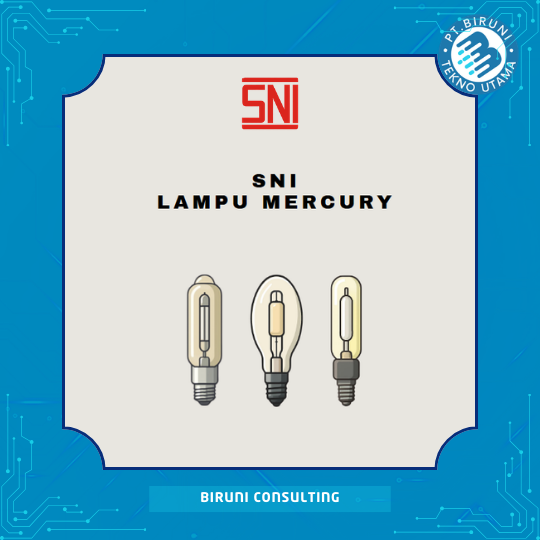
Indonesian National Standard for Safety and Compliance of Mercury Vapor Lamps
Because mercury lamps operate under high pressure and contain hazardous materials, products distributed in Indonesia must comply with the Indonesian National Standard (SNI). This certification ensures product safety, environmental responsibility, and regulatory compliance before market distribution.
Understanding SNI for Mercury Lamps
SNI for Mercury Lamps is a national conformity standard regulating safety requirements, construction specifications, performance characteristics, and testing procedures for mercury vapor lighting products sold in Indonesia. These standards are generally harmonized from international IEC standards and adapted into Indonesian regulatory frameworks.
Manufacturers or importers whose products meet these requirements receive the Certificate of Product Use of SNI Mark (SPPT-SNI), which authorizes the official use of the SNI mark on the product and packaging.
Regulatory Framework
The implementation of SNI certification for mercury lamps is supported by national regulatory policies and supervised by accredited certification bodies.
Ministry of Industry Regulations
The Indonesian Ministry of Industry regulates electrical product circulation in order to:
-
Protect consumers from unsafe electrical products
-
Ensure quality control for domestic and imported goods
-
Strengthen industrial competitiveness
-
Enforce electrical safety compliance
HID Lamp Safety Standards
Mercury lamps fall within the category of HID lighting products with specific safety risks. Therefore, safety requirements include:
-
Resistance to internal pressure of the arc tube
-
Structural stability of the outer glass envelope
-
Electrical insulation integrity
-
Lamp base safety and mechanical strength
-
Ballast compatibility and electrical stability
Accredited Laboratory Testing
All conformity tests must be conducted in accredited laboratories to ensure validity and regulatory acceptance during the certification process.
Technical Characteristics of Mercury Lamps
Mercury vapor lamps generate light by creating an electric arc inside a tube filled with mercury vapor and inert gases. This process produces a characteristic bluish-white light spectrum.
Key characteristics include:
-
High luminous intensity
-
Long operational lifespan
-
Higher efficiency than incandescent lamps
-
Requirement for electrical ballast
However, compared to modern LED systems, mercury lamps are less energy efficient and require careful handling due to mercury content.
Risks Without Compliance
If mercury lamps are manufactured without proper safety standards, several hazards may occur:
-
Arc tube rupture due to excessive pressure
-
Mercury leakage posing environmental risks
-
Fire hazards caused by excessive heat
-
Electrical instability due to incompatible ballast
-
Premature lumen degradation
SNI certification ensures these risks are minimized through rigorous testing and compliance verification.
Technical Testing Parameters
Certification involves comprehensive testing procedures, including:
Electrical Safety Testing
-
Insulation resistance verification
-
Dielectric strength testing
-
Leakage current measurement
-
Surge voltage resistance testing
Thermal Resistance Testing
Products are tested under maximum operating temperature to verify structural durability.
Photometric Testing
-
Luminous flux measurement
-
Light distribution analysis
-
Color stability evaluation
-
Luminous flux consistency
Lifetime Testing
Operational durability tests ensure that the product lifespan matches manufacturer claims.
Certification Procedure
The certification process generally includes the following stages:
Application Submission
Manufacturers or importers submit certification applications to accredited Product Certification Bodies (LSPro).
Technical Documentation Review
Required documents typically include:
-
Product technical specifications
-
Lamp construction diagrams
-
Quality management system documentation
Laboratory Testing
Representative product samples undergo testing in accredited laboratories.
Factory Audit
Auditors inspect production facilities to verify manufacturing consistency and quality control systems.
Issuance of SPPT-SNI
If all requirements are fulfilled, the SPPT-SNI certificate is issued, allowing the company to legally apply the SNI mark.
Certification Challenges
Companies may face several challenges such as:
-
Non-compliant product specifications
-
Ballast compatibility issues
-
Failure in thermal or pressure resistance tests
-
Incomplete technical documentation
-
Weak quality management systems
Professional guidance can significantly streamline the certification process.
Conclusion
SNI Mercury Lamp certification plays a vital role in ensuring safety, regulatory compliance, and environmental responsibility in Indonesia’s lighting industry. Considering the high-pressure operation and mercury content involved in this technology, strict safety standards are essential.
For manufacturers and importers, SNI certification is not only a regulatory requirement but also a strategic step toward enhancing product credibility and market competitiveness.
Biruni Consulting provides professional assistance for companies seeking SNI certification for Mercury Lamps. Our services cover regulatory analysis, documentation preparation, laboratory coordination, factory audit support, and certification issuance. With extensive experience in Indonesian product compliance, we ensure that the certification process is efficient, compliant, and successful.
Partner with Biruni Consulting for reliable and professional SNI certification support.