
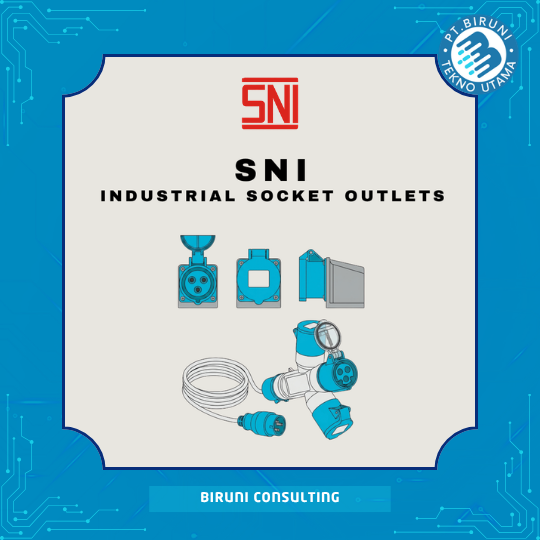
Standards and Certification of Industrial Socket Outlets in Indonesia
Industrial socket outlets are electrical accessories used to connect equipment or machinery to an electrical power source in industrial environments. These products have different characteristics from household socket outlets because they are designed for use under more diverse electrical conditions and requirements.
For socket outlet products intended for industrial use, one relevant standard is SNI IEC 60309-1:1999+Amd.1:2005+Amd.2:2012, entitled Plugs, socket-outlets and couplers for industrial purposes – Part 1: General requirements. BSN records this standard as valid and as an identical adoption of IEC 60309-1.
Compliance with standards for industrial socket outlets is important to ensure that products have technical characteristics and safety levels appropriate for their intended use. In addition to considering the product standard, companies also need to identify whether the product falls within the scope of mandatory SNI implementation based on its characteristics, intended use, rated voltage, and rated current.
What Are Industrial Socket Outlets?
An industrial socket outlet is an electrical device used as a connection point between a power source and equipment or machinery, particularly in industrial environments and applications requiring specific electrical characteristics and construction.
Unlike household socket outlets, industrial products may be used in various applications such as manufacturing facilities, workshops, warehouses, construction sites, machinery installations, and other industrial facilities. Product selection needs to consider technical parameters such as voltage, current, pole configuration, frequency, installation method, and environmental conditions.
In the BSN catalog, SNI IEC 60309-1:1999+Amd.1:2005+Amd.2:2012 specifically covers plugs, socket-outlets and couplers for industrial purposes – Part 1: General requirements. The standard is currently valid.
SNI Standards Related to Industrial Socket Outlets
One of the main standards to consider for industrial socket outlet products is SNI IEC 60309-1:1999+Amd.1:2005+Amd.2:2012. This standard provides a reference for general requirements for plugs, socket-outlets, and couplers intended for industrial purposes.
In addition to this standard, there are related standards for specific applications. BSN also lists SNI 04-6202.3-2000 concerning plugs, socket-outlets, connectors, and appliance inlets for use in explosive gas atmospheres. This standard has a specific scope, so its application must be adjusted to the characteristics and intended environment of the product.
Therefore, companies should not determine the applicable standard solely based on the term “industrial socket outlet”. Identification should consider the product design, intended use, electrical rating, construction, and installation environment.
Are Industrial Socket Outlets Subject to Mandatory SNI?
Mandatory SNI requirements must be determined based on the scope of regulations applicable to each product. Minister of Energy and Mineral Resources Regulation No. 7 of 2021, for example, includes plugs and socket outlets for household electrical installations, fixed electrical installations, low-voltage generating sets, or similar applications, with several exemptions including products with a rated current above 32 A.
This means that mandatory SNI status cannot be determined solely from the term “socket outlet”. The product must be reviewed based on its technical specifications and the scope of applicable regulations.
For companies manufacturing or importing industrial socket outlets, reviewing the latest standards and regulations is an important step before determining the certification scheme. This also helps ensure whether the product requires product certification, specific testing, or other technical requirements.
SNI Requirements for Industrial Socket Outlets
Certification requirements for industrial socket outlets depend on the applicable standard and certification scheme implemented by the Product Certification Body (LSPro). In general, companies need to prepare product information and documents that allow the certification body to identify the product and its production process.
Documents generally required include:
- Company legal documents and NIB.
- Manufacturer information and production facility location.
- Product brand and type.
- Industrial socket outlet technical specifications.
- Design drawings or technical drawings.
- Material and component information.
- Product electrical diagram or configuration.
- Production process information.
- Quality management system documents where required.
- Relevant testing documents and records.
For imported products, information concerning the overseas manufacturer, factory, brand, type, and importer identity should also be kept consistent throughout the certification documents.
Testing of Industrial Socket Outlets
Testing is an important part of product conformity assessment. Testing is conducted to ensure that product characteristics comply with the requirements of the applicable standard.
The types of testing depend on the applicable standard and product characteristics. In general, aspects that may be considered in electrical product testing include:
- Electrical characteristics.
- Resistance to heat.
- Insulation resistance.
- Mechanical strength.
- Protection against electrical contact.
- Resistance to specified operating conditions.
- Construction and dimensional conformity.
The testing scope should not be determined solely based on the product category. The laboratory and LSPro should refer to the applicable standard for the specific type and construction of the industrial socket outlet submitted.
SNI Certification Process for Industrial Socket Outlets
Product Identification
The first stage is to identify the product completely. The company needs to determine whether the product is a plug, socket outlet, coupler, or a combination of several functions.
Information such as rated voltage, rated current, number of poles, contact configuration, installation type, and operating environment needs to be reviewed because these factors may determine the appropriate standard and technical requirements.
Document Preparation
After the applicable standard and product scope have been determined, the company prepares administrative and technical documents.
The documents should accurately represent the actual product and production process. Inconsistencies between the documents, samples, and manufactured products may extend the certification process.
Certification Application
The certification application is submitted to an LSPro with an appropriate scope for the product. The LSPro will conduct an initial review of the documents and product information before determining the subsequent conformity assessment stages.
At this stage, the company needs to ensure that the brand, type, specifications, production location, and technical information submitted correspond to the actual product.
Laboratory Testing
Product samples are then tested according to the requirements of the applicable standard. The test results are used as one of the bases for the conformity assessment process.
The number of samples and types of testing may vary depending on the applicable standard, product type, and certification scheme.
Factory Audit
If the applicable certification scheme requires production process assessment, the LSPro may conduct an audit or assessment of the production facility.
The audit aims to ensure that the company is capable of consistently producing products that comply with the requirements. The aspects assessed may include production processes, raw material control, product inspection, production equipment, testing equipment, personnel competence, and handling of nonconforming products.
Certificate Issuance
After all conformity assessment stages meet the requirements, the LSPro may issue the certificate according to the applicable certification scheme.
The certificate serves as evidence that the product has undergone conformity assessment based on the applicable standard. For products subject to mandatory SNI requirements, companies must also comply with applicable marking and trade requirements.
Difference Between Industrial and Household Socket Outlet SNI
Industrial and household socket outlets cannot simply be treated as the same products because their intended uses and applicable standards may differ.
For household and similar products, BSN lists standards such as SNI 04-3892.1-2006 and several parts of SNI IEC 60884. Meanwhile, for industrial purposes, BSN lists SNI IEC 60309-1:1999+Amd.1:2005+Amd.2:2012 as the standard for plugs, socket outlets, and couplers for industrial purposes.
This difference demonstrates the importance of identifying the applicable standard based on the product’s intended use. Applying a household standard to a product actually designed for industrial applications may result in nonconformity during certification or technical compliance assessment.
Why Is SNI Certification for Industrial Socket Outlets Important?
Socket outlets are part of an electrical system, so the quality and safety of their construction are directly related to the safety of users and connected equipment. The government has also taken enforcement action against socket outlet products that failed to comply with SNI requirements. In 2021, the Ministry of Energy and Mineral Resources and the Ministry of Trade took action against 6,540 socket outlet products that did not comply with SNI because products failing to meet quality requirements could create risks such as fire.
Certification and testing help companies ensure that products have been assessed against relevant technical requirements. For manufacturers and importers, compliance with standards can also increase product confidence and support fulfillment of applicable market and regulatory requirements.
Contact Us
Biruni Consulting helps companies with the certification and compliance process for SNI industrial socket outlets professionally and in accordance with applicable regulations in Indonesia.
Our services include
- Consultation on applicable regulations.
- Identification of applicable standards.
- Certification document preparation.
- Laboratory testing assistance.
- Factory audit or assessment assistance.
- Certification processing until certificate issuance.
With extensive experience in product certification in Indonesia, Biruni Consulting helps ensure products comply with applicable safety, quality, and standards requirements so they are ready for legal distribution in Indonesia.
Contact Us for consultation, certification assistance, and industrial socket outlet certification processing services.