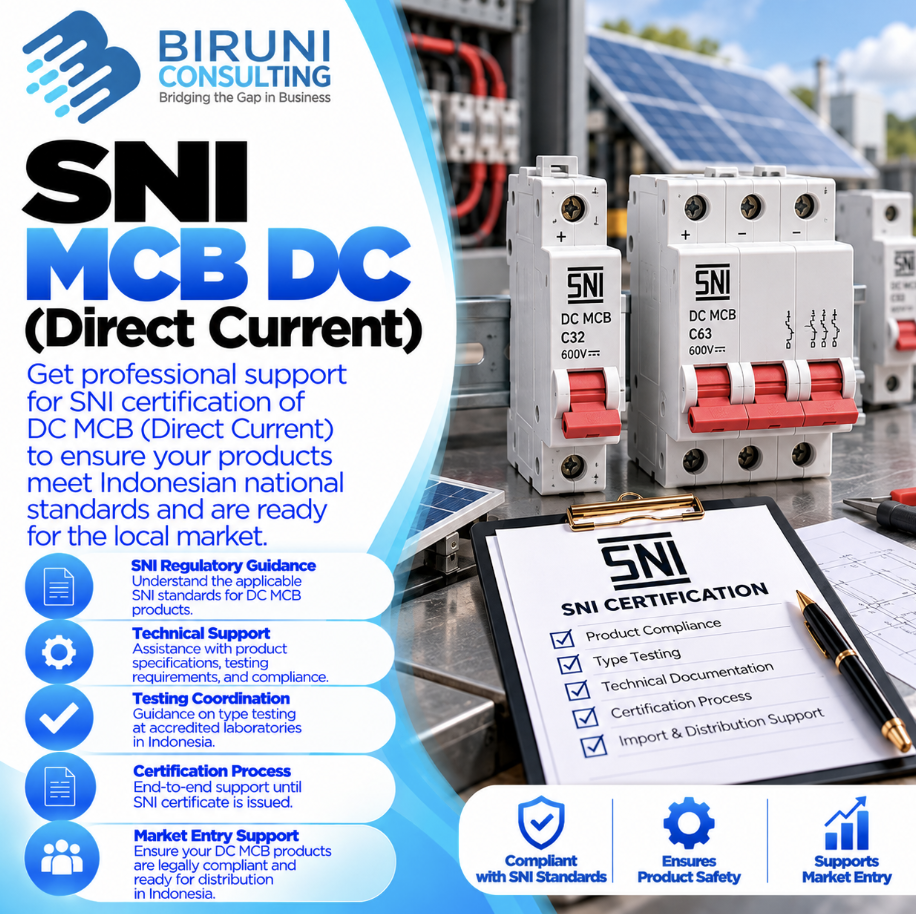
Guide to Standards, Certification, Testing, HS Code, and Requirements for Direct-Current Miniature Circuit Breakers
A DC MCB or Direct Current Miniature Circuit Breaker is a circuit breaker designed to protect direct-current electrical systems against overcurrent and short-circuit conditions. These products are commonly used in photovoltaic installations, battery energy storage systems, telecommunications, DC distribution panels, electric-vehicle systems, charging systems, UPS equipment, and other low-voltage DC installations.
Determining the appropriate SNI for a DC MCB requires particular care because a standard for AC MCBs cannot automatically be applied to a DC-only product. Indonesia has SNI 04-6507.2-2002 – Circuit-breakers for overcurrent protection for household and similar installations – Part 2: Circuit-breakers for AC and DC operation, which BSN currently lists as active. Pesta
At the same time, the mandatory MCB requirement under Minister of Energy and Mineral Resources Regulation No. 7 of 2021 refers to SNI 8528-1:2018, which is a standard for AC-operated circuit breakers. A DC-only MCB should therefore not automatically be assumed to follow the same mandatory certification scheme merely because its physical appearance, current rating, or HS classification resembles an AC MCB. JDIH ESDM
Assessment should consider DC voltage, rated current, number of poles, breaking capacity, intended application, manufacturer standard, HS Code, and whether the product is designed according to IEC 60898-2, IEC 60898-3, IEC 60947-2, or another standard.
What Is a DC MCB?
A DC MCB is a compact circuit breaker designed to interrupt current automatically when an overload or short circuit occurs in a direct-current electrical system.
Unlike AC systems, DC does not have a natural current zero crossing every half cycle. This makes arc interruption when breaker contacts open more challenging.
A DC circuit breaker therefore needs a contact arrangement, arc-extinguishing system, magnetic construction, terminal configuration, and voltage rating suitable for direct current.
DC MCBs are commonly used in:
- Solar photovoltaic systems and combiner boxes.
- Batteries and energy storage systems.
- DC distribution panels.
- Telecommunications and data centers.
- EV charging and electric-vehicle systems.
Products used in these applications do not necessarily belong to the same certification category, making intended use an important part of the assessment.
SNI for DC MCB
The Indonesian national standard that explicitly covers both AC and DC operation is SNI 04-6507.2-2002.
Its official title concerns circuit breakers for overcurrent protection for household and similar installations, Part 2, covering circuit breakers for AC and DC operation. BSN currently lists this standard as active. Pesta
The standard belongs to the IEC 60898 family and is therefore an important reference where the product is genuinely designed as a household or similar circuit breaker capable of DC operation.
The existence of this SNI, however, does not by itself mean that SNI 04-6507.2-2002 is currently mandatory for every DC MCB marketed in Indonesia. An active SNI standard and a mandatory SNI regulatory requirement are two different concepts.
Is SNI Mandatory for DC MCBs?
This question requires careful assessment.
Minister of Energy and Mineral Resources Regulation No. 7 of 2021 remains part of the current electricity-standardization framework. For overcurrent protection circuit breakers or miniature circuit breakers, the regulation lists SNI 8528-1:2018, which is an AC-operation standard. JDIH Kemenkoinfra
The regulatory MCB scope includes circuit breakers for household and similar installations, rated voltage not exceeding 440 V between phases, rated current not exceeding 125 A, and rated short-circuit capacity not exceeding 25,000 A. The tariff lines are listed as ex 8536.20.91 and ex 8536.20.99. JDIH ESDM
However, SNI 8528-1 is an AC-operation standard. BSN has subsequently replaced SNI 8528-1:2018 with SNI 8528-1:2022, which adopts IEC 60898-1:2019 and remains an AC circuit-breaker standard. SNI 8528-1:2022 is currently active, while the 2018 edition is listed by BSN as no longer active. Pesta
A DC-only MCB should therefore not automatically be submitted against SNI 8528-1 merely because it is commercially described as an MCB. The type of current the breaker is designed to interrupt needs to be established first.
Difference Between AC and DC MCB Standards
AC and DC MCBs can appear nearly identical externally. Both may use DIN-rail mounting, similar toggles, and current ratings such as 10 A, 16 A, 20 A, 32 A, or 63 A.
The important differences relate to interruption capability and internal construction.
For household and similar circuit breakers, SNI 8528-1:2022 is the active Indonesian standard for AC operation. Pesta
Meanwhile, SNI 04-6507.2-2002 explicitly addresses circuit breakers for AC and DC operation. Pesta
Markings such as “AC 230/400 V” and “DC 250 V” are therefore more than marketing information. They indicate different validated operating capabilities.
SNI 8528-1:2022 Is Not a Dedicated DC MCB Standard
SNI 8528-1:2022 is titled Electrical accessories – Circuit-breakers for overcurrent protection for household and similar installations – Part 1: Circuit-breakers for AC operation, adopting IEC 60898-1:2019 with modifications. Pesta
Where a product has only a DC rating and no applicable AC rating, companies should therefore be cautious about using SNI 8528-1 as the certification basis.
Where a breaker has dual AC/DC ratings, both capabilities need to be reviewed against its construction, marking, test reports, and manufacturer-declared standard.
SNI 04-6507.2-2002 for AC and DC Operation
SNI 04-6507.2-2002 explicitly covers circuit breakers for overcurrent protection for household and similar installations intended for AC and DC operation.
BSN currently lists the standard as active. Pesta
This makes it particularly relevant when assessing DC MCBs within the IEC 60898 family.
It is nevertheless important to distinguish an active national standard from a mandatory national standard under a technical regulation. The current mandatory MCB list under Ministerial Regulation No. 7 of 2021 points to SNI 8528-1:2018 for AC operation rather than SNI 04-6507.2-2002. JDIH ESDM
The certification route for a DC MCB therefore needs to be confirmed using the actual product configuration and available certification scope.
IEC 60898-3 for DC MCBs
Internationally, IEC 60898-3:2019 – Electrical accessories – Circuit-breakers for overcurrent protection for household and similar installations – Part 3: Circuit-breakers for DC operation specifically addresses DC circuit breakers.
IEC 60898-3:2019 is also listed in Minister of Energy and Mineral Resources Regulation No. 22 of 2021 among technical standards associated with electric-vehicle charging infrastructure. The same regulation also lists IEC 60947-2 for circuit breakers. JDIH ESDM
Its inclusion in an EV infrastructure regulation does not automatically make IEC 60898-3 a general mandatory SNI certification standard for every DC MCB sold in Indonesia.
The regulatory context and product scope still need to be separated.
DC MCBs for Solar PV
DC MCBs are widely used in solar photovoltaic installations, particularly between PV strings, combiner boxes, inverters, charge controllers, and battery systems.
PV systems may operate at much higher DC voltages than ordinary low-voltage DC equipment. Breakers can have ratings such as 250 VDC, 500 VDC, 600 VDC, 800 VDC, or 1,000 VDC depending on the system and product design.
An ordinary AC MCB should therefore not be used in a PV circuit simply because its current rating is identical.
Important information includes maximum DC voltage, rated current, breaking capacity, number of poles, polarity, wiring arrangement, and the standard used for product testing.
Where a breaker is specifically intended for PV applications, the complete system design and applicable international standards also need to be considered.
DC MCBs for Batteries and Energy Storage
Battery banks and battery energy storage systems may produce very high prospective short-circuit currents.
A circuit breaker for these applications needs to be selected according to voltage, prospective fault current, battery chemistry, system arrangement, and DC interruption capability.
A 63 A circuit breaker is not automatically suitable for every 63 A battery system. Its breaking capacity and maximum DC operating voltage must also be adequate.
For higher-voltage battery systems, an industrial breaker based on IEC 60947-2 may be more appropriate than a household breaker based on IEC 60898.
The commercial term “DC MCB” alone is therefore insufficient for determining the applicable standard.
DC MCB and IEC 60947-2
For circuit breakers used in industrial applications or having characteristics outside the household MCB scope, the IEC 60947-2 family may be more relevant.
Indonesia has SNI 04-6282.2-2002 – Low-voltage switchgear and controlgear – Part 2: Circuit-breakers, based on IEC 60947-2. ESDM’s list of Indonesian electricity standards includes this SNI for low-voltage circuit breakers. gatrik.esdm.go.id
IEC 60947-2 covers low-voltage circuit breakers and can include DC applications within its defined voltage limits.
An Indonesian certification body also lists voluntary SNI certification for MCCBs based on SNI 04-6282.2-2002, with scope extending to 1,000 V AC or 1,500 V DC. actanindya.biz
DC breakers intended for industrial panels, ESS installations, or higher-voltage systems therefore need to be assessed to determine whether they are household MCBs or industrial circuit breakers/MCCBs.
DC MCB Is Not the Same as DC MCCB
MCBs and MCCBs both provide circuit protection, but their construction, ratings, adjustable protection functions, breaking capacity, and standards can differ.
MCBs are commonly associated with household and similar installations under the IEC 60898 family.
MCCBs are generally associated with low-voltage switchgear and controlgear under IEC 60947-2.
A product should therefore not be classified solely from its physical size or DIN-rail appearance.
The manufacturer’s datasheet and standard marking should be reviewed.
Polarized and Non-Polarized DC MCBs
Polarity is an important issue for DC circuit breakers.
Some products carry + and − markings and must be connected according to the manufacturer’s specified direction. These are commonly referred to as polarized DC breakers.
Other products are designed as non-polarized breakers.
Incorrect wiring of a polarized breaker can affect arc interruption and safe fault clearing.
Installation diagrams and terminal markings should therefore form part of the DC MCB assessment.
Number of Poles for DC MCBs
DC MCBs may be supplied in 1P, 2P, 3P, and 4P configurations.
In some systems, multiple poles may be connected in series to achieve a higher DC voltage rating. Such arrangements should only be used where specifically permitted and tested by the manufacturer.
A breaker with a particular single-pole rating should not automatically be assumed to have twice that voltage rating simply because two poles are connected in series.
Manufacturer markings and wiring diagrams remain essential.
DC Breaking Capacity
Breaking capacity is one of the critical parameters when selecting a DC MCB.
It is generally expressed in kA and indicates the maximum fault current the breaker can safely interrupt under specified conditions.
In battery and PV applications, the prospective short-circuit current needs to be properly evaluated.
A 32 A breaker with insufficient breaking capacity can still be unsafe where the installation’s prospective fault current exceeds its interruption capability.
Rated current and breaking capacity should therefore be assessed separately.
DC Voltage Cannot Be Treated as Equivalent to AC Voltage
An MCB marked 230/400 V AC is not automatically suitable for 230 or 400 V DC.
DC arc interruption is different from AC interruption.
Conversely, a breaker carrying both AC and DC ratings should be used only within the manufacturer-declared limits.
During certification and product assessment, information such as Ue, Ui, Uimp, rated current, breaking capacity, utilization category, and applicable standard should be reviewed where provided.
B, C, and D Curves
Household MCBs commonly use B, C, or D tripping characteristics.
These curves relate partly to the magnetic-trip response to overcurrent conditions.
However, a particular curve should not automatically be assumed to provide identical behavior under DC operation merely because the marking is commonly used on AC breakers.
Companies should confirm that the manufacturer’s declared tripping characteristics are validated for the stated DC rating.
DC MCB Testing
Testing requirements depend on the applicable standard but generally need to demonstrate safe performance under normal and fault conditions.
Assessment may include marking, terminals, mechanical operation, dielectric properties, temperature rise, overcurrent tripping characteristics, endurance, and short-circuit interruption capability.
For DC operation, reliable arc interruption is particularly important.
The test sample should represent mass-production construction, including the contacts, arc chamber, terminals, thermal-magnetic trip mechanism, housing materials, and internal construction.
DC MCB Marking
Breaker markings should allow installers to clearly identify the product’s permitted operating conditions.
Relevant information may include rated current, rated voltage, DC symbol, pole configuration, breaking capacity, model, brand, applicable standard, terminal polarity where relevant, and required wiring direction.
An AC/DC breaker should clearly distinguish between its AC and DC ratings.
A single voltage marking should not be used ambiguously where users cannot identify whether it applies to AC, DC, or both.
DC MCB Product Family
A manufacturer may offer a DC MCB series in ratings such as 6 A, 10 A, 16 A, 20 A, 25 A, 32 A, 40 A, 50 A, and 63 A.
The same series may also include 1P, 2P, 3P, and 4P versions with different breaking capacities.
Product-family assessment should not rely solely on identical external housings. Contact systems, arc chambers, trip mechanisms, terminals, rated voltage, breaking capacity, number of poles, and materials should also be compared.
Where different current ranges use different internal constructions, representative test models need to be selected carefully.
HS Code for DC MCBs
MCBs and circuit breakers generally fall under heading 8536, although the appropriate subheading depends on the actual goods.
LAMANSITU currently lists the Overcurrent Protection Circuit Breaker (Miniature Circuit Breaker/MCB) category under HS Codes 85362091 and 85362099, together with SNI 8528-1:2018 and NPB as quality-policy requirements. LAMANSITU
Minister of Energy and Mineral Resources Regulation No. 7 of 2021, however, uses ex 8536.20.91 and ex 8536.20.99. The “ex” designation is significant because it means only certain goods within those tariff lines fall within the stated mandatory scope. JDIH ESDM
A DC circuit breaker classified under 85362091 or 85362099 should therefore not automatically be considered subject to the AC mandatory SNI merely because it shares the same HS heading. Product scope and applicable standard still need to be reviewed.
NPB for DC MCBs
LAMANSITU currently lists the Goods Registration Number or NPB as a quality-policy requirement for the MCB category under HS Codes 85362091 and 85362099 together with SNI 8528-1:2018. LAMANSITU
For a DC-only breaker, however, the relationship between the actual product and this quality-policy category needs to be established first.
Where the product genuinely falls within the relevant mandatory MCB scope, SNI and NPB requirements should be handled accordingly. Where the product falls outside the cited SNI scope, companies should not assume that the NPB process applies in exactly the same way without further assessment.
DC MCBs for EV Charging
Electric-vehicle charging systems may use different circuit breakers on the AC and DC sides.
Minister of Energy and Mineral Resources Regulation No. 22 of 2021 lists IEC 60947-2:2016+Amd1:2019 and IEC 60898-3:2019 among technical references related to EV charging infrastructure. JDIH ESDM
This demonstrates why breaker selection for EV applications needs to distinguish between AC-side protection, DC-side protection, household-type overcurrent protection, and industrial switchgear.
One breaker type cannot automatically be applied throughout an EV charging system merely because its rated current appears suitable.
Documents to Prepare
Before selecting a certification route for a DC MCB, manufacturers and importers should prepare sufficient technical documentation.
Important documents may include the product catalogue, datasheet, model list, internal construction drawings, wiring diagrams, label artwork, product photographs, and existing IEC/CB test reports.
Technical information should clearly identify:
- Rated DC voltage and rated current.
- Number of poles and polarity.
- Breaking capacity and tripping characteristics.
- Applicable IEC/SNI standard.
- Intended use such as PV, battery, household, industrial, or EV applications.
This information is essential for determining whether the product is more appropriately assessed under the IEC 60898 family, IEC 60947-2, or another standard.
SNI Certification for DC MCBs
For DC MCBs, certification should not begin with an assumption that every product uses SNI 8528-1.
The first step is to review the manufacturer’s datasheet and test reports. Where the manufacturer’s primary standard is IEC 60898-2 or IEC 60898-3, this should be mapped against the available Indonesian standards and certification schemes.
Where the product is more accurately classified as an industrial circuit breaker tested under IEC 60947-2, assessment should consider SNI 04-6282.2-2002 and available certification scopes.
Standard mapping is therefore an important step before selecting a laboratory or product certification body.
An Active SNI Does Not Automatically Mean Mandatory SNI
The distinction between active and mandatory standards is particularly important for DC MCBs.
SNI 04-6507.2-2002 remains active according to BSN and explicitly covers circuit breakers for AC and DC operation. Pesta
The mandatory MCB list in Ministerial Regulation No. 7 of 2021, however, points to SNI 8528-1:2018, an AC-operation standard. JDIH ESDM
Meanwhile, BSN has established SNI 8528-1:2022 as the active revision and lists the 2018 edition as no longer active. Pesta
This illustrates why companies need to review the technical regulation, standard edition, product scope, and certification scheme together rather than simply selecting the newest SNI number.
Mistakes to Avoid
One common mistake is using an AC MCB in a DC installation without an explicit DC rating from the manufacturer.
Another is assuming that every DC MCB must use SNI 8528-1 simply because the regulation and LAMANSITU list MCBs under HS Codes 85362091 or 85362099.
Companies should also avoid ignoring polarity, number of poles, maximum DC voltage, and breaking capacity.
For imported products, misclassification may also occur when what is technically an industrial breaker or MCCB is treated as a household miniature circuit breaker merely because of its relatively compact size.
Why Is DC MCB Assessment Important?
DC MCBs are safety protection products, so selecting an incorrect rating or standard can have serious consequences.
A circuit breaker must be capable of interrupting fault current at the correct voltage and current type. A sufficiently rated AC breaker does not necessarily have equivalent DC interruption capability.
Assessment is also needed to determine whether the product is a household MCB, AC/DC breaker, DC-only breaker, industrial circuit breaker, PV breaker, or MCCB.
Conducting assessment before certification, mass production, or import helps companies determine the correct standard, HS Code, test reports, product family, SNI requirement, and NPB requirement.
Contact Us
Biruni Consulting assists companies with DC MCB (Direct Current) SNI assessment and certification, including standard identification, HS Code review, mandatory-SNI scope assessment, product family assessment, testing, and certification assistance.
Our services include:
- Consultation on SNI standards for DC MCBs, AC/DC MCBs, and circuit breakers.
- Review of SNI 04-6507.2-2002, SNI 8528-1, IEC 60898, and IEC 60947-2 according to product construction.
- Review of HS Code, rated voltage, rated current, breaking capacity, polarity, and number of poles.
- Identification of DC MCBs for solar PV, battery systems, EV charging, household, and industrial applications.
- Product family assessment and review of datasheets and existing IEC/CB test reports.
- Testing and SNI certification assistance, including assessment of applicable NPB requirements.
Contact Biruni Consulting for information regarding DC MCB SNI certification, DC circuit-breaker certification, AC/DC MCB certification, solar PV breaker SNI, battery-system breaker SNI, and MCB regulatory assessment in Indonesia according to your product’s brand, model, DC voltage, rated current, breaking capacity, construction, HS Code, and country of origin.