
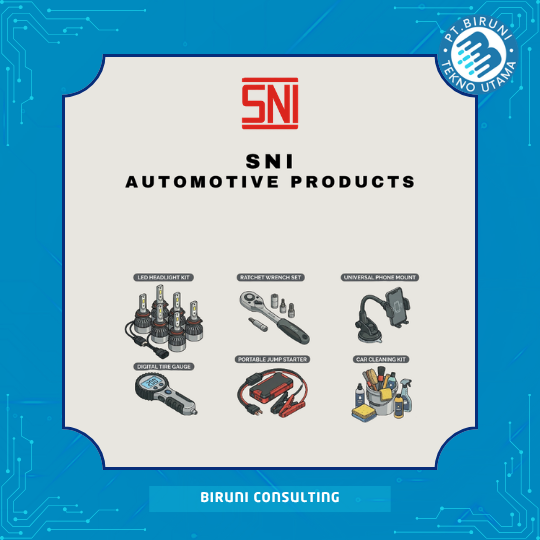
SNI for Automotive Products in Indonesia
SNI for automotive products is a national standard used in Indonesia to ensure that vehicle components circulating in the market meet safety, quality, and technical requirements. This standard plays an important role in ensuring that every automotive product used in vehicles does not create risks for users, passengers, or road safety conditions in general.
Automotive products are considered high-risk items because they are directly related to driving safety and vehicle performance. Even a small defect in automotive components can potentially lead to serious accidents or mechanical failure. Therefore, each product must undergo strict testing, evaluation, and certification before being legally marketed in Indonesia. The process includes technical assessment, safety testing, durability testing, and conformity evaluation with applicable Indonesian standards.
In the automotive industry, SNI is applied to ensure product uniformity, consistency, and reliability. This also helps maintain fair competition in the market and ensures that both imported and locally produced automotive components meet the same minimum safety requirements.
Types of Automotive Products in SNI
1 Vehicle tires and wheel components
2 Vehicle lights and lighting systems
3 Vehicle glass such as windshields and side windows
4 Helmets and rider safety equipment
5 Batteries and electrical systems
6 Brake system components
7 Engine spare parts
8 Vehicle accessories such as wipers and mirrors
These products play a critical role in ensuring vehicle safety, stability, and performance. Each category has different technical characteristics and therefore requires different testing methods and safety standards. For example, braking systems require high precision testing, while lighting systems must meet visibility and durability requirements under various environmental conditions.
Why SNI for Automotive Products Is Important
SNI for automotive products plays a very important role in ensuring road safety and reducing the risk of accidents caused by substandard components. Products that do not comply with safety standards can lead to mechanical failure, reduced vehicle performance, and increased risk for drivers and passengers.
In addition, SNI helps ensure product quality consistency in the Indonesian market by setting clear technical benchmarks that all manufacturers and importers must follow. This supports consumer confidence, improves industry competitiveness, and helps create a more structured and regulated automotive ecosystem in Indonesia.
How to Obtain SNI Certification
Product Identification
The first step in the certification process is identifying the automotive product type in detail. This is important to determine the applicable SNI standard because each automotive component has different technical regulations, safety requirements, and testing parameters depending on its function and usage in vehicles.
Document Preparation
1 NIB and OSS
2 Technical product specifications
3 Technical data and product images
4 Product labels and packaging
These documents are required as the basic administrative and technical requirements for the certification process. Complete and accurate documentation is essential to avoid delays during evaluation and verification stages.
Certification Submission
Submitted through a Product Certification Body accredited by Komite Akreditasi Nasional
Laboratory Testing
Testing is conducted to ensure that the product meets all applicable safety and technical standards. This stage is one of the most important parts of the certification process.
1 Material durability testing to ensure product strength and resistance under operational conditions
2 Product safety testing to evaluate potential risks during usage
3 Technical performance testing to ensure the product functions according to specifications
SPPT SNI Issuance
If all requirements are met, SPPT SNI is issued as official proof that the product complies with Indonesian national standards and is eligible for legal distribution in the market. This certification serves as a guarantee that the product has passed all required safety and quality assessments.
SNI Processing Obstacles
The certification process may face several challenges such as incomplete documentation, test results that do not meet required standards, or lack of understanding regarding technical regulations. These issues can delay the overall certification timeline.
In addition, the certification process may take a considerable amount of time due to multiple stages of verification, laboratory testing, and administrative review that must be completed sequentially before approval is granted.
Contact Us
Biruni Consulting helps companies in the SNI automotive product certification process professionally and in accordance with applicable regulations in Indonesia
Our services include
1 Consultation on automotive SNI regulations
2 Identification of product category standards
3 Certification document preparation
4 Laboratory testing assistance
5 Certification processing until SPPT SNI issuance
With extensive experience in product certification in Indonesia, Biruni Consulting helps ensure automotive products meet all required safety standards and are ready for legal distribution in the Indonesian market
Contact Us for automotive SNI certification services consultation and SPPT SNI processing