
Differences Between an SNI Certificate Holder and Importer for Imported Products in Indonesia
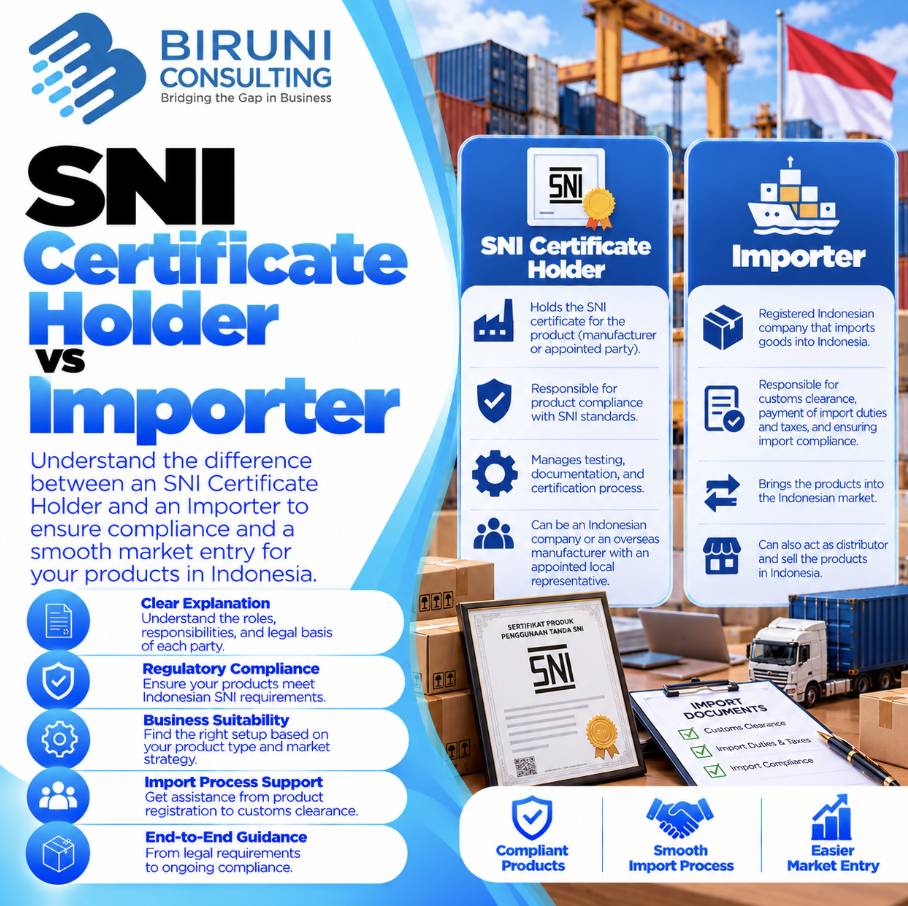
SNI Certificate Holder vs Importer involves two functions that are frequently treated as identical when an Overseas Manufacturer prepares certification and importation for Indonesia. Under many Mandatory SNI schemes, however, the party holding the SNI Certificate and the party performing importation can be different legal entities.
An SNI Certificate Holder is the party legally holding the SNI Certificate under the applicable product-specific regulation and certification scheme. An Importer, meanwhile, conducts importation and performs customs obligations including the Import Customs Declaration or PIB, applicable Customs Duty and Import Taxes, and compliance with prohibitions and restrictions.
Indonesia’s current general import framework uses Minister of Trade Regulation No. 16 of 2025 concerning Import Policy and Regulation. It has been effective since August 29, 2025 and requires Importers to hold an NIB functioning as an API. The framework has subsequently been amended, including through Minister of Trade Regulation No. 18 of 2026 effective June 4, 2026. BPK Regulations
Who can become an SNI Certificate Holder, however, is not determined by the general import regulation. It follows the regulation making SNI mandatory for the specific product. Minister of Industry Regulation No. 8 of 2025 for lubricating oil, for example, provides that an SNI Certificate can only be held by an Industrial Company or an Overseas Manufacturer. BPK Regulations
An Importer should therefore not automatically be treated as the SNI Certificate Holder merely because it brings the goods into Indonesia.
What Is an SNI Certificate Holder?
An SNI Certificate Holder is the party officially holding an SNI Certificate following conformity assessment through an LSPro or Lembaga Sertifikasi Produk / Product Certification Body.
The term “SNI Certificate Holder” needs to be used carefully because the exact eligible holder depends on the product-specific regulation.
For lubricating oil, Minister of Industry Regulation No. 8 of 2025 expressly provides that the SNI Certificate can only be held by:
- an Industrial Company; or
- an Overseas Manufacturer.
Under that scheme, the certificate is issued to one Industrial Company or one Overseas Manufacturer for the relevant SNI at one production location. BPK Regulations
An Indonesian company acting only as Importer therefore does not automatically become the SNI Certificate Holder.
What Is an Importer?
An Importer is the party bringing goods into Indonesia and fulfilling applicable import requirements.
Minister of Trade Regulation No. 16 of 2025 requires Importers to hold an NIB functioning as API. The NIB serves as the Business Operator’s identity, while the API identifies the company as an Importer. BPK Regulations
From the customs perspective, Indonesia Customs explains that for Imports for Use, the Importer generally needs to submit a PIB, pay applicable Customs Duty, Excise and Import Taxes, and satisfy prohibitions and restrictions. Beacukai
The Importer’s principal function is therefore importation and customs compliance, rather than ownership of the SNI Certificate.
Main Differences Between SNI Certificate Holder vs Importer
The simplest distinction concerns the legal basis and principal responsibility.
| Area | SNI Certificate Holder | Importer |
|---|---|---|
| Principal function | Holds the SNI Certificate | Imports goods |
| Basis of requirement | Product-specific SNI regulation | Import and customs regulations |
| NIB/API | Depends on the entity and applicable structure | Required within the importer structure |
| LSPro | Directly connected with certification | Not automatically the certification applicant |
| Factory audit | Connected with manufacturer/certificate scope | Not automatically the audited party |
| Laboratory testing | Connected with certification scope | Not automatically the testing applicant |
| PIB | Not automatically responsible | Part of importer responsibility |
| Customs Duty/PDRI | Not automatically responsible | Part of customs responsibility |
| Official Representative | Can be connected through the scheme | Not automatically the same party |
| SPPT SNI | Product specific | Not automatically the holder |
| One legal entity can perform several functions where permitted, but the functions remain legally distinct. |
Can an Importer Become the SNI Certificate Holder?
Only where the Importer also falls within a category legally permitted to hold the certificate under the applicable product regulation.
For example, if an Indonesian company is an Industrial Company manufacturing the product and the regulation allows it to hold the certificate, that entity can become the certificate holder.
A company performing only importation or trading does not automatically qualify.
The lubricating-oil regulation is explicit: only an Industrial Company or Overseas Manufacturer can hold the SNI Certificate. BPK Regulations
The correct question is therefore not simply “does the Importer have SNI?” but “which party is legally named as SNI Certificate Holder under the applicable regulation?”
An Overseas Manufacturer Can Be the SNI Certificate Holder
Certain Mandatory SNI regulations permit an Overseas Manufacturer to hold the certificate.
Under Regulation No. 8 of 2025, an Overseas Manufacturer is one of the parties eligible to hold the SNI Certificate. The certificate is also associated with a production location, meaning manufacturers operating several production sites need to assess certification coverage by site in accordance with the regulation. BPK Regulations
This is particularly important for multinational manufacturers.
One global brand does not necessarily mean that factories in several countries are all covered by one Indonesian SNI Certificate.
The Importer Does Not Replace the Overseas Manufacturer
An Importer can manage physical importation without replacing the manufacturer within the certification structure.
Where a Mandatory SNI scheme links certification to the manufacturing facility, conformity assessment concerns the manufacturer, production processes, quality-management system, sampling, and product testing.
Using a third-party Importer therefore does not change the actual manufacturer.
The product origin and manufacturing site still need to correspond with the certificate scope.
SNI Certificate Holder and Official Representative Are Also Different
For an Overseas Manufacturer, another role needs to be distinguished: the Official Representative.
Under the Mandatory SNI regulation for lubricating oil, the Overseas Manufacturer needs an Official Representative. The Representative is subject to requirements including manufacturer appointment, trademark-related responsibilities, warehouse control, and a SIINas account. The regulation also allows the Official Representative to act as Importer. BPK Regulations
The ability of the Official Representative to act as Importer does not make it the SNI Certificate Holder.
For lubricating oil, the certificate holder remains the Industrial Company or Overseas Manufacturer. BPK Regulations
Three Roles That Need to Be Distinguished
For imported SNI products, companies should at minimum distinguish:
- SNI Certificate Holder — the party holding the SNI Certificate.
- Official Representative — the Indonesian representative of the Overseas Manufacturer where required.
- Importer — the party conducting importation and customs clearance.
Certain functions can be combined where permitted.
They should nevertheless never be assumed to be identical.
Lubricating Oil Structure Example
Minister of Industry Regulation No. 8 of 2025 provides a useful example for understanding SNI Certificate Holder vs Importer.
The regulation remains in force and imposes Mandatory SNI on lubricating oil. BPK Regulations
For an Overseas Manufacturer:
- the Overseas Manufacturer can hold the SNI Certificate;
- the Overseas Manufacturer needs an Official Representative;
- the Official Representative can act as Importer; and
- where the Official Representative does not act as Importer, it can appoint up to five Importers. BPK Regulations
A project can therefore have Manufacturer A as SNI Certificate Holder, Company B as Official Representative, and Company C as Importer.
SNI Certificate Application for an Overseas Manufacturer
Under the lubricating-oil example, the Overseas Manufacturer submits the SNI Certificate application through the Official Representative electronically through SIINas. BPK Regulations
This again demonstrates that the Importer is not automatically the certification applicant.
Where the Official Representative and Importer are separate companies, the Importer can conduct physical importation without taking ownership of the certificate.
What Is the Role of LSPro?
An LSPro is the conformity-assessment body conducting product certification within its scope and applicable scheme.
BBSPJIKKP explains that product certification is a conformity-assessment process used to confirm that companies maintain an appropriate quality system and can consistently manufacture products satisfying applicable standards. For Ministry of Industry Mandatory SNI schemes, certification applications are submitted through SIINas. Kemenperin
The LSPro is different from:
- the SNI Certificate Holder;
- the Importer;
- the Official Representative;
- the Distributor; and
- a consultant.
Consultants can coordinate the process, but certification decisions remain with the authorized certification body.
Mandatory and Voluntary SNI
Not every product with an SNI number requires an SNI Certificate.
BBSPJIKKP distinguishes Mandatory SNI from Voluntary SNI. Mandatory status arises when the government makes an SNI compulsory through the applicable regulation. Kemenperin
Before determining the certificate-holder or importer structure, companies therefore need regulatory assessment to establish whether the product actually falls within Mandatory SNI scope.
Finding a relevant SNI number alone is insufficient.
The Certificate Holder Can Be Linked to the Manufacturing Site
Under certain certification schemes, the certificate is directly associated with the production location.
For lubricating oil, the SNI Certificate is issued to one Industrial Company or one Overseas Manufacturer for the relevant SNI at one production location. BPK Regulations
This differs fundamentally from the Importer role.
An Importer can import goods from an approved manufacturer but does not automatically extend certification to another manufacturing facility.
Moving production to another factory therefore requires regulatory impact assessment.
Multiple Importers Do Not Mean Multiple Certificate Holders
One Overseas Manufacturer can use a particular importer structure without changing certificate ownership.
For lubricating oil, an Official Representative that does not import directly can appoint up to five Importers. BPK Regulations
One certificate-holder structure can therefore interact with several Importers where the scheme permits.
This can be useful for manufacturers using multiple distribution channels.
Changing the Importer Can Affect the Certificate
Although the Importer is not the certificate holder, changing the Importer can still trigger regulatory consequences.
Under the lubricating-oil regulation, a change to the Importer or Importer information before expiration of the SNI Certificate requires the Official Representative to apply for an amendment to the issued certificate. BPK Regulations
“Importer is not the certificate holder” therefore does not mean that the Importer can always be changed without regulatory action.
The applicable product regulation determines the procedure.
Changing the SNI Certificate Holder Is More Fundamental
Changing the certificate holder can be more fundamental than changing a logistics provider because certification is connected with the manufacturer, production location, conformity-assessment result, and certification scope.
Where the actual manufacturer changes, companies need to determine whether the existing certificate remains valid.
The same principle applies when production is transferred to another factory.
An SNI Certificate should not be treated as an ordinary transferable commercial document without reviewing the regulation and LSPro requirements.
SNI Certificate Holder vs SPPT SNI Holder
The SNI Certificate also needs to be distinguished from SPPT SNI.
Under Regulation No. 8 of 2025, SPPT SNI represents approval to use the SNI Mark. For lubricating oil, SPPT SNI is granted to the Industrial Company or Official Representative and the application is submitted through SIINas. BPK Regulations
The difference is important:
- the SNI Certificate can be held by the Industrial Company or Overseas Manufacturer;
- under the imported lubricating-oil structure, SPPT SNI can be granted to the Official Representative;
- the Importer can be the Official Representative or another appointed entity where permitted.
Certificate holder, SPPT SNI holder, Official Representative, and Importer therefore need precise terminology.
The Importer Is Not Automatically the SPPT SNI Holder
Where an Importer is not the Official Representative, it does not automatically become the SPPT SNI holder merely because it imports the goods.
In the lubricating-oil example, the regulation specifically grants SPPT SNI to the Industrial Company or Official Representative. BPK Regulations
This distinction should also be reflected in commercial agreements.
An Importer should not be described as “owning the SNI” where the actual approval belongs to the manufacturer or Official Representative.
SNI Certificate Holder vs Importer in Customs
Customs responsibilities remain separate from certificate ownership.
Indonesia Customs explains that the Importer prepares the PIB using Supporting Customs Documents and is responsible for calculating, paying, and depositing applicable Customs Duty, Excise, and/or Import Taxes based on the PIB. The Importer is also responsible for satisfying applicable prohibitions and restrictions. Beacukai
Even where an Overseas Manufacturer holds the SNI Certificate, it does not automatically replace the Indonesian Importer in the customs process.
PIB and Certificate Information
PIB information should correspond with the product approval.
Areas requiring consistency can include:
- manufacturer;
- product description;
- brand;
- model or type;
- HS code;
- country of origin; and
- manufacturing site.
Where the actual imported product falls outside the certificate scope, a valid Importer does not automatically resolve the discrepancy.
Importer readiness and certificate readiness therefore need to be assessed together.
Prohibitions and Restrictions
Mandatory SNI can form part of import compliance for regulated goods.
Indonesia Customs explains that restricted imported goods can only be released after the Importer satisfies requirements imposed by the relevant authority, and the Importer is responsible for declaring applicable restrictions in the PIB. Beacukai
The Importer therefore needs to understand the product’s compliance status before shipment.
The Certificate Holder, meanwhile, needs to ensure certification remains valid and the actual goods remain within approved scope.
NIB/API Does Not Make an Importer the Certificate Holder
NIB/API establishes eligibility within the importer framework, not ownership of product certification.
Minister of Trade Regulation No. 16 of 2025 requires Importers to hold an NIB functioning as API. BPK Regulations
SNI Certificate ownership is instead determined by the product-specific Mandatory SNI regulation.
These are separate legal concepts.
The Certificate Holder Does Not Automatically Have NIB/API
The reverse also applies to an Overseas Manufacturer.
An Overseas Manufacturer can hold an SNI Certificate under certain schemes, but because it is established outside Indonesia, physical commercial importation still requires an appropriate Indonesian import structure.
Holding the certificate does not automatically provide Indonesian customs-import capability.
A foreign manufacturer that has already obtained its SNI Certificate can therefore still need an Importer and, where required, an Official Representative.
SNI Certificate Holder and Distributor
The Distributor is another separate role.
A Distributor generally handles sales, domestic distribution, dealer networks, customer support, and commercial development.
The Distributor can also act as Importer where legally eligible.
However, it does not automatically become the SNI Certificate Holder.
An Overseas Manufacturer should avoid commercial agreements that merge certificate ownership, importation, and distribution without clearly allocating legal responsibilities.
Why Does Regulatory Ownership Matter?
The distinction between SNI Certificate Holder vs Importer has significant implications for regulatory ownership.
An Overseas Manufacturer should know:
- Who holds the SNI Certificate?
- Who is the Official Representative?
- Who holds SPPT SNI?
- Who is the Importer?
- Who controls SIINas?
- Who is the Distributor?
- What happens when one of the partners changes?
A clearly designed structure helps preserve business continuity where the Importer or Distributor changes.
Risks of Treating the Importer as the Certificate Holder
Misunderstanding the roles can create several problems.
The manufacturer can incorrectly assume that the Importer owns the certificate when the certificate is actually issued to the manufacturer.
The Importer can also appear to have regulatory control that actually belongs to the Official Representative or manufacturer.
Such misunderstandings can affect contracts, product launches, distributor changes, renewals, surveillance, and exit strategies.
Certificate ownership should therefore be verified from the actual certificate and regulation rather than commercial terminology.
SNI Certificate Holder for Multiple Brands
A certificate can have a particular structure concerning brands or trademarks depending on the product regulation.
The lubricating-oil regulation, for example, allows more than one brand to be stated in an SNI Certificate under specified conditions. BPK Regulations
Importer appointment does not itself provide trademark rights.
Manufacturers therefore need to manage certification, trademarks, Official Representative arrangements, and importer agreements separately but in a coordinated manner.
SNI Certificate Holder for Multiple Manufacturing Sites
A multinational manufacturer can operate several production facilities.
For lubricating oil, certification is tied to the production location, and where more than one production site exists, certificate applications are structured for each location according to the regulation. BPK Regulations
The Importer needs to know which sites have actually been certified.
Commercial supply should not be transferred to another factory without regulatory assessment.
Multiple Importers for One Overseas Manufacturer
Using several Importers can form part of a commercial strategy where the product regulation permits.
The lubricating-oil example allows an Official Representative that does not import directly to appoint up to five Importers. BPK Regulations
This structure can provide several commercial channels without automatically changing the identity of the SNI Certificate Holder.
Additional Importers can nevertheless increase certificate-administration, data-management, labeling, and traceability requirements.
Can the Certificate Holder Be Changed?
The possibility of changing the certificate holder needs to be assessed under the applicable regulation and certification procedure.
An SNI Certificate should not be treated as an ordinary transferable commercial asset.
Where a change involves the manufacturer, production site, corporate identity, trademark arrangements, or other fundamental certification information, additional assessment or a new application can be required.
Regulatory impact assessment should therefore precede corporate restructuring or manufacturing transfers.
Can the Importer Be Changed?
The Importer can be changed where the applicable framework permits, but the change can require regulatory action.
For lubricating oil, changing an Importer or its information before certificate expiration requires an amendment to the SNI Certificate through the Official Representative. BPK Regulations
Other product categories can use different procedures.
Changing the Importer should therefore involve more than changing a Bill of Lading or commercial agreement.
SNI Certificate Holder and Surveillance
The Certificate Holder has a direct interest in maintaining certification.
Product certification does not necessarily end once the certificate is issued.
BBSPJIKKP maintains procedures concerning certification maintenance, suspension, restoration, reduction or extension, and withdrawal. Kemenperin
Surveillance can involve factory assessment, quality-system review, sampling, testing, or other activities depending on the scheme.
The Importer can assist with coordination, but manufacturer and certificate-holder obligations remain relevant.
Importer and Post-Import Compliance
The Importer also has continuing responsibilities of its own.
In addition to customs records, an Importer can need to maintain traceability, reporting, import-realization information, or compliance with Import Approvals.
Minister of Trade Regulation No. 18 of 2026 amended several aspects of the current framework, including import-realization reporting and administrative sanctions. BPK Regulations
Certificate maintenance and importer compliance should therefore be managed as parallel workstreams.
Product Changes After Certification
A manufacturer can change specifications, materials, formulations, models, manufacturing processes, production sites, or trademarks.
Such changes need assessment from a certification perspective.
The Importer also needs to assess whether they affect HS classification, Import Approvals, restrictions, invoice descriptions, or customs information.
Change-control procedures should occur before changed products are shipped.
Model and Variant Control
Where certification covers specified models, the Importer should not import unapproved variants merely because the brand and manufacturer are the same.
Pre-shipment review should compare the actual model with:
- the SNI Certificate;
- laboratory reports;
- SPPT SNI where applicable;
- Commercial Invoice;
- Packing List; and
- product labels.
Model control is therefore an important point of coordination between the Certificate Holder and Importer.
Pre-Shipment Compliance
Before cargo is shipped, the Overseas Manufacturer should establish two groups of readiness.
Certification readiness includes the applicable SNI, SNI Certificate, SPPT SNI where required, model scope, production site, surveillance status, and labeling.
Importer readiness includes NIB/API, Customs Access, Import Approvals where applicable, PIB preparation, restrictions, shipping documentation, and duty and tax planning.
Indonesia Customs also recommends that Importers understand applicable restrictions before shipment to avoid later cost and administrative problems. Beacukai
Do Not Ship Merely Because the SNI Certificate Has Been Issued
An SNI Certificate does not automatically mean that a commercial shipment can immediately proceed.
The Importer structure or other product-specific import requirements can still be incomplete.
Conversely, products should not be shipped merely because an Importer has NIB/API where Mandatory SNI certification remains incomplete.
Commercial shipment requires combined regulatory readiness.
Example Structure 1: Manufacturer as Certificate Holder
A possible structure for an imported Mandatory SNI product is:
Overseas Manufacturer → SNI Certificate Holder
Official Representative Indonesia → regulatory representative and SPPT SNI party where provided by the regulation
Importer Indonesia → customs importation
Distributor Indonesia → sales and domestic distribution
Under this structure, four functions can be divided among three or four separate legal entities.
Example Structure 2: Official Representative Also Acts as Importer
Where the regulation permits, the Official Representative can simultaneously act as Importer.
Minister of Industry Regulation No. 8 of 2025 expressly allows the Official Representative to act as Importer for lubricating oil produced by the Overseas Manufacturer it represents. BPK Regulations
The SNI Certificate Holder for the imported-manufacturer structure nevertheless remains the Overseas Manufacturer. BPK Regulations
This is a clear example where Importer and Certificate Holder remain different even though the Representative and Importer roles are combined.
Example Structure 3: Official Representative with Multiple Importers
Under the lubricating-oil scheme, an Official Representative that does not act as Importer can appoint up to five Importers. BPK Regulations
This structure can support multiple commercial channels where regulatory requirements are satisfied.
Governance becomes more important because Importer information is also connected with certificate administration under that scheme.
Product-Specific Regulations Remain Decisive
Minister of Industry Regulation No. 8 of 2025 should not be treated as a universal rule for every Mandatory SNI product.
Indonesia currently has other product-specific Mandatory SNI regulations, including Minister of Industry Regulation No. 9 of 2025 for tires and Regulation No. 15 of 2025 for motor-vehicle safety glass. BPK Regulations
Applicant, Certificate Holder, Official Representative, Importer, warehouse, testing, surveillance, and SPPT SNI requirements need to be assessed separately under each regulation.
Regulatory Gap Analysis
Before appointing an Importer or beginning certification, companies should conduct regulatory gap analysis.
Common gaps include:
- Mandatory SNI status not yet confirmed;
- Certificate Holder structure not established;
- Overseas Manufacturer has no Official Representative where required;
- Importer does not yet have an appropriate NIB/API structure;
- LSPro not selected;
- manufacturing site not covered;
- laboratory testing incomplete;
- SPPT SNI unavailable; or
- responsibilities among manufacturer, Representative, Importer, and Distributor remain unclear.
Gap analysis reduces the risk of restructuring after certification has already progressed.
SNI Certificate Holder vs Importer Roadmap
An Overseas Manufacturer can generally use the following roadmap:
- Product classification and Mandatory SNI assessment.
- Determine which party can legally become the SNI Certificate Holder.
- Determine whether an Official Representative is required.
- Determine the SPPT SNI structure where applicable.
- Select the Importer and review NIB/API and Business Licensing.
- Complete LSPro assessment, factory audit, sampling, and testing.
- Complete product and Import Approvals.
- Conduct pre-shipment compliance review.
- Begin commercial importation.
- Manage surveillance, importer compliance, and regulatory monitoring.
The exact sequence remains product specific.
Timeline
There is no single timeline applicable to every project.
Timing can depend on:
- product classification;
- SNI scope;
- LSPro availability;
- factory audits;
- laboratory testing;
- corrective actions;
- Official Representative setup;
- SIINas;
- SPPT SNI;
- importer readiness; and
- Import Approvals.
The existence of either a Certificate Holder or Importer alone therefore cannot determine the market-launch date.
Cost
Costs also arise from two different workstreams.
Certification-related costs can include regulatory assessment, LSPro, testing, factory audits, auditor travel, sample shipment, surveillance, and Official Representative arrangements.
Import-related costs can include importer services, customs brokerage, freight, duties, import taxes, Import Approvals, warehousing, and local delivery.
Manufacturers should calculate total regulatory and import costs rather than only the certification fee or importer fee.
Common SNI Certificate Holder vs Importer Mistakes
A common mistake is describing the Importer as the “SNI holder” without checking the actual certificate.
Other mistakes include:
- assuming the Importer automatically becomes the SNI Certificate Holder;
- assuming the Official Representative automatically becomes the Certificate Holder;
- treating the SNI Certificate and SPPT SNI as the same instrument;
- assuming NIB/API creates certification ownership;
- changing the Importer without regulatory impact assessment;
- using an unapproved manufacturing site;
- shipping models outside the certificate scope; and
- failing to design a regulatory-ownership strategy.
Each role needs to be established from the regulation and actual approvals.
How to Determine the Appropriate Structure
An Overseas Manufacturer should begin with the regulation rather than the commercial partner.
Questions to answer include:
- Who is permitted to become the SNI Certificate Holder?
- Can the Overseas Manufacturer hold the certificate?
- Is an Official Representative required?
- Who receives SPPT SNI?
- Who acts as Importer?
- Can the Importer be separate from the Official Representative?
- What happens when the Importer or Representative changes?
Once the regulatory structure is clear, commercial agreements can be aligned with it.
Conclusion
SNI Certificate Holder vs Importer involves two different functions within Indonesian market-entry and Mandatory SNI structures.
The SNI Certificate Holder is the party legally holding the SNI Certificate under the applicable product-specific regulation. The Importer conducts importation, maintains an NIB functioning as API, submits the PIB, settles applicable customs obligations, and complies with prohibitions and restrictions. BPK Regulations
Minister of Industry Regulation No. 8 of 2025 for lubricating oil provides a clear example. The SNI Certificate can only be held by an Industrial Company or Overseas Manufacturer. For an Overseas Manufacturer, the Official Representative can act as Importer or, where it does not import directly, appoint up to five Importers. BPK Regulations
The same regulation also demonstrates the distinction between the SNI Certificate and SPPT SNI. SPPT SNI is approval to use the SNI Mark and, under that scheme, is granted to an Industrial Company or Official Representative. BPK Regulations
By distinguishing the SNI Certificate Holder, Official Representative, SPPT SNI holder, Importer, and Distributor from the beginning, an Overseas Manufacturer can reduce regulatory-ownership errors, certification disruption, customs delays, and excessive dependency on a single commercial partner.
Contact Us
Biruni Consulting assists companies with SNI Certificate Holder vs Importer professionally and in accordance with applicable regulations in Indonesia.
Our services include:
- Regulatory consultation.
- Identification of applicable standards.
- Preparation of certification documents.
- Assistance with laboratory testing.
- Certification processing until certificate issuance.
Biruni Consulting assists Overseas Manufacturers with determining the SNI Certificate Holder, Official Representative, Importer, SPPT SNI, SIINas, LSPro, laboratory testing, regulatory ownership, and import structure before products are marketed in Indonesia.
Contact Us for guidance on SNI Certificate Holder vs Importer, SNI Certificate Holder Indonesia, SNI Importer Indonesia, SNI Official Representative Indonesia, and imported-product regulatory compliance assistance.