
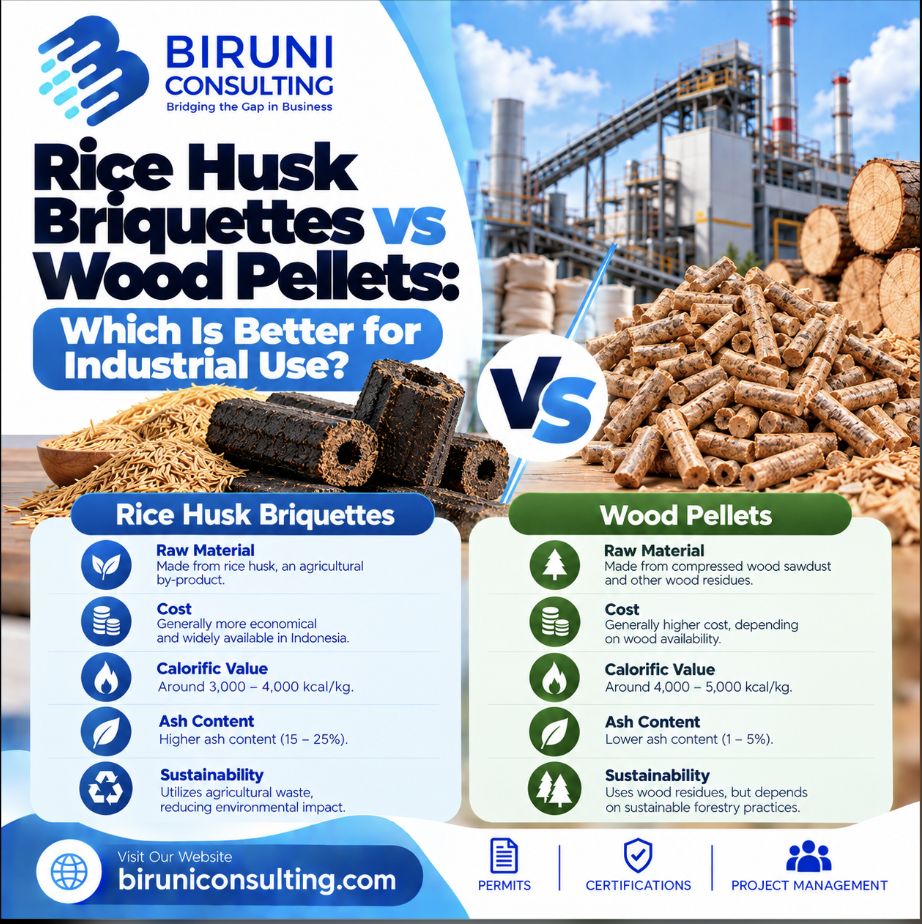
Rice Husk Briquettes and Wood Pellets as Industrial Biomass Fuels
Rice husk briquettes and wood pellets are two forms of densified solid biomass fuel that can be considered for industrial thermal-energy requirements.
Both fuels may be used in compatible boilers, furnaces, dryers, biomass burners, and other combustion equipment.
However, they are not technically identical.
Differences in raw material, manufacturing process, dimensions, density, ash content, calorific value, mechanical properties, and feeding characteristics can result in significantly different operating performance.
Wood pellets have a dedicated international classification framework. ISO 17225-2:2021 specifies quality classes and fuel specifications for graded wood pellets intended for both industrial and non-industrial use. ISO
Rice husk briquettes are produced from residues generated during rice milling and can have more variable characteristics depending on whether the material is carbonized, the binder used, moisture control, compaction, and other manufacturing conditions.
For this reason, there is no universal answer that wood pellets or rice husk briquettes are always better. Selection should be based on boiler compatibility, fuel specifications, supply conditions, logistics, ash handling, and total operating cost.
Main Differences Between Rice Husk Briquettes and Wood Pellets
A general comparison is shown below.
| Parameter | Rice Husk Briquettes | Wood Pellets |
|---|---|---|
| Raw Material | Rice husk | Sawdust and wood-processing residues |
| Physical Form | Generally larger briquettes | Small uniform cylindrical pellets |
| Density | Higher than loose rice husk | High and relatively uniform |
| Calorific Value | Depends strongly on processing | Generally consistent for graded products |
| Ash Content | Typically higher | Generally lower for quality wood pellets |
| Automatic Feeding | Equipment-dependent | Well suited to pellet-feeding systems |
| Storage | Better than loose rice husk | Highly efficient due to uniform dimensions |
| Ash Handling | Usually requires greater capacity | Generally lower for low-ash pellets |
| Supply | Depends on rice-producing regions | Depends on wood-processing supply |
| Pricing | Depends on supplier and location | Depends on grade, supplier, and logistics |
Actual specifications should always be confirmed using supplier data and laboratory results.
Raw Materials
Rice husk briquettes and wood pellets come from different biomass supply chains.
Rice Husk Briquettes
Rice husk is generated during rice milling.
It can be dried, processed, and densified directly, or carbonized before briquetting depending on the required product.
For industrial facilities located close to rice-producing areas, rice husk can provide access to a locally available agricultural biomass resource.
Wood Pellets
Wood pellets are generally manufactured from sawdust or other residues generated by wood-processing activities.
ISO 17225-2:2021 covers wood pellets produced from virgin wood, residues and by-products from the wood-processing industry, and certain chemically untreated used wood materials. ISO
The mineral composition of woody biomass differs significantly from that of rice husk, which affects ash generation and combustion behavior.
Calorific Value Comparison
Calorific value indicates the amount of thermal energy that can be generated by a fuel.
Both rice husk briquettes and wood pellets can provide useful heating values for industrial applications, although actual performance varies by product.
Research investigating pellets manufactured from mixtures of rice husk and wood particles reported heating values of approximately 15–18 MJ/kg, with values generally increasing as the proportion of wood particles increased. DOI
Research involving rice-husk-containing briquettes has also shown substantial variation in calorific value, with one study reporting values of approximately 4,551–5,945 cal/g across the formulations tested. R.E.M. Jurnal
These values should be treated as research examples rather than universal commercial specifications.
Which Fuel Has the Higher Calorific Value?
Quality wood pellets can provide relatively consistent energy characteristics when manufactured according to defined specifications.
Rice husk briquettes can also achieve useful calorific values, particularly when moisture, carbonization, formulation, and compaction are well controlled.
Industrial buyers should nevertheless avoid comparing calorific-value numbers without confirming the reporting basis.
A specification reported as Gross Calorific Value on a dry basis cannot be directly compared with a Net Calorific Value reported on an as-received basis without appropriate conversion.
Ash Content Comparison
Ash represents one of the most important practical differences between wood-based and rice-husk-based fuels.
Rice husk naturally contains relatively high mineral content, and its ash is particularly rich in silica. Studies examining rice husk combustion have found its ash particles to consist predominantly of silica. ACS Publications
Research on pellets made from mixtures of rice husk and wood particles also found that increasing the proportion of rice husk increased ash levels, while woody biomass generally demonstrated substantially lower ash levels. DOI
For plants seeking to minimize the quantity of ash that must be removed and handled, quality wood pellets therefore often have an operational advantage.
Does Higher Rice Husk Ash Always Mean More Boiler Problems?
Not necessarily.
The quantity of ash matters, but its chemical composition and melting behavior are also important.
Rice husk ash has distinctive silica-rich characteristics.
Research comparing rice-derived residues found rice husk to have lower calculated slagging and fouling tendencies than rice straw under the conditions evaluated. MDPI
An Indonesian study examining alternative biomass fuels for sugar-mill boilers also classified rice husk as having relatively low slagging and fouling potential in the specific conditions evaluated. Journal UGM
Actual boiler behavior, however, depends on operating temperature, combustion technology, fuel blending, ash composition, and other operating conditions.
An industrial trial therefore remains important.
Moisture Content
Moisture affects both fuels because energy is consumed in evaporating water before useful heat can be transferred to the process.
Both wood pellets and rice husk briquettes should therefore be protected from rain and excessive humidity.
Wood pellets can lose mechanical integrity when exposed to significant moisture, causing swelling and disintegration.
Rice husk briquettes can also absorb moisture, potentially changing their combustion characteristics and durability.
Covered storage, appropriate packaging, and good inventory practices are consequently important for both fuels.
Size and Shape
Physical dimensions are particularly important for automated fuel-handling systems.
Wood Pellets
Wood pellets have small and relatively uniform cylindrical dimensions.
This makes them particularly suitable for:
- hoppers,
- screw feeders,
- conveyors,
- and automated fuel-feeding systems.
Consistent dimensions can help maintain a predictable fuel flow when the equipment is specifically designed for pellets.
Rice Husk Briquettes
Briquettes are normally larger than pellets.
They may be cylindrical, rectangular, or produced in another form depending on the briquetting equipment.
Larger briquettes can work effectively in manual feeding systems or biomass boilers specifically designed for larger solid fuels.
However, they may not be directly compatible with small automatic pellet feeders.
Density and Storage
Both products use densification to improve handling compared with loose biomass.
Loose rice husk has a relatively low bulk density and can require substantial storage volume.
Converting it into briquettes significantly improves material handling and storage efficiency.
Wood pellets also provide high bulk density and highly uniform physical dimensions, making them particularly convenient for silo storage and automated fuel handling.
For facilities using conventional warehouses, bags, or jumbo bags, rice husk briquettes can also be practical.
Fuel-Feeding Systems
A plant’s existing feeding equipment can determine which fuel is more practical.
Where a boiler uses a dedicated automatic pellet-feeding system, wood pellets may require fewer modifications.
Rice husk briquettes may be suitable for:
- manual feeding,
- fixed-grate systems,
- moving-grate systems,
- larger conveyors,
- and biomass systems designed for larger fuel dimensions.
Engineering teams should verify the minimum and maximum fuel dimensions allowed by the boiler and feeding equipment before switching fuels.
Mechanical Durability
Biomass fuel must survive several handling stages before combustion.
These include:
- Manufacturing.
- Packaging.
- Loading.
- Transportation.
- Unloading.
- Storage.
- Fuel feeding.
Quality wood pellets are commonly manufactured with controlled mechanical durability.
Rice husk briquettes can also have excellent mechanical strength when compaction and formulation are appropriately controlled.
However, actual quality varies among suppliers.
Products with poor durability may create excessive fines, which can affect storage cleanliness and fuel feeding.
Ash Handling
Wood pellets can offer a significant advantage where minimizing ash-handling volume is an operational priority.
Research on rice-husk/wood fuel pellets notes that woody biomass generally has low ash levels, while higher rice-husk fractions considerably increase ash content. DOI
This does not mean every wood pellet has extremely low ash.
Bark, soil contamination, raw-material quality, and manufacturing practices can increase ash levels.
A supplier’s Certificate of Analysis should therefore be reviewed regardless of the fuel type.
Combustion Performance and Emissions
Combustion performance and emissions cannot be predicted solely from whether the fuel is a wood pellet or rice husk briquette.
Results also depend on:
- moisture,
- ash,
- volatile matter,
- furnace temperature,
- combustion-air control,
- residence time,
- boiler design,
- loading rate,
- and emission-control equipment.
An operational trial provides more useful information than making a general assumption that one fuel will always produce cleaner combustion.
Comparing Fuel Prices
The purchasing price is an important consideration, but price per ton alone is not sufficient.
A fuel costing less per ton may still be more expensive to operate if substantially more fuel is required to produce the same amount of steam.
For industrial boilers, companies should consider an indicator such as:
Fuel Cost per Ton of Steam
rather than only:
Fuel Price per Ton.
Example of Cost per Ton of Steam
Consider a simplified example.
Fuel A requires:
180 kg to generate one ton of steam
at a price of IDR 3,000/kg.
The fuel cost is:
180 × IDR 3,000 = IDR 540,000 per ton of steam.
Fuel B costs IDR 3,400/kg but requires only:
150 kg × IDR 3,400 = IDR 510,000 per ton of steam.
In this example, the fuel with the higher unit price produces a lower fuel cost per ton of steam.
These numbers are purely illustrative. Actual consumption must be determined through operating data or a controlled boiler trial.
Logistics Costs
Biomass fuels are physical products for which logistics can represent a significant portion of total delivered cost.
Industrial buyers should consider:
- Ex-factory price.
- Transportation.
- Truck capacity.
- Supplier distance.
- Delivery frequency.
- Packaging.
- Unloading costs.
- Warehouse requirements.
A rice husk briquette supplier located close to a customer’s factory may offer a lower total cost than a distant wood-pellet supplier even if the wood pellet has better technical specifications.
The opposite may also be true where a reliable pellet supply chain is already established.
Raw-Material Availability
Long-term supply security should be evaluated before entering into a fuel contract.
Rice husk briquette production depends on rice-milling activities and the supplier’s ability to collect and process sufficient rice husk.
Wood pellet production depends on reliable access to sawdust and other appropriate wood-processing residues.
Industrial customers should verify that suppliers have sustainable raw-material sourcing and sufficient capacity beyond their existing contracts.
Product Consistency
For industrial operations, consistency may be more valuable than receiving one exceptionally good batch.
Large changes in moisture, ash, dimensions, density, or calorific value can require repeated adjustments to boiler operating parameters.
Wood pellets benefit from established international specification frameworks such as ISO 17225-2. ISO
Rice husk briquettes can also be supplied consistently where manufacturers maintain appropriate raw-material controls, manufacturing procedures, and quality-assurance systems.
Practical Comparison for Industrial Buyers
| Factor | Rice Husk Briquettes | Wood Pellets |
|---|---|---|
| Purchasing Cost | Can be competitive near rice-producing regions | Depends on pellet grade and location |
| Calorific Value | Depends heavily on processing | Often relatively consistent |
| Ash | Generally higher | Generally lower |
| Ash Silica | High | Generally lower |
| Fuel Dimensions | Larger | Small and uniform |
| Automatic Feeding | Requires compatible equipment | Particularly suitable |
| Storage Efficiency | Good | Very good |
| Standardization | Supplier-specific specifications common | ISO 17225-2 available |
| Ash Handling | Generally greater | Generally lower |
| Industrial Potential | High with compatible boiler | High, particularly for automated systems |
When May Rice Husk Briquettes Be More Suitable?
Rice husk briquettes can be attractive where:
- The boiler accepts larger biomass fuel.
- Reliable suppliers are located close to the factory.
- Delivered prices are competitive.
- Ash-handling equipment has sufficient capacity.
- Storage facilities are suitable.
- Product specifications remain consistent.
- Calorific value meets operating requirements.
- Monthly supply can be guaranteed.
- Boiler trials demonstrate stable combustion.
- Cost per ton of steam is competitive.
Under these conditions, rice husk briquettes can provide an economically attractive biomass option.
When May Wood Pellets Be More Suitable?
Wood pellets can be preferable where:
- The boiler uses an automatic pellet-feeding system.
- Uniform dimensions are critical.
- Minimizing ash handling is a priority.
- Standardized fuel grades are preferred.
- Silos and feeding systems are designed for pellets.
- Mechanical durability needs to be highly consistent.
- Delivered cost remains economically acceptable.
- Reliable long-term supply is available.
Wood pellets can be particularly attractive for facilities seeking higher automation.
Can Rice Husk Briquettes Replace Wood Pellets?
Potentially, but not without technical evaluation.
Switching simply because rice husk briquettes have a lower price per ton can create feeding or combustion problems if the existing system was designed specifically for pellets.
Engineering teams should evaluate:
- Fuel dimensions.
- Feeding mechanism.
- Calorific value.
- Moisture content.
- Ash content.
- Ash chemistry.
- Furnace temperature.
- Air-to-fuel ratio.
- Ash-removal system.
- Boiler capacity.
If these parameters appear compatible, a controlled trial can be conducted before full conversion.
Can Wood Pellets Replace Rice Husk Briquettes?
The same principle applies in the opposite direction.
Wood pellets have different dimensions, bulk density, and combustion characteristics.
Changing the fuel may alter the mass flow entering the boiler even when the same feeding equipment is used.
Fuel-feed rates and combustion-air settings may therefore require adjustment.
Why a Boiler Trial Is Essential
An operational trial is one of the most reliable ways to determine which fuel is more suitable for a particular plant.
Companies can measure:
- Fuel consumption per hour.
- Steam production.
- Fuel-to-steam ratio.
- Furnace temperature.
- Steam pressure.
- Combustion stability.
- Feeding performance.
- Ash quantity.
- Cleaning frequency.
- Deposit or clinker formation.
- Auxiliary electricity consumption.
- Operator intervention.
- Total cost per ton of steam.
These data allow the company to compare actual operating performance rather than theoretical specifications alone.
Certificate of Analysis Comparison
When comparing rice husk briquette and wood pellet suppliers, industrial buyers should request technical documentation.
| Parameter | Rice Husk Briquettes | Wood Pellets |
|---|---|---|
| Total Moisture | CoA | CoA |
| Ash Content | CoA | CoA |
| Gross Calorific Value | CoA | CoA |
| Net Calorific Value | If available | If available |
| Volatile Matter | CoA | CoA |
| Fixed Carbon | CoA | CoA |
| Bulk Density | Supplier Data | Supplier Data |
| Sulfur | Where required | Where required |
| Chlorine | Where required | Where required |
| Mechanical Durability | Where available | Particularly relevant |
| Dimensions | Specification | Specification |
The reporting basis and test method should be comparable before values are used to make procurement decisions.
Evaluate Total Cost of Use
A common biomass-procurement mistake is selecting the supplier with the lowest quoted price.
A more useful calculation is:
Fuel + Transportation + Handling + Storage + Actual Consumption + Ash Handling + Maintenance + Downtime
This provides a more realistic Total Cost of Use.
A cheaper fuel can become more expensive if it increases fuel consumption, cleaning frequency, feeding problems, or unplanned downtime.
A Practical Selection Process
Industrial buyers can evaluate both fuels through several stages.
Stage 1 – Technical Screening
Compare:
- moisture,
- ash,
- calorific value,
- dimensions,
- density,
- ash characteristics.
Stage 2 – Supply Evaluation
Verify:
- supplier capacity,
- raw-material sources,
- monthly availability,
- lead time,
- supply continuity.
Stage 3 – Commercial Evaluation
Compare:
- price per ton,
- transportation costs,
- packaging,
- payment terms,
- delivered cost.
Stage 4 – Boiler Trial
Test both fuels under controlled operating conditions.
Stage 5 – Total Cost Analysis
Compare cost per:
- ton of steam,
- operating hour,
- unit of production,
- or useful energy output.
This approach provides a stronger basis for selecting an industrial biomass fuel.
Rice Husk Briquettes or Wood Pellets: Which Is Better?
Neither fuel is automatically better for every industrial application.
Quality wood pellets generally offer advantages in dimensional consistency, standardized quality classification, automatic feeding, and lower ash content. ISO 17225-2 provides a dedicated specification framework for graded wood pellets. ISO
Rice husk briquettes can be attractive where reliable local supply, competitive delivered pricing, compatible boiler equipment, and adequate ash-handling capacity are available.
The silica-rich nature of rice husk ash should also be evaluated based on actual ash chemistry and boiler operating conditions rather than ash percentage alone. ACS Publications
Ultimately, the more suitable fuel is the one that provides stable boiler performance, reliable supply, and the most appropriate total operating cost for the facility.
Information Required Before Selecting a Fuel
Before comparing suppliers, industrial buyers should prepare:
- Boiler type.
- Boiler capacity.
- Grate or burner type.
- Feeding system.
- Acceptable fuel dimensions.
- Required steam output.
- Daily operating hours.
- Current fuel consumption.
- Ash-handling capacity.
- Warehouse capacity.
- Monthly fuel requirements.
- Factory location.
- Target fuel specifications.
- Target fuel cost.
- Trial requirements.
This information makes technical and commercial evaluation substantially more accurate.
Contact Us
Biruni Consulting can assist companies that require information and support regarding product requirements, documentation, and compliance processes related to product importation, marketing, or use according to business requirements in Indonesia.
The services that can be supported include:
- Consultation on product requirements for industrial needs.
- Initial assessment of product specifications and applications.
- Technical document review.
- Review of product specifications and information.
- Consultation on applicable regulatory requirements according to the product type and business activities.
- Assistance in preparing required documents.
- Consultation on certification or licensing processes when required based on the product characteristics and intended use.
Contact Biruni Consulting for information regarding product requirements, documentation, certification, and compliance needs to support business activities and product marketing in Indonesia