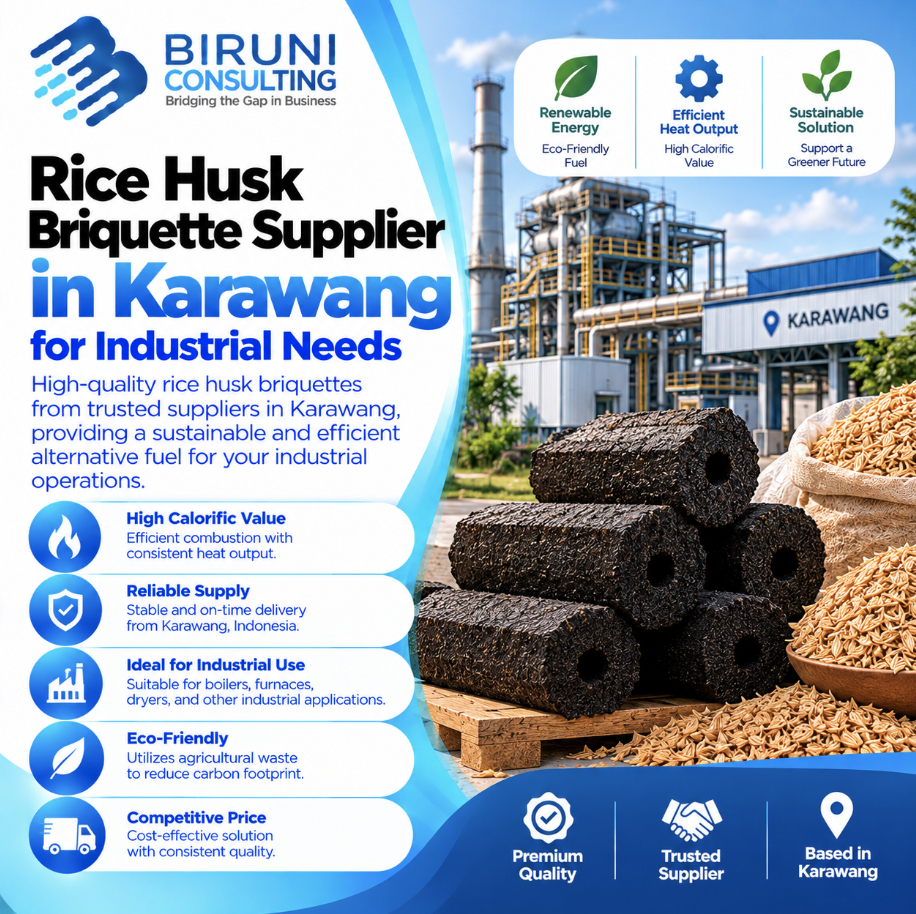
Rice Husk Briquettes for Industrial Users in Karawang
Karawang combines a substantial rice-production base with extensive manufacturing activity, creating an interesting environment for agricultural biomass supply.
According to Statistics Indonesia’s West Java office, Karawang produced approximately 1,194,712 metric tons of dry unhusked paddy in 2025, corresponding to around 689,925 tons of rice. Rice-processing activity on this scale creates a relevant feedstock base for by-products such as rice husk. BPS Jabar
Karawang is also home to major manufacturing facilities and industrial estates. Karawang International Industrial City (KIIC), for example, operates an approximately 1,500-hectare industrial estate along the Jakarta–Cikampek corridor. KIIC
This combination makes a rice husk briquette supplier in Karawang potentially relevant to factories operating biomass boilers, dryers, furnaces, burners, or other thermal systems.
However, the closest supplier is not necessarily the most economical supplier. Industrial buyers should compare specifications, delivered cost, available capacity, quality consistency, and actual fuel performance.
What Are Rice Husk Briquettes?
Rice husk briquettes are densified solid biomass fuels produced from husks generated during rice milling.
Indonesia’s agricultural post-harvest research agency explains that densification can improve the physical characteristics and energy per unit volume of rice-derived biomass while making the material more convenient to store and transport. Rice-residue biobriquettes can also be used as an energy source for industrial applications. Pascapanen
Compared with loose rice husk, briquettes have a more compact and relatively uniform form.
For industrial facilities, this can simplify transportation, storage planning, and material handling where the combustion and feeding systems are compatible.
Rice Husk Availability in Karawang
Rice husk is generated as a by-product of rice milling.
Indonesia’s post-harvest agricultural agency has specifically highlighted opportunities to utilize rice-processing residues in Karawang, including initiatives involving rice husk and straw for value-added products. Pascapanen
This does not mean that all rice husk produced in the region is available for briquette manufacturing.
Availability depends on rice mills, existing alternative uses, seasonal conditions, collection networks, and contractual arrangements.
For this reason, industrial buyers should investigate feedstock security in addition to briquetting-machine capacity.
Rice Husk Briquettes as Non-Woody Biomass
Rice husk is an agricultural biomass rather than woody biomass.
ISO 17225-7:2021 establishes fuel-quality classes and specifications for graded non-woody briquettes. Its scope includes herbaceous biomass and by-products from cereal crops and food-processing operations. ISO
This distinction matters because rice husk briquettes can behave differently from wood briquettes or wood pellets.
Differences can be particularly important for ash content, mineral composition, and combustion characteristics.
Purchasing teams should therefore compare actual product data rather than treating all biomass briquettes as equivalent.
Industrial Applications
Rice husk briquettes can be considered for compatible steam boilers, biomass boilers, industrial dryers, certain furnaces, biomass burners, food-processing facilities, agricultural processing, and manufacturing processes requiring steam or heat.
Compatibility needs to be verified before substantial fuel purchases.
A boiler originally designed around another solid fuel may require operational adjustment before switching to rice husk briquettes.
Engineering teams should review the grate, feeder, furnace dimensions, air-distribution system, and ash-removal equipment.
Carbonized vs. Non-Carbonized Rice Husk Briquettes
Suppliers may offer different product categories.
Non-Carbonized Rice Husk Briquettes
Rice husk is processed, dried, and compressed without first being converted into charcoal.
The original biomass characteristics remain more prominent.
Carbonized Rice Husk Briquettes
The rice husk undergoes carbonization, changing characteristics such as fixed carbon, volatile matter, ignition, and combustion behavior.
The two products should not be compared using price per kilogram alone.
Buyers should confirm the actual product type before evaluating supplier quotations.
Specifications Industrial Buyers Should Request
Technical specifications should ideally be defined before commercial negotiations.
| Parameter | Information to Request |
|---|---|
| Raw Material | Rice husk / actual composition |
| Product Type | Carbonized / non-carbonized |
| Calorific Value | GCV and/or NCV |
| Moisture | Maximum percentage |
| Ash | Maximum percentage |
| Proximate Analysis | Volatile matter and fixed carbon |
| Dimensions | Diameter, length and shape |
| Physical Quality | Density, strength or fines where relevant |
| Packaging | Bags, jumbo bags or other format |
| Available Capacity | Metric tons per month |
For recurring supply, buyers should also define the testing and reporting basis so both parties evaluate quality using the same criteria.
Calorific Value
Calorific value indicates the energy potential of the fuel.
Industrial buyers should distinguish between:
Gross Calorific Value (GCV/HHV)
and:
Net Calorific Value (NCV/LHV).
Laboratory results may also be stated on an as-received or dry basis.
Two fuels with different kcal/kg values cannot always be compared directly when the reporting basis is different.
Supplier quotations should therefore include laboratory information that identifies both the calorific-value type and reporting basis.
Moisture Content
Moisture is important because water consumes heat as it is evaporated during combustion.
Excessive or inconsistent moisture can influence both fuel consumption and combustion stability.
Storage and local transportation conditions also matter.
A product that meets specification immediately after production can deteriorate if stored where it is exposed to rain or excessive humidity.
A maximum moisture value can therefore be included as a contractual acceptance criterion.
Ash Content
Ash is especially relevant for rice-husk-based fuels because their mineral characteristics differ from woody biomass.
For boiler operators, ash affects residue volumes, cleaning frequency, ash handling, and maintenance.
A high calorific value does not automatically make a fuel operationally superior if ash significantly increases maintenance requirements.
Purchasing and engineering teams should therefore evaluate calorific value and ash together.
More detailed ash analysis may also be considered where a boiler has specific deposit or ash-melting concerns.
Briquette Dimensions
Briquette dimensions need to match the fuel-handling system.
Buyers should verify compatibility with the hopper, conveyor or screw feeder, grate, and combustion chamber.
Oversized briquettes can interfere with feeding.
Products with inadequate mechanical strength can break during transportation and create excessive fines.
Physical samples should ideally be evaluated after representative handling rather than only immediately after production.
Density, Strength and Fines
Physical quality becomes important in recurring industrial supply.
Briquettes move through production, warehousing, truck loading, transportation, unloading, storage, and boiler feeding.
Weak products can break before reaching the combustion chamber.
Significant batch-to-batch variations in density may also influence storage and feeding behavior.
Factories using automatic feeding systems can therefore place considerable importance on dimensional and physical consistency.
Certificate of Analysis
Industrial buyers can request a Certificate of Analysis or CoA as part of technical screening.
A practical CoA may include:
- Calorific value and reporting basis.
- Moisture and ash.
- Volatile matter and fixed carbon.
- Dimensions or density where relevant.
- Additional boiler-specific parameters.
The test date and sample or batch identification should also be reviewed.
An outdated laboratory certificate may not accurately represent current production.
Why Supplier Location Matters
Biomass fuel can involve substantial transportation volume.
As transport distance increases, trucking costs can become a significant component of delivered fuel cost.
A supplier located in Karawang or a nearby area may therefore offer shorter lead times and potentially lower transportation costs for local industrial users.
Karawang also has direct access to the Jakarta–Cikampek industrial corridor; KIIC, for example, is located along that route. KIIC
Location alone, however, should not determine the procurement decision.
A slightly more distant supplier may still offer better economics through more consistent quality, larger capacity, or stronger logistics management.
Ex-Factory vs. Delivered Pricing
Buyer quotations should use the same commercial basis.
An ex-factory price represents the product price at the supplier’s facility before transport to the customer’s factory.
A delivered price includes transportation to the agreed destination.
For industrial users in Karawang, delivered pricing often provides a more practical basis for comparing suppliers.
Buyers should still confirm whether packaging, loading, toll charges, unloading, and other logistics costs are included.
Compare Fuel Cost, Not Only Price per Kilogram
Purchase price alone can be misleading.
For example:
Supplier A
Delivered price: IDR 3,000/kg
Consumption: 190 kg/ton of steam
Fuel cost:
IDR 570,000/ton of steam
Supplier B
Delivered price: IDR 3,350/kg
Consumption: 165 kg/ton of steam
Fuel cost:
IDR 552,750/ton of steam
In this illustration, Supplier B has a higher price per kilogram but a lower fuel cost per ton of steam.
The figures are illustrative only. Actual performance should be measured through a boiler trial.
Total Cost of Use
Industrial customers can use a broader calculation:
Fuel Price + Transportation + Storage + Actual Consumption + Ash Handling + Cleaning + Maintenance + Downtime
This produces a more meaningful Total Cost of Use.
A lower-priced fuel may lose its advantage if it requires higher consumption or significantly increases maintenance.
A slightly higher-priced product may be more economical if it provides stable combustion and lower operating costs.
Conduct a Boiler Trial
A boiler trial is one of the most useful stages of supplier qualification.
The evaluation can focus on:
- Fuel consumption and fuel-to-steam ratio.
- Steam output and combustion stability.
- Feeding performance.
- Ash generation and residue condition.
- Cleaning requirements and actual operating cost.
The trial should ideally reflect normal operating conditions.
Purchasing can then evaluate commercial terms while engineering assesses technical performance.
Calculate Monthly Fuel Requirements
Monthly requirements can be estimated from daily consumption.
For example:
8 MT/day
for:
25 operating days/month
equals approximately:
200 MT/month.
Safety stock should then be added according to the factory’s operating requirements.
This calculation allows purchasing teams to screen suppliers using realistic monthly volume requirements.
Production Capacity vs. Available Capacity
A supplier’s machine capacity should not automatically be treated as available supply.
Suppose a supplier has:
300 MT/month production capacity.
If:
180 MT/month
is already committed to existing customers, only around:
120 MT/month
may remain available.
That supplier cannot independently support a buyer requiring 200 MT/month unless additional capacity is available.
Industrial buyers should therefore ask specifically for available monthly capacity.
Raw-Material Continuity
Karawang has a substantial rice-production base. BPS recorded approximately 1.19 million tons of paddy production in the regency in 2025. BPS Jabar
High regional rice output, however, does not mean that all rice husk is available to one briquette supplier.
Manufacturers still need reliable collection arrangements with rice mills and may compete with other uses for the same by-product.
For regular contracts, buyers can review feedstock networks, raw-material storage, the number of sourcing points, and backup supply arrangements.
A diversified feedstock network can reduce dependence on a single mill.
Batch-to-Batch Consistency
Industrial customers need repeatable quality.
A high-quality initial sample does not guarantee that shipments six months later will have the same characteristics.
Changes in feedstock, moisture, drying, compression, or production settings can influence calorific value, ash, density, and dimensions.
Long-term purchasing specifications can therefore establish acceptable quality ranges and testing methods.
Suppliers capable of maintaining consistent batches are generally more suitable for recurring industrial demand.
Industrial Packaging
Packaging should match the factory’s receiving and handling system.
Regular bags may suit some operations, while big bags or jumbo bags can be practical for factories equipped with forklifts and appropriate unloading facilities.
The decision should consider moisture protection, unloading efficiency, storage space, and handling cost.
The lowest-cost packaging option may not provide the lowest total handling cost.
Delivery Scheduling
Even with a nearby supplier, deliveries should be planned according to factory consumption and storage capacity.
A factory requiring 200 MT/month may choose weekly deliveries instead of receiving the entire month’s supply at once.
This can reduce warehouse requirements while maintaining adequate inventory.
The supplier must therefore have suitable transportation arrangements and be capable of meeting the agreed delivery frequency.
Safety Stock
Safety stock protects operations from unexpected supply interruptions.
If consumption is:
8 MT/day
and the factory requires four days of buffer inventory, approximately:
32 MT
of safety stock would be required.
The appropriate buffer depends on lead time, warehouse capacity, road conditions, production criticality, and supplier reliability.
Where biomass fuel is critical to continuous production, an approved backup supplier may also be appropriate.
Local Karawang Supplier vs. Supplier From Outside the Area
A local supplier may offer logistical advantages, but location should not be the only selection criterion.
| Factor | Karawang/Nearby Supplier | More Distant Supplier |
|---|---|---|
| Transport Distance | Potentially shorter | Longer |
| Lead Time | Potentially faster | Depends on logistics |
| Technical Quality | Must still be verified | Must still be verified |
| Capacity | Supplier-dependent | Supplier-dependent |
| Delivered Cost | Potentially lower | Can remain competitive |
| Backup Options | Depends on local network | Expands sourcing options |
The strongest supplier is the one providing the best combination of technical suitability, delivered cost, capacity, and supply reliability.
Manufacturer, Trader or Aggregator?
Industrial buyers may encounter different supplier structures.
A manufacturer produces briquettes directly.
A trader purchases from one or several producers.
An aggregator may combine production from several sources to meet higher-volume demand.
None of these models is automatically superior.
For industrial procurement, traceability, quality consistency, available capacity, and problem-solving capability are more important.
For larger contracts, buyers may also request visibility into the actual manufacturing source.
Comparing Suppliers
A simple supplier matrix can make procurement decisions more systematic.
Suppliers that fail the technical requirements can be eliminated before extended price negotiations.
This keeps procurement focused on qualified products.
Information to Provide When Requesting a Quote
A buyer can provide several key details:
- Product type and intended application.
- Target calorific value, moisture, and ash.
- Required dimensions or shape.
- Trial volume and monthly demand.
- Factory location and packaging requirement.
- Delivery schedule and CoA requirements.
With this information, a supplier can determine whether its product and capacity are suitable before submitting the final quotation.
How to Select a Rice Husk Briquette Supplier in Karawang
Supplier qualification can follow several practical stages.
1. Technical Screening
Review product specifications, raw materials, CoA, dimensions, and packaging.
2. Capacity Verification
Confirm that available monthly capacity matches the factory’s requirements.
3. Sample and Trial
Inspect physical samples and conduct an operational boiler trial.
4. Commercial Evaluation
Compare delivered prices and actual fuel costs.
5. Supply Evaluation
Assess quality consistency, delivery performance, communication, and feedstock security before entering a long-term agreement.
This approach allows purchasing decisions to be based on measurable performance rather than initial quotation alone.
Supplier Red Flags
Additional verification may be appropriate when a supplier cannot provide clear specifications or explain its available capacity.
Other concerns can include laboratory certificates unrelated to the current product, large quality variations between samples, uncertain feedstock sources, or unreliable delivery scheduling.
An unusually low quotation should also be compared against moisture, ash, packaging, product dimensions, and quotation terms.
Price differences may result from different product specifications rather than greater supplier efficiency.
Monthly Supply Agreements
Once a product passes the trial stage, the parties can consider a recurring supply agreement.
The contract can focus on monthly volume, technical specifications, delivered price, delivery schedule, payment terms, quality-control procedures, and the process for dealing with off-specification material.
Quantity tolerance may also be relevant for higher-volume contracts.
Industrial customers may prefer to verify supplier reliability through several deliveries before relying entirely on one source.
Advantages of a Supplier Close to Industrial Areas
A shorter distribution distance can create several operational benefits.
Delivery frequency may become more flexible, trucking time can be reduced, and emergency replenishment may be easier to arrange.
Factories with limited warehouse space can potentially maintain lower inventories when supplier lead times are short and reliable.
However, these advantages only become commercially meaningful when the supplier can also maintain quality and production volume.
The value of a local supplier should therefore be proven through delivered cost and operational performance.
Are Rice Husk Briquettes Suitable for Industries in Karawang?
Rice husk briquettes can be a viable biomass-fuel option for industrial facilities in Karawang when the product specification matches the combustion equipment.
Karawang combines substantial rice production with a strong industrial base. BPS reported more than 1.19 million tons of paddy production in 2025, while agricultural institutions have also highlighted the opportunity to utilize rice-processing by-products such as husk. BPS Jabar
Nevertheless, procurement decisions should not be based on regional feedstock availability or supplier location alone.
Industrial buyers should evaluate the combination of calorific value, moisture, ash, physical quality, delivered price, boiler performance, available capacity, and long-term supply consistency.
The most suitable supplier is one that can maintain this combination reliably throughout the supply period.
Contact Us
Biruni Consulting can assist companies that require information and support regarding product requirements, documentation, and compliance processes related to product importation, marketing, or use according to business requirements in Indonesia.
The services that can be supported include:
- Consultation on product requirements for industrial needs.
- Initial assessment of product specifications and applications.
- Technical document review.
- Review of product specifications and information.
- Consultation on applicable regulatory requirements according to the product type and business activities.
- Assistance in preparing required documents.
- Consultation on certification or licensing processes when required based on the product characteristics and intended use.
Contact Biruni Consulting for information regarding product requirements, documentation, certification, and compliance needs to support business activities and product marketing in Indonesia.