
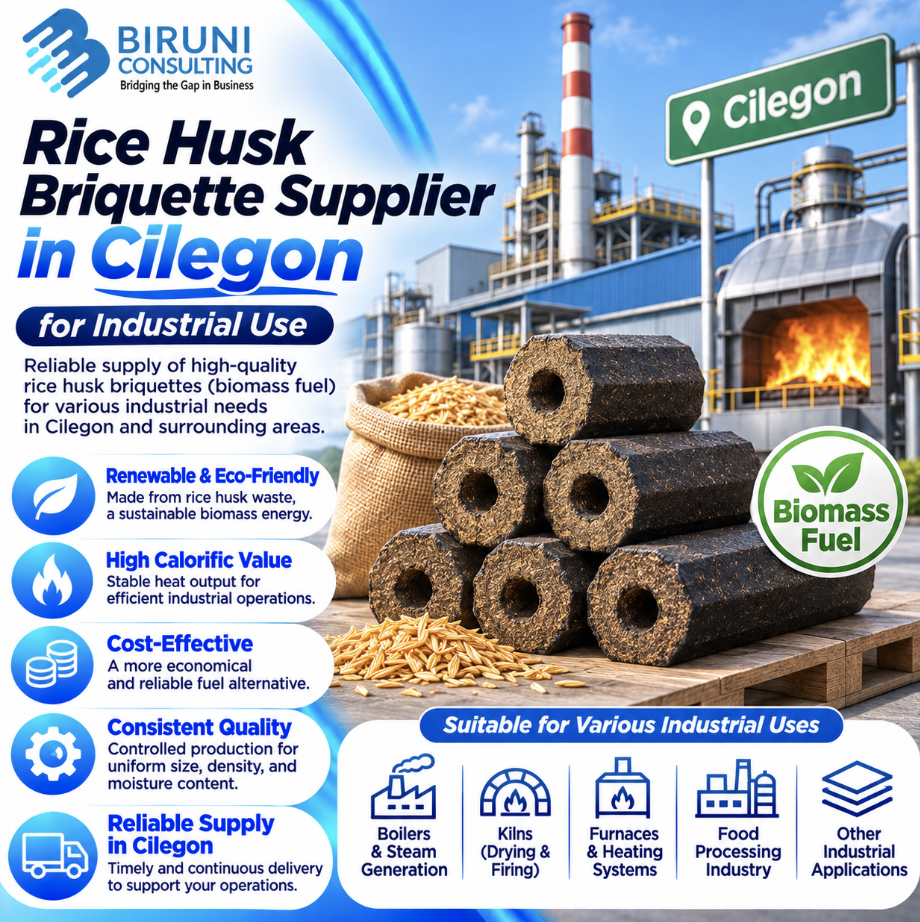
Rice Husk Briquettes for Industrial Applications in Cilegon
Cilegon has a strong manufacturing base within Banten Province. BPS-Statistics Indonesia reported that Cilegon’s manufacturing sector grew by 7.09% in 2025, while manufacturing GRDP at constant prices reached approximately IDR 57.9 trillion. These figures demonstrate the importance of manufacturing activity and the corresponding need for industrial energy and process heat. BPS Cilegon
For factories operating steam boilers, dryers, furnaces, and process-heating systems, a rice husk briquette supplier in Cilegon for industrial use can provide one potential source of solid biomass fuel.
Cilegon itself is not a major rice-production center. BPS recorded only about 8,413 metric tons of paddy production in Cilegon in 2025, compared with approximately 1.77 million tons across Banten Province. Pandeglang produced about 552,983 tons and Serang Regency approximately 419,792 tons. This makes regional sourcing more practical than depending exclusively on rice husk produced within Cilegon. BPS Banten
What Are Rice Husk Briquettes?
Rice husk briquettes are densified solid biomass fuels produced from husks generated during rice milling.
Indonesia’s agricultural post-harvest research agency explains that densification improves the physical characteristics and energy per unit volume of rice biomass. Briquettes are also easier to store and transport and can be used as an industrial energy source. pascapanen.brmp.pertanian.go.id
Compared with loose rice husk, briquettes provide a more compact and relatively consistent physical form.
For industrial users, this can improve transportation, warehousing, unloading, inventory management, and fuel feeding.
Rice Husk Briquettes as Non-Woody Biomass
Rice husk originates from cereal crops and is categorized as non-woody biomass.
ISO 17225-7:2021 establishes fuel-quality classes and specifications for graded non-woody briquettes. Its scope includes herbaceous biomass, including cereal crops and their production or processing by-products. As of November 2026, the standard remains published and is undergoing systematic review. ISO
Thermally treated biomass briquettes such as torrefied briquettes are excluded from the scope of ISO 17225-7.
Buyers should therefore distinguish conventional non-carbonized rice husk briquettes from carbonized or other thermally treated products.
Why Cilegon Is Relevant for Industrial Biomass Supply
Cilegon has substantial industrial demand.
The manufacturing sector grew by 7.09% in 2025, reinforcing the importance of industrial activity within the local economy. BPS Cilegon
Cilegon also has logistics infrastructure through Banten Port in Ciwandan. Pelindo identifies Banten Port as being located directly in Ciwandan, Cilegon. pelindo.co.id
Biomass suppliers can therefore serve industrial customers through trucking from rice-producing areas in Banten, West Java, or other regions where delivered economics remain competitive.
Regional Rice Husk Supply Potential
Banten Province produced approximately 1,774,017 metric tons of paddy in 2025, with Pandeglang, Lebak, Serang, and Tangerang representing the largest producing areas. BPS Banten
Indonesia’s Ministry of Agriculture notes that rice husk can generally account for around 20–30% of initial paddy weight during milling, although actual yields depend on milling conditions and technology. Pustaka BPPSDMP
Not all of this husk is commercially available for briquetting because rice husk has other uses.
Nevertheless, the regional production base gives suppliers an opportunity to develop multi-source rice-mill networks rather than depending on feedstock from Cilegon itself.
Industrial Applications
Rice husk briquettes may be considered for compatible combustion equipment used for steam or process heat.
Applications can include steam boilers, biomass boilers, industrial dryers, food processing, agricultural processing, and selected furnaces or biomass burners.
Not every boiler can use rice husk briquettes without adjustment.
Engineering teams should review fuel-feeding equipment, grate design, combustion chambers, air distribution, and ash-removal systems before committing to large volumes.
Carbonized vs. Non-Carbonized Briquettes
Suppliers may offer different product types.
Non-Carbonized Rice Husk Briquettes
Rice husk is dried and densified without prior carbonization.
The original biomass characteristics remain more prominent.
Carbonized Rice Husk Briquettes
The material undergoes carbonization, changing characteristics such as fixed carbon, volatile matter, ignition, and combustion behavior.
The two products should not be compared solely on price per kilogram.
Product type should be clearly identified in quotations and specifications.
Industrial Rice Husk Briquette Specifications
Technical requirements should ideally be established before price negotiations.
| Parameter | Information to Confirm |
|---|---|
| Raw Material | Rice husk / actual composition |
| Product Type | Carbonized / non-carbonized |
| Calorific Value | GCV/HHV and/or NCV/LHV |
| Moisture | Maximum percentage |
| Ash | Maximum percentage |
| Proximate Analysis | Volatile matter and fixed carbon |
| Dimensions | Diameter, length and shape |
| Physical Quality | Density, strength and fines |
| Packaging | Bags, big bags or jumbo bags |
| Available Capacity | MT per month |
Recurring supply agreements can also specify tolerances and agreed testing procedures for shipment acceptance.
Calorific Value
Calorific value indicates the amount of energy available from the fuel.
Industrial buyers should distinguish between:
Gross Calorific Value / Higher Heating Value (GCV/HHV)
and:
Net Calorific Value / Lower Heating Value (NCV/LHV).
The reporting basis also matters.
Dry-basis and as-received figures should not be compared directly without considering moisture.
Suppliers should therefore provide representative laboratory reports or Certificates of Analysis.
Moisture Content
Moisture directly affects useful boiler energy.
Part of the heat released during combustion is consumed in heating and evaporating water contained in the fuel.
High or inconsistent moisture can increase fuel consumption and create variation between shipments.
Recurring contracts can establish a maximum moisture requirement, supported by proper drying and covered storage.
Ash Content
Ash is particularly important when evaluating rice-husk-based fuel.
Rice husk has different mineral characteristics from woody biomass.
Ash can influence cleaning frequency, residue handling, grate condition, maintenance, and total operating cost.
Industrial buyers should therefore evaluate:
calorific value + ash + actual boiler performance
together.
Additional ash testing may be useful where the boiler has specific deposit or ash-melting concerns.
Dimensions, Density and Fines
Physical quality affects handling throughout the supply chain.
Briquettes may pass through:
production → loading → trucking → unloading → warehousing → boiler feeding.
Weak products can generate excessive fragments and fines.
Inconsistent dimensions can also cause difficulties with automatic feeders.
Physical samples should therefore be inspected after representative transportation whenever possible.
Certificate of Analysis
Industrial buyers may request a Certificate of Analysis or CoA.
Relevant information can include calorific value, reporting basis, moisture, ash, volatile matter, fixed carbon, and any additional boiler-specific parameters.
The certificate should also identify the sample or production batch and provide a relevant testing date.
Historical laboratory results may not accurately represent current commercial shipments.
Suppliers Do Not Need to Manufacture in Cilegon
Cilegon itself produces considerably less paddy than surrounding agricultural areas. In 2025, Cilegon produced approximately 8,413 tons, compared with about 419,792 tons in Serang Regency and 552,983 tons in Pandeglang. BPS Banten
A briquetting plant may therefore operate closer to rice-milling sources and transport finished products to Cilegon.
Industrial buyers should focus more on:
quality + delivered pricing + available capacity + lead time + delivery reliability
than supplier address alone.
Rice Husk Briquette Prices in Cilegon
There is no single price applicable to every industrial requirement.
Pricing can vary according to product specifications, calorific value, moisture, ash, monthly quantity, packaging, production location, and delivery distance.
A simple request asking:
“What is your price per kilogram?”
does not provide enough information for an accurate industrial quotation.
A more useful RFQ could state:
Rice husk briquettes – 200 MT/month – delivered Cilegon – target GCV/NCV – maximum moisture – maximum ash – required packaging.
Ex-Factory vs. Delivered Cilegon
An ex-factory price represents the product price before transportation from the supplier’s facility.
A delivered Cilegon price includes transportation to the buyer’s agreed location.
For industrial procurement, delivered pricing generally provides a more practical comparison.
Buyers should confirm whether packaging, loading, trucking, toll charges, and unloading are included where applicable.
Price per Kilogram Is Not Enough
Consider an illustrative comparison:
Supplier A
Delivered price: IDR 3,000/kg
Consumption: 190 kg/ton of steam
Fuel cost:
IDR 570,000/ton of steam
Supplier B
Delivered price: IDR 3,350/kg
Consumption: 165 kg/ton of steam
Fuel cost:
IDR 552,750/ton of steam
In this example, Supplier B has a higher purchase price but a lower fuel cost per ton of steam.
Actual performance should always be established through boiler testing.
Total Cost of Use
Industrial buyers can evaluate a broader cost structure:
Fuel Price + Transportation + Storage + Actual Consumption + Ash Handling + Cleaning + Maintenance + Downtime
This provides a more meaningful Total Cost of Use.
A low-priced fuel can become more expensive if it requires higher consumption or increases cleaning and maintenance.
These differences become particularly important at monthly consumption levels of hundreds of metric tons.
Boiler Trials
A boiler trial should normally precede a large recurring contract.
Buyers can begin with physical samples and laboratory testing before conducting a larger operational trial.
Important indicators include fuel-to-steam ratio, steam production, combustion stability, feeding performance, ash generation, and cleaning requirements.
Testing under representative operating conditions provides a better indication of real fuel economics.
Calculating Monthly Demand
Suppose a factory consumes:
8 MT/day
for:
25 operating days/month.
Basic fuel requirements would be:
200 MT/month.
Safety stock can increase the total purchasing requirement.
Monthly consumption should be communicated during quotation so suppliers can confirm available capacity.
Production Capacity vs. Available Capacity
A supplier’s machine capacity does not necessarily equal available supply.
For example:
Production capacity: 400 MT/month
Existing commitments:
250 MT/month
Available capacity:
150 MT/month
That supplier cannot independently support a new customer requiring 200 MT/month.
Buyers should therefore ask for available monthly capacity for new contracts.
Feedstock Security
Reliable briquette production requires reliable rice-husk sourcing.
Banten produced approximately 1.77 million tons of paddy in 2025, with major volumes coming from Pandeglang, Lebak, Serang, and Tangerang. BPS Banten
Suppliers can reduce feedstock risk through relationships with multiple rice mills, raw-material inventory, and backup sourcing.
For long-term contracts, this sourcing capability can be as important as briquetting-machine capacity.
Deliveries to Cilegon
Delivery schedules should reflect fuel consumption and warehouse capacity.
Cilegon has logistics infrastructure that includes Banten Port in Ciwandan, directly within the municipality. pelindo.co.id
A 200 MT/month requirement does not necessarily need to arrive at once.
Scheduled weekly or multi-drop deliveries can reduce warehouse requirements while maintaining suitable inventory.
Packaging and Handling
Rice husk briquettes can be supplied in standard bags, big bags, jumbo bags, or other agreed formats.
The best solution depends on receiving and unloading equipment.
Factories equipped with forklifts may benefit from larger packaging where the fuel-handling arrangement supports it.
Packaging decisions should consider moisture protection, unloading efficiency, warehouse space, and final delivered cost.
Safety Stock
If daily consumption is:
8 MT
and the factory maintains four days of buffer stock, basic safety stock would be:
32 MT.
The actual requirement depends on supplier lead time, warehouse capacity, transport reliability, and the importance of the boiler to production.
Critical operations may also justify maintaining an approved backup supplier.
Primary and Backup Suppliers
Depending entirely on one supplier increases supply-chain risk.
Machine failures, raw-material shortages, transportation problems, or off-specification production can interrupt deliveries.
Industrial users may therefore maintain a primary supplier and a technically approved backup source.
Backup fuel should ideally be tested before an emergency occurs.
Shipment-to-Shipment Consistency
Industrial buyers require repeatable quality.
A successful initial sample does not guarantee that later shipments will have identical moisture, ash, or calorific value.
Recurring specifications can establish:
minimum calorific value + maximum moisture + maximum ash + dimensional tolerance + agreed testing method.
Consistent performance over time is generally more valuable than exceptional results from a single batch.
Manufacturer, Trader or Aggregator?
Suppliers may operate as manufacturers, traders, or aggregators.
Manufacturers directly control production, traders provide sourcing flexibility, while aggregators may combine output from several facilities to meet larger volume requirements.
No model is automatically superior.
Industrial buyers should prioritize traceability, specification consistency, available capacity, quality control, and delivery reliability.
Comparing Suppliers
A simple procurement matrix can help compare alternatives.
| Parameter | Supplier A | Supplier B | Supplier C |
|---|---|---|---|
| Product Type | Data | Data | Data |
| GCV/NCV | CoA | CoA | CoA |
| Moisture | CoA | CoA | CoA |
| Ash | CoA | CoA | CoA |
| Delivered Cilegon | Quote | Quote | Quote |
| Available Capacity | Data | Data | Data |
| Boiler Trial | Result | Result | Result |
Technically unsuitable suppliers can be removed before detailed price negotiations.
Commercial comparison can then focus only on products capable of meeting boiler requirements.
Information to Include in an RFQ
Industrial buyers should provide the briquette type, boiler application, required calorific value, moisture, ash, dimensions, trial quantity, monthly volume, Cilegon delivery location, packaging, and CoA requirements.
Providing these details allows suppliers to evaluate technical suitability, production capacity, and logistics before preparing a final quotation.
How to Select a Rice Husk Briquette Supplier in Cilegon
1. Technical Screening
Review product specifications, raw material, CoA, dimensions, and physical quality.
2. Capacity Verification
Confirm available monthly capacity and feedstock security.
3. Sample and Boiler Trial
Test the fuel under representative operating conditions.
4. Commercial Evaluation
Compare delivered prices with actual fuel cost per ton of steam.
5. Supply Performance
Evaluate several shipments before making a larger long-term commitment.
This approach reduces the risk of selecting a low-priced fuel that performs poorly in actual operations.
Monthly Supply Contracts
After successful trials, the parties can establish a recurring supply agreement.
The contract can define monthly quantities, technical specifications, delivered pricing, delivery schedules, payment terms, testing procedures, and processes for off-specification products.
Quantity tolerances may also be appropriate for higher-volume contracts.
New suppliers should ideally demonstrate reliable performance across several deliveries before becoming the sole fuel source.
Are Rice Husk Briquettes Suitable for Industries in Cilegon?
Rice husk briquettes can be considered as an alternative biomass fuel for Cilegon industries where product specifications match the combustion system.
Cilegon has a strong manufacturing base, with manufacturing growth of 7.09% in 2025. At the same time, Banten produced approximately 1.77 million tons of paddy, with major agricultural production occurring in nearby regencies such as Pandeglang and Serang. BPS Cilegon
This combination creates an interesting regional biomass supply opportunity.
Industrial purchasing decisions should nevertheless consider calorific value, moisture, ash, physical quality, delivered cost, boiler performance, available capacity, and long-term supply reliability.
The strongest supplier is not necessarily the closest or cheapest, but the one capable of consistently delivering the required fuel quality and volume.
Contact Us
Biruni Consulting can assist companies that require information and support regarding product requirements, documentation, and compliance processes related to product importation, marketing, or use according to business requirements in Indonesia.
The services that can be supported include:
- Consultation on product requirements for industrial needs.
- Initial assessment of product specifications and applications.
- Technical document review.
- Review of product specifications and information.
- Consultation on applicable regulatory requirements according to the product type and business activities.
- Assistance in preparing required documents.
- Consultation on certification or licensing processes when required based on the product characteristics and intended use.
Contact Biruni Consulting for information regarding product requirements, documentation, certification, and compliance needs to support business activities and product marketing in Indonesia.