
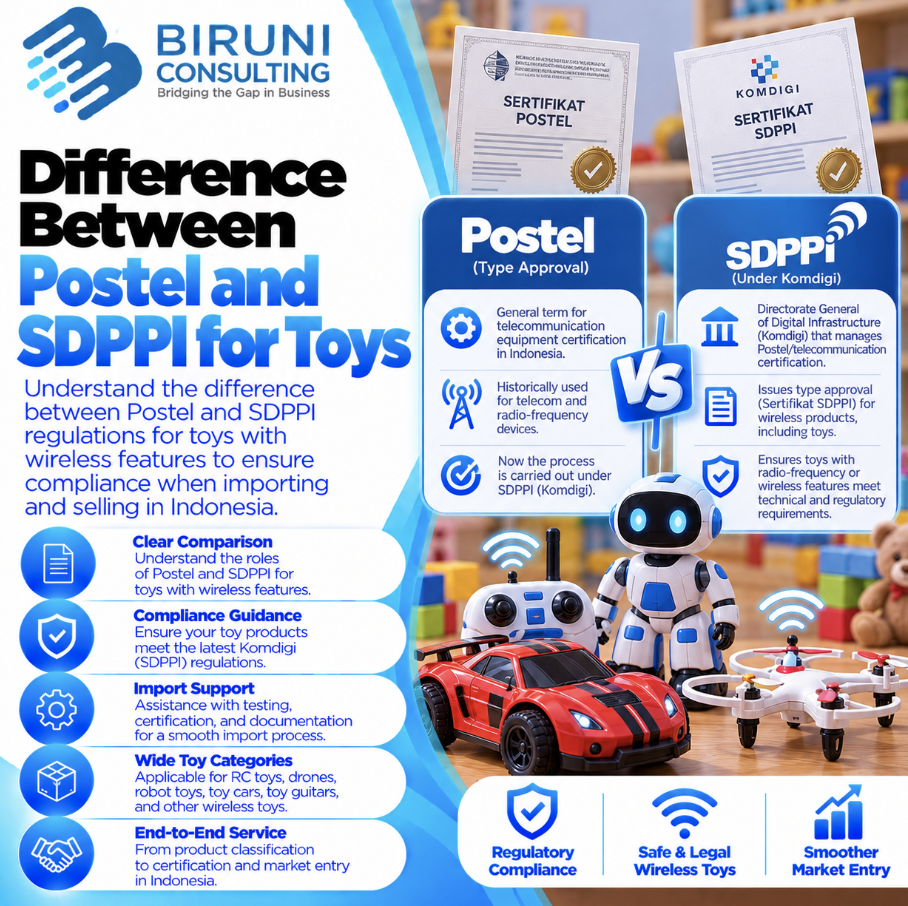
Technical review services for RF test reports and laboratory reports before DJID/SDPPI Certification in Indonesia
A test report or Laporan Hasil Uji (LHU) is one of the principal documents used in Indonesia’s telecommunications-device certification process. However, having a CE, FCC, ETSI, Bluetooth, WiFi, cellular, or other overseas RF report does not automatically mean that the report can be submitted directly for Indonesian certification.
The report should be assessed against the exact product, brand and model, wireless technologies, operating frequencies, transmission power, antennas, test standards, laboratory status, and applicable Indonesian Technical Standards.
Regulation Number 3 of 2024 identifies the test report and technical specifications among the supporting documents for a Certificate application and requires applicants to submit correct information and valid documentation. JDIH Komdigi
Why Review a Test Report Before Certification?
A wireless product can have several laboratory reports.
A multi-radio device may have separate reports for Bluetooth, WiFi, cellular, NFC, proprietary RF, EMC, and electrical safety.
Not every report necessarily supports the same Indonesian certification requirement.
A technical review helps determine which reports are relevant, whether the test coverage is sufficient, and whether the tested configuration actually represents the product that will be certified.
Product Identity Review
The first step is to compare the equipment identified in the laboratory report with the final commercial product.
Brand, model/type, manufacturer, hardware information, firmware information where relevant, and the Equipment Under Test should be checked.
OEM and private-label projects frequently use a laboratory report containing the manufacturer’s internal model while the final commercial product uses another brand or model.
This relationship should be assessed before submission.
Wireless Technology Review
Every wireless interface incorporated into the final product should be identified.
A device may contain only Bluetooth, while another may combine Bluetooth, WiFi, NFC, proprietary RF, and cellular functions.
The available laboratory reports should provide appropriate evidence for each radio function that falls within the certification scope.
A Bluetooth report should not automatically be treated as evidence for an additional WiFi or cellular radio.
Frequency and Operating Mode Review
The frequencies tested in the report should correspond to the final product specification.
This becomes particularly important where manufacturers produce different regional variants.
A product sold under the same commercial family may support different WiFi bands, cellular bands, radio channels, or firmware configurations depending on the target country.
The report should therefore be compared with the exact version that will enter the Indonesian market.
Transmission Power Review
Transmission power should be reviewed against the product datasheet, module information, and final firmware configuration.
The review should also determine what measurement basis is being reported, such as conducted output power or another radiated-power parameter.
Significant inconsistencies between the laboratory report and manufacturer specifications should be clarified before the Certificate application is submitted.
Test Standard Review
A key part of the service is assessing whether the standards and methods referenced in the report can support the applicable Indonesian Technical Standards.
Designated laboratories are required to perform testing according to the Indonesian Technical Standards and within their designated testing scope. Postel
A report carrying a CE, FCC, EN, ETSI, or IEC reference is therefore not automatically sufficient on that basis alone.
Its test parameters, methods, frequency coverage, and limits need to be mapped against the Indonesian requirements.
CE and FCC Reports
CE and FCC reports can provide valuable technical evidence.
However, they belong to other regulatory frameworks and do not automatically substitute for Indonesian DJID/SDPPI Certification.
A review can determine whether existing test results provide suitable technical coverage and whether any additional parameters or testing may be required.
Laboratory Recognition Review
The technical content of the report is only part of the assessment.
The status of the laboratory that issued the report also matters.
DJID’s current e-Sertifikasi requirements state that a test report must be issued by a designated Indonesian laboratory or an overseas laboratory recognised by the ministry responsible for communication and digital affairs. e-Sertifikasi NextGen
DJID also maintains laboratory information showing designated laboratories and their testing scopes. e-Sertifikasi NextGen
A laboratory name alone is therefore not sufficient; its applicable recognition and scope should also be checked.
Overseas Laboratories and the 2026 Transition
This issue is particularly important for certification projects being prepared at the end of 2026.
Regulation Number 5 of 2024 provides that overseas-laboratory designation through the non-MRA mechanism remains valid until December 31, 2026. JDIH Komdigi
DJID has also stated that from January 1, 2027, acceptance of overseas laboratory reports is intended to move to laboratories recognised through the Mutual Recognition Agreement mechanism. Postel
For overseas reports, certification timing and laboratory recognition should therefore be reviewed together.
Laboratory Scope
A recognised laboratory may have a defined testing scope.
Recognition should not automatically be interpreted as covering every technology or test standard.
Regulation Number 5 of 2024 requires laboratories to conduct tests according to the applicable Technical Standards and their designated scope. Postel
A report review should therefore establish the chain between the laboratory, its scope, the test standard, the product technology, and the Indonesian Technical Standard.
LHU Summary for Overseas RF Reports
DJID’s current e-Sertifikasi requirements contain an additional requirement for applicants submitting an RF LHU issued by an overseas laboratory.
A summary of the LHU must be provided and declared to be correct and consistent. e-Sertifikasi NextGen
Reviewing the report before submission can help identify the relevant report pages and parameters that should be reflected in this summary.
Reports Owned by Another Party
In OEM and private-label projects, the applicant may not own the original test report.
The report may belong to the manufacturer, module supplier, trademark owner, or another company.
Regulation Number 3 of 2024 requires an applicant using a test report owned by another party to provide the report owner’s approval for use of that test report. JDIH Komdigi
Report ownership should therefore be checked early in the certification project.
Module Test Report Review
Many wireless products incorporate Bluetooth, WiFi, cellular, or proprietary RF modules with existing laboratory reports.
Module reports can support certification, but the relationship with the final equipment must be documented.
Current e-Sertifikasi requirements for products relying on a module LHU include a block diagram, a photograph showing the installed module location, and a declaration identifying the module brand/type and the final equipment brand, type, and variant. e-Sertifikasi NextGen
The review should therefore compare the module report with the final product integration.
Antenna Comparison
A wireless module can be installed with different antenna configurations.
The antenna used for laboratory testing should therefore be compared with the final product.
Relevant information may be contained in the module datasheet, RF report, antenna specification, internal photographs, block diagram, or operational description.
Where the antenna configuration differs, the impact on the certification evidence should be assessed.
Firmware and RF Settings
Two products using the same chipset may not necessarily have the same RF configuration.
Firmware can control supported channels, bandwidths, transmission power, and enabled operating modes.
A report review should therefore establish whether the tested configuration remains representative of the commercial product.
OEM and Private-Label Reports
OEM projects frequently involve different model numbers between the test report and the final commercial product.
For example:
Tested model: OEM-X100
Commercial model: ABC-100
In this situation, the relationship between the tested device and the final product needs to be assessed.
Model mapping, PCB configuration, modules, antennas, firmware, manufacturer declarations, and product specifications may all become relevant.
Test Reports for HKT Devices
Regulation Number 3 of 2024 contains a specific rule for cellular phones, handheld computers, and tablet computers.
For these categories, the test report used in a Certificate application must have been issued no more than five years before the Certificate application date. JDIH Komdigi
The report date is therefore an important review point for HKT certification projects.
Test Report Gap Analysis
A useful report review should identify more than a simple pass-or-fail conclusion.
Potential gaps can include model mismatches, missing frequency bands, untested operating modes, laboratory-scope issues, outdated reports for applicable categories, incomplete module documentation, antenna differences, or missing supporting documents.
The result should help determine whether the report can be used as submitted, requires additional documentation or clarification, or needs supplementary testing.
Reducing Unnecessary Retesting
Reviewing available test reports before sending a new sample for testing can help define the actual testing requirement.
Where existing technical evidence is appropriate and meets the applicable requirements, it may support the certification approach.
Where significant gaps exist, they can be identified before the official application begins.
This allows the importer or manufacturer to plan testing and certification more efficiently.
Documents for Test Report Review
For an initial assessment, it is useful to prepare:
- Complete RF test report or LHU.
- Product datasheet.
- User manual.
- Product and label photographs.
- Exact brand and model/type.
- Wireless-module datasheets.
- Antenna information where available.
- Block diagram.
- Manufacturer and country-of-manufacture information.
- List of wireless technologies and supported frequencies.
Where several reports are available, all relevant wireless reports should ideally be reviewed together.
What the Review Should Establish
Following the assessment, the business should be able to understand whether the report:
- matches the exact product;
- was issued by a relevant laboratory;
- covers the required wireless technologies;
- can be mapped to the applicable Indonesian Technical Standards;
- requires an LHU summary;
- requires authorisation from the report owner;
- can support a module-report route; or
- contains gaps requiring additional testing.
This information can then be used to define the DJID/SDPPI certification strategy.
Our Postel Test Report Review Process
The process begins by identifying the exact product and all enabled wireless interfaces.
The laboratory, report number, tested model, test standards, operating frequencies, transmission power, antennas, operating modes, wireless modules, and supporting documentation are then reviewed.
The available evidence is compared against the applicable Indonesian Technical Standards.
Where gaps are found, the required clarification, documentation, or additional testing can be identified before the formal Certificate application is submitted.
Conclusion
Postel test report review services help businesses determine whether their LHU, RF reports, CE/FCC reports, or wireless-module reports can support DJID/SDPPI Certification in Indonesia.
Regulation Number 3 of 2024 identifies laboratory test reports as a principal certification document, while current e-Sertifikasi requirements require the report to originate from an eligible designated or recognised laboratory. JDIH Komdigi
The review should examine the exact product model, wireless technologies, operating frequencies, transmission power, antennas, standards, laboratory recognition, module integration, report ownership, and supporting documentation.
For overseas laboratory reports, timing is also particularly important because the current non-MRA designation mechanism under Regulation Number 5 of 2024 runs through December 31, 2026. JDIH Komdigi
A pre-submission review can identify technical gaps early and establish whether existing reports can be used, need additional documentation, or require supplementary testing.
Contact Us
Biruni Consulting assists with DJID/SDPPI assessment and certification for Postel test report reviews and various wireless products that will be imported or marketed in Indonesia.
Our services include:
- Assessment of DJID/SDPPI certification requirements.
- Transmitter and receiver assessment.
- RF specification review.
- Frequency and transmission power analysis.
- Technical document review.
- Certification document preparation.
- Testing coordination where required.
- DJID/SDPPI Certification assistance.
If you have a wireless-product test report, you can prepare product photos, brand, model, datasheet, RF specifications, and wireless module datasheet for an initial assessment of the Postel Certification requirements.