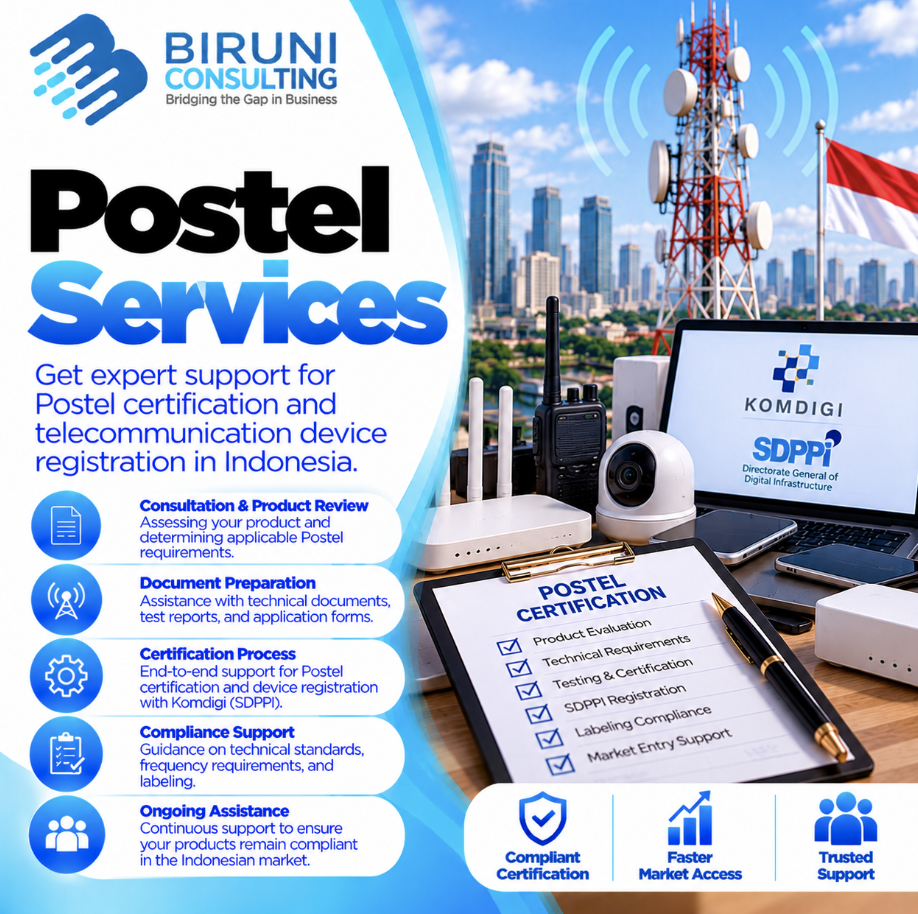
DJID/SDPPI certification services for telecommunications equipment and wireless products in Indonesia.
Postel Certification services assist businesses with technical assessment, documentation, RF specification review, testing coordination, and the DJID/SDPPI Certification process for equipment that will be imported, manufactured, or marketed in Indonesia.
Products may incorporate Bluetooth, WiFi, cellular, proprietary RF, Short Range Device technologies, remote controls, IoT connectivity, or other telecommunications functions. Because every product has a different radio configuration, certification requirements should be determined from the exact model, operating frequencies, transmission power, wireless modules, antennas, and enabled telecommunications functions.
Indonesia’s principal certification framework remains Minister of Communication and Informatics Regulation Number 3 of 2024 on Certification of Telecommunications Equipment and/or Devices. The regulation remains in force and repealed Regulation Number 16 of 2018. It defines a Certificate as a document confirming that an equipment type complies with the applicable Technical Standards. JDIH Kemkomdigi
Postel and DJID/SDPPI Certification
The term Postel Certification remains widely used by importers, manufacturers, distributors, and businesses when referring to Indonesian telecommunications-device certification.
Under the current regulatory process, business applicants submit Certificate applications through OSS integrated with the Directorate General’s certification service facility. JDIH Kemkomdigi
In practice, Postel Certification services can therefore cover the complete DJID/SDPPI process from initial technical assessment through certification assistance.
Products Requiring Postel Assessment
Postel requirements should not be determined solely from the product name or HS Code.
A product that appears to be ordinary electronic equipment may contain an active wireless module. Conversely, two products with the same commercial description may have different radio configurations.
Products commonly assessed include routers, modems, access points, smart devices, IoT equipment, Bluetooth products, WiFi products, remote-control devices, wireless toys, cellular GPS trackers, wireless keyboards and mice, vehicle keyless systems, and many other radio-equipped products.
The assessment should focus on the actual telecommunications functionality.
Wireless Technology Assessment
The first step should be to identify every active wireless interface in the exact product.
One device may contain only Bluetooth, while another may incorporate Bluetooth, WiFi, cellular, NFC, and proprietary RF simultaneously.
Each radio should be mapped according to its operating frequency, transmission power, module, antenna, firmware, and applicable Technical Standard.
This becomes particularly important for multi-radio products because different telecommunications functions can be subject to different technical references.
Bluetooth and Short Range Devices
Bluetooth is widely used in speakers, wearable devices, smart-home products, toys, computer peripherals, vehicles, electronic healthcare products, and IoT equipment.
DJID’s current official regulatory list continues to include Minister of Communication and Informatics Decision Number 260 of 2024 on Short Range Device Technical Standards. The Decision includes Bluetooth IEEE 802.15.1 operating in the 2400–2483.5 MHz range. Postel
However, identifying the product as “Bluetooth” is not sufficient. Bluetooth version, output power, modules, antennas, and the final implementation should still be reviewed.
WiFi and RLAN
Products containing WiFi need to be assessed against the relevant Radio Local Area Network requirements.
DJID’s current Technical Standard reference database lists Minister of Communication and Digital Decision Number 12 of 2025 on class-licensed spectrum and RLAN Technical Standards as currently applicable. Postel Certification
A WiFi assessment should therefore consider frequency bands, operating modes, transmission power, antennas, supported channels, and the final radio configuration.
Where both WiFi and Bluetooth are incorporated, both functions need to be reviewed.
Cellular and Other Telecommunications Equipment
Postel Certification services also cover products incorporating cellular modules or mobile-network functions.
DJID’s current Technical Standard list includes Decision Number 45 of 2025 for GSM/IMT-2000 and Decision Number 569 of 2025 for LTE and IMT-2020 technologies. Postel Certification
Cellular assessment may involve supported bands, technology modes, laboratory reports, modules, antennas, and additional wireless interfaces such as Bluetooth and WiFi.
Because Technical Standards may be updated, the exact model should be checked against the standards in force at the time of application.
Class-Licensed Spectrum and Equipment Certification
Use of class-licensed spectrum does not automatically mean that equipment is exempt from Postel Certification.
Indonesia’s class-license framework under Regulation Number 2 of 2023 was amended by Minister of Communication and Digital Regulation Number 2 of 2025, which remains in force. JDIH Kemkomdigi
Class licensing concerns spectrum use, while equipment certification concerns conformity with applicable Technical Standards.
These two regulatory issues should therefore be assessed separately.
Postel Certification Documents
For an initial assessment, businesses should prepare sufficient information to identify the exact commercial product.
Useful documents generally include:
- Product photographs.
- Brand and model information.
- Product datasheet and user manual.
- RF, Bluetooth, WiFi, or cellular module datasheets.
- Operating frequencies and transmission power.
- RF test reports, where available.
- Antenna, manufacturer, and country-of-manufacture information.
DJID’s current requirements for a new Certificate application include NIB and OSS access for business applicants, a test report, technical specifications, Declaration of Conformity, colour photographs showing the brand and model/type, and a declaration that the submitted information and documents are correct and complete. Postel Certification
Laboratory Test Reports
The test report is a key part of the certification process.
Regulation Number 3 of 2024 identifies the test report and technical-specification documentation among the principal supporting documents for a Certificate application. JDIH Kemkomdigi
DJID’s current e-Sertifikasi requirements state that the report should be issued by a designated domestic laboratory or a recognised overseas laboratory under the applicable framework. Postel Certification
CE, FCC, or other overseas laboratory reports should therefore not automatically be assumed to be acceptable. The laboratory status, test standard, exact model, radio configuration, and report contents should be reviewed.
Using Module Test Reports
Many products incorporate Bluetooth, WiFi, cellular, or proprietary RF modules that already have laboratory documentation.
A module report may support certification, but the final equipment still needs to be linked clearly to the module that was tested.
DJID’s current requirements for equipment using a module test report include a block diagram, a photograph showing the installed module location, and a declaration identifying the module brand/type and the final equipment in which it is installed. Postel Certification
A module test report should therefore not automatically be treated as sufficient for every final product using that module.
Who Can Apply?
Regulation Number 3 of 2024 sets out several categories of Certificate applicants.
Business applicants can include an Indonesian registered trademark holder, an appointed representative or distributor of the trademark holder, manufacturers or assemblers, and businesses using equipment for their own purposes. JDIH Kemkomdigi
DJID’s current e-Sertifikasi requirements also specify additional documentation according to applicant status. An Indonesian company appointed by a foreign trademark owner as an official representative or distributor, for example, may need to provide an appointment letter. Postel Certification
The appropriate applicant structure should therefore be determined before submission.
Multiple Models and Variants
Suppliers often offer several models that have different external designs while sharing similar radio hardware.
This technical similarity should be reviewed before determining the certification approach.
Models should not be grouped solely because they share the same enclosure family, product category, or HS Code. The assessment should compare modules, operating frequencies, transmission power, antennas, wireless functions, brand, model/type, firmware, and other relevant technical characteristics.
Early assessment can help determine whether separate applications are required or whether an applicable regulatory mechanism allows certain variants to be covered together.
Our Postel Certification Process
The process normally begins with a technical assessment of the exact product and manufacturer documentation.
Applicable Technical Standards are identified, available laboratory reports are reviewed, modules and antennas are checked, and any additional testing requirements are determined.
Once the technical and administrative documentation is ready, the application can be prepared through OSS and e-Sertifikasi according to the applicant category. Regulation Number 3 of 2024 provides that business applications are submitted through OSS integrated with the Directorate General’s certification service facility. JDIH Kemkomdigi
Early technical review helps reduce discrepancies between product specifications, laboratory reports, and actual equipment.
Certificate Period
Under Regulation Number 3 of 2024, the Certificate itself is not time-limited.
However, the Certificate holder may manufacture, assemble, or import the relevant equipment for trade and/or use in Indonesia for a maximum of three years from the Certificate issuance date. JDIH Kemkomdigi
Where these commercial activities continue beyond the applicable period, the requirements for renewed Technical Standard compliance and a new Certificate need to be considered.
This is particularly relevant to importers and distributors making repeated shipments of the same product.
Label, QR Code, and Warning Sign
Certification is followed by regulatory-marking obligations.
The annex to Regulation Number 3 of 2024 provides formats for the Certificate number and PLG ID, QR Code, and Warning Sign. JDIH Kemkomdigi
DJID’s current certification information also requires Certificate holders to implement the prescribed marking and report its implementation within 30 working days after Certificate issuance by uploading photographs of the marked equipment. Postel Certification
Label design and placement should therefore ideally be considered before mass production or shipment.
Why Pre-Import Assessment Matters
Products with almost identical external designs may contain different radio configurations.
Manufacturers may use different modules, chipsets, antennas, firmware, or output-power settings for different destination markets or production batches.
Assessment before a major purchase order helps confirm the exact product, frequencies, transmission power, modules, antennas, available test reports, applicable Technical Standards, and applicant structure.
This reduces the risk that goods have already been shipped before inconsistencies in the technical documentation are discovered.
Conclusion
Postel Certification services help businesses manage DJID/SDPPI Certification for telecommunications equipment and wireless products intended for importation, manufacturing, or marketing in Indonesia.
The process should begin with assessment of the exact model, wireless technologies, operating frequencies, transmission power, modules, antennas, RF test reports, and applicable Technical Standards.
Regulation Number 3 of 2024 remains the principal certification framework, while technology-specific Technical Standards are determined according to the functions incorporated into the product. DJID’s current reference database includes standards for SRD, RLAN, cellular technologies, and many other equipment categories. JDIH Kemkomdigi
A technical assessment before importation can help determine the certification route, testing requirements, suitability of existing reports, model grouping, applicant documentation, and labeling obligations more accurately.
Contact Us
Biruni Consulting assists with DJID/SDPPI assessment and certification for telecommunications equipment and various wireless products that will be imported or marketed in Indonesia.
Our services include:
- Assessment of DJID/SDPPI certification requirements.
- Transmitter and receiver assessment.
- RF specification review.
- Frequency and transmission power analysis.
- Technical document review.
- Certification document preparation.
- Testing coordination where required.
- DJID/SDPPI Certification assistance.
If you have telecommunications equipment or a wireless product, you can prepare product photos, brand, model, datasheet, RF specifications, and wireless module datasheet for an initial assessment of the Postel Certification requirements.