
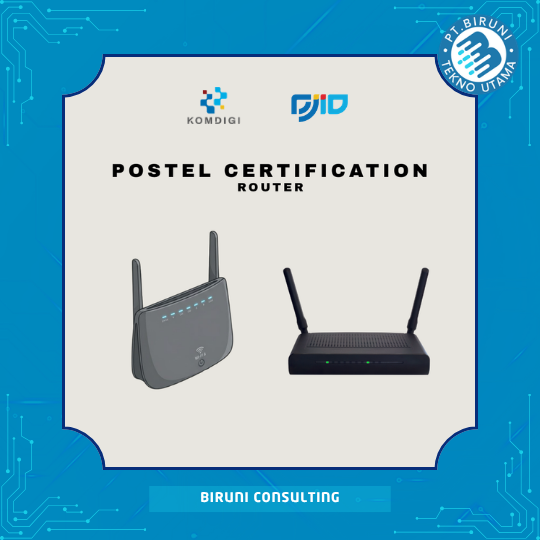
Postel Certification for Router and DJID Compliance in Indonesia
A router is a networking device designed to connect multiple devices to the internet or local area networks (LAN). Routers are widely used in homes, offices, schools, data centers, industrial facilities, and commercial environments to manage network traffic and provide stable connectivity.
As networking technology continues to evolve, routers now offer advanced features such as WiFi connectivity, dual-band operation, mesh networking, VPN support, firewall protection, parental controls, and support for WiFi 6 and WiFi 7 technologies. Modern routers enable multiple devices to connect simultaneously while maintaining high-speed and secure network access.
Because routers utilize wireless communication technologies such as WiFi to transmit and receive data, they are classified as telecommunication devices that must comply with Postel or DJID certification requirements before being legally imported, distributed, and marketed in Indonesia.
What Is a Router in Regulatory Context
Under Indonesian telecommunications regulations, a router is a networking device responsible for directing, forwarding, and managing data traffic between different networks. Routers may provide connectivity through wired or wireless communication technologies.
Most modern routers include WiFi modules operating on frequency bands such as 2.4 GHz, 5 GHz, and other designated wireless frequencies. Since routers utilize radio frequency technology to transmit data wirelessly, they fall within the scope of DJID technical compliance requirements.
Every router intended for the Indonesian market must undergo technical evaluation and certification to ensure compliance with applicable radio frequency standards.
Is Postel Certification Required
Postel certification is mandatory for routers because they utilize wireless communication technology and telecommunication network functions.
Common features found in routers include:
- WiFi connectivity
- Dual-band communication
- Wireless LAN (WLAN)
- Mesh networking
- Ethernet routing
- VPN support
- Internet gateway functionality
- Network management features
Because routers transmit and receive radio signals through WiFi technology, certification is required before legal market distribution in Indonesia.
Regulations in Indonesia for Telecommunication Devices
Telecommunication device regulations in Indonesia are administered by the Directorate General of Digital Infrastructure (DJID) under the Ministry of Communication and Digital Affairs, formerly known as SDPPI or Postel.
Any device utilizing radio frequency spectrum such as WiFi, Bluetooth, NFC, or other wireless technologies must comply with applicable technical requirements. These regulations are designed to ensure proper spectrum management, prevent harmful interference, and maintain communication quality and safety.
DJID certification serves as proof that the router complies with Indonesian technical standards before entering the market.
Certification Requirements
Companies are generally required to prepare several important documents, including:
- Business legality documents such as NIB and OSS
- Product technical specifications
- User manual
- WiFi module datasheet
- Product labeling information
- Product photographs
- Laboratory test reports
- Additional supporting documents as required
These documents are reviewed during the technical and administrative evaluation process.
Certification Process Overview
The certification process begins with product identification to determine the applicable testing scope. Technical and administrative documentation is then reviewed as part of the initial assessment.
Laboratory testing is conducted on the wireless communication modules integrated into the router. Testing may include radio frequency (RF), electromagnetic compatibility (EMC), transmit power, receiver performance, occupied bandwidth, WiFi performance, and other technical parameters depending on the product characteristics.
Once all requirements have been fulfilled and the product successfully passes evaluation, the DJID certificate is issued as official authorization for legal distribution in Indonesia.
Common Challenges in Certification Process
Common challenges include frequency allocation mismatches with Indonesian regulations, incomplete technical documentation, regulatory updates, and WiFi modules that do not fully comply with local requirements.
Additionally, routers supporting multiple communication technologies often require broader testing scopes, making the evaluation process more complex.
Understanding regulatory requirements from the beginning can help companies accelerate certification and reduce compliance risks.
Contact Us
Biruni Consulting provides professional services for Postel/DJID certification of routers and various networking devices.
We assist companies with:
- Telecommunication regulatory analysis
- Device classification under DJID requirements
- Technical and administrative document preparation
- Coordination of accredited laboratory testing
- End-to-end certification assistance until approval is issued
With experience in telecommunication and electronic product regulations, we help companies complete certification requirements efficiently and in accordance with applicable regulations.
Contact us for Postel certification consultation so your router products can be legally marketed in Indonesia