
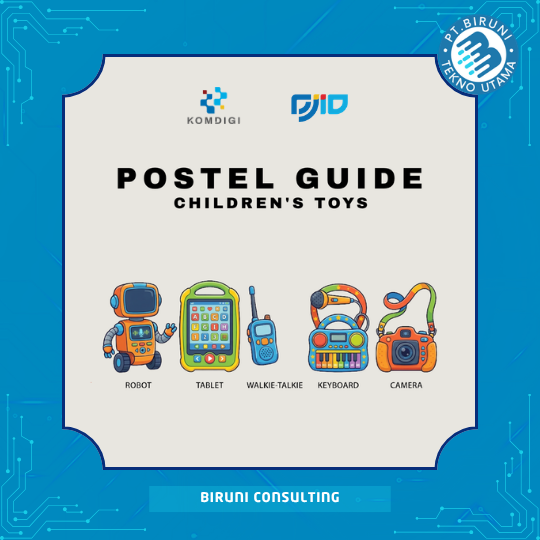
Guide to Postel/DJID requirements for children’s toys using Bluetooth, WiFi, remote control, and wireless technology in Indonesia
Children’s toys are increasingly equipped with electronic and wireless communication technology. In the past, toys mainly used batteries to produce sounds, lights, or movements, while many products today already have Bluetooth, WiFi, remote control, radio frequency, or other wireless features.
Examples can be found in remote-control cars, children’s robots, smart toys, interactive educational toys, toys connected to smartphones, wireless controllers, and toys that use Bluetooth to communicate with other devices.
When a toy uses radio communication functions or certain telecommunications features, the Postel/DJID aspects need to be assessed before the product is imported, manufactured, assembled, or marketed in Indonesia.
The main basis for telecommunications device certification is Minister of Communication and Informatics Regulation Number 3 of 2024 concerning Certification of Telecommunications Equipment and/or Telecommunications Devices. The regulation stipulates that devices complying with Technical Standards are evidenced by a Certificate.
Therefore, the term “children’s toy” alone cannot determine whether a product requires Postel Certification. The determination must be based on the features and technical specifications used in the product.
Are Children’s Toys Required to Have Postel Certification?
Not all children’s toys are required to have a Postel/DJID Certificate.
Toys that only have mechanical or internal electronic functions and do not use radio communication need to be distinguished from toys that have wireless transmitters or receivers.
For example, a toy car that only uses a battery to operate its motor is different from a remote-control car that receives commands from a remote through radio frequency.
When a toy has Bluetooth, WiFi, radio control, wireless controller, or other radio communication technology, an assessment is required to determine whether the device falls within the certification scope.
Minister of Communication and Informatics Regulation Number 3 of 2024 regulates the certification of telecommunications equipment and/or telecommunications devices based on compliance with Technical Standards. Such compliance considers the device type, brand, and country of manufacture.
Therefore, the Postel Certification obligation for children’s toys cannot be determined solely based on the product category, but must be assessed based on the communication technology used.
Children’s Toys with Bluetooth
Bluetooth is one of the most widely used wireless technologies in modern children’s toys.
Toys may use Bluetooth to connect with smartphones, tablets, applications, speakers, controllers, or other devices. Examples include educational robots, smart toys, interactive toys, and various gaming devices controlled through applications.
Under Minister of Communication and Informatics Regulation Number 2 of 2023 concerning the Use of Radio Frequency Spectrum Based on Class License, Bluetooth IEEE 802.15.1 is included in the Short Range Device (SRD) group.
Although Bluetooth uses relatively low transmission power and operates over short distances, the use of this technology still needs to be assessed to determine the applicable Postel requirements.
Children’s Toys with WiFi
In addition to Bluetooth, some children’s toys also use WiFi as a communication medium. These toys may connect to the internet, smartphone applications, servers, or other devices within a network.
Examples include smart toys, educational robots, toy cameras, interactive toys, and gaming devices that can be controlled through applications.
WiFi generally uses IEEE 802.11 technology. Under Minister of Communication and Informatics Regulation Number 2 of 2023, IEEE 802.11 or WLAN is included in the RLAN group.
Therefore, when a toy has WiFi, its wireless specifications need to be examined, including frequency, bandwidth, transmit power, channel, antenna, and module used.
Remote-Control Toys
Remote-control toys are one of the product examples that most commonly use radio technology.
Products such as:
- Remote-control cars.
- Remote-control boats.
- Toy aircraft.
- Toy helicopters.
- Remote-control robots.
- Toy construction vehicles.
- Other toy vehicles.
may use a radio transmitter in the remote controller to send commands to the toy unit.
In a Postel assessment, not only the toy unit needs to be examined. The remote controller also needs to be examined because it may function as a radio transmitter.
The technical information that needs to be examined includes frequency, transmission power, bandwidth, modulation, number of channels, antenna, RF module, and transmitter and receiver characteristics.
Children’s Toys with Low Power
Some children’s toys use wireless technology with relatively low transmission power. Such products are often referred to as low-power devices.
Minister of Communication and Informatics Regulation Number 2 of 2023 includes several devices in the SRD group, including devices with transmission power below 10 mW. Bluetooth IEEE 802.15.1, NFC, RFID, UWB, LR-WPAN IEEE 802.15.4, and several other devices are also included in the SRD group according to the applicable provisions.
However, transmission power below 10 mW does not automatically mean that the toy is exempt from Postel Certification.
Transmission power is only one technical parameter. The assessment still needs to consider frequency, technology, device function, bandwidth, antenna, and applicable Technical Standards.
Examples of Children’s Toys That Need Postel Assessment
Examples of toys that should undergo an initial assessment include:
- Remote-control cars.
- Bluetooth robots.
- WiFi robots.
- Smart toys.
- Educational toys connected to smartphones.
- Toys with Bluetooth speakers.
- Toys controlled through applications.
- Remote-control aircraft or helicopters.
- Wireless controllers.
- Toys with RF transmitters.
- Toys with NFC or RFID.
- Toys with other wireless devices.
Assessment is necessary because two products with the same name and function may have different requirements when they use different wireless technologies.
Documents Required for Postel Assessment of Children’s Toys
To conduct an assessment, product owners should prepare sufficient technical information so that the wireless characteristics can be examined from the beginning.
The documents generally required include:
- Product photos.
- Packaging photos.
- Product label photos.
- Brand.
- Type or model.
- Country of manufacture.
- Product datasheet.
- User manual.
- Bluetooth/WiFi/RF module datasheet.
- Operating frequency.
- Transmit power.
- Bandwidth.
- Antenna specifications.
- Chipset or RF module information.
- Block diagram, if available.
- Test report, if available.
- Remote controller specifications if the product uses a remote control.
These documents help determine whether the product is a device that requires certification and how the certification process needs to be carried out.
Is a Bluetooth or WiFi Module Certificate Sufficient?
Not necessarily.
For some products, manufacturers use Bluetooth modules or WiFi modules that already have certificates or test documents from other countries. However, this does not automatically mean that the final product is exempt from certification requirements in Indonesia.
Certification under Minister of Communication and Informatics Regulation Number 3 of 2024 concerns the conformity of telecommunications equipment and/or telecommunications devices with applicable Technical Standards. Such compliance relates to devices that will be manufactured, assembled, or imported for trade and/or use in Indonesia.
Therefore, the integration of the module into the toy needs to be examined. Aspects such as antenna, transmission power, RF configuration, firmware, enclosure, and module implementation in the final product may form part of the assessment.
Can Several Toy Variants Use One Certificate?
This may depend on the characteristics of each product.
Minister of Communication and Informatics Regulation Number 3 of 2024 provides specific provisions for certain equipment and/or devices having a telecommunications feature with transmission power below 10 mW and only one identical telecommunications feature. Under certain conditions, one Certificate may apply to more than one variant if the requirements specified in the regulation are fulfilled.
However, this does not mean that all toy variants with transmission power below 10 mW can automatically be combined under one Certificate.
Each variant still needs to be examined based on its brand, type, telecommunications features, module, and technical characteristics.
Postel Certification Process for Children’s Toys
The Postel Certification process should ideally begin with an assessment so that the product owner understands the requirements that must be fulfilled before submitting an application.
In general, the process includes:
- Identify the brand, type, model, and country of origin.
- Identify the wireless technology used.
- Examine the frequency.
- Examine the transmit power.
- Examine the bandwidth and modulation.
- Examine the antenna.
- Identify the Technical Standards.
- Prepare technical documents.
- Conduct testing when required.
- Submit the DJID/SDPPI Certification application.
- Certificate issuance.
- Fulfill labeling requirements.
Minister of Communication and Informatics Regulation Number 3 of 2024 stipulates that compliance with Technical Standards is carried out through testing, and devices that comply with the Technical Standards are evidenced by a Certificate.
Postel Certificate Validity Period for Children’s Toys
Under Minister of Communication and Informatics Regulation Number 3 of 2024, the Certificate has no time limit. However, there is a provision that the Certificate holder may manufacture, assemble, or import telecommunications equipment and/or telecommunications devices for trade and/or use in Indonesia for a maximum of three years from the date the Certificate is issued.
This provision is important for importers and brand owners that repeatedly or continuously import toys.
Postel Label on Children’s Toys
Toys that have obtained a Certificate also need to comply with labeling requirements.
Minister of Communication and Informatics Regulation Number 3 of 2024 stipulates that device labels include the Certificate number, PLG ID, QR Code, and warning sign according to the applicable provisions.
For small-sized toys, label placement needs to be considered so that the information remains readable and complies with the applicable requirements.
Postel Certification Costs for Children’s Toys
Postel/DJID Certification costs need to be assessed based on the process required by the product.
Certificate issuance is subject to PNBP according to the applicable provisions. In addition, when a product requires testing, testing costs may apply depending on the type of device, Technical Standards, testing parameters, laboratory, and product characteristics.
Therefore, costs should not be determined solely based on the product name “children’s toy”. A technical assessment is required first to determine the type of certification and testing needed.
Importance of Postel Assessment Before Importing Children’s Toys
Pre-import assessment is an important step for importers and brand owners of children’s toys.
By conducting an assessment from the beginning, product owners can determine:
- Whether the toy requires Postel Certification.
- The wireless technology used.
- The device frequency and transmission power.
- The applicable Technical Standards.
- Testing requirements.
- Documents that must be prepared.
- Requirements related to the wireless module.
- The possibility of combining several variants if the requirements are fulfilled.
An assessment can also help reduce the risk of the product already being in the import process while the certification requirements have not yet been fulfilled.
Conclusion
The Postel guide for children’s toys should essentially begin with an examination of the technology used in the product. Toys that do not use radio communication cannot be treated in the same way as toys using Bluetooth, WiFi, remote control, RF transmitters, or other wireless technologies.
Bluetooth is included in the SRD group under Minister of Communication and Informatics Regulation Number 2 of 2023, while other wireless devices need to be assessed based on frequency, transmission power, technology, and applicable technical requirements.
Therefore, children’s toys with wireless features should undergo a Postel/DJID assessment before being imported or marketed in Indonesia. The assessment can help determine certification requirements, testing needs, technical documents, and labeling requirements that must be fulfilled.
Contact Us
Biruni Consulting assists with DJID/SDPPI assessment and certification for Bluetooth toys and various wireless products that will be imported or marketed in Indonesia.
Our services include:
- DJID/SDPPI certification requirement assessment.
- Bluetooth module assessment.
- RF specification review.
- Frequency and transmission power analysis.
- Technical document review.
- Certification document preparation.
- Testing coordination where required.
- DJID/SDPPI Certification assistance.
If you have a Bluetooth toy, you can prepare the product photographs, brand, model, datasheet, and Bluetooth module datasheet for an initial assessment of the Postel Certification requirements