
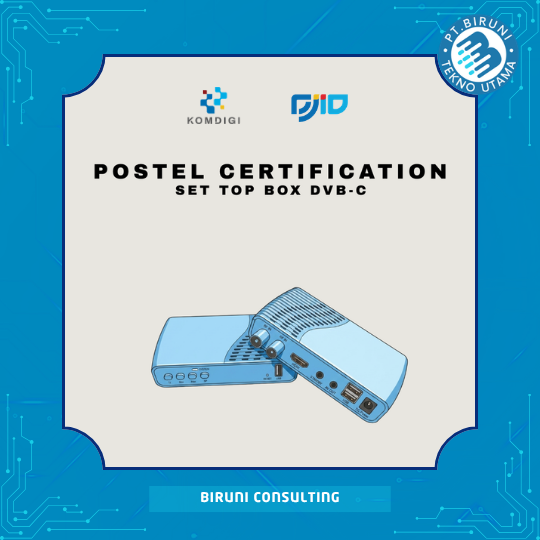
Guide to Postel Certification for DVB-C Set Top Boxes in Indonesia
A DVB-C Set Top Box is a digital television receiver that uses the Digital Video Broadcasting – Cable (DVB-C) standard. The device is designed to receive digital television signals distributed through cable networks and process those signals so they can be displayed on a television or other display device.
DVB-C Set Top Boxes are commonly used in cable television systems to receive digital television channels provided by operators. They generally include an RF or coaxial input for receiving signals from the cable network and outputs such as HDMI, AV, or other interfaces for connecting the device to a television.
In addition to television reception, some DVB-C Set Top Boxes may incorporate additional features such as Electronic Program Guide (EPG), Conditional Access System (CAS), USB, Ethernet, WiFi, Bluetooth, and other interactive functions.
Because the device may incorporate signal reception and processing functions as well as additional communication technologies, DVB-C Set Top Boxes intended to be imported, marketed, or distributed in Indonesia need to be assessed for DJID (formerly Postel/SDPPI) Certification based on their specifications and functions.
What Is a DVB-C Set Top Box?
A DVB-C Set Top Box is a device used to receive digital television broadcasts through a cable network using the DVB-C standard. DVB-C is a digital television transmission standard designed for distributing digital content through cable networks.
The device receives signals from the cable network through an RF or coaxial connector. The signal is then processed by the tuner and decoder system inside the Set Top Box before being delivered to the television through the available output interfaces.
DVB-C Set Top Boxes can be used in cable television systems that provide digital broadcasting services. Certain models may also support conditional access systems, allowing only authorized subscribers to access specific channels.
Does a DVB-C Set Top Box Require DJID (Postel) Certification?
The need for DJID (Postel) Certification for a DVB-C Set Top Box needs to be determined based on the device’s functions, configuration, and technical characteristics.
Devices that receive signals through cable networks need to be assessed based on applicable technical requirements. If the Set Top Box also includes communication functions such as Ethernet, WiFi, Bluetooth, or other wireless technologies, these modules also need to be assessed when determining certification requirements.
Therefore, certification requirements cannot be determined solely from the product name “DVB-C Set Top Box.” The tuner specifications, frequency range, RF characteristics, input and output interfaces, and communication modules incorporated into the device need to be assessed first.
DVB-C Set Top Box Postel Certification Requirements
For DVB-C Set Top Boxes that fall within the certification scope, companies generally need to prepare administrative and technical documentation.
The required documents may include:
- Company legal documents.
- Business Identification Number (NIB).
- Technical product specifications.
- Datasheet.
- User Manual.
- Product photographs.
- Product label and marking photographs.
- Block diagram.
- DVB-C tuner specifications.
- Operating frequency range.
- RF input and output specifications.
- Bandwidth information.
- WiFi or Bluetooth module specifications, where applicable.
- Test reports where required.
- Additional supporting documents according to applicable DJID requirements.
Technical documentation needs to clearly describe the device configuration because a single Set Top Box model may incorporate several communication functions.
DVB-C Set Top Box Postel Certification Process
The certification process begins by identifying the DVB-C Set Top Box model and functions. The assessment covers the DVB-C technology, tuner system, frequency range, RF characteristics, and additional communication features.
Administrative and technical documentation is then reviewed to determine the applicable certification requirements. Where testing is required, the device may undergo testing at a laboratory that meets the applicable technical requirements.
Testing may include RF parameters, Electromagnetic Compatibility (EMC), operating frequency, bandwidth, input and output characteristics, and other parameters relevant to the device and communication technologies used.
Once the documentation and test results meet the applicable requirements, the certification process can proceed until the certificate is issued by the relevant authority.
Benefits of DVB-C Set Top Box Postel Certification
Meeting certification requirements provides benefits for manufacturers, importers, distributors, cable television operators, and brand owners.
Key benefits include:
- Supporting compliance with Indonesian telecommunications regulations.
- Supporting product importation.
- Ensuring the device meets applicable technical requirements.
- Reducing potential issues during product commercialization.
- Increasing operator and distributor confidence.
- Supporting legal product distribution in Indonesia.
Certification also helps ensure that equipment used in cable television systems meets applicable technical requirements.
Types of DVB-C Set Top Boxes That Require Certification Assessment
Examples of products that may require certification assessment include:
- DVB-C Set Top Boxes.
- Digital Cable TV Set Top Boxes.
- DVB-C Cable Receivers.
- DVB-C Decoders.
- HD DVB-C Set Top Boxes.
- DVB-C Set Top Boxes with CAS.
- DVB-C Set Top Boxes with Ethernet.
- DVB-C Set Top Boxes with WiFi.
- DVB-C Set Top Boxes with Bluetooth.
- Interactive DVB-C Set Top Boxes.
Certification requirements may vary depending on communication technologies, frequency range, RF configuration, transmission capabilities, and additional features incorporated into each product.
Contact Us
Biruni Consulting provides professional services to assist with DJID (Postel) Certification for various telecommunications and cable television devices, including DVB-C Set Top Boxes.
We assist with:
- DJID (Postel) certification requirement analysis.
- Device classification identification.
- DVB-C and RF specification assessment.
- Assessment of WiFi, Bluetooth, and other communication modules.
- Preparation of administrative and technical documentation.
- Coordination of laboratory testing where required.
- Certification assistance until the certificate is issued.
Contact Biruni Consulting for consultation regarding Postel DVB-C Set Top Box Certification, including DVB-C receivers, cable decoders, and DVB-C Set Top Boxes with additional communication functions.