
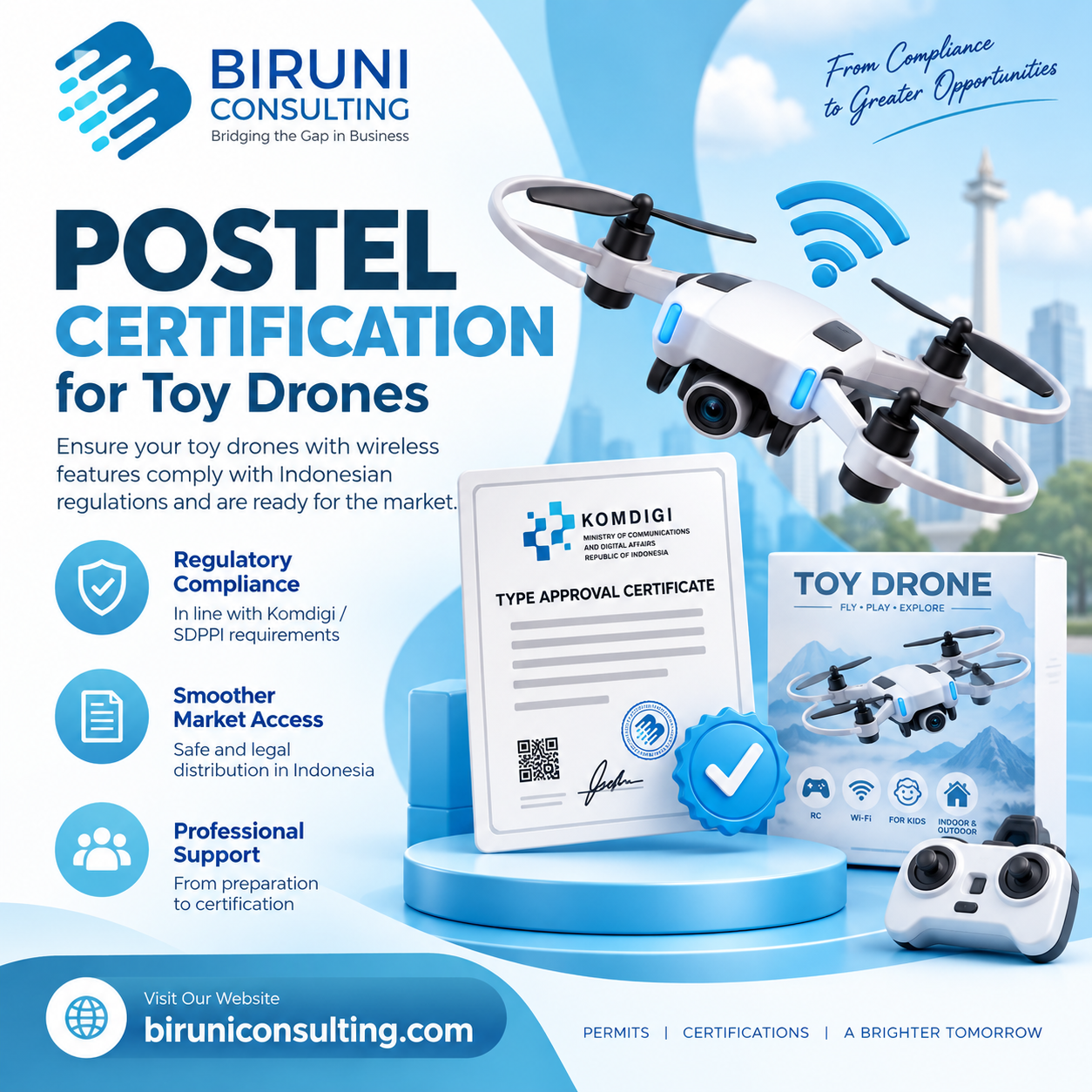
Guide Postel/DJID Certification for toy drones based in Indonesia.
Toy drones are devices that can be controlled wirelessly using a remote controller. These products generally use a transmitter and receiver to send flight commands from the remote controller to the drone unit.
Although they are used as toys, drones still need to be assessed from the telecommunications regulatory perspective when they use radio transmission. The assessment is required to determine whether the wireless system is subject to technical standards and requires a Certificate for Telecommunications Equipment and/or Telecommunications Devices.
The current certification requirements refer to Minister of Communication and Informatics Regulation Number 3 of 2024 concerning Certification of Telecommunications Equipment and/or Telecommunications Devices. The regulation revoked Minister of Communication and Informatics Regulation Number 16 of 2018.
Are Toy Drones Required to Have Postel Certification?
The requirement for Postel Certification cannot be determined solely based on the product being called a “toy drone.” The wireless specifications used by the product need to be assessed.
Several aspects need to be reviewed, including:
- Operating frequency.
- Transmission power or transmit power.
- Wireless technology.
- Type of transmitter and receiver.
- RF module used.
- Antenna.
- Bluetooth or WiFi, if available.
- Other technical specifications.
Therefore, toy drones with similar designs and functions may have different certification requirements if they use different wireless systems.
Wireless System in Toy Drones
The wireless system in a toy drone generally consists of a remote controller as the transmitter and the drone unit as the receiver. The remote controller sends commands such as ascending, descending, moving forward, moving backward, turning, or changing speed through radio signals.
For drones with cameras, the wireless system may also be used to transmit images or video to the remote controller or smartphone. This can make the product’s wireless specifications more complex and require a more detailed assessment.
Therefore, the assessment should not only cover the drone unit but also the remote controller and wireless modules used.
Toy Drone Frequency
Frequency is one of the main aspects in determining wireless device requirements.
Toy drones may use certain radio frequencies to communicate between the remote controller and drone. Other products may use Bluetooth, WiFi, or a combination of wireless technologies.
The use of radio frequency spectrum based on class license is regulated under Minister of Communication and Informatics Regulation Number 2 of 2023, which was subsequently amended by Minister of Communication and Digital Regulation Number 2 of 2025. The amendment includes changes to definitions and Annexes I and II concerning spectrum and telecommunications equipment/device groups.
Therefore, the frequency used by a toy drone needs to be assessed according to the regulations applicable at the time of assessment.
Transmission Power of Toy Drones
In addition to frequency, transmission power is an important part of the assessment.
Low-power toy drones do not automatically mean that they are exempt from certification requirements. Frequency, technology, transmission power, transmitter configuration, and device characteristics still need to be reviewed as a whole.
Minister of Communication and Informatics Regulation Number 3 of 2024 provides specific conditions for devices with telecommunications features using transmission power below 10 mW and only one identical telecommunications feature. Under certain conditions, one certificate may apply to more than one variant when the specified requirements are fulfilled.
Therefore, transmit power information should be available from the beginning of the assessment.
Toy Drones with Remote Control
The remote controller is an important part of the toy drone assessment because it functions as the transmitter that sends commands to the drone.
The remote controller information that may need to be reviewed includes:
- Brand and model.
- Operating frequency.
- Transmit power.
- RF module.
- Antenna.
- Number of channels.
- Datasheet.
- Other technical information.
If the remote controller uses a different RF system from other modules in the drone, each configuration needs to be reviewed to ensure compliance of the overall product.
Toy Drones with Bluetooth
Some toy drones may use Bluetooth to connect with smartphones or other control devices.
If Bluetooth is used, the Bluetooth module needs to be assessed based on its technical specifications. The required information may include module type, frequency, transmit power, Bluetooth version, antenna, and datasheet.
A Bluetooth module that already has certification does not automatically mean that the final product is exempt from assessment. The use of the module in the drone still needs to be reviewed based on the product configuration and applicable requirements.
Toy Drones with WiFi
Toy drones equipped with cameras or video transmission functions may use WiFi to communicate between the drone and remote controller or smartphone.
For such products, the assessment needs to consider frequency band, transmit power, bandwidth, WiFi module type, antenna, and the wireless functions used.
WiFi is a technology that needs to be assessed under the applicable radio frequency spectrum requirements. Therefore, the actual module specifications and product configuration are important in determining the certification requirements.
Does the Drone Camera Affect the Assessment?
The camera itself does not automatically determine Postel Certification. However, the communication system used to transmit camera output can affect the assessment.
For example, if a drone camera sends video wirelessly to a remote controller or smartphone, that wireless system needs to be assessed based on its frequency, transmission power, technology, and RF specifications.
Therefore, a toy drone using only a simple remote control system may have different assessment requirements from a toy drone equipped with a camera and video transmission.
Documents Required for Toy Drone Postel Assessment
For an initial assessment, the following documents should be prepared:
- Drone photos.
- Remote controller photos.
- Photos of the internal module or components, if available.
- Product brand.
- Product model or type.
- Drone datasheet.
- Remote controller datasheet.
- RF module datasheet.
- Frequency specifications.
- Transmit power specifications.
- Antenna information.
- Product manual, if available.
- Country of origin or manufacturing country.
The more complete the technical information, the easier it is to identify the wireless technology and applicable certification requirements.
Is a Certified RF Module Sufficient?
Not necessarily.
If a toy drone uses an RF module that already has certification, the certificate can serve as supporting documentation for the assessment. However, the final product still needs to be reviewed.
The assessment needs to consider how the module is installed, the antenna used, RF configuration, transmit power, and how the module is used in the final product.
Therefore, module certification cannot automatically be considered certification for the entire toy drone.
Can Several Toy Drone Models Use One Certificate?
The possibility of using one certificate for several models or variants needs to be reviewed based on the certification requirements and similarity of technical characteristics.
Minister of Communication and Informatics Regulation Number 3 of 2024 provides specific provisions regarding the use of one certificate for more than one variant, including certain conditions for devices with transmission power below 10 mW and one identical telecommunications feature when the specified requirements are fulfilled.
Therefore, several toy drones cannot automatically be considered eligible for one certificate simply because they have similar designs or functions. Brand, type, module, frequency, transmission power, and wireless configuration still need to be assessed.
Toy Drone Postel Certification Process
In general, the process can begin with a technical assessment of the drone and remote controller.
The stages may include:
- Collecting product information and documents.
- Reviewing RF specifications.
- Identifying the frequency.
- Reviewing transmit power.
- Reviewing the transmitter and receiver.
- Reviewing Bluetooth or WiFi modules, if used.
- Reviewing the antenna and wireless configuration.
- Determining the applicable technical standards.
- Testing if required.
- Preparing and submitting certification documents.
- Processing the issuance of the certificate.
Minister of Communication and Informatics Regulation Number 3 of 2024 provides for compliance with technical standards through testing, with testing conducted by testing laboratories designated according to the applicable requirements.
Validity of Toy Drone Postel Certification
Certificates for telecommunications equipment and/or devices need to be distinguished from the period during which the device may continue to be manufactured, assembled, imported, or used for trade or use purposes.
Therefore, companies need to pay attention to the applicable provisions after the certificate has been issued, particularly when drones will continue to be imported or marketed over the long term.
Postel Label on Toy Drones
Toy drones that have obtained certification also need to comply with applicable labeling requirements.
The certification label relates to information such as the certificate number, PLG ID, QR Code, and warning sign according to the applicable requirements.
The label placement needs to be considered so that the information remains readable and can be used to identify the device.
Toy Drone Postel Certification Costs
The cost of Postel Certification for toy drones cannot be determined solely based on the product type.
The cost may be affected by wireless technology, number of types or variants, testing requirements, technical documents, laboratory requirements, and the certification process required.
Therefore, a cost estimate should be provided after the drone and remote controller specifications have been reviewed.
Importance of Assessment Before Importing Toy Drones
Assessment before importation is important so that companies can determine the product requirements before the drone enters Indonesia.
Toy drones may have different configurations. Products that are all called toy drones may use different frequencies, transmission power, RF modules, Bluetooth, WiFi, or video transmission systems.
Through an initial assessment, companies can determine:
- Whether the drone requires DJID/SDPPI Certification.
- The wireless technology used.
- Frequency and transmission power.
- Testing requirements.
- Documents that need to be prepared.
- Labeling requirements.
- The possibility of using one certificate for several variants.
- The estimated certification process.
An assessment before importation can help reduce regulatory risks when the product is brought into and marketed in Indonesia.
Difference Between Postel Certification and Toy Certification
Postel Certification and toy certification requirements are two different regulatory aspects.
Postel/DJID Certification concerns telecommunications aspects and devices with certain communication or transmission functions. Meanwhile, toy certification requirements concern the regulations applicable to toy products.
Toy drones may have regulatory obligations under both aspects because the product is a toy while also using wireless technology.
Therefore, companies need to conduct a comprehensive assessment before importing and marketing the product.
Conclusion
Postel Certification for toy drones needs to be assessed based on the wireless technology used, rather than simply based on the product category as a toy.
Frequency, transmission power, transmitter, receiver, RF module, Bluetooth, WiFi, camera, and video transmission are several aspects that may affect the assessment.
The current certification requirements refer to Minister of Communication and Informatics Regulation Number 3 of 2024, while the use of radio frequency spectrum based on class license needs to be assessed according to the applicable regulations, including the amendment through Minister of Communication and Digital Regulation Number 2 of 2025.
By conducting an assessment before importation, companies can determine the certification, document, testing, and labeling requirements that need to be fulfilled for toy drones marketed in Indonesia.
Contact Us
Biruni Consulting assists with DJID/SDPPI assessment and certification for toy drones and various wireless products that will be imported or marketed in Indonesia.
Our services include:
- DJID/SDPPI certification requirement assessment.
- Toy drone transmitter and receiver assessment.
- RF specification review.
- Frequency and transmission power analysis.
- Technical document and datasheet review.
- Certification document preparation.
- Testing coordination where required.
- DJID/SDPPI Certification assistance.
If you have a toy drone, you can prepare product photos, brand, model, datasheet, RF specifications, remote controller, and wireless module datasheet for an initial assessment of the Postel Certification requirements.