
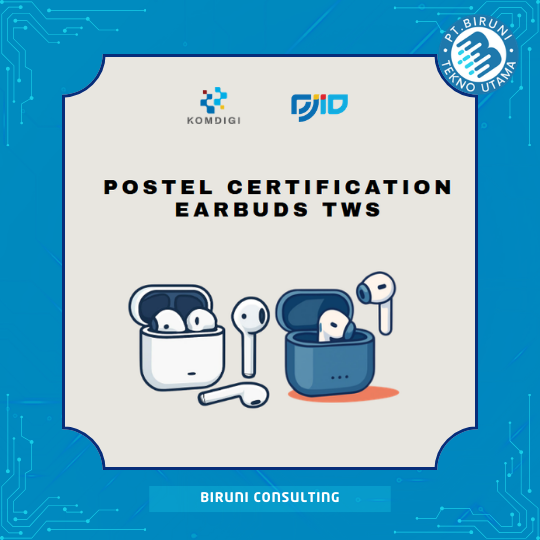
Understanding TWS Earbuds and Their Legal Classification
True Wireless Stereo (TWS) earbuds are wireless audio devices that connect independently to smartphones, tablets, laptops, and other compatible electronics using Bluetooth technology. Unlike conventional wired earphones or standard Bluetooth headsets, TWS devices operate without any physical cable between the left and right units and typically include a smart charging case.
Despite their compact size and consumer-oriented design, TWS earbuds are legally classified as telecommunications equipment in Indonesia because they incorporate active radio transmission modules operating within the 2.4 GHz ISM frequency band.
Since they use radio frequency spectrum, all TWS earbuds intended for importation, manufacturing, assembly, or commercial distribution in Indonesia must obtain mandatory Postel certification prior to market circulation.
This requirement is regulated under:
-
Law No. 36 of 1999 on Telecommunications
-
Government Regulation No. 46 of 2021
-
Ministerial Regulation No. 3 of 2024 concerning Certification of Telecommunication Equipment and/or Devices
Without an official certificate issued by the Directorate General of SDPPI, the product cannot be legally distributed within Indonesia.
Technical Compliance Requirements for TWS Earbuds
Although TWS earbuds operate at relatively low transmission power, they still emit radio frequency signals that must comply with national spectrum regulations to prevent interference.
Certification testing evaluates:
-
Operation within the authorized 2.4 GHz ISM band
-
Maximum transmission power compliance
-
Spurious emission limits
-
Frequency stability and occupied bandwidth
-
Conformity with Indonesian technical radio standards
Modern TWS devices may also include advanced features such as Active Noise Cancellation (ANC), Environmental Noise Cancellation (ENC), multipoint connectivity, and high-resolution audio codec support. These features do not exempt the device from regulatory testing requirements.
Certification Process in Indonesia
The certification process is conducted through the OSS RBA system and includes both technical and administrative evaluation.
The general procedure includes:
-
Technical identification and module classification
-
Radio Frequency testing at accredited laboratories
-
Preparation of technical documentation
-
Official submission through OSS
-
Regulatory evaluation by the Directorate General of SDPPI
-
Issuance of an official Postel certificate upon approval
Required documentation typically includes product datasheets, user manuals, block diagrams, internal and external photographs, RF test reports, and legal company documents.
Even if the Bluetooth module holds international approvals such as CE or FCC, compliance with Indonesian regulations remains mandatory.
Risks of Non-Compliance
Non-certified TWS earbuds may be detained by customs authorities, prohibited from marketplace distribution, subject to administrative sanctions, or confiscated. Businesses distributing uncertified devices risk significant operational disruptions and financial losses.
Conclusion
Postel Certification for Earbuds TWS is a mandatory legal requirement for manufacturers, importers, and distributors operating in Indonesia. Compliance with Ministerial Regulation No. 3 of 2024 ensures lawful distribution, spectrum safety, and regulatory approval.
Biruni Consulting provides comprehensive regulatory assistance for TWS Earbuds Postel certification. Our services include regulatory analysis, laboratory coordination, documentation preparation, submission management, and full certification support until official approval is granted. With extensive expertise in Indonesian telecom compliance, Biruni Consulting ensures your wireless audio products meet all regulatory standards efficiently and securely.