
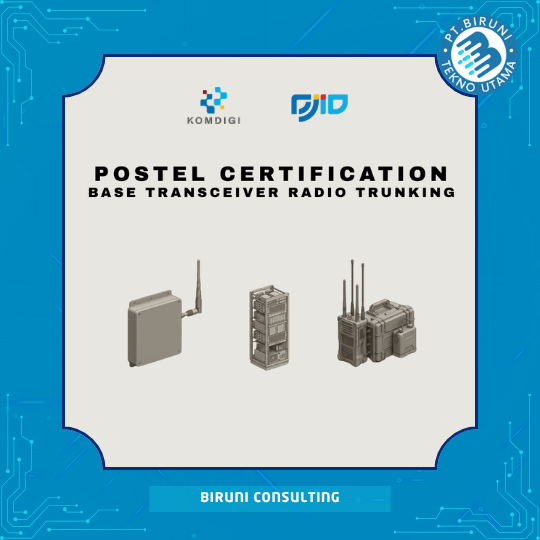
Guide to Base Transceiver Radio Trunking Postel Certification in Indonesia
A Base Transceiver Radio Trunking system is a telecommunications infrastructure device used in professional radio trunking networks to provide reliable voice and data communications for multiple users through efficient radio channel management. Radio trunking systems are widely deployed by government agencies, public safety organizations, utility companies, mining operations, oil and gas industries, transportation providers, airports, seaports, emergency response services, and security organizations that require dependable mission-critical communications.
Because Base Transceiver Radio Trunking equipment transmits and receives radio frequency signals, it is regulated under Indonesian telecommunications laws. Manufacturers, importers, distributors, and network operators must ensure that the equipment complies with applicable technical standards and obtains DJID (formerly Postel/SDPPI) Certification before it can be legally imported, marketed, installed, or operated in Indonesia.
Understanding certification requirements early in the project lifecycle helps organizations accelerate regulatory approval, reduce deployment delays, and ensure full compliance with Indonesian telecommunications regulations.
What Is a Base Transceiver Radio Trunking System?
A Base Transceiver Radio Trunking system is a fixed radio base station that connects subscriber radios to a centralized trunking network. Unlike conventional radio systems where each user is assigned a dedicated channel, trunking systems dynamically allocate available communication channels, allowing a large number of users to share radio resources efficiently.
A typical system includes radio transceivers, antennas, RF power amplifiers, duplexers, controllers, baseband processing units, transmission equipment, and network management systems. These components work together to support group calls, individual calls, emergency communications, dispatch operations, and secure data transmission.
Modern radio trunking technologies may utilize standards such as DMR (Digital Mobile Radio), TETRA (Terrestrial Trunked Radio), APCO Project 25 (P25), or other digital radio communication technologies depending on operational requirements.
Does Base Transceiver Radio Trunking Require DJID (Postel) Certification?
Yes. Since Base Transceiver Radio Trunking equipment operates using regulated radio frequency spectrum, it generally requires DJID (Postel) certification before it can be commercially distributed or deployed in Indonesia.
During the certification process, DJID evaluates the equipment’s technical specifications, radio frequency characteristics, transmission power, operating frequency bands, electromagnetic compatibility, and overall compliance with Indonesian telecommunications regulations.
In addition to equipment certification, radio trunking network deployment must also comply with Indonesia’s radio frequency spectrum licensing and operational requirements.
Base Transceiver Radio Trunking Certification Requirements
Companies preparing certification applications generally provide the following documentation:
- Company legal documents.
- Business Identification Number (NIB).
- Technical product specifications.
- User Manual.
- Product Datasheet.
- Product Label.
- Product Photographs.
- System architecture and block diagrams.
- Accredited laboratory test reports.
- Additional supporting documentation required by DJID regulations.
Complete documentation helps improve certification efficiency and minimizes unnecessary regulatory revisions.
Base Transceiver Radio Trunking Certification Process
The certification process begins with identifying the product category and the radio trunking technology implemented by the equipment.
Technical documentation is reviewed before laboratory testing is conducted where required. Testing may include Radio Frequency (RF), Electromagnetic Compatibility (EMC), Electrical Safety, communication performance, protocol verification, and other applicable technical evaluations according to Indonesian regulations.
After successfully completing both technical assessment and administrative review, DJID issues the certification authorizing legal commercialization and deployment of the equipment within Indonesia.
Benefits of Base Transceiver Radio Trunking Certification
Obtaining DJID certification provides significant benefits for manufacturers, distributors, and radio network operators.
Key benefits include:
- Compliance with Indonesian telecommunications regulations.
- Support for equipment importation and commercial distribution.
- Verification of technical conformity.
- Reliable interoperability within professional radio networks.
- Reduced regulatory risks.
- Increased confidence among customers and business partners.
Certification also demonstrates commitment to product quality, regulatory compliance, and reliable mission-critical communications.
Types of Radio Trunking Equipment That Commonly Require Certification
Examples of equipment that commonly require DJID certification include:
- Base Transceiver Radio Trunking Systems.
- Radio Trunking Base Stations.
- TETRA Base Stations.
- DMR Base Stations.
- APCO Project 25 (P25) Base Stations.
- Radio Trunking Controllers.
- Trunking Radio Repeaters.
- Radio Access Network Equipment.
- Base Station Controllers.
- Other radio trunking infrastructure utilizing regulated radio frequencies.
Certification requirements depend on the equipment’s communication technology, transmission capability, and applicable Indonesian technical regulations.
Contact Us
Biruni Consulting provides professional consulting services for DJID (Postel) certification of Base Transceiver Radio Trunking equipment and other telecommunications infrastructure products in Indonesia.
We assist companies with:
- Radio trunking regulatory analysis.
- Identification of applicable DJID certification requirements.
- Preparation of technical and administrative documentation.
- Coordination with accredited testing laboratories.
- End-to-end certification support until approval is granted.
With extensive experience in Indonesian telecommunications certification, we help manufacturers, importers, distributors, and network operators obtain certification efficiently while ensuring full regulatory compliance.
Contact us today for professional consultation regarding Base Transceiver Radio Trunking Postel certification and telecommunications equipment approval requirements in Indonesia