
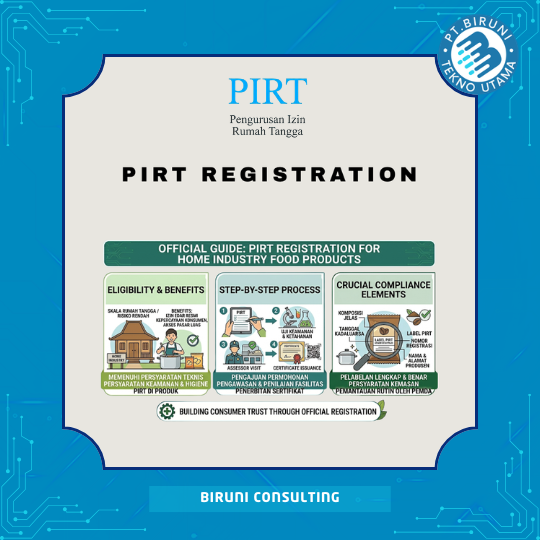
Guide to PIRT Registration for Food and Beverage Products in Indonesia
For food and beverage business owners, especially Micro, Small, and Medium Enterprises (MSMEs) and home industries, product legality is an important factor in building consumer trust and expanding market opportunities. One of the most common licenses required for processed food products in Indonesia is PIRT (Home Industry Food Production Certificate) or SPP-IRT.
PIRT is a certification granted to certain processed food products manufactured by home industries that meet basic food safety, hygiene, and labeling requirements. This certification allows products to be legally distributed and marketed within Indonesia.
Obtaining PIRT demonstrates that a business is committed to producing safe food products and complying with applicable regulations. It also helps businesses strengthen their credibility when working with distributors, retailers, and online marketplaces.
Why Is PIRT Registration Important?
PIRT registration is more than just a regulatory requirement. It provides assurance that food products have met basic food safety standards before reaching consumers.
Many modern retail stores, supermarkets, distributors, and e-commerce platforms require food products to have proper legal documentation before they can be sold. Therefore, obtaining PIRT can significantly increase business opportunities and market access.
In addition, having PIRT helps businesses build consumer confidence and demonstrates compliance with Indonesia’s food safety regulations.
Requirements for PIRT Registration
Before applying for PIRT, business owners should prepare the necessary documents and product information. Proper preparation can help accelerate the approval process and reduce the likelihood of revisions.
Generally, the required documents include business owner identification, a Business Identification Number (NIB) obtained through the OSS system, production facility information, and product details.
Businesses should also prepare complete product information, including ingredient composition, packaging specifications, shelf life, production methods, and product labeling.
Ensuring that product labels comply with food labeling requirements is particularly important, as labels are reviewed during the registration process.
PIRT Registration Process
The PIRT registration process consists of several stages that must be completed to obtain certification.
1. Obtain a Business Identification Number (NIB)
The first step is obtaining a Business Identification Number (NIB) through Indonesia’s Online Single Submission (OSS) system. NIB serves as the legal identity of the business and is required for licensing applications.
2. Prepare Product Documentation
Once the NIB has been issued, businesses should prepare all product-related documentation. This includes product specifications, ingredient information, production procedures, packaging details, and labeling information.
Complete documentation helps facilitate a smoother verification process.
3. Submit the PIRT Application
After all required information has been prepared, the application can be submitted through the applicable licensing system. Businesses will need to provide product details and supporting documents for evaluation.
The authorities will review the submitted information to ensure compliance with applicable regulations.
4. Attend Food Safety Training
In many cases, applicants are required to participate in Food Safety Training (PKP). This training provides guidance on hygiene practices, food safety standards, and proper manufacturing procedures.
The objective is to ensure that food products are produced in a safe and sanitary environment.
5. Verification and Inspection
Authorities may conduct document verification and inspect production facilities to confirm that food processing activities comply with food safety requirements.
Production facilities should be maintained in a clean and hygienic condition to support compliance.
6. Issuance of PIRT Certificate
If all requirements have been fulfilled successfully, the PIRT certificate will be issued. The registration number can then be displayed on product packaging, allowing the product to be legally distributed throughout Indonesia.
Having a valid PIRT certificate can help businesses increase customer confidence and improve market competitiveness.
Products Eligible for PIRT
PIRT generally applies to low-risk processed food products manufactured by home industries.
Examples include:
- Chips and snack products.
- Cookies and biscuits.
- Ground coffee products.
- Powdered beverages.
- Seasonings and spice products.
- Traditional packaged foods.
Certain products, such as infant food, dairy products, and commercially sterilized canned foods, may require BPOM registration instead of PIRT.
Regulations Related to PIRT
PIRT registration is governed by Indonesian food safety regulations and risk-based business licensing policies. The certification process is aligned with food safety standards and licensing requirements established by relevant government authorities.
These regulations are designed to ensure that food products distributed in the market are safe for consumption, properly labeled, and produced under hygienic conditions.
Compliance with these regulations not only helps businesses meet legal requirements but also contributes to consumer protection and product quality assurance.
Contact Us
Managing PIRT registration often requires an understanding of food regulations, documentation requirements, and labeling standards. Biruni Consulting is ready to assist MSMEs and food businesses throughout the PIRT registration process.
- PIRT product eligibility consultation to determine the appropriate licensing category.
- NIB (OSS) registration assistance as the foundation of business legality.
- Food product label review to ensure compliance with applicable regulations.
- PIRT document preparation support to minimize errors and revisions.
- Consultation and assistance until certificate issuance to ensure products are ready for legal distribution.
We help simplify the licensing process and ensure compliance with Indonesian food regulations