
Understanding the Relationship Between PIRT and BPOM for Food Product Licensing in Indonesia
In Indonesia’s food licensing system, the terms PIRT and BPOM are often mentioned together. Many business owners assume they are the same type of permit, but they actually serve different purposes and apply to different categories of food products.
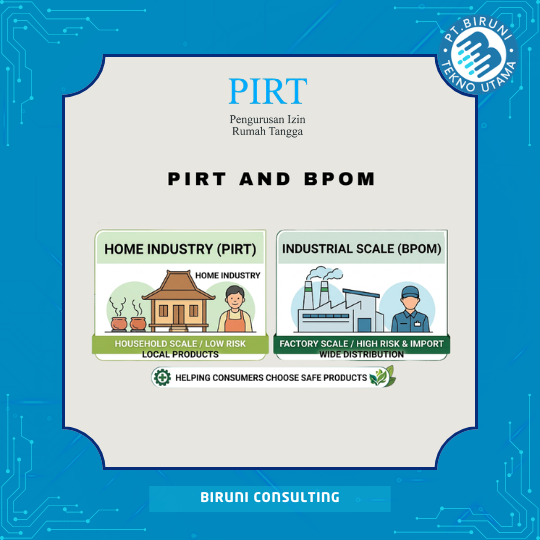
PIRT (Home Industry Food Production Certificate) is a permit intended for certain processed food products manufactured by home industries and small businesses. On the other hand, BPOM (National Agency of Drug and Food Control) is the government authority responsible for supervising the safety, quality, and distribution of food and pharmaceutical products in Indonesia.
Although PIRT is issued through local government authorities, its requirements and supervision are based on food safety regulations established by BPOM. This is why many people refer to food licensing as “PIRT BPOM” even though they are different regulatory mechanisms.
The Difference Between PIRT and BPOM
Understanding the distinction between PIRT and BPOM is important when determining the correct licensing pathway for a product.
PIRT generally applies to lower-risk processed food products manufactured by home industries. BPOM registration, however, is required for products that involve higher risks, specialized processing methods, or stricter regulatory oversight.
Products commonly eligible for PIRT include:
- Chips and packaged snacks
- Cookies and dry bakery products
- Certain sauces and seasonings
- Ground coffee and powdered beverages
- Low-risk dry food products
Products that generally require BPOM registration include:
- Milk and dairy products
- Infant food products
- Canned food products
- Functional foods with health claims
- Foods using specialized processing technologies
Determining the correct category before applying can save significant time and resources.
Does PIRT Require BPOM Approval?
PIRT is not issued directly by BPOM. However, the requirements for obtaining PIRT are based on food safety regulations and standards established by BPOM.
Businesses applying for PIRT must comply with food safety requirements, labeling regulations, hygiene standards, and proper production practices. These requirements help ensure that products distributed in the market are safe for consumers.
Although the PIRT number differs from a BPOM registration number, both systems operate within Indonesia’s national food safety framework.
Requirements for Obtaining PIRT
To obtain PIRT, business owners must prepare several documents related to business legality and product information.
These typically include business owner identification, a Business Identification Number (NIB), production facility information, and detailed product information. Product labels should also contain clear information regarding ingredients, net weight, shelf life, and manufacturer details.
In some regions, participation in food safety counseling programs may also be required before approval is granted.
How to Apply for PIRT
The process generally begins with obtaining a Business Identification Number (NIB) through the OSS system. Business owners then prepare product documents and supporting information required for evaluation.
The application process may include administrative verification, food safety counseling, and production facility inspections. Once all requirements are fulfilled, the PIRT number will be issued and can be displayed on product packaging.
Having PIRT helps businesses distribute products legally while improving consumer confidence and market access.
Regulations Related to PIRT and BPOM
PIRT registration is governed by food safety and processed food regulations in Indonesia.
Relevant regulations include:
- BPOM provisions regarding Home Industry Food Production Certificates (SPP-IRT)
- National food safety regulations
- OSS-based business licensing requirements
- Processed food labeling regulations
These regulations are designed to ensure that food products are safe, hygienically produced, and properly labeled for consumers.
Contact Us
Understanding whether a product requires PIRT or BPOM approval can be challenging. Biruni Consulting provides professional assistance to help businesses identify the appropriate licensing pathway and comply with Indonesian food regulations.
- Food product classification consultation for PIRT or BPOM requirements.
- NIB (OSS) registration assistance for business legality.
- Food label compliance review based on applicable regulations.
- Food licensing document preparation support to streamline the process.
- Consultation and assistance until permit issuance for legal market distribution.
We help businesses obtain the right licenses efficiently and in accordance with Indonesian regulations