
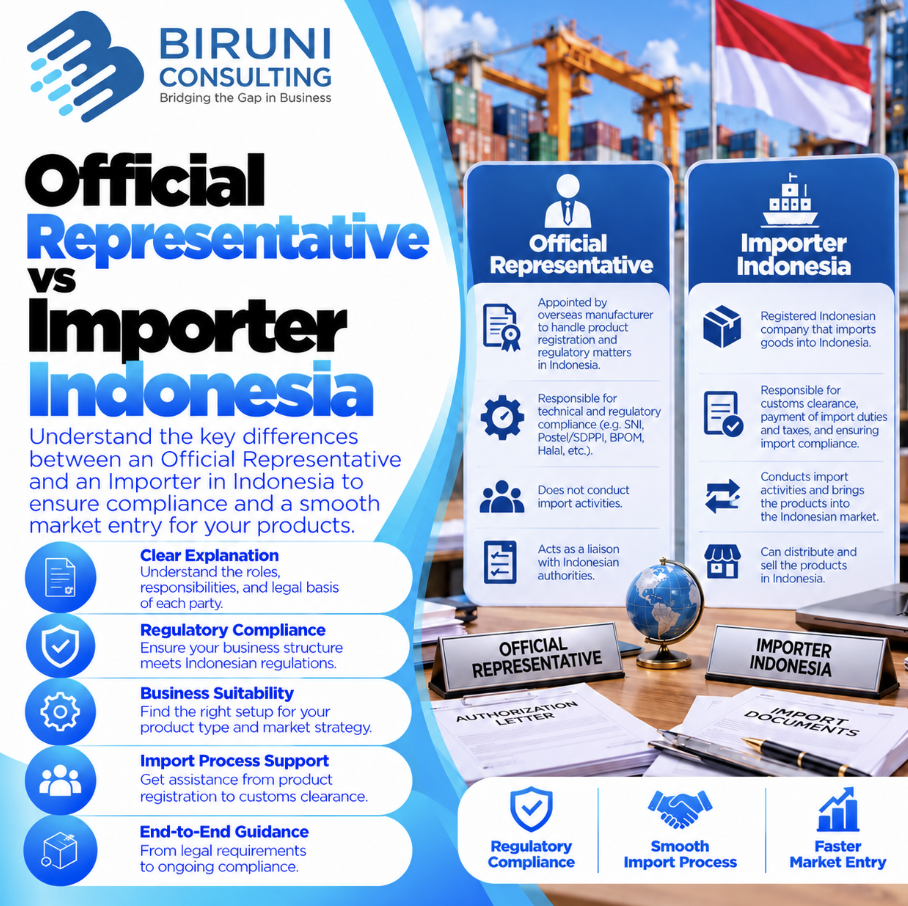
Differences Between an Official Representative and an Indonesian Importer for Overseas Manufacturers
Official Representative vs Importer Indonesia is one of the most important structural distinctions for an Overseas Manufacturer to understand before certification, registration, importation, and distribution in Indonesia.
Both parties can be Indonesian companies, but their regulatory functions are not necessarily the same. An Official Representative generally exists where a product-specific regulation requires an Overseas Manufacturer to maintain a party formally representing it in Indonesia. An Importer, meanwhile, is the party conducting importation and performing responsibilities relating to the entry of goods and customs procedures.
Under Indonesia’s general import framework, Minister of Trade Regulation No. 16 of 2025 requires Importers to hold an NIB functioning as an API or Importer Identification Number. The framework has subsequently been amended, including through the second amendment under Minister of Trade Regulation No. 18 of 2026 effective June 4, 2026. BPK Regulations
There is, however, no universal rule requiring every imported product to have an Official Representative. The requirement needs to be determined from the product-specific regulation. Certain Mandatory SNI schemes, including lubricating oil, tires, and motor-vehicle safety glass, specifically regulate Official Representative structures. BPK Regulations
Companies should therefore avoid using the terms Official Representative, Importer, Distributor, and SNI Certificate Holder interchangeably.
What Is an Official Representative Indonesia?
An Official Representative Indonesia is an Indonesian party formally appointed by an Overseas Manufacturer where the applicable product regulation requires that structure.
Its responsibilities can involve:
- Representing the Overseas Manufacturer within a specified regulatory structure.
- Managing applications or regulatory documentation where required.
- Performing trademark-related responsibilities where regulated.
- Maintaining applicable warehouse arrangements.
- Coordinating SNI certification and post-certification compliance.
The exact responsibilities depend on the product.
Official Representative is therefore not a universal license that applies identically to every imported product.
What Is an Importer Indonesia?
An Importer Indonesia is the party performing importation into Indonesia.
Minister of Trade Regulation No. 16 of 2025 requires the Importer to hold an NIB functioning as an API. BPK Regulations
For Imports for Use, the Importer also has substantive customs responsibilities. Indonesia Customs explains that Importers need to complete release documentation, generally PIB, pay applicable Customs Duty, Excise and Import Taxes, and satisfy prohibitions and restrictions. Beacukai
An Importer is therefore more than a company name appearing on an Invoice or Bill of Lading.
Main Differences Between Official Representative vs Importer Indonesia
The simplest distinction is the principal function performed by each role.
| Area | Official Representative | Importer |
|---|---|---|
| Principal function | Represents an Overseas Manufacturer within a specified regulatory structure | Imports goods |
| Basis of requirement | Product-specific regulation | General import framework and product-specific import rules |
| NIB/API | Depends on functions performed; required if also acting as Importer | Required within the importer structure |
| Customs responsibility | Not automatic | Yes |
| PIB | Not automatically its function | Part of importer responsibility |
| SNI application | Can act as application channel where the regulation provides | Not automatically the SNI applicant |
| Certificate holder | Not automatic | Not automatic |
| SIINas | Can be required under product-specific schemes | Depends on role/regulation |
| Warehouse | Can be product-specific requirement | Depends on import/product structure |
| Distributor | Not automatically | Not automatically |
| One company can perform several roles, but the legal basis for each function remains different. |
Can the Official Representative and Importer Be the Same Company?
Yes, where the product-specific regulation and Business Licensing permit it.
A clear example is the Mandatory SNI regulation for lubricating oil. Minister of Industry Regulation No. 8 of 2025 provides that the Official Representative of an Overseas Manufacturer may act as Importer for the lubricating oil produced by that manufacturer. BPK Regulations
The same regulation also allows the roles to be separated. If the Official Representative does not act as Importer, it can appoint up to five Importers. BPK Regulations
Under that scheme:
- the Official Representative can also be the Importer; or
- the Official Representative and Importer can be separate companies.
This structure should not automatically be extended to other products because every Mandatory SNI regulation can establish different requirements.
Not Every Importer Is an Official Representative
A company can satisfy Importer requirements without serving as an Official Representative of the manufacturer.
For example, a company can have NIB/API and Customs Access and be capable of importing goods but lack the manufacturer appointment, trademark arrangements, SIINas responsibilities, or other requirements applicable to an Official Representative under a particular product regulation.
Customs capability therefore does not automatically satisfy an Official Representative requirement.
Not Every Official Representative Must Be the Importer
The reverse is also true.
An Official Representative can manage certification, SIINas, trademark responsibilities, or other regulatory obligations while physical importation is performed by another Importer.
The lubricating-oil regulation expressly allows this model by permitting an Official Representative that does not act as Importer to appoint up to five Importers. BPK Regulations
This can allow an Overseas Manufacturer to separate regulatory representation from commercial import channels where the regulation permits.
General Import Framework for the Importer
The Importer operates within Indonesia’s general import framework.
Minister of Trade Regulation No. 16 of 2025 requires Importers to hold an NIB functioning as API. Regulation No. 18 of 2026 subsequently amended provisions involving Import Business Licensing, Import Approvals, Surveyor Reports, Import Customs Declaration documents, import-realization reporting, and administrative sanctions. BPK Regulations
Importer assessment therefore needs to consider more than the existence of a legal entity.
NIB/API, KBLI, Business Licensing, Customs Access, product restrictions, and applicable Import Approvals need to be reviewed.
Official Representative Requirements Are Product Specific
Official Representative requirements differ because they generally arise from the product regulation.
Under the Mandatory SNI regulation for lubricating oil, for example, an Overseas Manufacturer needs an Official Representative. The Representative is subject to requirements concerning manufacturer appointment, trademark responsibilities, warehousing, the ability to act as Importer, and SIINas. BPK Regulations
This demonstrates that the Official Representative maintains a broader regulatory relationship with the manufacturer than a party merely handling customs clearance.
Official Representative Example for Lubricating Oil
Minister of Industry Regulation No. 8 of 2025 provides a clear example of how the two functions differ.
An Overseas Manufacturer needs an Official Representative. That Representative can act as Importer. Where it does not, it can appoint up to five Importers. BPK Regulations
The SNI Certificate application for the Overseas Manufacturer is also submitted by the Overseas Manufacturer through the Official Representative electronically through SIINas. BPK Regulations
The Importer is therefore not automatically the party applying for the SNI Certificate.
Example Under the Mandatory SNI for Tires
The Mandatory SNI regulation for tires also demonstrates that the Official Representative and Importer can be related but remain distinct.
Minister of Industry Regulation No. 9 of 2025 regulates the Official Representative for an Overseas Manufacturer and, under specified structures, allows the Official Representative to appoint an Importer. For imports of tires as components for specified vehicle-assembly operations, the appointed Importer needs to satisfy additional requirements established by the regulation. BPK Regulations
This shows how importer eligibility can be substantially more product-specific than merely holding an NIB/API.
Example for Motor-Vehicle Safety Glass
The Mandatory SNI regulation for motor-vehicle safety glass also establishes its own Official Representative structure.
Minister of Industry Regulation No. 15 of 2025 requires specified Official Representative documentation, including corporate documentation, Business Licensing, evidence of appointment, specified trademark arrangements, and warehousing evidence. BPK Regulations
Again, the Official Representative is not simply an Importer under another name.
Manufacturer Appointment
An Official Representative has an appointment relationship with the Overseas Manufacturer where required by the product regulation.
The exact appointment form needs to comply with the applicable rule.
Companies should therefore avoid assuming that a simple Letter of Appointment is always sufficient.
Certain regulations can impose more specific formal requirements.
An Importer can also have an appointment relationship with the manufacturer or Official Representative, but its core function remains importation under the applicable structure.
NIB/API
NIB/API is primarily relevant to the Importer function.
Minister of Trade Regulation No. 16 of 2025 requires Importers to hold an NIB functioning as API. BPK Regulations
An Official Representative that will also act as Importer needs to satisfy the applicable importer requirements.
An Official Representative that does not conduct importation should not automatically be treated as an Importer simply because it acts as regulatory representative.
Customs Access
The Importer needs operational customs readiness.
For Imports for Use, the Importer has responsibilities involving PIB, Customs Duty, Excise and/or Import Taxes, and compliance with prohibitions and restrictions. Beacukai
The Official Representative does not automatically assume these responsibilities unless it also performs the Importer function.
This is one of the clearest differences between the two roles.
PIB and Customs Declarations
The Pemberitahuan Impor Barang or PIB relates to the import process.
Indonesia Customs explains that the Importer or PPJK submits Supporting Customs Documents used as the basis for preparing the PIB, while the Importer is responsible for self-assessing applicable Customs Duty, Excise, and Import Taxes based on the PIB. Beacukai
An Official Representative that is not the Importer does not assume the customs-importer function merely because it represents the manufacturer in certification.
Import Approvals and Restrictions
The Importer also needs to determine whether the goods require Import Approvals, Surveyor Reports, or other restrictions.
Minister of Trade Regulation No. 18 of 2026 amended several aspects of the current framework, including Import Approvals, Surveyor Reports, and Import Customs Declaration documents. BPK Regulations
The Official Representative can participate in coordination where a product regulation connects it with the Importer, but customs and import obligations still need to follow the actual legal structure.
Official Representative and SIINas
SIINas can have an important role for Mandatory SNI products regulated by the Ministry of Industry.
BBSPJIKKP explains that certification applications under Ministry of Industry Mandatory SNI schemes are submitted through SIINas. Kemenperin
The party using SIINas for an application remains product specific.
For lubricating oil, the Overseas Manufacturer applies for an SNI Certificate through its Official Representative electronically through SIINas. BPK Regulations
A separate Importer does not automatically control the SNI application.
Official Representative and LSPro
An LSPro or Lembaga Sertifikasi Produk / Product Certification Body performs a different role from both parties.
BBSPJIKKP explains that product certification is a conformity-assessment process used to establish that a company can consistently produce goods satisfying the relevant standard. Kemenperin
The Official Representative is not the LSPro.
The Importer is not the LSPro.
Both can coordinate with the certification body, while the certification decision remains with the authorized conformity-assessment body.
Official Representative and SNI Certificate Holder
The Official Representative is not automatically the SNI Certificate Holder.
Product-specific regulations determine certificate ownership.
Under the lubricating-oil scheme, an Overseas Manufacturer submits its application through the Official Representative, while the certificate structure remains linked with the Overseas Manufacturer and production location. BPK Regulations
The following roles should therefore remain distinct:
- Overseas Manufacturer;
- Official Representative;
- Importer; and
- SNI Certificate Holder.
They can be connected without necessarily being the same legal entity.
Official Representative and SPPT SNI
An SNI Certificate and SPPT SNI are also different instruments.
Under certain newer Mandatory SNI regulations, the SNI Certificate relates to conformity assessment, while SPPT SNI provides approval to use the SNI Mark.
The applicable regulation determines the SPPT SNI applicant or holder.
The Importer should therefore not automatically be treated as the SPPT SNI holder, and the Official Representative should not automatically be treated as the SNI Certificate Holder merely because it participates in the SPPT SNI process.
Importer and Distributor
The Importer is different from the Distributor.
The Importer manages entry of goods and customs-related responsibilities.
The Distributor generally focuses on sales, channel management, domestic distribution, marketing, and customer relationships.
One company can perform both roles where licensing and regulations permit.
An Overseas Manufacturer can also keep the roles separate to preserve commercial flexibility.
Official Representative and Distributor
The Official Representative is also not automatically the Distributor.
Its function can focus primarily on regulatory representation rather than sales.
An Overseas Manufacturer can therefore have:
- Official Representative A.
- Importer B.
- Distributor C.
Alternatively, the roles can be combined within one company where regulations and Business Licensing allow.
The correct structure depends on the product regulation and commercial strategy.
Official Representative and Product Registration Holder
For product categories outside SNI, the same structural principle remains relevant.
The Importer is not necessarily the product-registration holder, and the Official Representative is not necessarily the registration applicant.
The manufacturer needs to establish which party controls the approval and regulatory account.
This becomes particularly important for business continuity when an Importer or Distributor changes.
Regulatory Ownership
Official Representative vs Importer Indonesia is also a regulatory ownership issue.
Before making appointments, an Overseas Manufacturer should determine:
- Who holds the certificate or registration?
- Who controls SIINas or another regulator account?
- Who manages renewals?
- Who manages surveillance?
- Who can appoint or replace Importers?
- What happens when the relationship terminates?
An unclear structure can reduce the manufacturer’s flexibility when commercial partners change.
Changing the Official Representative
Changing the Official Representative can have significantly greater consequences than changing an ordinary logistics provider.
Under the Mandatory SNI regulation for lubricating oil, if an Overseas Manufacturer changes its Official Representative before the SNI Certificate expires, the SNI Certificate is deemed to expire. BPK Regulations
The Official Representative can therefore be directly connected with certification continuity.
Selection should consider a long-term relationship rather than only the first shipment.
Changing the Importer
Changing the Importer can also have regulatory consequences, although the exact impact depends on the product.
For lubricating oil, where the Official Representative does not act as Importer, a change to the Importer or its information before expiration of the SNI Certificate requires the Official Representative to apply for an amendment to the issued certificate. BPK Regulations
Other product categories can use different procedures.
Importer changes should therefore undergo regulatory impact assessment.
Warehouse Requirements
Warehousing provides another example of the distinction between the roles.
Certain Mandatory SNI regulations impose direct warehouse obligations on the Official Representative.
Under the lubricating-oil regulation, the Official Representative needs to control a warehouse within the location framework specified by the regulation. BPK Regulations
The safety-glass regulation likewise identifies evidence of warehouse control among Official Representative documentation. BPK Regulations
The Importer can separately have logistics or warehousing arrangements, but these should not automatically be treated as identical to the Official Representative’s regulatory warehouse obligations.
One Official Representative with Multiple Importers
Certain regulations can permit an Official Representative to use more than one Importer.
The lubricating-oil regulation allows an Official Representative that does not import directly to appoint up to five Importers. BPK Regulations
This can support a manufacturer with multiple commercial channels.
However, additional Importers also increase the need for data consistency, regulatory amendments where required, product traceability, and governance.
When Should the Official Representative and Importer Be the Same?
Using one entity for both functions can simplify operations.
This approach can be suitable where:
- The regulation permits the combined structure.
- The company has appropriate NIB/API and Customs Access.
- It satisfies the Official Representative requirements.
- Applicable trademark and warehousing requirements are met.
- The manufacturer is comfortable concentrating regulatory and import control with one entity.
The principal benefit is fewer interfaces between regulatory and customs functions.
The manufacturer should nevertheless consider its dependency if the same company also acts as Distributor.
When Should the Official Representative and Importer Be Separate?
Separating the roles can be useful where the manufacturer wants the regulatory structure to remain stable while using several import channels or changing Importers more flexibly.
For example:
- the Official Representative manages SNI and regulatory compliance;
- the Importer manages customs and physical importation;
- the Distributor manages commercial sales.
This can separate regulatory ownership from sales performance.
The structure can only be used where the applicable product regulation allows it.
Benefits of Using One Company for Both Roles
Combining Official Representative and Importer functions can provide:
- Simpler coordination.
- Centralized regulatory and customs information.
- Fewer contractual interfaces.
- Simpler first-shipment preparation.
The concentration of functions, however, also increases dependency.
Changing the company later can potentially affect certification, importer arrangements, packaging, warehousing, and distribution at the same time.
Benefits of Separating the Roles
Separating the Official Representative from the Importer can provide greater flexibility.
The manufacturer can potentially retain one regulatory representative while changing Importers or Distributors where the applicable scheme permits.
It can also avoid placing all regulatory control with one commercial partner.
The structure requires more coordination, so responsibilities need to be clearly documented.
Official Representative Due Diligence
Before appointing an Official Representative, manufacturers should conduct due diligence.
Areas to assess can include:
- Legal entity and Business Licensing.
- Product-specific eligibility.
- SIINas capability.
- Trademark arrangements.
- Warehousing capability.
- Regulatory-document control.
- Surveillance support.
- Exit mechanisms.
Due diligence should follow the specific product regulation rather than a generic Representative checklist.
Importer Due Diligence
Importer due diligence has a different focus.
Areas to assess include:
- NIB/API.
- Customs Access.
- KBLI and Business Licensing.
- Product-specific Import Approvals.
- Experience with the relevant product.
- Customs-document capabilities.
- Tax and payment procedures.
- Traceability.
Operational capability is particularly important because the Importer performs the customs responsibilities.
Pre-Shipment Responsibilities
Before shipment, responsibility allocation between the Official Representative and Importer should be clear.
Where the applicable product regulation places those responsibilities on the Official Representative, it may need to ensure that SNI Certificates, SPPT SNI, SIINas, model scopes, and other regulatory requirements are ready.
The Importer needs to establish import licensing, PIB information, restrictions, shipping documents, duties, taxes, and customs readiness.
Both parties need to ensure that the actual cargo corresponds with the approved product.
Commercial Invoice and Packing List
The Importer needs consistent Commercial Invoices and Packing Lists for customs processing.
The Official Representative can also need access to product information where certificate scope relates to the model, type, brand, manufacturer, or production site.
Pre-shipment document review should therefore involve both regulatory and import functions.
Product descriptions, models, quantities, manufacturing sites, trademarks, and origin information need to remain consistent.
Manufacturing Sites
The Official Representative can participate in certification linked to particular manufacturing sites.
The Importer needs to ensure that the shipment actually originates from a manufacturer and site covered by the applicable approval.
Where an Overseas Manufacturer operates multiple factories, both parties need to know which facilities have been approved.
Changing supply sources without regulatory review can result in a mismatch between the certification and actual shipment.
Multiple Models and Variants
A product family can contain numerous models or variants.
The Official Representative needs to ensure that certification scope includes the relevant models.
The Importer needs to ensure that only approved models are commercially imported where the regulation requires model-specific coverage.
Model mapping supports consistency among:
- certificates;
- test reports;
- Invoices;
- Packing Lists;
- labels; and
- actual products.
Product Changes
Changes involving specifications, materials, formulations, manufacturing sites, brands, models, or packaging can affect both roles.
The Official Representative needs to assess the impact on certification or registration.
The Importer needs to assess the impact on HS classification, Import Approvals, restrictions, labels, and customs documentation.
Change-control procedures should therefore involve both parties before updated products are shipped.
Post-Market Compliance
The Official Representative can have continuing regulatory responsibilities after product launch.
The Importer can also have reporting or traceability obligations following importation.
For SNI-certified products, surveillance and certification maintenance can continue after the first shipment.
BBSPJIKKP explains that certification frameworks include procedures for maintenance, suspension, restoration, reduction or extension, and withdrawal of certification. Kemenperin
Compliance therefore continues after customs release.
Regulatory Monitoring
Indonesia’s regulatory framework can change.
Minister of Trade Regulation No. 16 of 2025 has already been amended through Regulation No. 18 of 2026, while product-specific Mandatory SNI regulations can also be amended or replaced. BPK Regulations
The Official Representative should monitor certification-related requirements.
The Importer should monitor import and customs requirements.
For an Overseas Manufacturer, both workstreams should ideally form part of one regulatory-monitoring program.
Official Representative vs Importer Indonesia for Market Entry
In market-entry planning, the main question should not be only “who is the Importer?”
Companies should also establish:
- Does the product regulation require an Official Representative?
- Who holds the SNI Certificate or product registration?
- Can the Official Representative also act as Importer?
- Can multiple Importers be used?
- Who is the Distributor?
- Who controls the regulatory approval?
These answers determine a more sustainable local structure.
Regulatory Gap Analysis
Gap analysis before appointment can prevent the wrong structure from being established.
Common gaps include:
- Official Representative required but not yet appointed;
- proposed Representative does not satisfy product-specific requirements;
- Importer does not hold appropriate NIB/API;
- SNI Certificate not ready;
- SIINas structure incomplete;
- Import Approval unavailable;
- warehouse requirements incomplete; or
- regulatory ownership not agreed.
The gaps can then be converted into an implementation roadmap.
Official Representative vs Importer Indonesia Roadmap
An Overseas Manufacturer can generally use the following roadmap:
- Product classification and regulatory assessment.
- Determine whether an Official Representative is required.
- Determine certificate or registration ownership.
- Select the Official Representative where required.
- Select the Importer and review NIB/API and licensing.
- Complete certification, testing, and product approvals.
- Complete Import Approvals and pre-shipment compliance.
- Conduct commercial importation.
- Manage surveillance, renewals, and regulatory monitoring.
The detailed sequence should still follow the applicable product-specific regulation.
Timeline
There is no single timeline applicable to every Official Representative vs Importer Indonesia structure.
Timing can be affected by:
- product classification;
- Representative appointment;
- trademark arrangements;
- warehouse setup;
- SNI certification;
- factory audits;
- laboratory testing;
- SIINas;
- Import Approvals;
- importer licensing; and
- document readiness.
Importer availability alone therefore cannot determine the commercial launch date.
Cost
The cost structure also differs between the two roles.
Official Representative costs can relate to regulatory representation, SIINas, warehouses, trademark arrangements, surveillance, and certification management.
Importer costs can relate to importer services, customs brokerage, duties, import taxes, warehousing, documentation, and local logistics.
Additional costs can arise from LSPro, laboratory testing, factory audits, sample shipments, translation, and product registration.
Companies should evaluate total market-entry compliance cost rather than importer fees alone.
Common Official Representative vs Importer Indonesia Mistakes
The most common mistake is assuming the two roles are always identical.
Other mistakes include:
- assuming every imported product needs an Official Representative;
- assuming the Importer automatically becomes the SNI Certificate Holder;
- assuming a Distributor automatically qualifies as Importer;
- appointing an Importer before assessing Mandatory SNI;
- giving all regulatory ownership to a commercial partner without an exit strategy;
- changing the Official Representative without assessing certificate consequences; and
- shipping commercial goods before product approvals are complete.
The product-specific regulation should determine the local-party structure.
How to Determine the Appropriate Structure
The strongest structure is not necessarily the one using the fewest companies.
The objective is to maintain regulatory compliance while preserving commercial flexibility.
An Overseas Manufacturer should consider:
- Applicable regulations.
- Certificate ownership.
- Manufacturer control.
- Import volumes.
- Number of distributors.
- Product portfolio.
- Long-term Indonesian strategy.
For certain products, one Official Representative acting simultaneously as Importer can be the simplest solution. For others, separating the roles can be more appropriate.
Conclusion
Official Representative vs Importer Indonesia involves two roles that need to be distinguished when an Overseas Manufacturer establishes an Indonesian market-entry structure.
The Importer performs importation and has responsibilities involving NIB/API, PIB, import payments, and prohibitions and restrictions. Minister of Trade Regulation No. 16 of 2025 requires the Importer to hold an NIB functioning as API, while Indonesia Customs confirms the Importer’s responsibilities for PIB, import duties and taxes, and restrictions under Imports for Use. BPK Regulations
The Official Representative is a role arising from product-specific regulations and is not required for every imported product. Under the Mandatory SNI regulation for lubricating oil, an Official Representative can act as Importer or, where it does not import directly, appoint up to five Importers. The Overseas Manufacturer also applies for the SNI Certificate through the Official Representative using SIINas. BPK Regulations
Mandatory SNI regulations for tires and motor-vehicle safety glass also demonstrate that the Official Representative can have appointment, trademark, warehousing, and other regulatory requirements that differ from ordinary Importer responsibilities. BPK Regulations
By establishing the Official Representative, Importer, Distributor, Certificate Holder, and regulatory-account controller from the beginning, an Overseas Manufacturer can reduce structural errors, cargo delays, regulatory dependency, and disruption when commercial partners change.
Contact Us
Biruni Consulting assists companies with Official Representative vs Importer Indonesia professionally and in accordance with applicable regulations in Indonesia.
Our services include:
- Regulatory consultation.
- Identification of applicable standards.
- Preparation of certification documents.
- Assistance with laboratory testing.
- Certification processing until certificate issuance.
Biruni Consulting assists Overseas Manufacturers with determining Official Representative, Importer, SNI Certificate Holder, distributor, NIB/API, SIINas, LSPro, product certification, customs preparation, and regulatory ownership before products enter the Indonesian market.
Contact Us for guidance on Official Representative vs Importer Indonesia, SNI Official Representative Indonesia, SNI Importer Indonesia, Indonesia Importer Service, and imported-product regulatory compliance assistance.