
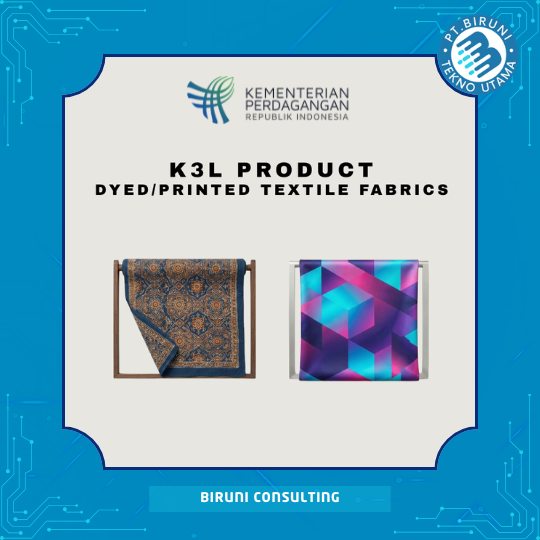
Guide to K3L Registration for Dyed or Printed Textile Fabrics Before Distribution in Indonesia
Dyed or Printed Textile Fabrics are textile materials that have undergone dyeing or printing processes to create specific colors, patterns, or decorative designs. These fabrics are widely used in the garment, fashion, home furnishing, interior decoration, hospitality, healthcare, and industrial textile sectors. Depending on their intended application, they may be produced from cotton, polyester, rayon, nylon, linen, or blended fibers.
Modern dyeing and printing technologies improve both the appearance and functionality of textile products. However, the manufacturing process also involves the use of dyes, pigments, auxiliaries, and other chemical substances that require careful quality control to ensure product safety and regulatory compliance.
Since many textile products come into direct contact with human skin, manufacturers and importers should ensure compliance with applicable K3L (Safety, Security, Health, and Environmental) requirements before marketing these products in Indonesia.
Why Do Dyed or Printed Textile Fabrics Require K3L Registration?
Dyed and printed textile products are widely used by consumers in clothing, bedding, curtains, upholstery, towels, and many other applications involving prolonged skin contact.
K3L registration helps demonstrate that textile products comply with Indonesian requirements relating to consumer safety, restricted chemical substances, product quality, and environmental responsibility.
Important compliance aspects include:
- Safety of textile dyes and chemical substances.
- Restricted hazardous substance requirements.
- Product quality and manufacturing consistency.
- Product labeling and consumer information.
- Manufacturing quality assurance.
- Compliance with applicable Indonesian K3L regulations.
Meeting these requirements helps manufacturers strengthen consumer confidence while supporting legal product distribution.
K3L Registration Process for Dyed or Printed Textile Fabrics
The registration process begins by identifying the textile category and determining the applicable regulatory requirements.
Manufacturers or importers then prepare administrative and technical documentation before submitting the registration application.
Required documents generally include:
- Product specifications.
- Manufacturer or importer information.
- Product and packaging photographs.
- Product labels.
- Material composition information.
- Supporting technical documentation.
- Laboratory test reports where required.
After documentation has been completed, the K3L registration process can proceed according to Indonesian regulations.
Benefits of K3L Registration
Obtaining K3L registration provides several advantages.
These benefits include:
- Supporting compliance with Indonesian regulations.
- Facilitating legal product distribution.
- Increasing consumer and distributor confidence.
- Reducing regulatory and commercial risks.
- Supporting cooperation with retailers and marketplaces.
- Improving competitiveness within the textile industry.
Proper compliance demonstrates a company’s commitment to product quality, consumer safety, and sustainable business practices.
Contact Us
Biruni Consulting provides professional K3L registration services for Dyed or Printed Textile Fabrics.
Our services include:
- K3L registration assessment.
- Technical and administrative documentation assistance.
- Regulatory consultation.
- Laboratory testing coordination.
- End-to-end K3L registration support.
We are ready to help ensure your Dyed or Printed Textile Fabrics comply with K3L requirements before entering the Indonesian market